How-To Guide
How to Make a Sigil
Автор: Seraphina
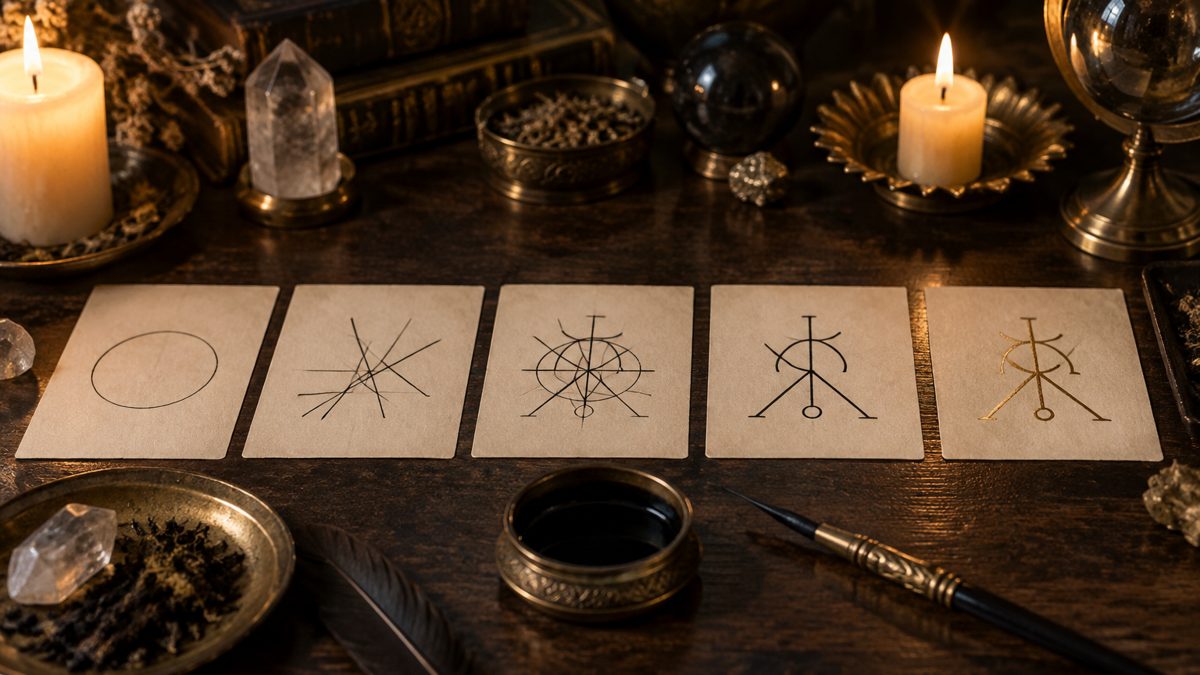
A sigil is a symbol created or chosen to represent an intention, name, power, or idea. In contemporary personal practice, making one often means turning a short statement into an abstract design, then using that design in a meaningful ritual. Some people understand this as magic; others approach it as creative reflection or a reminder of a commitment. You do not need to settle that question before picking up a pencil.
В Crossroads Journal мы относимся к созданию сигилов как к месту встречи традиции, веры и личной практики. Символ может помочь придать форму тому, что трудно выразить, но он не способен гарантировать исход или заменить практические действия. Сигил для поиска работы уместен рядом с откликами на вакансии и подготовкой к собеседованиям. Сигил для спокойствия может сопровождать тихий распорядок, не занимая места надлежащей помощи в вопросах психического здоровья.
Это руководство учит доступному методу на основе букв и объясняет, какое место он занимает в куда более широкой истории. Вы пройдёте путь от выбора намерения до рисования, использования и пересмотра вашего символа. Есть и разобранный пример, которому можно следовать, не копируя его окончательный рисунок. Художественное мастерство необязательно: чуть кривой знак, который что-то значит для вас, вполне подходит для этого упражнения.
Treat the instructions as a framework rather than a test of spiritual ability. You can omit candles, change the wording, keep the finished design, or stop if the process becomes uncomfortable. For alternative approaches, use the companion reference page, Sigil Methods. Here, the emphasis is on making one thoughtful, manageable sigil from beginning to end, with enough context to understand your choices.
Looking for the meaning of a single card or ingredient? Keep our Методы сигилов guide open beside you.
1. Understand What a Sigil Is
The word sigil comes from the Latin sigillum, meaning a seal or small sign. Historically, the term has been applied to different kinds of symbolic marks, including signs associated with spirits, planetary powers, and ritual authority. These were not all made by reducing an intention to letters. A symbol copied from a historical magical text and a personal design made this afternoon may both be called sigils, but their purposes and contexts can differ considerably.
В средневековой и раннесовременной европейской ритуальной магии печати и знаки могли входить в сложные системы с молитвами, выбором времени, материалами и определёнными религиозными или космологическими допущениями. У других культур есть собственные талисманные, священные и защитные изображения, которые не следует автоматически переименовывать в сигилы. Внешнее сходство не устанавливает общего значения. Изучая незнакомый символ, ищите его название, происхождение и назначение, прежде чем считать его универсальным магическим украшением.
The intention-based method popular today is strongly associated with the English artist and occultist Austin Osman Spare, whose work influenced later chaos magic practitioners. Many contemporary versions simplify or adapt those ideas, sometimes combining them with journaling, meditation, or art. This guide presents one such modern adaptation, not an unchanged ancient formula. If historical accuracy matters to your practice, distinguish what a source actually teaches from later interpretations and your own additions.
2. Choose an Intention Within Your Influence
Begin with one area of life where you want to act differently or bring more attention. Useful starting points include preparing for an exam, maintaining a creative habit, speaking clearly in meetings, or protecting time for rest. Broad wishes such as happiness or success can be meaningful, but they are difficult to translate into a workable practice. Ask what a small, recognizable expression of that wish would look like during an ordinary week.
Keep the intention centered on your choices rather than another person's obedience. Instead of trying to make a particular person love you, consider your readiness for reciprocal connection or your willingness to communicate honestly. Instead of trying to defeat a colleague, focus on preparing your work and asserting appropriate boundaries. This does not mean you control every outcome. It means your sigil points toward something you can support without overriding someone else's autonomy.
Choose a scale that leaves room for real life. An intention to study regularly is more useful than a demand never to feel distracted again. Consider resources, disability, caring responsibilities, and circumstances outside your control. For a first attempt, select a low-stakes habit rather than a frightening emergency. If your situation involves danger, serious illness, debt, or legal trouble, prioritize qualified help and practical safeguards; symbolic work can be an optional accompaniment.
- 1. Запишите одним предложением сферу жизни, которой хотите заняться.
- 2. Identify one behavior or choice that could support it.
- 3. Check that the intention respects consent and does not depend on controlling someone else.
- 4. Choose a modest time frame for reviewing your actions, such as one or two weeks.
3. Gather Simple, Suitable Materials
The basic materials are paper, a pencil or pen, and a surface on which to draw. Scrap paper is useful for experiments, and an eraser can help if you enjoy revising. A notebook gives you a place to record your intention and later observations. You do not need special ink, crystals, expensive tools, or purchased spellwork. Keeping the setup simple makes it easier to notice whether the practice itself suits you.
Optional materials might include a ruler, tracing paper, colored pencils, or a small envelope for storing the finished symbol. Choose additions because they help you work comfortably or carry a personal association. Blue might suggest steadiness to you, while a circle might suggest continuity. Such associations vary between people and traditions; they are not universal instructions. Ordinary paper and black ink are as appropriate as a carefully decorated ritual journal.
Планируйте с учётом вашей реальной обстановки. Если вы живёте не одни, используйте переносной блокнот, а не постоянную выставку, которая может вызвать ненужные вопросы. Если мелкая моторика затруднена, попробуйте крупные фигуры, цифровой инструмент для рисования или раскладывание кусочков бумаги. Не наносите обычные чернила на кожу, еду или посуду для питья. Свечи и благовония необязательны, особенно при чувствительности дыхательных путей, любопытных питомцах, детях или правилах аренды, запрещающих открытое пламя.
4. Prepare Your Space and Attention
Подготовка может быть обычной и краткой. Освободите достаточно места для материалов, отключите лишние уведомления и определите себе разумную точку остановки. Десяти или двадцати неспешных минут может хватить для первого рисунка. Вам не нужно доводить дом до безупречной чистоты или ждать идеального настроения. Цель — уменьшить отвлекающие факторы, а не доказать, что вы духовно чисты или достойны начать.
Некоторые практикующие предпочитают вымыть руки, прочесть короткую молитву или положить рядом значимый предмет. Другие просто садятся и записывают дату. Эти действия могут отметить переход к сосредоточенной работе, но ни одно не требуется для действенности. Если вы используете молитву или ритуальную форму определённой традиции, поймите её контекст, а не заимствуйте незнакомые слова ради атмосферы. Простого заявления, что вы выделяете время для размышления, достаточно.
Settle into a comfortable posture and notice your surroundings. Breathe normally rather than forcing deep breaths or holding your breath. If closing your eyes feels unpleasant, keep them open. You should remain able to stop, move, or answer a necessary interruption. If you feel panicky, unreal, or overwhelmed, put the work aside and return to something familiar. Intensity is not a measure of skill, and distress does not mean a ritual is progressing.
- 1. Clear a small drawing area and place your supplies within reach.
- 2. Решите, сколько времени хотите потратить и что будете делать после.
- 3. Notice your feet, your seat, and a few ordinary objects around you.
- 4. Прочтите выбранное намерение и проверьте, что оно по-прежнему кажется уместным.

5. Turn Your Intention Into a Clear Sentence
Write a short sentence expressing what you want to practice or encourage. Concrete language is usually easier to work with than a complicated declaration. For example, I begin my writing session with ten minutes of work identifies an action more clearly than I unlock limitless creative greatness. You can keep qualifications and practical details in your journal rather than squeezing every concern into the sentence that will become your design.
Many modern instructions recommend present-tense, affirmative wording. You may find that useful because it emphasizes a desired action rather than an unwanted condition. However, there is no established rule that negations confuse a supernatural mechanism or that a particular tense guarantees results. Choose wording that is honest enough to sit with comfortably. I practice speaking clearly may feel more believable and useful than I am perfectly confident in every conversation.
Read the sentence aloud or silently and look for hidden pressure. Words such as always, never, instantly, and perfectly can turn a supportive intention into an impossible demand. Also check for accidental bargains: you do not need to promise pain, deprivation, or sacrifice in exchange for success. Once the sentence expresses your aim, stop polishing. Endless rewriting can become a way of avoiding the ordinary action the sigil was meant to support.
- 1. Draft two or three short versions of your intention.
- 2. Choose the version that most clearly describes a helpful direction or behavior.
- 3. Remove unnecessary demands, exaggerated promises, and attempts to control others.
- 4. Copy the final sentence into your journal before transforming its letters.
6. Reduce the Sentence to a Set of Letters
One common modern method removes spaces, punctuation, vowels, and repeated letters, leaving a smaller set of forms to combine. Other versions retain vowels or use different reduction rules. There is no single universally correct sequence. For your first attempt, choose one convention and follow it consistently. Here, we will remove A, E, I, O, and U, then keep only the first occurrence of each remaining letter.
Write the sentence in capitals if that makes the shapes easier to see. Cross out vowels, then scan the remaining letters from left to right, recording each different letter once. Treat Y as a consonant for this exercise; another method may handle it differently. The result is a design toolkit, not a secret code that must be decoded later. You may rotate, overlap, simplify, or partially merge these letterforms during drawing.
If your intention uses a different language or writing system, do not force it into English spelling unless you want to. Vowel removal does not translate neatly across all scripts. You can instead simplify selected written forms, combine meaningful words visually, or use an image-based approach from Sigil Methods. The important point is to understand your chosen process, rather than assuming a method designed around the Latin alphabet must apply everywhere.
- 1. Перепишите окончательное намерение в чётко читаемом виде.
- 2. Удалите пробелы, знаки препинания и гласные A, E, I, O и U.
- 3. Move from left to right and keep each remaining letter only the first time it appears.
- 4. Write the reduced letter set separately so you can experiment without losing your place.
7. Build and Refine the Symbol
Begin by treating the letters as shapes rather than as readable text. An M offers diagonals, an R offers a curve and a slanting leg, and a T offers a crossbar. Place two forms on top of each other and look for shared lines. Rotate a letter, lengthen a curve, or let one stroke serve more than one purpose. Your first sketches can be awkward; exploration matters more than producing an impressive emblem.
Сделайте несколько небольших вариантов, а не исправляйте раз за разом один большой рисунок. Попробуйте компактный дизайн, более открытый дизайн и вариант на основе одной вертикальной линии. Сохраняйте достаточную связь с вашим набором букв, чтобы процесс оставался осмысленным, но не беспокойтесь, если каждую букву станет трудно распознать. Одни практикующие предпочитают полную абстракцию, другие сохраняют видимую инициальную букву или узнаваемый мотив. Ни один выбор не даёт большей магической силы.
Select the design that feels coherent and is reasonably easy to redraw. Remove stray details that contribute nothing, then test it at the size you intend to use. Avoid mistaking complexity for significance. If the result resembles a familiar hate symbol, commercial logo, or sacred emblem you did not mean to invoke, revise it, especially before displaying it publicly. Accidental resemblance is a design issue, not evidence that an outside force has intervened.
- 1. Нарисуйте от трёх до шести быстрых сочетаний из сокращённых букв.
- 2. Поэкспериментируйте с поворотом, общими штрихами, изгибами и расстояниями.
- 3. Choose one version and simplify any unnecessary marks.
- 4. Redraw it on clean paper, leaving enough space around it to see the whole design.
8. Проследите полный разобранный пример
Suppose your aim is to establish a small creative routine. Your practical plan is to keep a notebook beside your breakfast place and write for five minutes afterward. For the sigil itself, you choose the concise sentence I WRITE DAILY. This is a direction for practice, not a prediction that illness, travel, or fatigue will never interrupt you. In your journal, you also note that missing a day will not require punishment or starting everything over.
Removing spaces produces IWRITEDAILY. Removing A, E, I, O, and U leaves WRTDLY. There are no repeated consonants in that sequence, so the final set remains W, R, T, D, L, Y. You can check the reduction once, then move on. If you notice a harmless copying difference later, you may revise it or keep the design as a personal variation; a clerical mistake is not a dangerous omen.
For one possible design, use a tall stem shared by T, D, and L. Add a short crossbar near its top, curve the D around its right side, and give the base a small rightward foot. Place a shallow W beneath it, fork the top into a Y, and add a diagonal leg suggesting R. Simplify any crowded area. Your drawing will likely differ from someone else's interpretation, which is entirely acceptable.
- 1. Record the intention I WRITE DAILY and the supporting five-minute writing plan.
- 2. Сократите предложение до WRTDLY методом, описанным выше.
- 3. Sketch three arrangements, then choose the easiest one to recognize and redraw.
- 4. Уделите готовому символу краткий миг внимания, затем проведите пятиминутную писательскую сессию.
- 5. Через неделю проанализируйте распорядок, отметив возможности, препятствия и реальные писательские сессии.
9. Give the Sigil a Deliberate Moment of Attention
Many practitioners call this stage charging or activation. Within magical belief, it may be understood as directing intention into the symbol. In a non-supernatural interpretation, it can be a deliberate transition from planning to commitment. Neither explanation requires claiming that the process has proven effects on external events. For a beginner, a quiet, bounded exercise is more appropriate than an attempt to induce an extreme or unfamiliar state.
Place the sigil where you can see it comfortably. Read your intention once, then look at the design without trying to force a sensation. Notice its outline, the movement of its strokes, and what the intention asks of you in daily life. After a short interval, mark the end by putting down your pen, closing your notebook, or saying that the exercise is complete. Feeling ordinary afterward is not a failure.
Можно включить краткую молитву, если она принадлежит вашей практике, но не придумывайте обязательств, которые потом почувствуете себя вынужденным выполнять. Боль, лишение сна, опьянение, гипервентиляция и длительный пост не нужны. Таймер поможет, если вы склонны повторять ритуалы, пока они не покажутся совершенно верными. Закончите чем-то конкретным и мягким: потянитесь, выпейте воды или сделайте первое практическое действие, связанное с вашим намерением.
- 1. Sit comfortably with the finished symbol in view.
- 2. Read the intention once and reflect on the action it represents.
- 3. Смотрите на рисунок от тридцати секунд до двух минут, остановившись раньше, если станет неприятно.
- 4. Close the exercise with a simple gesture and return to ordinary activity.
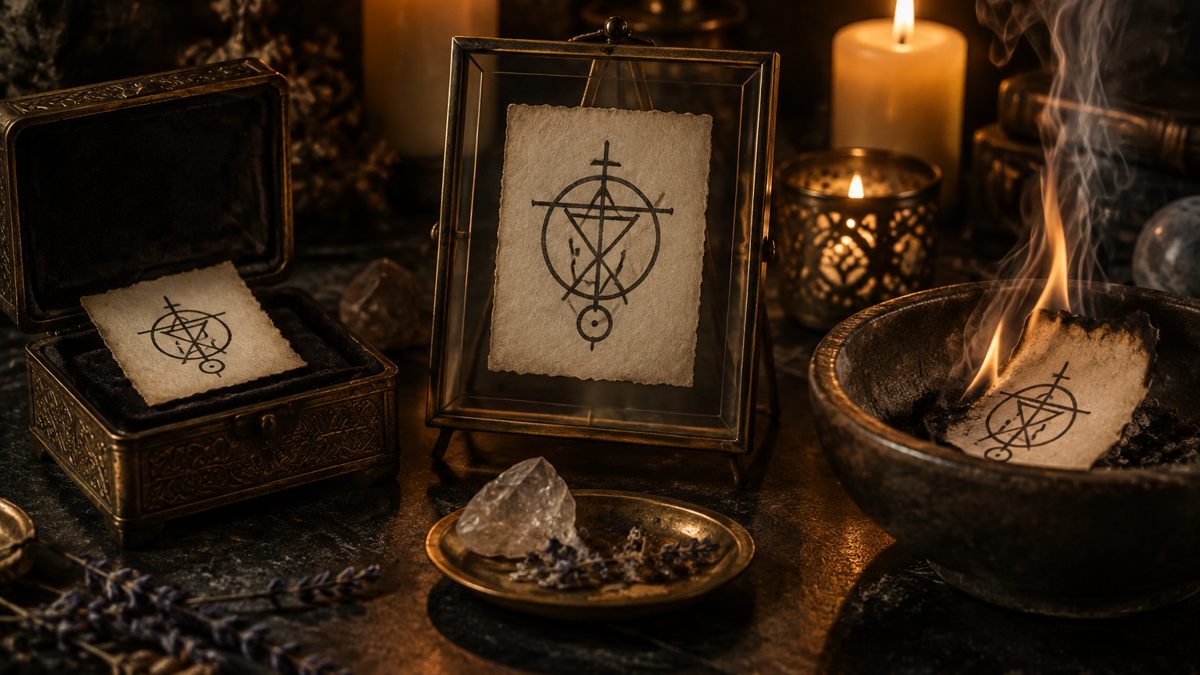
10. Decide Whether to Keep, Display, or Release It
Разные методы дают разные советы о том, что происходит дальше. Некоторые подходы хаос-магии предлагают после ритуала убрать намерение из сознательного внимания. Другие личные практики оставляют сигил на виду как напоминание. Это разные рабочие модели, а не указания, которые нужно как-то выполнить одновременно. Выберите роль до начала: символ может быть личным ритуальным предметом, практической подсказкой или произведением искусства, связанным с вашим намерением.
For a reminder-based practice, place the design near the relevant activity: inside a study notebook, beside a musical instrument, or on your own calendar. Avoid displaying confidential intentions in shared workplaces or homes unless you are comfortable discussing them. For a release-based practice, put it in an envelope or close the journal. You do not need to force yourself to forget. Remembering your intention is normal and does not invalidate the exercise.
Уничтожение необязательно. Разрывание обычной бумаги или её переработка, где это разрешено местными правилами, могут дать ясное завершение без огня. Не отпускайте бумагу, ленты, воск или блёстки в водоёмы и на природу. Закапывание материалов тоже может внести в почву мусор или нежелательные вещества. Если намерение меняется, вы можете «отправить на покой» сигил краткой записью в дневнике. Вам не нужны платное очищение, контрзаклинание или сложный ритуал утилизации.
11. Interpret Results Without Turning Everything Into a Sign
Evaluate the practice by returning to the intention and the actions you recorded. Did you write more often, prepare more consistently, or remember a boundary at a useful moment? Also note what did not change. A favorable event after a ritual does not demonstrate that the ritual caused it. Timing, chance, other people's choices, and your own behavior all matter, and a personal journal cannot isolate those influences with scientific certainty.
Dreams, coincidences, and emotional shifts may feel meaningful, and you can record them as experiences without treating them as instructions or predictions. Distinguish observation from interpretation: noticing a repeated image is one thing; concluding it guarantees a job offer is another. If an apparent sign would lead you to spend money, abandon treatment, confront someone, or take a serious risk, pause and seek ordinary evidence and appropriate advice.
Если желаемый исход не наступает, не думайте, что вам не хватило веры или что вы притянули неудачу. Проверьте, было ли намерение реалистичным и не требовал ли поддерживающий план больше времени, ресурсов или помощи. Иногда самый полезный результат — осознать, что исходная цель вам не нужна. Многократное перерисовывание символа ради облегчения страха может стать мучительным, а не поддерживающим. Если ритуал ощущается как принуждение или мешает повседневной жизни, отступите и подумайте о профессиональной поддержке.
12. Avoid Common Mistakes and Keep the Practice Safe
Common beginner mistakes include crowding several goals into one sigil, searching endlessly for the perfect shape, and making new symbols instead of taking practical steps. Another is believing that every extra ingredient increases effectiveness. Start with one intention and one design, then allow time to observe your experience. If the activity becomes expensive, exhausting, or frightening, simplify it. No seller or practitioner can legitimately guarantee supernatural results, and threats of unavoidable misfortune are a warning sign.
Огонь не обязателен. Если вы выбираете свечу, используйте устойчивый жаростойкий подсвечник на свободной поверхности, вдали от бумаги, ткани, детей и питомцев, и никогда не оставляйте её без присмотра. Избегайте сжигания сигила, особенно если он содержит неизвестные чернила, покрытия, клей или синтетические материалы. Благовония и дым могут раздражать лёгкие и влиять на животных; проветривание не делает безопасным каждый продукт. Незажжённая свеча или обычная настольная лампа могут отметить событие без горения.
Травы, масла и соль тоже требуют осторожности. «Натуральное» не значит безопасное для проглатывания, сжигания или нанесения на кожу. Не принимайте ритуальные смеси внутрь и не добавляйте неизвестные вещества в воду для ванны, еду или напитки; эфирные масла и некоторые растения могут быть вредны, особенно для домашних животных. Держите соль и солёную воду подальше от растений и почвы. Уважайте согласие и собственность: не прячьте сигилы в чужих вещах, не отмечайте общие помещения без разрешения и не используйте телесные материалы другого человека.
13. Keep a Useful Journal and Develop Your Own Approach
A useful journal entry records the date, intention, reduction rule, sketch, and reason for choosing the final design. Add the practical action that will accompany it and the date you plan to review. You may record mood or personal associations, but you do not need to document every passing thought. Keep sensitive information secure, especially if your notes involve relationships, health, or work. Initials and general descriptions can protect other people's privacy.
At review time, compare your experience with the original aim rather than rewriting the aim to fit whatever happened. Include uneventful attempts as well as memorable ones. Ask whether the symbol helped you remember a commitment, whether the process was enjoyable, and whether any part created pressure. Your record may reveal that a visible reminder suits you better than a release ritual, or that drawing alone provides the reflection you were seeking.
Develop your approach gradually. Change one feature at a time if you want to compare experiences, and use Sigil Methods when you are ready to explore a different construction process. Read historical sources with attention to context, and keep personal adaptations clearly identified as your own. You may also decide that sigil making is not useful to you. A thoughtful practice leaves room for curiosity, revision, and stopping; it does not demand fear or certainty.
- 1. Record what you made, how you made it, and what you intended to do alongside it.
- 2. Choose a review date that discourages constant checking.
- 3. Note concrete actions and outcomes separately from feelings and symbolic interpretations.
- 4. Decide whether to continue, revise, retire, or simply enjoy the design as artwork.
These practices are shared as tradition and personal reflection, not as a substitute for medical, legal or financial advice.
Продолжайте узнавать
- Методы сигилов
- How to read tarot cards
- How to use angel oracle cards
- Как читать игральные карты
- Как использовать кристаллы в заклинаниях
- Как использовать травы в ведовстве
- How to read the Dr. Moorne Egyptian Tarot
- How to read dice
- How to read tea leaves
- Как пользоваться маятником
- Как наложить заклинание со свечой
- How to make a spell jar
- How to make a sigil
- How to cleanse your home
- How to set up an ancestor altar
- How to open a sacred space
- How to time spells with the moon
- How to work with water and salt
- How to make a protection charm bag
- Read the Journal или посетите shops