How-To Guide
How to Read Dice for Divination
Автор: Seraphina
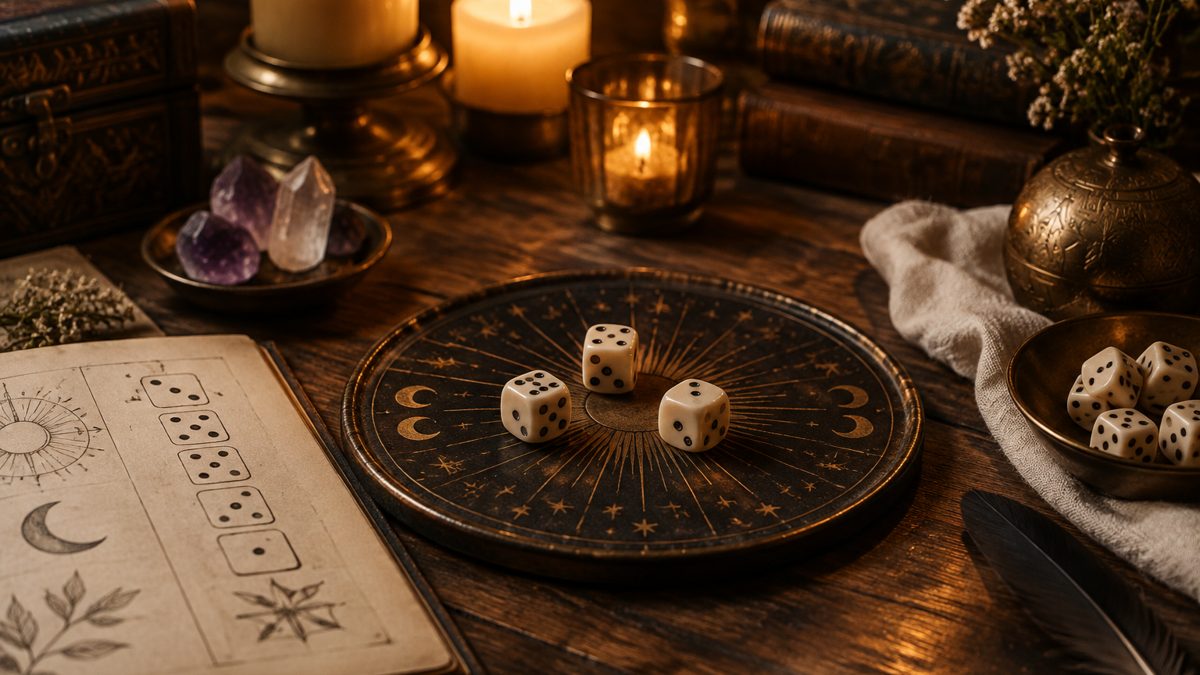
A handful of dice can turn an ordinary tabletop into a place for reflection. Their appeal is simple: you ask a question, let the dice fall, and consider what their numbers might suggest. In divination, this becomes a symbolic conversation with uncertainty rather than a reliable way to establish facts or predict what must happen.
Гадание на костях часто называют клеромантией, хотя этот термин охватывает более широкое семейство практик с бросанием жребия. Одни подходят к нему духовно, как к способу искать наставление в рамках своих верований. Другие используют его как творческую подсказку, прерывающую привычный ход мыслей. Решать этот философский вопрос до освоения практического метода не нужно.
This guide uses ordinary six-sided dice and a clearly defined reading system. It is an approachable modern framework, not a claim to recover one universal ancient tradition. You will learn how to prepare, choose a useful question, cast the dice, interpret a result, and translate your reflections into a sensible next step.
Keep the companion reference page, Dice Divination Meanings, nearby when you want to explore number symbolism in more depth. Here, the emphasis is on how to conduct a complete reading without becoming overwhelmed by competing rules. The aim is a practice that feels thoughtful, grounded, and genuinely useful, whether you read occasionally or keep a regular journal.
Looking for the meaning of a single card or ingredient? Keep our Dice divination meanings guide open beside you.
1. Understand the History Without Flattening the Traditions
People have used lots, marked objects, knucklebones, and dice-like pieces for decision-making and divination in many societies. These objects are related in function, but they are not interchangeable. A bone cast in a ritual setting, a numbered gaming die, and a sacred lot drawn by a religious specialist can belong to very different systems of meaning.
В древнем Средиземноморье астрагалы, то есть бараньи косточки, использовались в играх и некоторых гадательных практиках. Их неправильная форма создавала систему бросков, отличную от современных кубических костей. Сохранившиеся свидетельства включают также нумерованные оракулы, связанные с бросками. Эта история показывает, что бросание предметов в поисках наставления — давний обычай, но не доказывает единого непрерывного метода, общего для всех современных толкователей.
The word cleromancy is useful as an umbrella term for divination by lots. Astragalomancy refers more specifically to divination associated with knucklebones, although popular modern writing sometimes uses it loosely for dice reading. Terminology varies between sources, so look for an explanation of the actual objects and rules rather than assuming a label tells the whole story.
When studying a particular tradition, ask who recorded it, where it was practiced, and whether the source distinguishes historical evidence from later interpretation. Respect community boundaries around restricted religious practices. You can create a personal dice ritual without presenting it as inherited Slavic, Greek, Roman, or any other culturally specific practice you have not actually learned.
2. Gather a Simple, Reliable Reading Kit
Begin with three ordinary six-sided dice, a notebook, and a flat surface. Different-colored dice make positional readings easier because you can assign a separate role to each color. If yours are identical, roll them individually into labeled spaces instead. The goal is to know which die answers which part of the question without rearranging the result afterward.
Выбирайте кости с чёткими, легко читаемыми гранями и без явных повреждений. Сбалансированные игровые кости — практичный вариант; дорогие камни или затейливые символы не нужны. Декоративные кости могут быть прекрасны, но скруглённые края, неровная отделка или трудночитаемая маркировка могут сделать результаты менее однозначными. Ни у одного материала нет доказанного сверхъестественного преимущества перед другим.
A shallow tray or folded cloth can keep the dice from bouncing across the room. Leave enough room for them to tumble rather than simply slide out of your hand. A small cup is useful if gripping or shaking dice is difficult. You can also use a digital random-number generator, provided you decide its settings and rules before beginning.
Необязательные предметы могут включать значимую фотографию, незажжённую свечу или небольшой знак, связанный с вашим вопросом. Воспринимайте их как личные опоры для внимания, а не как обязательные источники силы. Ваш базовый набор должен оставаться простым в использовании, недорогим и доступным. Сложная обстановка нередко создаёт больше поводов для отвлечения, чем простой стол и три кости.
3. Choose Your Rules Before You Cast
Толкование становится яснее, если метод определён до того, как вы увидите числа. В этом руководстве используйте три кости с закреплёнными ролями: ситуация, вызов и полезный ответ. Читайте каждую кость отдельно, пользуясь одними и теми же шестью темами чисел. Так вы получите законченную структуру, подобную предложению, а не необъяснённую сумму, которая может означать почти что угодно.
Наши рабочие значения намеренно широки: один говорит об инициативе; два — об отношениях или равновесии; три — о выражении или росте; четыре — о структуре; пять — о переменах или трении; шесть — о заботе или ответственности. Это толковательный выбор для данного метода, а не универсальные законы. Запишите их, чтобы незаметно не менять значение в пользу желаемого ответа.
Other systems read the sum of several dice, use a marked casting cloth, or assign special meanings to doubles and triples. Those approaches can be valid parts of a chosen symbolic practice, but they should not be mixed casually. A meaning written for a total of eleven does not automatically explain an individual die, and positional rules cannot be reconstructed after a cast.
For your first several readings, ignore where dice land beyond keeping them inside the tray. Do not add bonus meanings for proximity, direction, noise, or the time on the clock. You can experiment later, but a stable starting framework makes it easier to learn what you are actually doing and recognize where your own interpretation enters.
- 1. Assign one die or labeled space to situation, one to challenge, and one to helpful response.
- 2. Copy the six working meanings into your notebook before casting.
- 3. Decide that a die outside the tray, stacked on another die, or tilted without a clear upper face will be rerolled by itself.
- 4. Set a limit of one main cast and, only if necessary, one clearly framed clarifying cast.
4. Ask a Question That Leaves Room for Choice
The most useful questions focus on something you can examine or influence. Instead of asking whether your life will improve, ask what deserves attention as you work toward a specific goal. Instead of asking what another person secretly thinks, ask how you can communicate more clearly or decide what boundaries you need in that relationship.
Открытые вопросы обычно лучше подходят для символических раскладов, чем требования вердикта «да» или «нет». Число может предложить задуматься о структуре, переговорах или переменах, но не способно подтвердить заболевание, раскрыть частный разговор или установить, можно ли доверять человеку. Считайте такие вопросы предметом для доказательств, прямого разговора или соответствующей профессиональной консультации.
Give the reading a reasonable scope. What will help me prepare for next week's conversation is easier to explore than what is my destiny. A timeframe describes the period you intend to reflect on; it does not make the dice capable of forecasting events within that period. Narrowing the question simply makes your interpretation less vague.
Write the question exactly as you intend to ask it. If it contains several separate problems, choose one or plan separate readings on another occasion. You may discover that the act of refining the question already provides useful clarity. That is not a failed divination session; it is one of the practical benefits of slowing down.
- 1. Назовите тему одним предложением, например: подготовка к трудному разговору.
- 2. Определите, что находится в вашей власти: подготовка, общение, выбор времени или границы.
- 3. Turn the concern into an open question beginning with what or how.
- 4. Убедитесь, что вопрос не требует от костей фактов, которые вам нужно проверить иначе.

5. Prepare Yourself and the Reading Space
Выберите место, где вам удобно сидеть и слышать собственные мысли. Освободите достаточно места для подноса и блокнота, затем, если возможно, отложите отвлекающие уведомления. Полная тишина и идеальное настроение не нужны. Подготовка — лишь способ отделить этот период осознанного размышления от остального дня.
Notice your emotional state before starting. If you are frightened, exhausted, angry, or urgently hoping for one particular answer, name that in your notes. You may still choose to reflect, but consider postponing the cast when disappointment would feel unbearable. Dice are not a dependable way to regulate a crisis or obtain certainty under pressure.
Some practitioners like to cleanse their tools symbolically. A dry cloth, a spoken intention, or a minute of quiet can serve that purpose without smoke or liquids. If cleansing has spiritual meaning for you, frame it as your ritual belief. Dice do not need supernatural purification to function as randomizing objects or reflective prompts.
Keep physical safety straightforward. An electric candle avoids an open flame; if using a real candle, place it in a stable holder away from fabric and never leave it unattended. Smoke can aggravate respiratory conditions and affect pets. Avoid soaking dice in salt water, which may damage finishes or metal, and do not pour salt water onto plants or garden soil.
6. Cast the Dice: A Complete Step-by-Step Method
Когда вопрос и правила готовы, сделайте несколько обычных спокойных вдохов. Прочтите вопрос вслух или про себя. Можно добавить намерение, например желание увидеть ситуацию яснее, но особые формулировки не нужны. Не обещайте себе, что бросок откроет неоспоримую истину: такое ожидание затрудняет обращение с обычной неоднозначностью.
Shake the dice in your hand or cup and release them onto the prepared surface. If you are using identical dice, cast one at a time into the corresponding labeled spaces. Let each die settle naturally. There is no required number of shakes, no ideal casting hand, and no need to repeat the action until it feels sufficiently dramatic.
Record the raw result before interpreting anything. Write the role and number together, such as situation four, challenge two, helpful response five. This preserves the actual cast and prevents later memory from blurring into the story you developed. If a die needed rerolling under your advance rules, record that briefly without treating the mishap as an omen.
Теперь читайте по одной позиции, затем соединяйте их. Начните с простой темы числа, подумайте, как эта тема может проявиться в отведённой ей роли, и сопоставьте толкование с тем, что вы уже знаете. Завершите скромным действием, а не предсказанием. Хороший сеанс должен оставить вам что-то, что можно изучить или попробовать, а не приказ, которому вы чувствуете себя обязанным подчиниться.
- 1. Date the entry and copy your question and positional assignments.
- 2. Settle your attention and cast the three dice using the method you chose.
- 3. Применяйте только заранее записанные правила для неясных или выпавших за пределы костей.
- 4. Record every number in its correct position before consulting meanings.
- 5. Interpret the positions separately, then write a short combined reading.
- 6. Choose one proportionate next step and close the session.
7. Читайте шесть чисел в контексте
One can prompt questions about beginnings, independence, initiative, or excessive self-reliance. Two can point toward partnership, exchange, balance, or hesitation between alternatives. Neither is automatically favorable or unfavorable. In a challenge position, one might invite you to examine whether you are carrying everything alone, while two might raise the issue of compromise that has become avoidance.
Three can suggest expression, experimentation, social connection, or scattered effort. Four can suggest routines, foundations, limits, or rigidity. If four appears as helpful response, you might benefit from a schedule or clear agreement. If it describes the challenge, the same number may invite you to question a rule that no longer serves its purpose.
Five can suggest movement, disruption, curiosity, or friction. Six can suggest care, responsibility, repair, or overextension. A five is not a warning that disaster is coming, and a six does not guarantee harmony. Their usefulness lies in the questions they generate: what needs to change, whose needs are being considered, and which responsibilities are genuinely yours?
Use the companion page, Dice Divination Meanings, to deepen your vocabulary, while checking that any interpretation matches the method you chose. Readings become richer through specificity, not through collecting every possible association. For each number, select one or two themes that fit the position and explain why. If nothing fits, it is acceptable to leave the result unresolved.
8. Follow a Worked Example From Question to Action
Представьте, что вы готовитесь обсудить с соседом по квартире неравное распределение домашних дел. Ваш вопрос: «Как мне подойти к разговору на этой неделе о распределении домашней работы более конструктивно?» Он подходит, потому что касается вашей подготовки и поведения. Он не просит кости раскрыть личные мотивы соседа или гарантировать исход обсуждения.
Suppose the cast is situation four, challenge two, and helpful response five. Four suggests looking at existing structure: perhaps there is no agreed schedule, or tasks have accumulated around whoever notices them first. That is a hypothesis to compare with your experience. The die itself does not establish that your household arrangements are unfair or ineffective.
Two in the challenge position suggests examining negotiation and balance. You might realize you have been avoiding disagreement by saying everything is fine. Alternatively, both people may have different understandings of equal effort. Five as helpful response invites flexibility and a change in approach, perhaps trying a new task arrangement rather than arguing over who is naturally more responsible.
The combined reading could be: Make the current arrangement visible, discuss differences directly, and propose a short experiment. Your practical action is to list recurring tasks, ask for the housemate's perspective, and agree on a two-week trial with a review date. This is a reasonable plan even without divination, which is a useful test of whether the reading supports sound judgment.
- 1. Write down known facts separately from assumptions about the other person.
- 2. Translate each number into a question relevant to its position.
- 3. Combine the answers into a tentative interpretation, using language such as might or could.
- 4. Выберите практическое действие и оценивайте его позже по реальному разговору, а не по очередному броску.
9. Разбирайтесь с повторами, противоречиями и уточнениями
Repeated numbers naturally attract attention, but repetition is not evidence of an urgent message. If two or three dice show the same number, you can explore that theme across the assigned roles. Three fours, for instance, might invite reflection on structure as the present condition, excessive rigidity as the challenge, and a better-designed routine as the response.
Different numbers can appear to pull in opposite directions. Four may suggest stability while five suggests change. Rather than forcing one to cancel the other, ask whether they describe different needs: maintaining a dependable foundation while changing one unhelpful habit. The assigned positions help you distinguish these functions without inventing a secret rule to resolve the tension.
If you choose a sum-based method later, remember that totals from multiple dice are not equally likely. With two fair six-sided dice, seven has more possible combinations than two or twelve. Likewise, striking patterns eventually occur by chance. Probability does not prevent symbolic reflection, but it does undermine claims that an ordinary repeat proves a supernatural intervention.
Use a clarifier only when you can name what remains unclear. Under this guide's rules, one additional single die may answer: What quality could help me carry out the response? Use the same six meanings. If the result adds confusion, stop rather than building a chain of clarifiers. Uncertainty is a legitimate conclusion, not a fault that endless casting will necessarily fix.
10. Avoid the Most Common Reading Mistakes
Самая лёгкая ошибка — перебрасывать, пока не выпадет что-то утешительное. Так практика превращается в поиск разрешения, а нежеланные результаты начинают казаться угрожающими. Придерживайтесь оговорённой точки остановки. Если первоначальный расклад расстраивает, отложите его и изучите свою реакцию, а не считайте очередной бросок единственным способом вернуть покой.
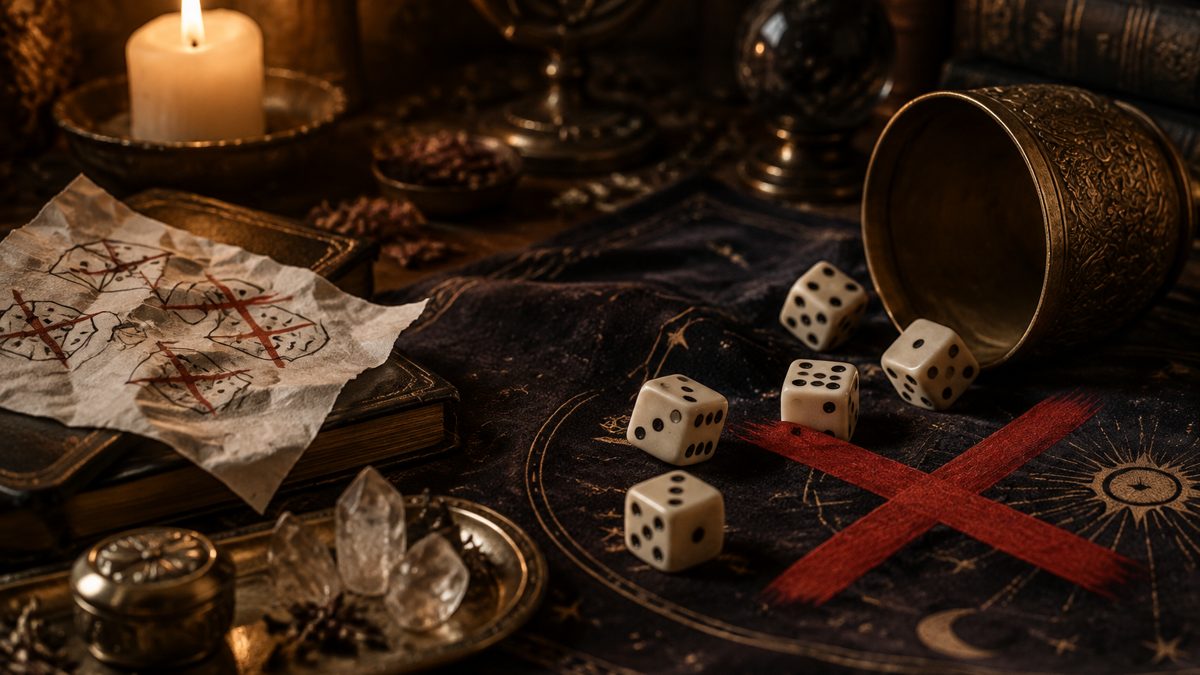
Another mistake is changing the interpretive system after seeing the result. A reader might begin with individual numbers, switch to totals, then add doubles or spatial directions because one version sounds more appealing. Experimentation is fine when it is planned and recorded. Retrofitting rules makes it difficult to tell whether a method is helpful or merely accommodating.
Watch for confirmation bias: the tendency to notice matches and overlook misses. Broad statements can fit many situations, especially after events have occurred. Write your interpretation before the outcome is known, include plausible alternatives, and record when a reading was vague or unhelpful. Honest uncertainty is more valuable than making every entry appear remarkably accurate.
Finally, avoid dividing numbers into lucky promises and unlucky threats. A difficult theme does not predict punishment, and a gentle theme does not remove the need for caution. If every cast seems to announce betrayal, danger, or destiny, step back from the method. Good reflection should expand your choices rather than narrow them through fear.
11. Practice Safety, Consent, and Ethical Boundaries
Используйте кости для размышления, а не для диагностики, экстренной оценки, юридических выводов или финансовых гарантий. Никогда не используйте гадание, чтобы решить, прекращать ли лекарства, игнорировать ли симптомы, делать ли рискованное вложение или отмахиваться от признаков опасности. Для серьёзных решений ищите надёжную информацию и квалифицированную помощь. Символическая подсказка может помочь подготовить вопросы, но не заменит ответы, которых требуют такие ситуации.
Когда читаете для другого человека, получите ясное согласие и объясните пределы метода. Спросите, что он хочет исследовать, и позвольте ему отвергнуть толкование. Избегайте заявлений о смерти, беременности, болезни, измене, проклятиях или скрытых намерениях другого человека. Представляйте возможности, не претендуя на особый авторитет над отношениями, будущим или способностью человека выбирать.
Protect privacy as carefully as you would in any sensitive conversation. Do not share someone else's question, identifying details, or journal entry without permission. If payment is involved, explain the price and scope in advance. Claims that a frightening cast requires an urgent, expensive cleansing are a serious warning sign; no dice result establishes that such a service is necessary.
Keep dice away from young children and animals because they are choking hazards. Herbs and oils are optional and may irritate skin or harm pets; natural does not mean harmless. Do not ingest ritual preparations or add unknown substances to drinks. If reading becomes compulsive, disrupts sleep, or increases anxiety, pause and seek support rather than adding more rituals.
12. Keep a Journal That Encourages Honest Learning
A useful journal separates the cast, the interpretation, and the later outcome. These are three different things. The cast is what the dice showed; the interpretation is the meaning you proposed; the outcome is what actually happened afterward. Keeping those layers distinct makes it harder to reshape an old reading until it appears to have predicted everything.
Record your question, method, number assignments, raw results, and emotional state. Then write a brief interpretation and one intended action. You can include a photograph of the cast if that helps, but a simple written record is enough. Avoid making documentation so elaborate that keeping the journal becomes a burden or distracts you from ordinary life.
At a later review, ask whether the session helped you notice something specific, make a thoughtful choice, or communicate more clearly. Also note when it increased confusion or had no practical value. A helpful reflection does not demonstrate supernatural accuracy, and an outcome that resembles your interpretation may have several explanations, including your own actions and chance.
Review patterns across several entries rather than drawing conclusions from one memorable match. You may discover that work questions lead you toward useful planning, while romantic uncertainty encourages repetitive checking. That distinction can guide healthier boundaries. Your journal should teach you about your attention, habits, and decisions, not become a ledger of omens you feel required to obey.
- 1. Create headings for date, question, method, cast, interpretation, and next action.
- 2. Добавьте заметку об уверенности: насколько ясной или неопределённой кажется трактовка.
- 3. Назначьте дату пересмотра, подходящую для вопроса, не ожидая предсказанного события.
- 4. Запишите, что произошло на самом деле, альтернативные объяснения и помог ли расклад.
- 5. Скорректируйте практику, если повторные сеансы вызывают тревогу, а не полезное размышление.
13. Build a Sustainable Personal Practice
Begin with occasional readings on manageable topics rather than consulting the dice about every choice. A weekly session or a reading before a planned conversation may be enough. Keep using the same framework for several sessions so you can learn its strengths and limitations. Familiarity often produces more thoughtful interpretation than constantly switching to a new system.
Если вы хотите развить метод, меняйте по одной особенности за раз. Можно попробовать ежедневное размышление с одной костью, систему, основанную на сумме, или ткань с заранее обозначенными зонами. Запишите новые правила до броска и отличайте свои дополнения от практик, имеющих исторические источники. Личному творчеству не нужна выдуманная древняя родословная, чтобы быть значимым.
Завершайте каждую сессию осознанно. Уберите кости, запишите следующее действие и вернитесь в мир, где можно собирать информацию, разговаривать с людьми и делать выбор. Заключительная фраза или тихий момент могут показаться полезными, но для предотвращения вреда они не обязательны. Незавершённый или оставленный без ответа расклад не подвергает вас сверхъестественной опасности.
В лучшем случае гадание на костях может дать скромную паузу между неопределённостью и реакцией. Вы бросаете, замечаете, задаёте вопросы и решаете, что заслуживает дальнейшего внимания. Пусть символика остаётся гибкой, практические границы твёрдыми, а ваше собственное суждение — ведущим. Кости могут подсказать, но ответственность и свобода выбора остаются за вами.
These practices are shared as tradition and personal reflection, not as a substitute for medical, legal or financial advice.
Продолжайте узнавать
- Dice divination meanings
- How to read tarot cards
- How to use angel oracle cards
- Как читать игральные карты
- Как использовать кристаллы в заклинаниях
- Как использовать травы в ведовстве
- How to read the Dr. Moorne Egyptian Tarot
- How to read dice
- How to read tea leaves
- Как пользоваться маятником
- Как наложить заклинание со свечой
- How to make a spell jar
- How to make a sigil
- How to cleanse your home
- How to set up an ancestor altar
- How to open a sacred space
- How to time spells with the moon
- How to work with water and salt
- How to make a protection charm bag
- Read the Journal или посетите shops