How-To Guide
So liest du Spielkarten zur Wahrsagung (Kartenlegen)
Von Seraphina
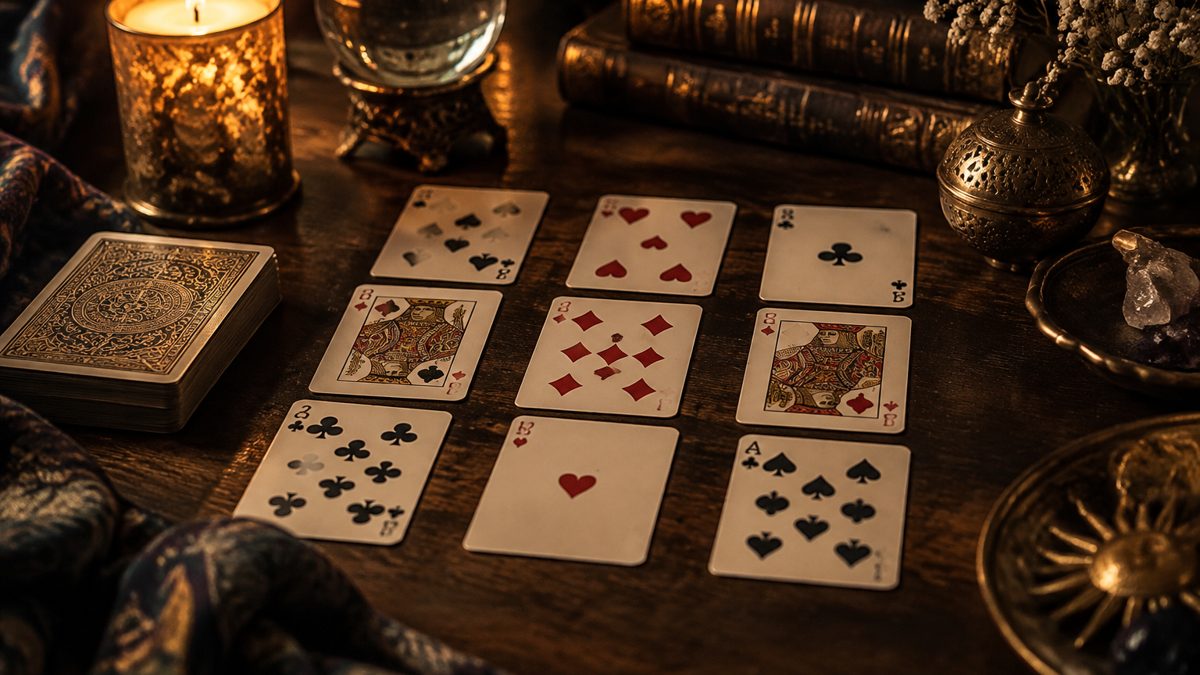
Ein Spielkartendeck auf einem Küchentisch hat etwas wunderbar Einladendes. Es braucht weder ein Samttuch noch aufwendige Bilder, um voller Möglichkeiten zu wirken. Seine vertrauten Herzen und Piks gehören bereits zu einer Sprache aus Spielen, Zufall und menschlicher Gesellschaft. Hier im Crossroads Journal nähere ich mich dem Kartenlegen gern in genau diesem einladenden Geist: als traditionelle symbolische Praxis, die Raum für Reflexion, Fantasie und ein wenig alltägliche Zeremonie schaffen kann.
I’m Seraphina, and this is the beginner’s guide I would want beside me when opening an ordinary deck for the first time. We will explore the history of playing-card divination, build a practical vocabulary for the suits and ranks, prepare a deck, and try both three-card and nine-card layouts. I will also explain the significator, show how cards modify one another, and walk through a complete example without pretending there is only one correct interpretation.
Eine sanfte Anmerkung vorab: Menschen verstehen Wahrsagen unterschiedlich. Manche betrachten es als spirituelle Praxis; andere als Erzählen, Kontemplation oder Weg, die eigenen Annahmen zu bemerken. Es gibt keine verlässlichen Belege dafür, dass gemischte Karten zukünftige Ereignisse vorhersagen. In diesem gesamten Leitfaden werden magische Zuordnungen als Traditionen und Überzeugungen dargestellt, nicht als gesicherte Tatsachen, und keine Legung sollte als Versprechen oder als Anweisung verstanden werden, die dein eigenes Urteil außer Kraft setzt.
You need only a standard 52-card deck, a clear surface, and something to write on. Remove the jokers for the system below. Bring curiosity rather than a demand for certainty, and choose an everyday question with room for your own agency. My favorite starting point is not “What must happen?” but “What might be useful to consider?” That small change makes the whole practice more generous.
Looking for the meaning of a single card or ingredient? Keep our Playing card meanings guide open beside you.
So liest du Spielkarten zur Wahrsagung (Kartenlegen)
Cartomancy means divination using cards. In everyday usage, the word often refers specifically to reading ordinary playing cards, although it can describe a wider family of card-based practices. Playing cards existed before the familiar modern systems of fortune-telling attached to them. Their earlier history reaches into Asia, and cards arrived in Europe by the late fourteenth century, where different regions developed distinctive suits, designs, and games.
The hearts, diamonds, clubs, and spades used here belong to the French-suited tradition. Those symbols became widely familiar through the spread of French-style decks. European playing-card divination is documented in early modern sources, with printed methods becoming especially visible in the eighteenth and nineteenth centuries. Professional readers, household traditions, and popular manuals all helped shape the practice. That history is varied rather than a single unbroken system handed down unchanged.
Tarot and ordinary playing-card reading are related, but they are not interchangeable. Tarot developed as a card game in fifteenth-century Europe, and its widespread association with occult divination came later. A standard playing deck has no major arcana and has three court ranks per suit rather than tarot’s four. You can borrow ideas across traditions, but I find it clearer to learn the particular deck in your hands before mixing systems.
Vor allem stimmen historische Methoden des Kartenlegens nicht in jeder Bedeutung überein. Ein Buch behandelt eine bestimmte Karte als Besucher, ein anderes als Nachricht, ein weiteres als eine bestimmte Art von Beziehung. Die Bedeutungen in diesem Leitfaden sind ein stimmiger Rahmen für Einsteiger, kein Anspruch auf universelle Autorität. Wenn deine Familie oder kulturelle Tradition ein anderes System nutzt, musst du es nicht verwerfen. Stimmigkeit innerhalb einer Legung ist wichtiger, als jede mögliche Definition zu sammeln.
1. Ask a Question That Leaves You Room to Choose
Before thinking about meanings, decide what kind of conversation you want to have with the cards. A narrow prediction can encourage you to squeeze a complex life into an unhelpful yes or no. An exploratory question gives the symbols something more useful to do. Instead of “Will my new neighbor become my best friend?” try “How can I approach getting to know my new neighbor?” The second question keeps the focus on your conduct, expectations, and available choices.
Good beginner questions are specific enough to anchor the reading but open enough to invite several perspectives. “What should I notice about starting a creative project?” is more workable than “Tell me everything about my life.” You might also ask what supports a situation, what complicates it, and what small next step deserves consideration. Avoid repeatedly rephrasing the same question until you receive the card you were hoping for.
A reading is not a reliable way to discover another person’s private thoughts, confirm accusations, or establish facts. If a question concerns a relationship, keep it on your side of the fence: what you have observed, how you communicate, and which boundaries matter to you. Cards cannot substitute for a direct conversation. They also should not guide medical, legal, or financial decisions; those belong with appropriate information and qualified support.
When reading for someone else, explain your approach and ask permission before beginning. Make clear that interpretations are symbolic and uncertain, and let the person decline any topic. I would rather offer one thoughtful possibility than deliver a dramatic pronouncement. The reader’s responsibility is not to sound all-knowing, but to keep the exchange respectful, grounded, and open to correction.
2. Learn the Four Suits as Areas of Everyday Life
Hearts concern affection, belonging, pleasure, hospitality, and emotional connection in this framework. They do not automatically mean romance. A heart might point toward friendship, family rituals, enjoying your own company, or the atmosphere you create when welcoming someone. In practice, ask: where is feeling or connection central to this question? A heart in a position called “support” might suggest encouragement or companionship, while the same suit in “complication” could invite reflection on expectations of closeness.
Clubs concern activity, learning, effort, collaboration, and the development of skills. Think of hands making something, people organizing a shared task, or a beginner practicing until a movement becomes familiar. Although some traditions connect clubs strongly with business, I use them more broadly for purposeful engagement. In a question about joining a choir, clubs might bring attention to rehearsals, regular attendance, or learning to contribute to a group.
Karo betrifft greifbare Dinge: Besitz, Materialien, praktische Vorkehrungen, Austausch und das, was wir wertschätzen. Manche Traditionen des Kartenlegens betonen hier Geld, doch dieser Leitfaden nutzt Karo als weitere Erinnerung an alltägliche Ressourcen. Ein Karo könnte die Vorräte für ein Bastelprojekt, den verfügbaren Platz in einem Raum oder eine Absprache über das Teilen von Ausrüstung symbolisieren. Es zeigt nicht, ob eine Investition gelingt oder ein Kauf klug ist. Halte die Symbolik auf der Ebene praktischer Reflexion.
Spades concern difficulty, limits, disagreement, separation, and necessary clarification. They deserve attention, but not dread. A spade might suggest that a plan needs a boundary, that an assumption needs questioning, or that something is asking for closure. In some traditional systems, spades receive severe meanings; I do not treat any card as evidence of death, illness, betrayal, or disaster. As a quick memory aid, hearts connect, clubs engage, diamonds make things tangible, and spades examine what resists or needs defining.
3. Gib den Zahlenkarten ein praktisches Vokabular
In this method, a card’s working meaning comes from combining its suit with its rank. The suit supplies the area of life; the number supplies a movement or pattern. These number associations are an interpretive scaffold, not a universal code. Learn them in small groups, and test them against ordinary situations. You are not trying to memorize fifty-two rigid predictions. You are learning to construct a sensible phrase, such as “a beginning in connection” or “effort meeting resistance.”
Aces suggest an opening, a seed, or a concentrated expression of the suit. The ace of hearts might represent an invitation to connect; the ace of clubs, the first impulse toward an activity. Twos suggest a pair, an exchange, a choice, or the task of balancing two elements. Threes suggest growth, expression, participation, or the complication that arrives when something expands beyond a pair. A three of diamonds, for instance, might prompt you to consider how several practical contributions fit together.
Fours suggest structure, stability, routine, or a boundary. Stability can be comforting or restrictive depending on the question. Fives suggest disturbance, adjustment, friction, or a change that requires a response. Sixes suggest cooperation, accommodation, or a workable rhythm after adjustment. Imagine these ranks as a small sequence: a structure forms, something disrupts it, and a new arrangement becomes possible. The six does not promise resolution; it invites you to look for ways a situation might become more workable.
Siebenen deuten auf Bewertung, Ungewissheit, Geduld oder das Erproben eines Vorgehens hin. Achten deuten auf Bewegung, Wiederholung, gezielte Anstrengung oder Schwung hin. Neunen deuten auf Anhäufung, Intensität oder das Näherkommen an einen Punkt der Fülle hin. Zehnen deuten auf Vollendung, den vollen Ausdruck der Farbe oder den Übergang in eine andere Phase hin. Eine Neun kann sich daher befriedigend oder überladen anfühlen; eine Zehn kann sich vollständig oder bereit zum Loslassen anfühlen. Die umliegenden Karten und die Position in der Legung helfen dir zu entscheiden, welcher Aspekt Aufmerksamkeit verdient.
For a brief practice, compare the four fours: hearts might suggest familiar emotional comforts; clubs, an established practice routine; diamonds, an orderly arrangement of materials; spades, a firm limit. Notice that the rank stays recognizable while the suit changes its setting. If you cannot find a natural connection, write down two tentative possibilities rather than forcing an answer. Fluency comes from comparing interpretations with lived context, not from making every draw sound profound.
4. Read Jacks, Queens, and Kings Without Stereotypes
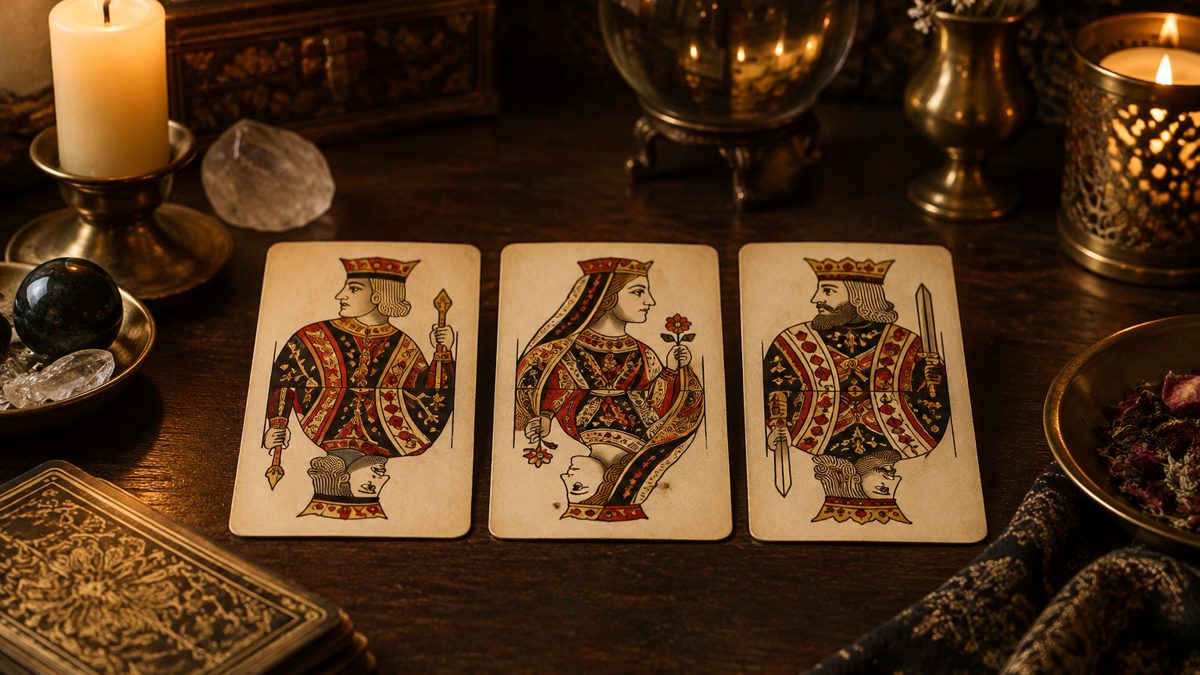
Bei den Hofkarten verheddern sich Einsteiger oft. Ältere Handbücher beschreiben Menschen mitunter über starre Annahmen zu Geschlecht, Familienstand, Aussehen oder gesellschaftlicher Stellung. Du brauchst diese Annahmen nicht, um ein Deck zu lesen. Ich behandle Hofkarten lieber zuerst als Rollen oder Arten des Auftretens und erst in zweiter Linie als mögliche Personen. Das macht sie anpassungsfähiger und vermeidet die Vorspiegelung, eine Karte könne den Charakter eines Fremden an seinem Aussehen erkennen.
Jacks suggest curiosity, messages, experimentation, or someone entering a situation with developing experience. Queens suggest cultivation, discernment, attentiveness, and the ability to sustain an atmosphere or practice. Kings suggest stewardship, direction, responsibility, and decisions that shape a wider setting. These are symbolic roles, not a hierarchy of personal worth. Anyone, of any gender or age, can embody any of them, and the same person may occupy different roles in different situations.
Combine role and suit just as you combine number and suit. A jack of clubs might suggest an eager learner or an invitation to try an activity. A queen of hearts could represent thoughtful hospitality. A king of diamonds might point toward responsibility for shared materials, while a queen of spades might suggest clear discernment and well-kept boundaries. These are starting phrases, not fixed portraits. The question tells you whether the card’s quality is helpful, excessive, missing, or simply noticeable.
If a court seems to represent someone, ask what supports that interpretation. Does the person actually occupy the relevant role, or are you attaching their name because you wanted them to appear? When several courts turn up, consider multiple approaches or competing responsibilities before declaring a cast of characters. My favorite question is “What role is needed here?” It usually creates a more useful reading than “Who exactly is this?”
5. Prepare Your Deck and Make a Simple Reading Ritual
Any complete, readable 52-card deck will do. A well-used pack from the cupboard is just as suitable for learning as a new one. Check that all four suits are present from ace through king and set the jokers aside. Some traditions use jokers, but their meanings vary; leaving them out makes this beginner’s system easier to follow. There is no requirement to buy a dedicated divination deck.
Some practitioners believe in cleansing or consecrating cards through ritual. You might instead regard preparation as a way of settling your attention. Neither interpretation requires elaborate equipment. I suggest straightening the deck, clearing a space, and taking a quiet breath. If you enjoy symbolism, place a meaningful object nearby or wrap the deck in a favorite cloth afterward. These actions can mark the occasion without being presented as necessary for supernatural accuracy.
Mische auf eine Weise, die bequem und zugänglich ist. Du kannst die Karten übereinanderziehen, sanft auf dem Tisch durchmischen oder das Deck teilen und wieder zusammenfügen. Eine genaue Anzahl ist nicht nötig. Entscheide vor dem Ziehen, ob du nur aufrechte Bedeutungen verwendest; das empfehle ich zu Beginn, da viele Spielkarten kein klar markiertes Oben haben. Entscheide außerdem, dass beim Mischen versehentlich herabgefallene Karten einfach zurück ins Deck wandern, statt automatisch zu Botschaften zu werden.
Write down the question and the spread positions before turning anything over. Shuffle, cut if you wish, and deal from the top. You do not need a special sensation to tell you when the deck is ready. A consistent procedure helps you avoid changing the rules to favor an appealing result. Stop or postpone the reading if you feel distressed or compelled to keep drawing. The cards will still be there when curiosity feels more spacious.
6. Decide Whether to Use a Significator
Eine Signifikatorkarte ist eine bewusst gewählte Karte, die die Person, die Situation oder das zentrale Thema einer Legung darstellt. Sie dient als Bezugspunkt, nicht als Vorhersage. Traditionelle Systeme wählen oft eine Hofkarte nach persönlichen Eigenschaften, doch du kannst stattdessen nach Rolle oder Absicht wählen. Wer ein ungewohntes Hobby beginnt, könnte den Kreuz-Buben wählen; wer sich mit Gastfreundschaft beschäftigt, die Herz-Dame.
A number card can work just as well. The two of hearts might stand for a developing connection, while the four of diamonds could represent the practical arrangement of a shared space. Choose a card because its symbolism fits the question, not because you think it captures your permanent identity. You are much more complicated than a single piece of printed cardboard. The significator is a temporary label on the table.
For beginners, the simplest method is to place the significator face up above the spread and then shuffle the remaining fifty-one cards. It is a chosen anchor, so do not count its presence as an independently drawn message. Alternatively, write its name in your notebook and keep the full deck intact. Some traditions leave a significator in the shuffled deck and interpret cards around it, but that requires a different procedure from the spreads taught here.
You can also skip the significator entirely. I often do when a clear written question already provides enough focus. If you use one, decide before shuffling and record the choice. Do not search through the deck afterward for a card you hoped would appear. The purpose is to orient the reading, not to manufacture confirmation.
7. Begin with a Three-Card Spread
A three-card spread is small enough to keep you honest. It gives each card a clear job and leaves less room for wandering into unrelated stories. My preferred beginner’s layout is situation, complication, and constructive response. It explores what is being considered, what makes it less straightforward, and an approach worth weighing. The third position is not an order, and it does not guarantee that a suggested action will produce a particular result.
You can also use past influence, present focus, and possible direction. If you choose that version, keep the final card conditional: it suggests a theme to consider if the current approach continues, not a future already written. I generally favor the first layout because it stays close to choice and observation. Whatever you select, write the position names first rather than deciding what they mean after seeing the cards.
Read each card through its assigned position before combining the three. A heart in the complication position does not automatically make the reading cheerful; it could bring attention to a wish for approval or an unspoken emotional expectation. A spade in the constructive-response position is not necessarily discouraging; a clear limit might be precisely the useful idea. The position changes the question you ask of the symbol.
Finish with a short summary and one grounded reflection. For example: “This looks like enthusiasm complicated by too many assumptions; I could ask a clearer question before proceeding.” Then check whether that interpretation fits what you actually know. If it does not, let it remain unhelpful. Not every arrangement needs to become a revelation, and a reading gains nothing from being forced.
- Write one question and label three positions: situation, complication, constructive response.
- Mische und lege drei Karten verdeckt von links nach rechts aus, dann drehe sie um.
- Write one sentence per card using its position, suit, and rank.
- Connect the sentences, note an alternative interpretation, and identify one optional next step.
8. Expand into a Nine-Card Spread
Once three cards feel manageable, try a nine-card box arranged in three rows of three. There are many traditions for reading this layout; here is one consistent beginner’s version. The top row represents background influences, the middle row represents the present situation, and the bottom row represents possible approaches. The columns, from left to right, represent your perspective, the point of interaction, and the surrounding conditions.
Read each position as the intersection of its row and column. The top-left card concerns background influences on your perspective. The top-middle card concerns the background of the interaction, and the top-right concerns earlier surrounding conditions. The center card focuses on the current interaction itself. The bottom-right card suggests an approach to the surrounding conditions, rather than predicting what the environment will inevitably do.
Begin with the center, then read each row from left to right. Afterward, read the columns downward to trace how a background theme relates to the present and to a possible response. This is a lot of information, so keep each individual interpretation short. You can note a dominant suit or repeated rank, but do not add diagonals, special corner rules, and extra layers merely because the layout has room for them.
The nine cards are best treated as a structured conversation, not nine separate forecasts. If the top row emphasizes clubs and the bottom row emphasizes hearts, one possible reading is a shift from doing and practicing toward connection and enjoyment. That is a reflective comparison, not proof of an approaching event. If the spread becomes muddy, return to the question and the center card instead of drawing more cards to explain every uncertainty.
- Write the row and column meanings in your notebook before drawing.
- Deal cards one through three across the top, four through six across the middle, and seven through nine across the bottom.
- Deute Karte fünf als gegenwärtigen Berührungspunkt und lies dann alle drei Reihen.
- Lies die Spalten von oben nach unten und notiere wiederkehrende Farben oder Werte.
- Summarize the whole spread in three sentences and separate observations from speculation.
9. Combine Cards Without Losing the Question
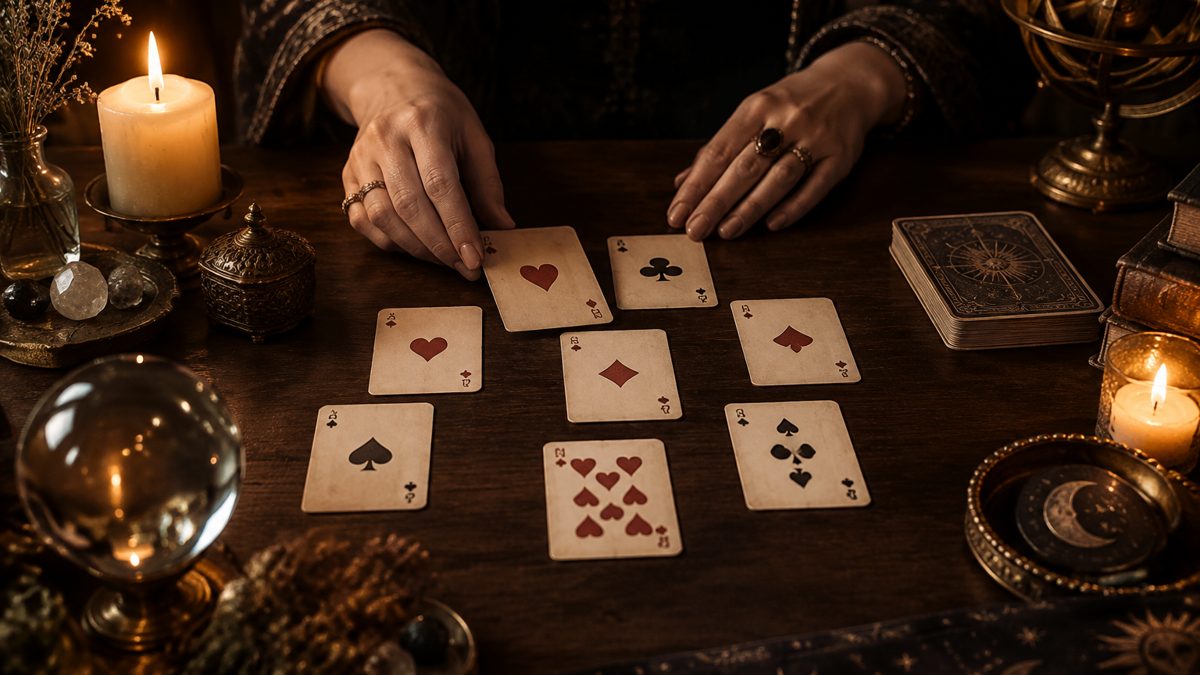
Combining cards is less like looking up a secret password and more like making a sentence. Start with each card’s assigned position, then let nearby cards qualify the interpretation. A two of hearts beside an eight of clubs could suggest connection developed through repeated shared activity. Reverse the emphasis, and it might suggest that an activity works better with cooperation. Neither combination guarantees friendship; both offer a way to think about participation.
Contrast is especially useful. A four of hearts next to a five of clubs might place emotional comfort beside disruption in an activity. You could ask whether a familiar routine is resisting an experiment, or whether a new task is unsettling an otherwise comfortable group. The question and positions should help you choose between those possibilities. Avoid adding dramatic details, named people, or precise dates that the symbolic framework cannot establish.
Wiederholte Ränge deuten auf ein Thema hin, das einer näheren Betrachtung wert ist. Mehrere Zweien könnten Austausch oder Entscheidungen hervorheben; mehrere Vieren könnten Struktur und Grenzen in den Blick rücken. Eine Häufung einer Farbe kann ebenso einen Lebensbereich betonen. Karten jeder Farbe haben jedoch eine gewöhnliche Chance zu erscheinen, und eine fehlende Farbe beweist nicht, dass etwas in deinem Leben fehlt. Das Erkennen von Mustern ist eine Deutungstechnik, kein Beleg für übernatürliche Bedeutung.
Lass widersprüchliche Karten miteinander im Gespräch, statt eine durch die andere aufzuheben. Ein Herz und ein Pik könnten sowohl Wärme als auch Grenzen anregen. Ein Kreuz und ein Karo könnten nahelegen, Begeisterung mit praktischen Vorkehrungen auszugleichen. Wenn du unsicher bist, schreibe „eine Möglichkeit ist“ und biete eine zweite Lesart an. Auch auf Zeitregeln verzichte ich in dieser Anfängermethode: Zuordnungen zu Farbe und Zahl variieren zu stark, um eine Karte als verlässlichen Kalender zu behandeln.
10. Walk Through a Complete Sample Reading
Here is a hypothetical example, not a testimonial or a prediction. Imagine I am considering a small neighborhood craft afternoon and ask, “What should I consider when inviting people to make things together?” I choose the three-card layout: situation, complication, constructive response. I use no significator. The cards are the three of hearts, the seven of diamonds, and the king of clubs. Before interpreting, I write down the facts: the gathering is only an idea, and nobody has yet been invited.
Die Herz-Drei in der Situationsposition verbindet Wachstum oder Teilnahme mit Verbundenheit und Freude. Eine einfache Lesart ist, dass die Idee um gemeinsames Vergnügen kreist und nicht um beeindruckende Ergebnisse. Ich könnte mich fragen, ob ich wirklich einen entspannten Nachmittag möchte oder insgeheim sofortige Nähe erwarte. Die Karte zeigt nicht, dass die Gäste sich amüsieren werden; sie hilft mir, die soziale Hoffnung hinter dem Plan zu benennen.
The seven of diamonds in the complication position combines assessment or uncertainty with tangible arrangements. Perhaps the useful question is whether the practical details are settled: available table space, materials, and how much preparation I can comfortably manage. I would check those things directly rather than assuming the card has discovered a hidden problem. An alternative interpretation is that I am spending so long evaluating every detail that I have not yet made a simple invitation.
The king of clubs in the constructive-response position combines stewardship with purposeful activity. I read this as an invitation to provide a clear, manageable structure: choose one accessible activity, describe what people can expect, and avoid overloading the afternoon. I do not need to identify a literal king-like person who will arrive and organize everything. The role may simply be one I can take on for this occasion.
Zusammen legen die Karten diese vorläufige Zusammenfassung nahe: „Lass gemeinsames Vergnügen das Ziel sein, prüfe die praktischen Vorkehrungen und biete genug Struktur, damit die Teilnahme leichtfällt.“ Mein nächster Schritt könnte sein, zwei Nachbarn zu fragen, ob die Idee sie interessiert, bevor ich weiterplane. Nichts davon verspricht Teilnahme, Freundschaft oder einen gelungenen Nachmittag. Der Wert der Legung, falls sie einen hat, liegt in den Fragen, die sie zu ordnen half, und in den Annahmen, die sie sichtbar machte.
11. Führe ein Tagebuch und lass deine Praxis sanft bleiben
A reading journal is useful because memory can quietly polish a vague interpretation into something that seems uncannily exact. Record the date, question, spread positions, cards, and your initial wording before events have a chance to color it. Include what did not fit and any alternative interpretations. Later, distinguish between an actual observation and a resemblance you noticed after the fact. A journal should preserve uncertainty, not become a scrapbook of supposed proof.
For practice, draw one card and describe its symbolism in an ordinary scene rather than asking for a daily prediction. The six of clubs might become people finding a comfortable rhythm while rehearsing; the four of diamonds, a neatly arranged shelf of shared supplies. This builds vocabulary without encouraging constant monitoring for signs. You can also compare two cards and explain how changing either the suit or rank changes the story.
Wenn du versucht bist, eine Legung so lange zu wiederholen, bis sie dich beruhigt, leg das Deck beiseite. Mehr Karten schaffen nicht zwangsläufig mehr Klarheit. Auch schwierig wirkende Karten erfordern keine Schutzkäufe, kostspieligen Rituale oder den Gehorsam gegenüber den Warnungen eines Kartenlegers. Wer behauptet, du müsstest zahlen, um einen in den Karten offenbarten Fluch zu entfernen, gibt dir einen Grund, einen Schritt zurückzutreten, keinen Grund, dein Urteilsvermögen aufzugeben.
Mein Abschlussritual ist bewusst schlicht: einen Satz darüber schreiben, was nützlich war, die Karten einsammeln und in den Tag zurückkehren. Man kann sich dem Kartenlegen als überlieferter Tradition, persönlicher Symbolik oder stiller, fantasievoller Praxis nähern. Es muss keine Autorität über dein Leben werden. Hier im Crossroads Journal ist das die Art von Magie, der ich Raum gebe: das vom Glauben geprägte Ritual, die durchdachte Frage und die menschliche Freiheit, den Tisch zu verlassen und selbst zu entscheiden.
These practices are shared as tradition and personal reflection, not as a substitute for medical, legal or financial advice.
Weiterlernen
- Playing card meanings
- How to read tarot cards
- How to use angel oracle cards
- So liest du Spielkarten
- So verwendest du Kristalle in Zaubern
- So verwendest du Kräuter in der Hexerei
- How to read the Dr. Moorne Egyptian Tarot
- How to read dice
- How to read tea leaves
- So benutzt du ein Pendel
- Wie man einen Kerzenzauber wirkt
- How to make a spell jar
- How to make a sigil
- How to cleanse your home
- How to set up an ancestor altar
- How to open a sacred space
- How to time spells with the moon
- How to work with water and salt
- How to make a protection charm bag
- Read the Journal oder besuche die shops