How-To Guide
How to Use Herbs in Witchcraft: Spells, Baths and Charms
Von Seraphina
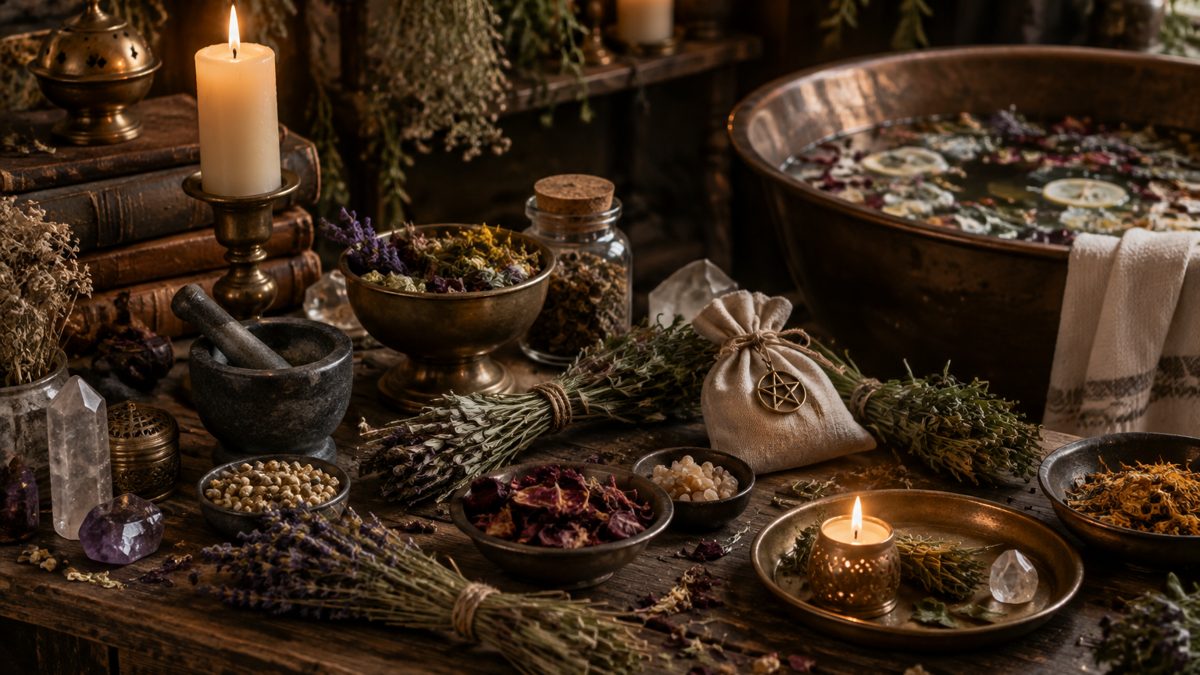
The herbs I return to most often are not rare or mysterious. They are the rosemary beside the kitchen door, the bay leaves in the cupboard, and the mint that would happily take over every pot I own. Welcome to Crossroads Journal. I’m Seraphina, and this is my guide to bringing herbs into a folk witchcraft practice with curiosity, care, and both feet on the ground.
Across many traditions, people have used plants to mark thresholds, bless households, remember the dead, celebrate seasonal changes, and give physical form to a wish. Those practices are not one universal system. Their meanings vary by place, family, religion, and practitioner. Here, I’m offering an adaptable, home-centered approach rather than claiming to reveal a single ancient rulebook.
I approach herbal magic as a practice of symbolism, attention, and belief. A charm can remind us of a boundary; a kitchen ritual can make an ordinary meal feel deliberate. Neither guarantees an outcome, and divination does not establish facts or reliably predict events. Herbal witchcraft belongs alongside practical action, never in place of appropriate professional advice or ordinary precautions.
We’ll work through gathering, drying, storing, sachets, baths, floor washes, smoke, candle arrangements, protection jars, and kitchen rituals before putting everything together in a simple ceremony. You do not need every method, a garden, or an overflowing apothecary. A few correctly identified ingredients, a clear purpose, and a willingness to leave unsafe ideas alone are more than enough.
Looking for the meaning of a single card or ingredient? Keep our Herbs in witchcraft guide open beside you.
How to Use Herbs in Witchcraft: Spells, Baths and Charms
My starting point is always the same: decide what the practice means before deciding what to buy. Are you marking a fresh beginning, expressing gratitude, remembering someone, or creating a moment to reflect on your boundaries? Write the purpose in one ordinary sentence. “I want to make my home feel thoughtfully tended” gives you a more useful starting point than an elaborate list of ingredients with no personal connection.
Wähle als Nächstes eine Pflanze, deren Duft, Geschichte, Aussehen oder alltägliche Verwendung diese Absicht unterstützt. In manchen zeitgenössischen, von der Volkstradition inspirierten Praktiken wird Rosmarin mit Erinnerung und Schutz verbunden, Lorbeer mit Wünschen oder Anerkennung und Lavendel mit Frieden. Das sind Beispiele für überlieferte Zuordnungen, nicht für messbare Eigenschaften oder allgemein geteilte Bedeutungen. Die Küchenminze deiner Großmutter kann für dich mehr bedeuten als eine Entsprechungstabelle.
I like to distinguish an inherited tradition from a personal invention. If I learned a custom from a family member, I say so. If I adapt a published practice, I keep a note of the source. If I invent a rosemary charm because its smell reminds me of home, I call it my own symbolism. That honesty makes a practice richer, not less magical.
There is also no obligation to borrow ceremonial plants or practices from communities whose teachings you do not share. Learn the context of what interests you, respect closed or restricted traditions, and avoid treating distinct cultures as a basket of interchangeable ingredients. Familiar culinary herbs can support a meaningful personal practice without pretending to carry someone else’s authority.
1. Begin with safety, not a correspondence list
A plant’s traditional magical reputation does not establish that it is safe to swallow, breathe, burn, or put on skin. The form matters too: a culinary leaf, concentrated extract, and essential oil are not interchangeable. For the beginner practices in this guide, I leave essential oils out entirely. Never ingest products labeled for incense, crafts, fragrance, or magical use, and never assume an online seller’s spiritual description is a safety assessment.
Raute verdient eine besonders deutliche Warnung. Sie ist giftig, wenn sie verschluckt wird, kann schwere Vergiftungen verursachen und heftige Hautreaktionen in Verbindung mit Sonnenlicht hervorrufen. In der Schwangerschaft ist sie besonders gefährlich. Ich empfehle Raute nicht für Bäder zu Hause, Tees, Öle, Rauch oder locker gehandhabte Zauber. Wenn sie bereits in deinem Garten wächst, vermeide Kontakt mit bloßer Haut und hole verlässlichen gärtnerischen Rat ein, bevor du sie anfasst. Ein geschriebenes Symbol kann sie im Ritual ersetzen.
Beifuß ist eine weitere Pflanze, die ich nicht unbedacht empfehlen würde. Meide ihn während der Schwangerschaft oder bei Kinderwunsch und hole fachkundigen Rat ein, bevor du ihn in der Stillzeit verwendest. Er kann außerdem allergische Reaktionen auslösen, auch bei Menschen, die auf verwandte Pflanzen empfindlich reagieren. Lass ihn in diesem Anfängerleitfaden einfach weg. Behauptungen über Träume oder Wahrsagung sind kein Grund, eine vermeidbare Belastung in Kauf zu nehmen, und Verbrennen macht ihn nicht harmlos.
Halte alle rituellen Zutaten von Kindern und Tieren fern; etwas, das ein erwachsener Mensch verträgt, kann für ein Haustier gefährlich sein. Bei Allergien, Asthma, Fragen zu Medikamenten, Schwangerschaft oder unsicherer Hautverträglichkeit wende dich an eine geeignete Fachperson oder Apotheke, statt ein Entsprechungsbuch zu befragen. Bei Verdacht auf Kontakt oder Vergiftung wende dich an deinen örtlichen Giftnotruf oder den Notdienst; bei einem Tier an eine Tierarztpraxis. Versuche kein magisches Heilmittel und löse kein Erbrechen aus, sofern du nicht dazu angewiesen wirst.
2. Sammle Kräuter respektvoll und bestimme sie mit Sicherheit
The simplest beginning is often a small packet of food-grade rosemary or bay from a reputable grocery supplier. You do not have to forage to be a “real” practitioner. If you grow herbs, retain the plant labels and learn the botanical names as well as the common ones. Common names can refer to different species, and resemblance is not enough to establish that a plant is suitable for handling or use.
When gathering outdoors, positively identify the plant using trustworthy references and, where needed, an experienced local botanist or foraging educator. Do not rely on a photograph or identification app alone. If any doubt remains, leave it standing. Avoid roadsides, sprayed areas, industrial land, and places contaminated by animal waste. Obtain permission and check local gathering restrictions; some plants and habitats are protected.
Take only a small amount from a healthy, abundant plant, leaving enough for its continued growth and for wildlife. Avoid uprooting plants or stripping every flower or seed head. For many leafy garden herbs, a dry morning after the dew has evaporated is a convenient harvesting time. Use clean scissors, remove damaged material, and keep different species separate so identification remains clear.
I sometimes pause before cutting to name what I’m gathering and why. That pause is a personal gesture of gratitude, not proof that the plant has granted permission or that harvesting has become ecologically harmless. The practical part still matters: a careful cut, a modest harvest, and an honest decision to leave a struggling plant alone. You can also honor a plant by observing it without taking anything.
3. Trockne Kräuter gründlich und führe gute Aufzeichnungen
Drying is less dramatic than spellwork, but it asks for exactly the quality I value in a practice: patient attention. Sort your harvest promptly. Discard diseased, moldy, or contaminated material rather than trying to rescue it for ritual use. For garden culinary herbs, rinse when appropriate and remove surface water thoroughly. Never assume drying will remove pesticides, toxins, or other contaminants.
Kleine, lockere Bündel geeigneter Blattkräuter können an einem trockenen, schattigen Ort mit stetigem Luftzug hängen. Ein dichtes Bündel kann in der Mitte feucht bleiben, besonders bei feuchtem Wetter. Alternativ breite die Blätter in einer einzelnen Schicht auf einem sauberen Trockengitter aus oder verwende einen Dörrautomaten gemäß seiner Anleitung für das jeweilige Kraut. Halte trocknende Pflanzen fern von Küchenfett, Haushaltssprays und neugierigen Tieren.
Leaves should be crisp rather than cool, limp, or leathery before you seal them away. Drying time varies with the plant, room humidity, and method, so a calendar alone cannot tell you when they are ready. Thick stems may retain moisture after the leaves seem dry. If a stored batch develops condensation, clumping from moisture, visible mold, or a musty smell, discard it.
Beschrifte jede Charge mit dem gebräuchlichen Namen, dem botanischen Namen, sofern bekannt, der Herkunft sowie dem Sammel- oder Kaufdatum. Füge den vorgesehenen Verwendungszweck hinzu: „lebensmitteltauglich“, „nur für äußerliche Bastelzwecke“ oder „Bestimmung unsicher – nicht verwenden“. Idealerweise gelangt unsicheres Material gar nicht erst in deinen Arbeitsschrank. Meine Etiketten sind schlicht statt malerisch, denn ich möchte sie sofort verstehen, auch an einem müden Abend, an dem alle getrockneten Blätter ziemlich gleich aussehen.
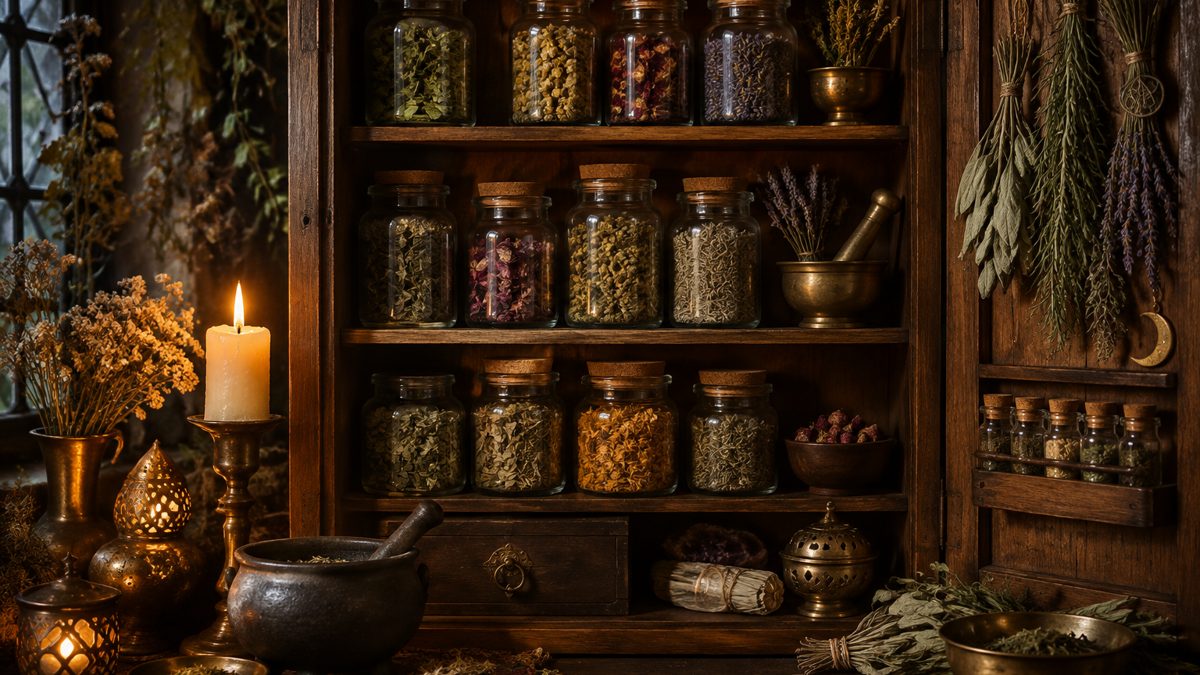
4. Build a small, well-organized herb cupboard
Store fully dried herbs in clean, dry, tightly closing containers away from sunlight, heat, and moisture. A cupboard is usually better than a windowsill or the shelf directly above a stove. Clear jars are convenient for inspection, but they still belong out of strong light. Check supplies periodically, and replace anything that shows deterioration. Older herbs may lose their scent, though age alone is not the only safety consideration.
Keep edible supplies separate from craft ingredients. Once herbs have touched candle wax, fragrance products, floor-cleaning tools, unknown decorations, or a non-food-safe vessel, they do not return to the kitchen. I use different spoons and containers for food and ritual crafts. This is especially important if a jar looks like an ordinary spice jar but contains something intended only for display.
Eine nützliche Anfängersammlung könnte Rosmarin, Lorbeer, Minze und Küchenthymian in Lebensmittelqualität enthalten, dazu Lavendel- oder Rosenblätter nur, wenn ihre Identität und der vorgesehene Verwendungszweck klar gekennzeichnet sind. Blumen vom Floristen sind nicht automatisch für Speisen oder Bäder geeignet. Wähle Zutaten für tatsächlich geplante Anwendungen, statt jede in einem Buch erwähnte Pflanze zu sammeln. Drei vertraute Kräuter, mit Bedacht verwendet, sind besser als dreißig Gläser, die du nicht sicher bestimmen kannst.
Keep a simple notebook beside your supplies. Record what you used, its source, the symbolic association you chose, and any practical observations. “The sachet shed dust” is useful. So is “I disliked this scent.” If you record dreams or draw a divination card, describe the interpretation as reflection, not evidence that an herb caused an event or revealed another person’s intentions.
5. Make sachets and charm bags with clear intentions
A sachet is a small fabric container for dried material; a charm bag gives that object an explicitly symbolic purpose. I like them because they can be simple, portable, and free of flame. Choose a tightly woven pouch that will not readily shed dust. Avoid powdered herbs, sharp stems, and long dangling cords. Even a securely closed pouch must stay out of reach of children and pets.
Für einen einfachen Haushaltszauber nimm eine Prise getrockneten Rosmarin und ein kleines Stück Papier mit einem Satz wie „Möge ich klare und besonnene Grenzen pflegen.“ Lorbeer kann eine optionale Ergänzung sein, wenn er dir etwas bedeutet, aber ein Kraut genügt. Die Worte drücken eine Hoffnung und eine Selbstverpflichtung aus; sie errichten keine übernatürliche Barriere und ersetzen weder Schlösser und Alarmanlagen noch andere praktische Schutzmaßnahmen.
Halte den geschlossenen Beutel einen Moment in der Hand und denke über die Handlung nach, die mit dem Wunsch verbunden ist. Vielleicht hörst du auf, beim Abendessen Arbeitsnachrichten zu beantworten, oder hältst deinen Eingangsbereich leichter begehbar. Lege den Talisman an einen passenden Ort, den neugierige Hände oder Pfoten nicht erreichen, statt ihn in Bettzeug oder auf die nackte Haut zu legen. Stecke lose pflanzliche Talismane nicht ohne Zustimmung in eine Wiege, ein Tierbett oder die Sachen einer anderen Person.
Check the bag occasionally for moisture, broken seams, insects, and irritating dust. Retire it whenever it no longer serves a purpose; there is no mandatory magical expiry date. Dispose of the contents according to their materials and local waste guidance. Keeping herbs, paper, and fabric separate at the beginning makes this easier. You do not need to bury a charm or leave it outdoors to complete the practice.
- Choose one intention and write it in a single sentence.
- Gib eine kleine Prise eines vertrauten, korrekt bestimmten getrockneten Krauts in ein unversehrtes Stoffbeutelchen.
- Lege deine schriftlich festgehaltene Absicht hinein, verschließe das Beutelchen sicher und verbinde es mit einer praktischen Handlung.
- Platziere es sicher und prüfe seinen Zustand regelmäßig.
6. Prepare ritual baths without treating the tub like a cauldron
Ein rituelles Bad kann ein gewöhnliches Bad sein, begleitet von einer gewählten Absicht. Kräuter sind optional. Tatsächlich ist ein geschlossenes Kräuterglas, sicher auf einem Regal außerhalb der Spritzzone, die Möglichkeit mit der geringsten Belastung, ihre Symbolik einzubeziehen. Wenn du empfindliche Haut, Allergien, verletzte Haut, eine relevante Erkrankung oder Unsicherheit bei einer Zutat hast, wähle schlichtes Wasser, statt mit einer Kräuterzubereitung zu experimentieren.
Wenn du dich für Kontakt mit Pflanzen entscheidest, verwende nur eine korrekt bestimmte Zutat, die du bereits verträgst und die laut verlässlicher Quellen für die äußerliche Anwendung geeignet ist. Lebensmittelqualität allein belegt keine Hautverträglichkeit. Ein Test an einer kleinen Stelle kann Reizungen aufdecken, garantiert aber nicht, dass ein ganzes Bad sicher ist, und schließt eine spätere Allergie nicht aus. Gib weder Raute noch Beifuß, ätherische Öle, unbekannte Mischungen oder konzentrierte Extrakte hinzu.
A strained, cooled infusion avoids the loose leaves that cling to skin and clog drains. Prepare a weak infusion with the chosen suitable herb in a separate clean vessel, strain it carefully through fine cloth, and add only a modest amount to comfortably warm water. Make it fresh and discard leftovers. Do not use boiling water in the bath, and stop immediately if you notice burning, itching, dizziness, or breathing discomfort.
Keep candles away from the tub, avoid glass vessels on slippery edges, and remember that plant residue or added products can make surfaces slippery. Never add oils as a default ritual ingredient. I prefer to mark the beginning with a spoken sentence and the ending by rinsing, drying, and putting on clean clothes. A shower with a symbolic herb kept outside the water works just as well for this purpose.
7. Nutze Bodenwaschungen als symbolische Pflege des Hauses
Floor washing has a place in several distinct folk and spiritual traditions, with different materials, prayers, and directions of movement. My personal version is simply ordinary cleaning paired with deliberate reflection. Some practitioners move toward a door when symbolically releasing something, or inward when welcoming something. Those directions are conventions within a practice, not universal laws you must obey.
Clean according to the flooring manufacturer’s instructions first. An herbal infusion is not a disinfectant, and it may stain surfaces, leave residue, or damage finishes. Wood, unsealed stone, and specialty flooring can be particularly unforgiving. The safest adaptation is to use your usual compatible cleaning method while keeping the herbs in a closed jar nearby. You retain the symbolism without adding an uncertain substance to the floor.
If the surface guidance permits a particular water-based preparation and you still wish to use one, make it weak, strain it thoroughly, and test an inconspicuous spot. Avoid loose leaves and oils. Never mix homemade washes with bleach, ammonia, or other cleaning products, and do not assume vinegar is suitable for every surface. Keep people and animals away until the floor is dry and any required rinsing is complete.
As I clean, I name the ordinary task behind the ritual: making a room usable, removing tracked-in dirt, or creating a clear entrance. That language prevents “cleansing” from becoming a claim that unseen danger has been objectively removed. Dispose of wash water appropriately for its contents and local guidance, not into a stream or garden as a ceremonial offering. Responsible cleanup is part of the practice.
8. Approach incense and smoke cleansing with restraint
Smoke cleansing is a broad description for practices that use smoke symbolically; it should not erase the specific names, histories, or restrictions of particular ceremonies. I describe a personal household practice plainly rather than borrowing a culturally specific title. Herbs do not need to be burned to be meaningful, and smoke does not disinfect a room or demonstrate that an unwanted presence existed.
All smoke introduces particles and combustion products into the air. Good ventilation does not make exposure harmless. Avoid indoor burning around children, pregnant people, anyone with asthma or other respiratory sensitivities, and animals; birds are especially vulnerable. If you share a home, ask the other occupants before using fragrance or smoke. Their comfort and consent matter more than finishing your planned ritual.
For beginners, I recommend a smoke-free substitute rather than loose herbs on charcoal. Charcoal brings additional heat and carbon monoxide concerns. Do not burn unknown plants, treated decorations, poisonous herbs, essential oils, or kitchen mixtures simply because a recipe calls them “cleansing.” If you use a product intended for incense, follow its directions, use a stable heat-resistant holder and protective surface, and keep it clear of anything combustible.
Never leave burning material unattended, carry smoldering herbs through cramped rooms, disable smoke alarms, or put warm ash into the bin. Extinguish everything fully and confirm it is cold. My favorite substitute is to open a window when conditions allow, tidy a small area, and ring a bell or read an intention. You can also simply sit with a labeled, closed herb jar and let the plant’s meaning be enough.
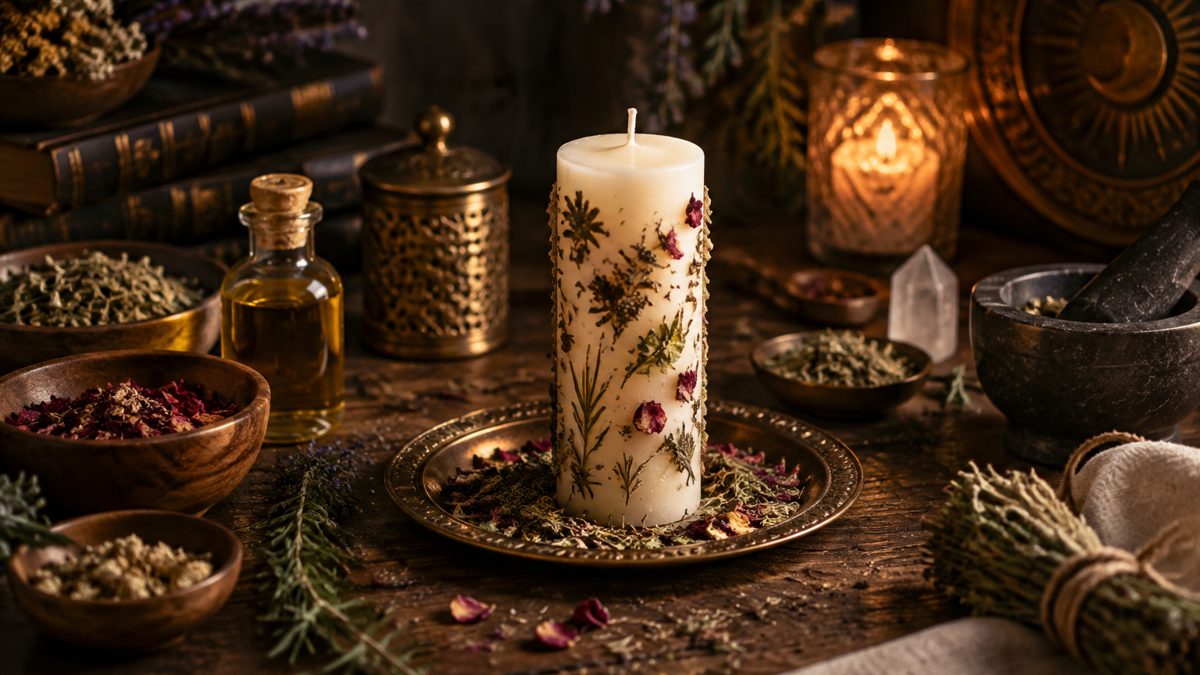
9. Dress a candle ritual without adding a fire hazard
Herbal candle dressing often means coating a candle with oil and rolling it in dried plant material. I do not recommend that method. Dried herbs can ignite, act as additional wicks, and produce unpredictable flames. Plant fragments dropped into melted wax can also become fuel. A candle sold with decorative botanicals is not automatically safe just because it was commercially made.
Instead, dress the ritual setting rather than the candle itself. Use a plain candle in a suitable holder on a stable, heat-resistant surface, following the manufacturer’s instructions and clearances. Keep the herbs in a separate closed container well away from the flame and heat. Do not make a ring of dried leaves around the holder, scatter petals on the candle plate, or place a paper petition beneath a hot vessel.
Eine flammenlose LED-Kerze macht dies noch einfacher. Stelle sie neben ein Kräuterglas und eine schriftliche Absicht, mit Batterien, die vor Kindern und Haustieren gesichert sind. Das ist meine bevorzugte Anordnung, wenn das Ritual Einkehr, geschlossene Augen oder längeres Schreiben umfasst. Die Aufmerksamkeit schweift bei reflektierender Arbeit natürlich ab, und genau deshalb sollte eine offene Flamme keine unerlässliche Voraussetzung sein.
If you choose a real candle, remain present, keep it clear of drafts and anything combustible, and extinguish it before leaving or becoming sleepy. There is no need to let it burn down completely. Ending a ritual early for safety does not spoil its symbolic purpose. Nor should a flickering flame or cracked container be interpreted as proof of a message; address the physical hazard first.
10. Assemble a dry protection jar and plan its retirement
A protection jar can be a visual reminder of the boundaries and habits you want to maintain. For this guide, keep it dry and uncomplicated: a small, clean container, a pinch of rosemary, an optional bay leaf, and a folded note. You might write, “This home is a place where I practice care and clear limits.” These ingredients express a belief or intention; they do not provide a guaranteed protective effect.
Avoid adding bodily fluids, fresh plants, food scraps, liquids, sharp objects, or unidentified minerals. Wet organic mixtures can spoil, grow mold, or ferment and build pressure in a sealed container. Nails, needles, and broken glass create handling and disposal hazards without being necessary to the symbolism. There is also no reason to seal the lid with hot wax; an ordinary secure closure is sufficient.
Place the jar where it will not fall, overheat, or attract a child or pet. A nonbreakable container may be the better choice in a busy household. Pair the ritual with a concrete check: is the doorway clear, are important contacts easy to find, and have you communicated the boundary you wrote down? The jar can remind you to act, but it cannot take those actions for you.
Decide at the beginning how you will retire the object. You can empty it into appropriate household waste and clean the reusable container. Compost only suitable, uncontaminated plant material if your compost system accepts it; remove paper, string, salt, and other additions as needed. Do not bury jars, leave them in public places, or throw them into water. A quiet ending at home is entirely sufficient.
11. Bring herbal symbolism into everyday cooking
In der Küchenhexerei fühlt sich Kräuterritual für mich am natürlichsten an. Sie kann so schlicht sein, wie Rosmarin zu Ofengemüse zu geben und dabei an die Menschen zu denken, die du willkommen heißen möchtest, oder Minze in ein vertrautes Rezept zu rühren, um eine neue Jahreszeit zu markieren. Die symbolische Ebene verändert die physikalischen Eigenschaften des Essens nicht und sollte niemals eine unsichere Menge einer Zutat erfordern.
Use only correctly identified, food-grade herbs in ordinary culinary quantities and recipes appropriate to them. Follow normal food hygiene, storage, and temperature guidance. Do not cook with herbs taken from charm bags, incense supplies, bath mixtures, or decorative bouquets. “Natural” is not a food-safety category, and a plant’s association with abundance or love does not establish that it belongs in dinner.
Achte auf alle, die die Mahlzeit essen. Prüfe Allergien, Vorlieben und relevante Ernährungseinschränkungen und sei transparent bei den Zutaten. Entferne ganze Lorbeerblätter vor dem Servieren, da ihre steifen Kanten Erstickungs- oder Verletzungsgefahr bergen können. Gib keine Kräuter heimlich hinzu und stelle ein gemeinsames Gericht nicht als Zauber dar, der das Einverständnis eines Menschen überwinden soll. Gastfreundschaft ist eine weit tragfähigere Grundlage, als die Gefühle eines Gastes kontrollieren zu wollen.
Avoid improvising shelf-stable herb-infused oils, particularly with fresh herbs or garlic; improperly prepared and stored oils can present a botulism risk. Use a tested food-safety recipe and its exact storage instructions, or choose a simpler dish. My favorite kitchen ritual needs no preserved preparation at all: cook something familiar, pause before serving, and name one thing you appreciate about the work that brought the food to the table.
12. Try a simple threshold ritual, then reflect
Hier ist ein rauch- und flammenfreies Ritual, das den Leitfaden zusammenführt. Sein Zweck ist es, einen frischen Anfang im Zuhause zu markieren, nicht Schutz zu garantieren oder eine objektiv belegte spirituelle Bedrohung zu beseitigen. Du brauchst ein kleines, beschriftetes Glas mit getrocknetem Küchenrosmarin, ein Stück Papier, einen Stift und ein Tuch, das sich zum Reinigen deiner Türschwelle eignet. Lass das Kraut die ganze Zeit in seinem geschlossenen Glas.
Choose a time when you can work without rushing. If the doorway is shared, respect other people’s access and belongings. Begin with the ordinary task of clearing clutter and wiping the appropriate surface according to its care instructions. You are not making the entrance ritually perfect. You are giving a small, useful job your full attention and allowing it to represent something larger.
When the steps are finished, spend a few minutes writing about the experience. Did the process help you clarify what “welcome” or “boundary” means to you? Was there a practical task you had been avoiding? These observations are more useful than searching for signs that the ritual worked. If you use divination afterward, treat the result as a prompt for reflection rather than an instruction or factual prediction.
That is the kind of herbal witchcraft I hope to make room for at Crossroads Journal: curious, personal, grounded, and willing to be simple. You may eventually explore a particular regional or family tradition in greater depth, with careful sources and appropriate teachers. For now, one familiar herb and one honestly chosen action are enough. Let the ritual support the life you actually live.
- Räume den Eingangsbereich frei, ohne Ausgänge zu versperren, und reinige eine geeignete Fläche nach der dafür empfohlenen Methode.
- Set the closed rosemary jar on a stable surface away from the doorway’s traffic, children, and pets.
- Write one intention, such as “I will make room for welcome while respecting my limits.”
- Lies den Satz laut oder still. Bedenke die Bedeutung des Rosmarins in deiner Praxis, ohne diese Zuordnung als versprochene Wirkung zu behandeln.
- Choose one achievable action that expresses the intention: put away shoes, establish a visiting preference, or make space for a guest’s coat.
- Führe die Handlung zu Ende, verstaue das Glas sicher und bewahre das Papier auf oder gib es ins Recycling, wie du es möchtest. Das Ritual ist abgeschlossen.
These practices are shared as tradition and personal reflection, not as a substitute for medical, legal or financial advice.
Weiterlernen
- Herbs in witchcraft
- How to read tarot cards
- How to use angel oracle cards
- So liest du Spielkarten
- So verwendest du Kristalle in Zaubern
- So verwendest du Kräuter in der Hexerei
- How to read the Dr. Moorne Egyptian Tarot
- How to read dice
- How to read tea leaves
- So benutzt du ein Pendel
- Wie man einen Kerzenzauber wirkt
- How to make a spell jar
- How to make a sigil
- How to cleanse your home
- How to set up an ancestor altar
- How to open a sacred space
- How to time spells with the moon
- How to work with water and salt
- How to make a protection charm bag
- Read the Journal oder besuche die shops