How-To Guide
Wie man in Zaubern mit Wasser und Salz arbeitet
Von Seraphina

Water and salt are ordinary materials with a long place in human ritual life. Water washes, nourishes, carries, and changes shape; salt seasons, preserves, and, in some traditions, represents protection or lasting commitment. Those everyday qualities help explain their symbolic appeal. Working with them can be a simple way to mark a fresh start, establish a personal boundary, or give focused attention to something you want to change.
This guide treats spellwork as tradition, belief, and personal practice, not as a proven way to control events or other people. Some practitioners understand a ritual as spiritual work; others use it as a symbolic exercise that helps them reflect and act deliberately. You do not need to settle every question about how magic works before making a meaningful ritual. You do need realistic expectations and a willingness to support your intention with practical action.
The approach here is deliberately modest: a bowl, clean water, a small amount of salt, and a clear purpose. Elaborate tools, rare ingredients, paid services, and strict lunar timing are optional, not requirements. We will look at historical context, preparation, a complete method, and a worked example, then consider results, mistakes, safety, and recordkeeping. The companion reference page, Water and Salt Magic, can sit alongside this practical guide as a place to revisit the broader subject.
Above all, let care guide the work. A ritual should not leave damaged plants, a frightened household, an injured pet, or a feeling that you must keep repeating it to prevent disaster. The most useful practice is one you can perform safely, adapt honestly, and finish without fear. Think of the water as an invitation to move and the salt as an invitation to choose what deserves to remain.
Looking for the meaning of a single card or ingredient? Keep our Water and salt magic guide open beside you.
1. Understand the history without flattening the traditions
Water appears in religious and folk practices across many regions, but its meanings are not interchangeable. Christian baptism, Jewish immersion in a mikveh, Islamic ablution, and Hindu bathing practices belong to distinct theological and communal settings. They are not simply versions of a universal cleansing spell. Learning about them can deepen respect for ritual water without turning a living religious practice into an ingredient for an unrelated personal ceremony.
Salt also has varied histories. Its practical importance in preserving food and sustaining households helps explain why it can signify endurance, hospitality, or protection. Salt appears in some European household customs and folk practices, including certain practices described as Slavic. However, there is no single Slavic salt ritual, and customs differ by locality, family, period, and religious background. Be cautious when a modern source presents one recipe as an unchanged ancient rule.
Contemporary witchcraft often combines water and salt for symbolic cleansing, consecration, or boundary setting. Particular correspondences, such as water with emotion or salt with earth, are useful within some systems but are not universal facts. If you inherit a practice, identify its source as clearly as you can. If you create your own, call it a personal adaptation. Honest attribution gives a ritual firmer foundations than an impressive but unsupported origin story.
2. Wähle einen Zweck und definiere, was Erfolg bedeutet
Start with an intention that concerns your own choices, space, or conduct. Suitable examples include ending the workday deliberately, preparing for a difficult conversation, or establishing a calmer bedtime routine. An intention such as making someone love you shifts attention toward controlling another person. Reword it around what is yours to do: communicating honestly, meeting people respectfully, or recognizing a relationship that is not right for you.
Halte den Zweck klein genug, um ihn in Handlung zu übersetzen. Jeden negativen Einfluss aus deinem Leben zu reinigen ist zu breit, um es zu bewerten, und kann ängstliches Absuchen nach Bedrohungen fördern. Deinen Schreibtisch aufzuräumen und die erste Aufgabe für morgen festzulegen ist konkret. Spirituelle Sprache kann trotzdem zählen: Du könntest das Ritual als Willkommen für Klarheit beschreiben und zugleich das sichtbare Verhalten benennen, das es begleitet. Symbolik und gewöhnliches Problemlösen müssen nicht miteinander konkurrieren.
Before gathering materials, write down what would count as a useful outcome and when you will review it. You might hope to feel ready to stop answering work messages tonight, then check whether you followed through. A feeling of relief is worth noticing, but it does not prove that an outside force changed. Defining success beforehand helps prevent every pleasant coincidence, setback, or cloudy patch of water from becoming evidence for a preferred explanation.
3. Gather simple, suitable materials
For the basic method, use a stable bowl, a little clean water, ordinary food-grade salt, a spoon, a tray or towel, and a notebook. Glass or glazed ceramic is usually convenient, provided the vessel is intact and suitable for holding water. A small pinch of salt is enough for symbolic work. There is no established magical advantage to making the mixture strongly saline, and using less makes cleanup easier.
Leitungswasser ist in der Regel die einfachste Wahl, wo die örtliche Versorgung sicher ist. Trinkwasser aus der Flasche ist bei Bedarf eine Alternative. Regen-, Fluss-, Meer- und Teichwasser kann Mikroorganismen oder Schadstoffe enthalten, auch wenn es klar aussieht. Du brauchst sie nicht, damit ein Ritual bedeutsam wird. Meersalz, Steinsalz und Speisesalz können jeweils einem persönlichen symbolischen Zweck dienen; jodiertes Salz ist nicht spirituell mangelhaft. Produktqualität und Erschwinglichkeit sind wichtiger als dramatische Beschriftungen.
Optional materials might include a written intention or an electric candle. Avoid adding ingredients merely because a recipe sounds incomplete without them. Herbs can irritate skin, trigger allergies, or endanger pets, and essential oils do not dissolve safely into plain water. Bath salts and cleaning salts are not substitutes for food-grade salt in this method. Never assume that a crystal, metal charm, or antique vessel is safe to soak; salt water can damage objects and encourage corrosion.
4. Prepare the place and yourself
Choose a surface that will not be damaged by an accidental splash, and place the bowl on a tray. Move electronics, important papers, and delicate objects away. If your intention concerns a doorway, keep the bowl on a nearby table rather than on the floor, where someone might kick it. You do not need to scatter salt across a threshold. A contained representation of a boundary avoids residue, slipping hazards, and damage to finishes.
Ordinary cleaning comes first. Wipe the surface, wash your hands, and deal with anything that needs practical attention. Ritual water is not a disinfectant, and it does not replace appropriate cleaning products or their instructions. If you are sharing the space, ask before using common surfaces or moving belongings. Choose a time when a short interruption will not create tension, and keep children and animals from accessing the materials.
Prepare your attention without demanding a special state. You can sit, stand, keep your eyes open, or use silent words. Take a few comfortable breaths, but avoid forced breathwork or holding your breath. If body-focused exercises feel unpleasant, simply describe the objects in front of you. Being distracted does not invalidate the work. The aim is enough attention to make a deliberate choice, not perfect concentration or a dramatic sensation.
- 1. Clear a small surface and set down a tray or washable towel.
- 2. Stelle die saubere Schüssel, das Wasser, das Salz, den Löffel und das Notizbuch griffbereit hin.
- 3. Beseitige Gefahrenquellen und vergewissere dich, dass die anderen Haushaltsmitglieder jeder Aktivität in gemeinsam genutzten Räumen zustimmen.
- 4. Read your intention once and identify the practical action that will follow.
- 5. Pause briefly, then begin when you feel ready enough rather than perfectly ready.
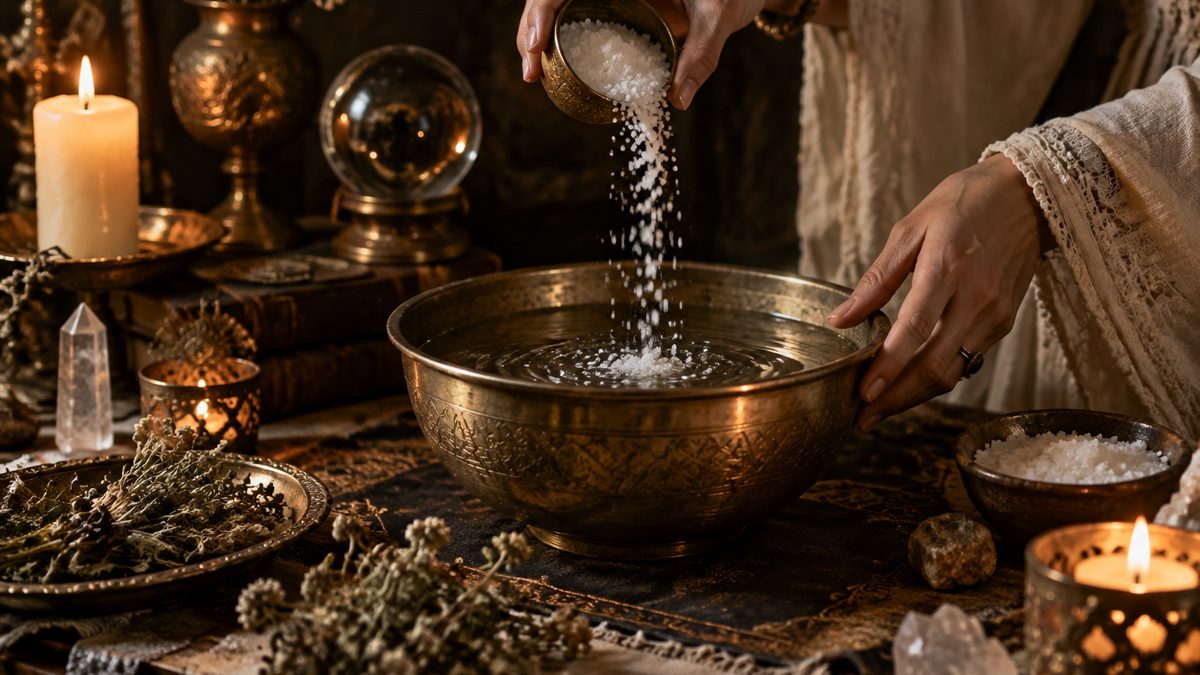
5. Führe den grundlegenden Wasser-und-Salz-Zauber durch
Bei dieser Methode steht Wasser für Bewegung oder Erneuerung und Salz für Beständigkeit oder eine bewusst gewählte Grenze. Das sind vorgeschlagene Bedeutungen, keine verpflichtenden Entsprechungen. Wenn deine Tradition sie anders zuordnet, passe die Erklärung an, statt einen Widerspruch zu erzwingen. Wichtig ist, dass du weißt, was jede Geste für dich bedeutet. Ein paar stimmige Handlungen sind meist hilfreicher als eine lange Abfolge, die ohne Verständnis übernommen wurde.
The spoken words below are newly written examples for this guide, not a historical charm. Replace them freely, or work silently. Likewise, stirring clockwise or counterclockwise has particular meanings in some traditions, but neither direction is required here. Stir simply to dissolve the salt. You are not trying to create a special chemical state or prove that the mixture has acquired supernatural properties.
Keep the water in the bowl throughout the procedure. Touching it, drinking it, sprinkling a room, or applying it to the body is unnecessary. This contained method makes the practice accessible to people with sensitive skin and reduces household damage. When you finish, let the ritual end. You do not have to wait for a sign, repeat the words until they feel perfect, or leave the bowl standing overnight.
- 1. Pour about half a cup of clean water into the bowl.
- 2. State your purpose in one sentence, such as, I am making room for a calmer evening.
- 3. Consider the water as a symbol of the change you are willing to make.
- 4. Add one small pinch of food-grade salt, naming the boundary or commitment you want to keep.
- 5. Stir gently until most or all of the salt dissolves, without treating any remaining grains as an omen.
- 6. Rest your attention on the bowl for a minute and picture yourself carrying out your chosen action.
- 7. Say a closing sentence, such as, This practice is complete; my next step is mine to take.
- 8. Carry out the practical action, dispose of the mixture appropriately, and wash and dry the equipment.
6. Worked example: leave the workday behind
Stell dir vor, du arbeitest zu Hause und prüfst nach dem Abendessen immer wieder Nachrichten, obwohl deine Arbeit keine Erreichbarkeit am Abend verlangt. Du wünschst dir einen Übergang zwischen bezahlter Arbeit und Privatzeit. Die Absicht ist nicht, dass sich dein Arbeitgeber anders verhält oder dass die Nacht friedlich wird. Sie soll eine Entscheidung stützen: notwendige Aufgaben beenden, deine Erreichbarkeit angemessen kommunizieren und aufhören, aus Gewohnheit Arbeitsprogramme erneut zu öffnen.
Stelle die Schüssel auf die Küchenarbeitsfläche, fern von der Essenszubereitung, statt neben deinen Computer. Schreibe vor dem Beginn die erste Aufgabe für morgen auf ein separates Blatt. Lass das Wasser den Übergang in den Abend darstellen und das Salz die Grenze um deine Aufmerksamkeit. Ein passender eigener Satz lautet: Meine Arbeit hat ihren Platz, und meine Ruhe hat ihren Platz. Ich kehre zu der Zeit zurück, die ich gewählt habe.
The meaningful follow-through is practical: close the laptop, mute nonessential notifications, and move into another activity. Adapt the boundary if you have agreed on-call responsibilities; a ritual should not encourage you to neglect safety or contractual duties. Later, note whether the transition helped and what interrupted it. If you still felt restless, that is information about your habits or workload, not proof that the spell failed or someone opposed it.
- 1. Vergewissere dich, was wirklich noch abgeschlossen werden muss, und notiere die erste Aufgabe für morgen.
- 2. Bereite das Wasser und die Prise Salz nach der Grundmethode zu.
- 3. Speak your boundary and name the time you intend to return to work.
- 4. Close work applications and adjust notifications within your actual responsibilities.
- 5. Empty and wash the bowl, then begin a specific evening activity.
- 6. Review the experience the next morning without judging yourself for every distraction.
7. Passe die Methode an, ohne unnötige Komplexität hinzuzufügen
For a personal fresh start, let the water represent movement away from an unhelpful routine and the salt represent one commitment you want to retain. Pair the ritual with changing the environment: remove a distracting shortcut, lay out walking shoes, or schedule a manageable task. Avoid framing yourself as dirty or spiritually contaminated. A renewal practice can acknowledge fatigue, mistakes, or grief without turning ordinary human experiences into impurity.
For a household boundary, keep the bowl near the area you are considering while you clarify a shared agreement. That might mean quiet hours, privacy, or a workable cleaning schedule. Do not secretly sprinkle another person's room or belongings. If household members do not want ritual involvement, use the practice privately to prepare for a respectful conversation. A boundary becomes workable through communication and consent, not through symbolism alone.
For remembrance, the water might stand for changing feelings and the salt for what remains important. Place a written memory beside the bowl, not inside it, and give yourself a few minutes to reflect. You do not need to seek contact with the dead or interpret sensations as messages. If grief becomes overwhelming, stop, do something grounding, and seek support. A ritual can accompany care from friends, community, or professionals, but should not replace it.
8. Decide whether timing, water sources, and correspondences help
Some practitioners favor a waning moon for release, a waxing moon for growth, or sunrise for beginnings. These are symbolic conventions within particular modern and inherited practices, not proven conditions for effectiveness. Use them if they enrich your experience without creating pressure. A calm Tuesday afternoon when you have privacy may be more useful than a midnight observance that disrupts sleep or leaves you too tired to clean up.
Water collected from a meaningful place may carry personal associations, but collecting it can raise safety, ecological, and access concerns. Observe local rules, avoid protected or culturally restricted sites, and never enter dangerous water to obtain an ingredient. There is no need to take water from a sacred source belonging to another community. A photograph, memory, or written place-name beside a bowl of tap water can express a connection without extraction.
Wenn du Wasser als persönliche Observanz Mond- oder Sonnenlicht aussetzt, halte es abgedeckt und eindeutig beschriftet, nur für den rituellen Gebrauch. Die Belichtung desinfiziert Wasser nicht, und direktes Sonnenlicht kann je nach Platzierung Behälter erhitzen oder andere Gefahren schaffen. Eine Fensterbank im Innenraum ist optional, keine Voraussetzung. Bewahre zubereitetes Wasser nicht unbegrenzt auf, weil du fürchtest, seine Bedeutung zu verlieren. Du kannst den Sinn in einem Tagebuch festhalten und beim nächsten Mal eine frische Mischung herstellen.
9. Interpret results with curiosity and restraint
Unterscheide zuerst Beobachtungen von Deutungen. Eine Beobachtung könnte sein, dass dein Atem leichter wurde, du das Aufräumen des Tisches beendet hast oder eine Stunde lang nicht aufs Handy geschaut hast. Eine Deutung könnte sein, dass das Ritual dir half, dich verbunden zu fühlen. Eine stärkere Behauptung, etwa dass das Wasser einen äußeren Einfluss entfernt hat, lässt sich durch diese Beobachtungen nicht belegen. Du kannst ein spirituelles Verständnis achten und zugleich klar benennen, was die Erfahrung zeigt und was nicht.
Changes in the bowl usually have ordinary explanations. Bubbles may be trapped air; cloudiness can come from additives, minerals, or residue; crystals can form as water evaporates. Salt dissolves differently depending on temperature, grain size, and concentration. None of these effects reliably diagnoses a curse, predicts danger, or reveals another person's intentions. If a pattern inspires reflection, use it as a prompt rather than an instruction you must obey.
Review outcomes over the period you chose beforehand. Consider sleep, stress, conversations, practical changes, and chance alongside the ritual. No noticeable result is a valid entry, and an unpleasant day afterward is not evidence of backlash. If interpreting signs makes you increasingly fearful, suspicious, or unable to make decisions without another ritual, pause the practice. Talk with someone grounded and trustworthy, and seek mental health support if the distress persists or interferes with daily life.
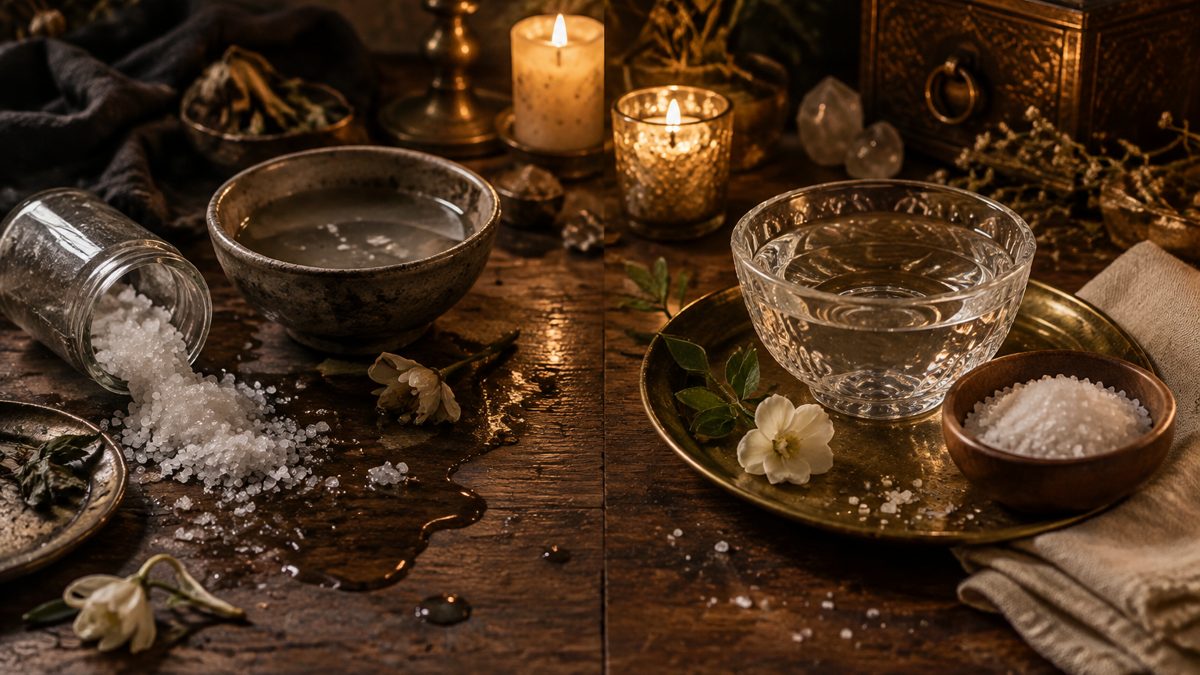
10. Recognize common mistakes and make simple corrections
Ein häufiger Fehler ist die Annahme, mehr Zutaten ergäben stärkere Arbeit. Zusätzliches Salz hinterlässt mehr Rückstände, zusätzliche Kräuter erschweren die Entsorgung, und mehrere Absichten machen die Reflexion schwerer. Kehre zu einer Schale, einer Prise, einem Zweck und einer praktischen Handlung zurück. Ebenso sind teures Salz oder eine besondere Flasche nicht nötig. Wähle Materialien, die du dir leisten und sicher handhaben kannst, statt das Einkaufen als Voraussetzung für spirituelle Ernsthaftigkeit zu betrachten.
Another mistake is mixing instructions from unrelated traditions without noticing their context. A prayer, direction of stirring, or sacred name may mean something specific in its original setting. You do not have to assemble every appealing detail into one ceremony. Read carefully, identify what you actually practice, and leave out elements you do not understand or have no appropriate basis to use. A plainly described personal ritual is enough.
Perfectionism can also turn a short practice into a burden. Spilling water, forgetting a line, or being interrupted does not require a corrective spell. Clean up, decide whether to continue, and finish normally. Avoid repeating the ritual whenever you feel uncertain; reassurance can become a loop rather than a resolution. If you set a repetition schedule, keep it modest and optional, and change the underlying plan when repeated ritual is substituting for needed action.
11. Gehe sicher mit Wasser, Salz, Kräutern und Feuer um
Keep ritual mixtures out of reach of children and animals, and do not drink them. Food-grade starting ingredients do not make a bowl left out for ritual safe to consume. Never use salt water to induce vomiting or treat an illness. Avoid application to eyes, wounds, mucous membranes, or irritated skin. This guide does not require bathing or skin contact; leaving the water in its bowl is a complete method.
Leave herbs and essential oils out unless you have researched the specific ingredient and exposure route. Natural does not mean harmless, and some plants and oils pose particular risks to pets, pregnancy, or people with allergies. Avoid unidentified plants, concentrated extracts, and any ingestion of ritual preparations. Do not add bleach, ammonia, or household cleaners, and never mix cleaning products. Ritual cleansing and hygienic cleaning are separate activities with different purposes.
An electric candle is the easiest lighting option. If you use a flame, place it in a stable, heat-resistant holder away from curtains, paper, sleeves, and dried plants. Never leave it unattended. Keep the water bowl separate from electrical equipment, and wipe spills promptly. Salt water can corrode metal, mark wood and stone, damage finishes, and harm plants. Do not pour it into plant pots or scatter salt on lawns, garden beds, or outdoor thresholds.
12. Respect consent, limits, and responsible disposal
Ethical spellwork begins with recognizing that your wishes do not override another person's autonomy. Avoid putting ritual mixtures in anyone's food, drink, bath, or personal space without informed permission. Even a well-meant blessing can be intrusive if it involves unwanted substances or spiritual participation. For someone who has asked for support, agree on what you will do and keep promises realistic. You can offer care without guaranteeing protection, reconciliation, healing, or a specific result.
Keep practical protections in place. A boundary ritual does not replace locks, a safety plan, legal advice, medical treatment, or professional help. If someone threatens you, respond to the real-world risk rather than relying on salt at a doorway. Be equally cautious about sellers who claim that only an urgent purchase can remove a curse or prevent disaster. Price, elaborate language, and dramatic certainty are not evidence of spiritual authority or effectiveness.
For the small, lightly salted mixture in this guide, disposal into a household sink connected to sanitary wastewater is generally appropriate, with a little fresh water afterward; follow local restrictions and system guidance. Do not pour it into a storm drain, stream, pond, or soil. Remove any solids first and dispose of them according to what they are. Leaving jars, salt, herbs, or offerings outdoors is not automatically respectful or environmentally harmless. Washing the bowl is a sufficient closing act.
13. Keep a useful journal and build a sustainable practice
A journal is most helpful when it records enough detail to reveal patterns without becoming a catalogue of omens. Note the date, intention, ingredients, approximate amounts, actions, and your mood before and after. Record relevant circumstances, such as poor sleep or an important conversation. If you adapted a source, name it. If you invented the practice, say so. These ordinary details make later reflection more reliable than a polished account written from memory.
Include the practical outcome and what you would change. Perhaps the bowl helped you pause, but the spoken words felt awkward; next time, use silence. Perhaps you felt calm during the ritual but still needed to renegotiate an unrealistic workload. That is useful learning, not spiritual failure. Review several entries together before drawing conclusions, and do not credit the ritual for every improvement while blaming yourself for every setback.
Over time, keep the parts that support attention, care, and responsible action. Let unnecessary rules fall away, and take breaks whenever the practice becomes demanding or fearful. There is no obligation to maintain a streak or repeat a ceremony to keep ordinary misfortune away. Water and salt can provide a small, meaningful structure for change: name what matters, mark the choice, clean up, and return to life prepared to do your part.
- 1. Halte vor dem Ritual eine Absicht, deine aktuelle Stimmung und die praktische Handlung fest, die du planst.
- 2. Afterward, describe what actually happened, separating observations from spiritual interpretations.
- 3. At your chosen review time, note the outcome and any ordinary factors that influenced it.
- 4. Choose one adjustment, or decide that no further ritual is needed.
- 5. Store the journal privately if it contains sensitive information about you or other people.
These practices are shared as tradition and personal reflection, not as a substitute for medical, legal or financial advice.
Weiterlernen
- Water and salt magic
- How to read tarot cards
- How to use angel oracle cards
- So liest du Spielkarten
- So verwendest du Kristalle in Zaubern
- So verwendest du Kräuter in der Hexerei
- How to read the Dr. Moorne Egyptian Tarot
- How to read dice
- How to read tea leaves
- So benutzt du ein Pendel
- Wie man einen Kerzenzauber wirkt
- How to make a spell jar
- How to make a sigil
- How to cleanse your home
- How to set up an ancestor altar
- How to open a sacred space
- How to time spells with the moon
- How to work with water and salt
- How to make a protection charm bag
- Read the Journal oder besuche die shops