How-To Guide
How to Use Angel Oracle Cards: A Step-by-Step Guide
Von Seraphina
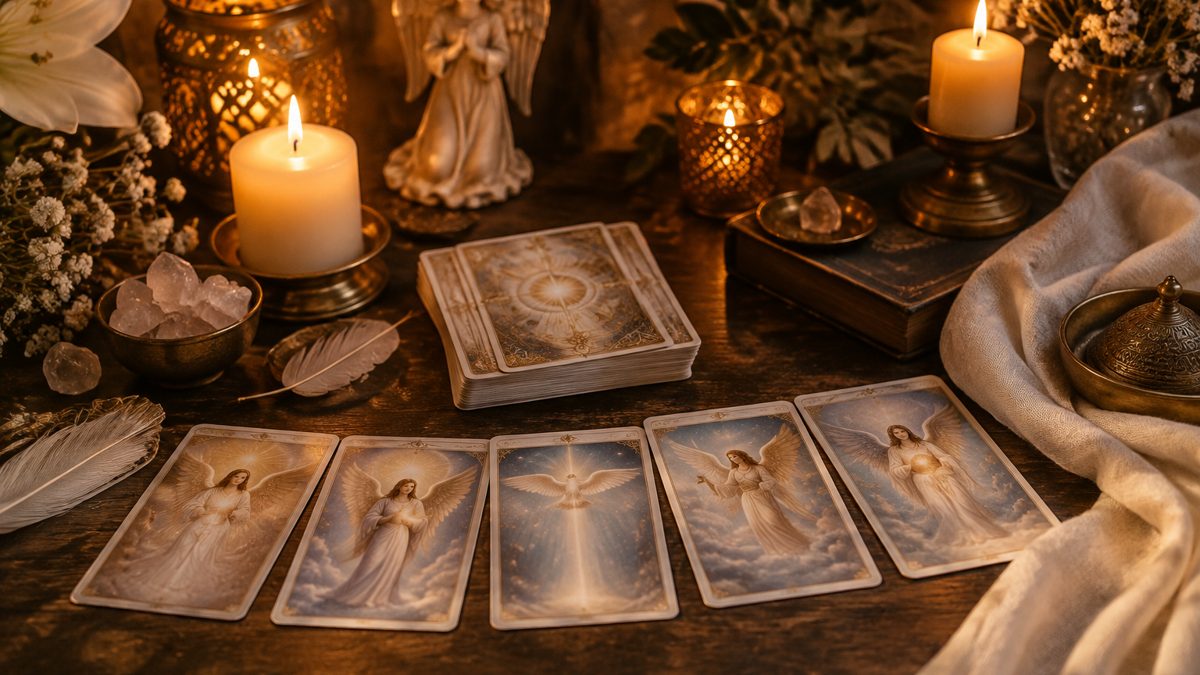
How to Use Angel Oracle Cards: A Step-by-Step Guide
There is something quietly inviting about a deck of cards waiting on a table: the painted wings, the unfamiliar symbols, the possibility of pausing long enough to hear yourself think. At Crossroads Journal, I like to approach practices like this with warmth and curiosity, but also with both feet on the ground. Angel oracle cards can belong to a spiritual tradition, a personal ritual, or a reflective journaling practice. You do not have to pretend certainty about the unseen to explore what the images bring to mind.
Ich bin Seraphina, und mein Ansatz ist einfach: Die Karten sollen ein Gespräch eröffnen, statt eine Frage zu beenden. Manche Deuter glauben, ein Engel-Orakeldeck biete Führung von Engeln oder anderen wohlwollenden geistigen Wesen. Andere verstehen die Erfahrung über Symbolik, Intuition und die Art, wie ein durchdachter Impuls etwas offenbaren kann, das unter den alltäglichen Ablenkungen bereits in Bewegung ist. Diese Sichtweisen sind nicht identisch, aber beide können eine bewusste, bedeutsame Praxis tragen, solange du ehrlich bleibst darüber, was du glaubst und was du nicht weißt.
This guide will take you from choosing your first deck to making a small reading your own. We will cover intention and prayer, daily draws, beginner-friendly spreads, interpretation, archangel traditions, journaling, and a complete sample reading. There is no requirement to buy elaborate tools, memorize a hidden system, or receive a dramatic sign. A deck, a little time, and permission to stay curious are enough to begin.
Looking for the meaning of a single card or ingredient? Keep our Angel oracle card meanings guide open beside you.
1. Understand what angel oracle cards are
Engel-Orakelkarten sind illustrierte Karten, die um Engelsbilder, spirituelle Themen oder Botschaften von Führung und Ermutigung gestaltet sind. Eine Karte kann ein Wort wie Geduld, Mut oder Erneuerung tragen. Eine andere kann einen Erzengel benennen oder eine Tür, einen Garten, eine Laterne oder ein Flügelpaar zeigen. Die meisten Decks enthalten ein Begleitbuch, das die vom Urheber beabsichtigte Symbolik erklärt und Wege zum Deuten der Karten vorschlägt. Es gibt keine einheitliche Struktur: Kartenzahl, Sprache und zugrunde liegende Überzeugungen unterscheiden sich von Deck zu Deck.
Within angel-oriented spiritual practice, readers may regard drawing a card as an invitation to receive a message from a benevolent presence. That is a matter of belief, not an established mechanism or a guarantee of supernatural communication. I find it helpful to make that distinction early. A reading can feel moving, timely, or deeply personal without proving where the experience came from. You can honor its emotional significance while leaving the larger metaphysical question open.
You can also use these cards without treating them as divination. A picture of a bridge might prompt you to consider a transition; a card about kindness might encourage you to examine your tone in a difficult conversation. In that approach, the deck supplies a subject for reflection rather than information about hidden events. The usefulness lies in the attention you bring to the prompt and the choices you make afterward.
Before your first reading, write one sentence describing your own starting point. Perhaps you believe angels can offer spiritual guidance. Perhaps you are exploring a family tradition. Perhaps you simply enjoy symbolic art. None of those positions requires performing conviction you do not feel. I would rather begin with an honest question than build a ritual around someone else’s certainty.
2. Know how oracle cards differ from tarot
Tarot and oracle cards share a family resemblance: both use images that can be arranged and interpreted. Their structures, however, differ. A conventional tarot deck contains 78 cards, divided into 22 Major Arcana cards and 56 Minor Arcana cards. The Minor Arcana usually comprises four suits, each with numbered and court cards. Decks vary in naming and imagery, but that underlying framework gives tarot readers a shared vocabulary across many editions.
Oracle decks do not follow one universal pattern. A creator might build a small collection of brief affirmations or a larger system with several categories and layered symbolism. An angel oracle deck might focus entirely on archangels, organize its cards around virtues, or mix angels with broader contemporary spiritual themes. Its guidebook is therefore especially useful: you are learning that particular creator’s system rather than assuming the rules of another deck apply.
Angel oracle cards often emphasize reassurance and constructive reflection, although not every deck is gentle in tone. Tarot can accommodate a broader dramatic range within its established symbolism, including conflict, endings, uncertainty, and change. Neither format is inherently more spiritually powerful, more accurate, or more suitable for everyone. The better starting point is the one whose imagery and structure help you ask thoughtful questions without feeling pressured or confused.
Du musst das Tarot nicht erlernen, bevor du ein Engel-Orakeldeck nutzt. Du musst auch keine Tarottechniken auf es übertragen. Umgekehrte Bedeutungen, aufwendige Legungen und Entsprechungen zu Astrologie oder anderen Systemen sind optional, sofern das Deck sie nicht ausdrücklich vorsieht. Für Anfänger empfehle ich, das Deck zunächst nach seinen eigenen Regeln kennenzulernen. Eine klare Karte und eine aufmerksame Frage lehren dich mehr über deine Gewohnheiten als Deuterin oder Deuter als eine aufwendige Anordnung, die du nicht bequem deuten kannst.
3. Choose a deck you can meet with curiosity
Beginne mit den Bildern, bleibe aber nicht dabei stehen. Du wirst längere Zeit damit verbringen, diese Bilder genau zu betrachten; achte darauf, ob sie zur Aufmerksamkeit einladen oder dich zerstreuen. Manche Decks verwenden traditionelle religiöse Bildsprache; andere zeigen Engel in zeitgenössischer Fantasy-Illustration, abstraktem Licht oder Naturszenen. Es gibt keine vorgeschriebene Ästhetik. Ich würde ein Deck wählen, bei dem ich gern vor einem Bild verweile, nicht eines, das ich zu bewundern glaube.
Lies als Nächstes mehrere Beispielbotschaften der Karten und, falls vorhanden, einen Auszug aus dem Begleitbuch. Lässt die Sprache Raum für Unterscheidungsvermögen? Klingt sie mitfühlend, ohne darauf zu bestehen, dass jede Schwierigkeit eine einfache spirituelle Erklärung hat? Ich bevorzuge Formulierungen, die zur Reflexion einladen, gegenüber solchen, die ein unvermeidliches Schicksal verkünden. Sei vorsichtig bei Decks oder begleitenden Angeboten, die Angst nutzen, exklusiven Zugang zur Wahrheit beanspruchen oder nahelegen, du müsstest etwas anderes kaufen, um eine unsichtbare Bedrohung zu entfernen.
Bedenke auch die praktischen Einzelheiten. Kannst du die Karten bequem halten und mischen? Ist der Druck lesbar? Erklärt das Begleitbuch, wie das Deck entstanden ist und wie man es verwendet? Wenn dich eine bestimmte religiöse Tradition interessiert, sieh dir die Quellen der Urheberin oder des Urhebers an, statt anzunehmen, engelhafte Bilder bedeuteten, dass das Deck diese Tradition getreu wiedergibt. Zeitgenössische Orakelsysteme verbinden oft Ideen aus mehreren Quellen.
You do not need an expensive deck, and you do not need someone else to give you your first one. Buying your own is perfectly reasonable. A borrowed or secondhand deck can also work if its condition and provenance are acceptable to you. Set a modest limit before browsing, choose one deck, and give yourself time to learn it. Familiarity usually offers more to a reflective practice than a rapidly growing collection.
- Look at several actual cards, not only the cover artwork.
- Read the deck description and a guidebook sample to understand its tone and beliefs.
- Check card size, readability, availability, and price.
- Choose a deck that encourages reflection without demanding unquestioning obedience.
4. Richte einen schlichten, bequemen Platz für die Deutung ein
A reading space need not resemble an altar in a photograph. A clear corner of a kitchen table can be enough. The purpose is to create a little room for attention, not to impress an imagined spiritual audience. Put down your phone if possible, move anything that might spill, and gather your deck, guidebook, and notebook. If your household is busy, even a few uninterrupted minutes may be more practical than waiting for perfect silence.
Manche Leserinnen und Leser reinigen oder segnen ihre Decks vor dem Gebrauch. In verschiedenen zeitgenössischen spirituellen Praktiken kann das ein Gebet, ein symbolisches Klopfen auf das Deck, ein Klang oder das Ablegen der Karten neben einem bedeutungsvollen Gegenstand sein. Diese Handlungen werden durch Tradition und persönlichen Glauben verstanden; sie sind nicht notwendig, damit ein Deck verwendbar ist. Wenn du ein Willkommensritual magst, wähle ein einfaches und sicheres. Vermeide Rauch, wo er Menschen oder Tiere stören würde, und halte die Karten von Flammen, Wasser und schädlichem Sonnenlicht fern.
I like the idea of beginning by getting acquainted rather than trying to activate anything. Look through the cards in order. Notice repeated colors, recurring symbols, and words that feel particularly inviting or uncomfortable. Read the creator’s introduction. This first pass helps you recognize the visual language of the deck and reduces the pressure to produce an immediate, meaningful reading. It is also a chance to spot themes you may want to approach carefully.
Decide how long your session will last before you start. Ten quiet minutes can hold a complete reading: settle, ask, draw, reflect, close. A time boundary helps prevent a simple question from becoming an afternoon of repeated draws. If the setting is distracting or you are too tired to engage, you can put the deck away. Missing a session does not damage a relationship with your cards or require a corrective ritual.
5. Set an intention or offer a prayer
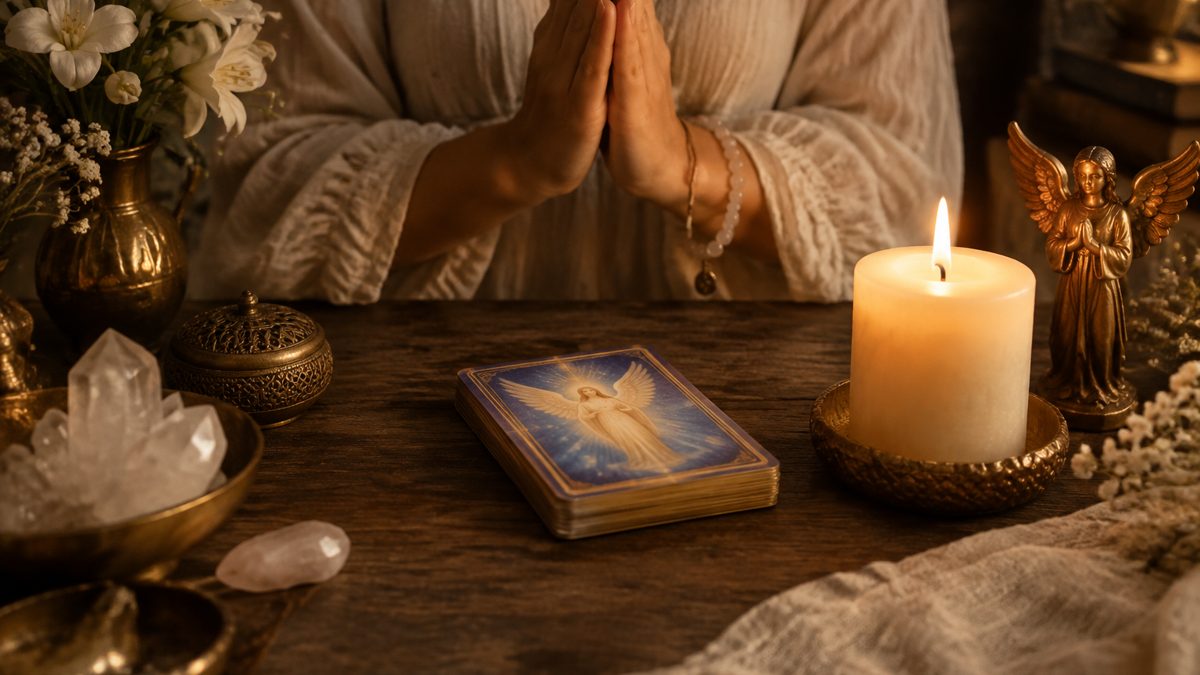
Eine Absicht gibt der Legung eine Richtung. Sie muss nicht aufwendig sein und erzwingt kein bestimmtes Ergebnis. Frage dich vor dem Mischen, was du eigentlich suchst: Trost, Perspektive, ein Tagebuchthema oder eine Möglichkeit, über deine nächste gewöhnliche Handlung nachzudenken. Diese kleine Klärung ist wichtig. Eine Frage danach, wie du ein Gespräch angehen kannst, ermöglicht nützlichere Reflexion als die Forderung, genau zu wissen, was ein anderer Mensch insgeheim denkt.
If prayer belongs to your spiritual practice, you may begin by addressing God, angels, or a benevolent presence in language consistent with your beliefs. A simple prayer could ask for clarity, compassion, and the wisdom to keep your own judgment. You might also ask that the practice remain grounded in kindness toward yourself and others. No particular wording is required, and an awkward sentence is not a spiritual mistake.
Wenn du einen nichtreligiösen Zugang bevorzugst, nenne deinen Zweck schlicht: Du nimmst dir ein paar Minuten, um nachzudenken, deine Reaktionen zu beobachten und einen hilfreichen nächsten Schritt zu bedenken. Du könntest die Hände auf das Deck legen oder einen bequemen Atemzug nehmen. Solche Gesten können den Übergang vom Alltag in fokussierte Aufmerksamkeit markieren, ohne etwas über unsichtbare Kräfte zu behaupten. Wähle, was sich aufrichtig anfühlt, statt ein Ritual zu übernehmen, bei dem du dich unwohl fühlst.
Keep your question open-ended and within your own sphere of action. Ask what deserves your attention, what perspective you might be overlooking, or what quality you want to bring to a situation. Avoid treating the cards as a way to obtain consent, read someone’s private thoughts, or settle factual matters that require evidence. When your question concerns another person, turn it gently toward your own communication, boundaries, or assumptions.
- Name the topic in one sentence, without trying to solve every part of it.
- Wähle eine offene Frage wie: Was würde mir helfen, dies mit Bedacht anzugehen?
- Offer a prayer if it fits your beliefs, or state a secular intention.
- Remind yourself that the cards are prompts to consider, not commands to obey.
6. Shuffle and begin with a daily one-card draw
There is no universally correct way to shuffle an oracle deck. You can use an overhand shuffle, cut the cards into piles, or spread them face down and mix them gently on a clean surface. Choose a method that suits your hands and does not damage the cards. Once you have shuffled, draw from the top or select one from a face-down fan. The method need not be mysterious to feel intentional.
Eine tägliche Karte ist eine der einfachsten Arten zu lernen. Bitte nicht um eine Vorhersage, sondern frage, über welches Thema du heute nachdenken könntest. Lege die Karte dorthin, wo du sie sehen kannst, lies ihren Titel und betrachte das Bild, bevor du das Begleitbuch aufschlägst. Gib dir einen Moment, um einen ersten Eindruck zu bilden. Du legst keine Prüfung ab, und es gibt keinen Preis dafür, die Erklärung der Urheberin oder des Urhebers Wort für Wort wiederzugeben.
Wenn beim Mischen mehrere Karten herausfallen, hast du Optionen. Manche Deuter halten sie für bedeutsam; andere betrachten sie als gewöhnliche Ausrutscher und geben sie zurück ins Deck. Lege vorab eine Regel fest, damit du die Methode nicht wechselst, nur weil dir ein Ergebnis besser gefällt als ein anderes. Dasselbe gilt für auf dem Kopf stehende Karten. Sofern dein Deck keine umgekehrten Bedeutungen vorsieht oder du sie bewusst übernommen hast, drehe die Karte aufrecht.
Most importantly, let one card be enough. If the message feels puzzling or disappointing, note that response instead of immediately replacing it. Repeatedly drawing until you receive reassurance can make the practice less reflective and more urgent. You may also decide that a card does not resonate today. That is an acceptable result. A daily practice is an invitation, not an obligation, and occasional draws work just as well for learning at your own pace.
- Nimm dir etwa fünf Minuten Zeit und wähle eine einfache Frage.
- Shuffle in a comfortable way, then draw one card.
- Write down its title and your first observation.
- Lies das Begleitbuch und wähle eine bodenständige Reflexion oder Handlung.
- Rufe dir die Notiz am Ende des Tages kurz noch einmal in Erinnerung, ohne eine Verbindung erzwingen zu wollen.
7. Try a few clear, beginner-friendly spreads
Eine Legung ist schlicht ein Layout, in dem jede Karte eine festgelegte Rolle hat. Die Positionen helfen, eine sonst breite Deutung einzugrenzen. Statt drei Karten alles erklären zu lassen, könntest du eine der Situation zuweisen, eine einer übersehenen Perspektive und eine einem möglichen nächsten Schritt. Schreibe die Positionen auf, bevor du ziehst. So vermeidest du, die Frage unbemerkt so umzuformen, dass sie zu den erscheinenden Karten passt.
For a two-card reading, try: what I am noticing, and what else I could consider. The first position gives you a place to examine your current focus; the second invites a wider view. It is a useful arrangement when you feel caught between a familiar reaction and a more thoughtful response. Neither card needs to describe objective reality. Both can function as lenses through which to examine your understanding.
For three cards, I like: where my attention is, what could support me, and one action I can choose. The final position is deliberately modest. It asks for a possibility within your control rather than an instruction from an unquestionable authority. Another useful three-card spread is: what I appreciate, what I am learning, and what I am ready to simplify. That version works especially well for a weekly reflection.
Keep the positions visible while you interpret. A courage card in a support position might prompt you to remember a skill you already have; in an action position, it might suggest preparing for an honest conversation. Resist expanding every reading with extra clarifying cards. If a position remains unclear, return to its question, consult the guidebook, or leave a note to revisit it. Uncertainty is not a failure of the spread.
- Choose a two- or three-card layout and write down the meaning of each position.
- Shuffle while holding the overall question in mind.
- Lege die Karten in der gezogenen Reihenfolge von links nach rechts aus.
- Interpret each card within its assigned position before looking for connections.
- Summarize the reading in one or two sentences.
8. Interpret messages without surrendering your judgment
Start with what is actually on the card. Describe the image as though you were explaining it to someone who cannot see it: a figure stands beside an open gate, the background is blue, a lantern hangs from one hand. Then notice your associations. Perhaps the gate suggests opportunity to you, while the lantern suggests preparation. Separating observation from interpretation makes it easier to see how your own experiences shape the reading.
Next, read the guidebook. Treat it as the creator’s explanation, not an infallible verdict. You may discover a symbol you overlooked or find that the written message differs from your first impression. Hold those possibilities side by side. Ask which interpretation best fits the question without stretching the facts. A card about forgiveness, for example, need not mean reconciliation, renewed access, or abandoning a boundary.
Look for practical meaning rather than dramatic certainty. A rest card does not establish why you feel tired, and a card about abundance does not predict material gain. It might instead prompt you to notice what you already have or reconsider an expectation. Cards are not substitutes for medical, legal, or financial expertise, and they cannot establish facts about those subjects. Use appropriate information and qualified help when a decision calls for them.
Be especially careful with fear-based interpretations. A dark image is not evidence of a curse, an approaching disaster, or a hostile presence. Likewise, a comforting image cannot promise safety or a particular outcome. Our minds naturally notice patterns and remember striking matches; keeping track of misses and ambiguous results helps preserve perspective. I ask three questions before accepting an interpretation: Is it compassionate? Is it plausible as reflection? Does it leave me free to choose?
9. Explore archangels as a spiritual tradition
Many angel oracle decks feature archangels, but the traditions behind those figures are not uniform. Angels appear in Jewish, Christian, and Islamic traditions, with differences in names, roles, texts, and devotional practices. Contemporary oracle creators may also draw on later esoteric teachings and modern spiritual systems. A deck that presents a neat list of archangels and corresponding colors is offering a particular framework, not necessarily a universal religious teaching.
In many Christian contexts, Michael is associated with protection and spiritual struggle, Gabriel with divine messages, and Raphael with healing, especially through the Book of Tobit, whose scriptural status differs among traditions. Modern angel practices may adapt these associations into reflective themes such as courage, communication, and care. Those symbolic themes do not establish that calling on a figure will produce an external result. When a deck makes a specific claim about tradition, its sources deserve a look.
If archangel devotion fits your beliefs, you might choose one figure to learn about through reputable sources from the relevant tradition. Read about the historical or textual context before adding correspondences from a deck. You could then offer a respectful prayer, draw a card, and reflect on a quality associated with that figure. Avoid assuming that traditions are interchangeable or that one guidebook speaks for every community that honors angels.
Du kannst auch symbolisch mit der Bildsprache arbeiten und dabei klar sagen, dass dies etwas anderes ist als devotionale Praxis. Michaels Bild könnte zum Nachdenken über eine Grenze einladen, Gabriels dazu, darauf zu achten, wie du dich ausdrückst. Es besteht keine Pflicht, ein benanntes Wesen zu kontaktieren, eine Gegenwart zu spüren oder ein Zeichen zu empfangen. Wenn eine Praxis deinem Glauben widerspricht oder dich unwohl fühlen lässt, lass sie beiseite. Respekt schließt ein, die eigenen Grenzen zu achten.
10. Keep a journal that welcomes honest observation
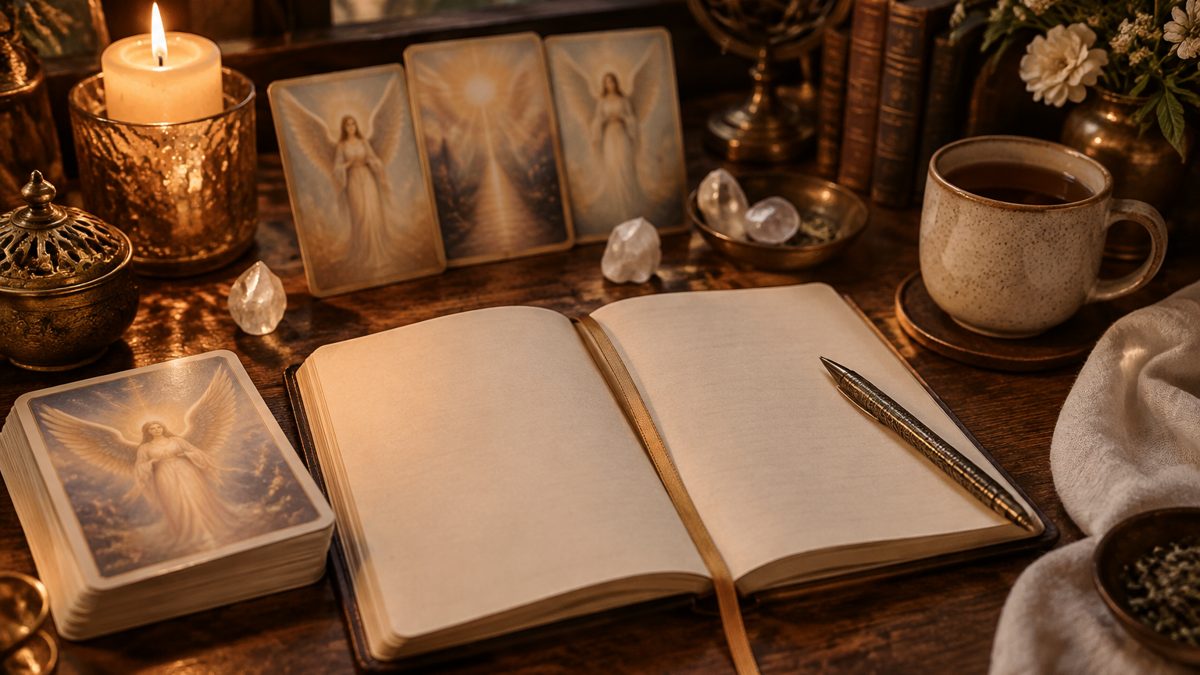
An oracle journal does not need to be beautiful to be useful. A plain notebook or a simple digital document will do. Record the date, your question, the deck, the card or cards drawn, and a few sentences about your response. Include the spread positions if you used them. These details give you a reliable record rather than relying on memory, which tends to highlight the most striking or emotionally satisfying moments.
Separate the card’s wording from your interpretation. You might note that the card’s title is Patience, while your response is that you feel rushed about a creative project. Then add what the guidebook contributed and what you actually intend to do. This distinction prevents a personal association from gradually becoming something you remember as an explicit message. It also helps you recognize which parts of the reading came from your existing knowledge of the situation.
Leave room for disagreement. Write down when a reading felt irrelevant, when you could not make sense of it, and when a suggested action did not suit your circumstances. Honest notes are more valuable than a record edited into a string of apparent confirmations. If the same card appears repeatedly, it may be interesting to reflect on, but repetition alone does not prove an outside message. You can explore the theme without assigning it special authority.
Sieh dein Tagebuch nach einigen Wochen durch. Achte auf Muster in deinen Fragen und Reaktionen, statt die Kraft des Decks berechnen zu wollen. Suchst du wiederholt die Erlaubnis, dich auszuruhen? Fragst du immer wieder nach einem Gespräch, auf das du dich direkt vorbereiten könntest? Die nützlichste Entdeckung betrifft vielleicht deine eigenen Aufmerksamkeitsgewohnheiten. Schütze die Privatsphäre des Tagebuchs, besonders wenn du über andere Menschen schreibst, und stelle deine Eindrücke nicht als Tatsachen über sie dar.
- Halte die Frage, die Karten und die Legepositionen fest.
- Beschreibe deine erste Reaktion, bevor du die Deutung aus dem Begleitbuch hinzuziehst.
- Choose one small action, or note that no action is needed.
- Sieh dir den Eintrag später noch einmal an und halte fest, was geschehen ist, ohne die ursprüngliche Deutung umzuschreiben.
- Notice recurring concerns while allowing for coincidence and ordinary repetition.
11. Walk through a sample three-card reading
Here is an illustrative reading using invented card titles, not a quotation from a published deck or a report of an actual supernatural message. Imagine that you have been postponing a personal writing project. You ask: What could help me return to this project in a thoughtful, manageable way? Your positions are where my attention is, what could support me, and one action I can choose. You draw Listening, Kindness, and Open Door.
In the first position, Listening might prompt you to examine how much advice you have been collecting. Perhaps you have read so many suggestions that you can no longer hear your own preferences clearly. That is one interpretation, not a fact established by the card. You test it against your experience: have you really been seeking more input instead of beginning? If not, Listening could invite another relevant reflection, such as noticing what originally attracted you to the project.
In the support position, Kindness might suggest changing the standard by which you judge a first attempt. Instead of expecting a polished piece immediately, you could allow an untidy draft. Notice how the interpretation stays connected to the question. It does not promise that kindness will make the project successful, and it does not claim that every obstacle is merely an attitude problem. It offers a possible way to make returning less intimidating.
In the action position, Open Door could suggest creating one small opening rather than planning a complete transformation. You decide to spend fifteen minutes outlining a scene tomorrow. Your summary becomes: I may be overwhelmed by outside advice; a gentler standard could help me begin; I will try one short writing session. You record that plan and close the reading. Tomorrow, whether you write or not, you can examine what helped and what got in the way. The value of the reading rests in the reflection and experiment, not in treating three cards as a prediction.
12. Schließe die Deutung ab und baue eine nachhaltige Praxis auf
Closing a reading can be very simple. Gather the cards, write your final thought, and return the deck to its box or another suitable place. If gratitude belongs to your practice, offer thanks in your own words. If you prefer a secular closing, acknowledge the time you gave yourself. A closing ritual marks the end of the session; it does not need to seal an invisible doorway or protect you from consequences for doing something incorrectly.
Choose a rhythm that fits your life. You might draw one card on quiet mornings, use a three-card spread each weekend, or reach for the deck only when you want a journaling prompt. There is no spiritual attendance record. If daily draws become repetitive, try reading less often or spending more time with a single image. Learning the deck includes noticing when it supports reflection and when another activity would serve you better.
Keep a few boundaries visible. Do not let a card override clear evidence, another person’s consent, or your own considered judgment. Avoid repeatedly checking the same question in search of certainty. If you notice that you feel unable to make ordinary choices without drawing, or that readings leave you increasingly frightened or preoccupied, put the cards away and reconnect with everyday sources of support. A reflective tool should remain something you can freely choose not to use.
What I hope you carry from this guide is not a perfect technique, but a gentle balance: imagination alongside discernment, tradition alongside curiosity, and meaningful ritual alongside ordinary action. Angel oracle cards can offer a language for reflection if that language speaks to you. They do not have to explain your future or solve your life. Sometimes the most worthwhile reading ends with a modest sentence in a notebook, a clearer question, and the willingness to take one thoughtful step.
These practices are shared as tradition and personal reflection, not as a substitute for medical, legal or financial advice.
Weiterlernen
- Angel oracle card meanings
- How to read tarot cards
- How to use angel oracle cards
- So liest du Spielkarten
- So verwendest du Kristalle in Zaubern
- So verwendest du Kräuter in der Hexerei
- How to read the Dr. Moorne Egyptian Tarot
- How to read dice
- How to read tea leaves
- So benutzt du ein Pendel
- Wie man einen Kerzenzauber wirkt
- How to make a spell jar
- How to make a sigil
- How to cleanse your home
- How to set up an ancestor altar
- How to open a sacred space
- How to time spells with the moon
- How to work with water and salt
- How to make a protection charm bag
- Read the Journal oder besuche die shops