How-To Guide
How to Read Tea Leaves
Von Seraphina
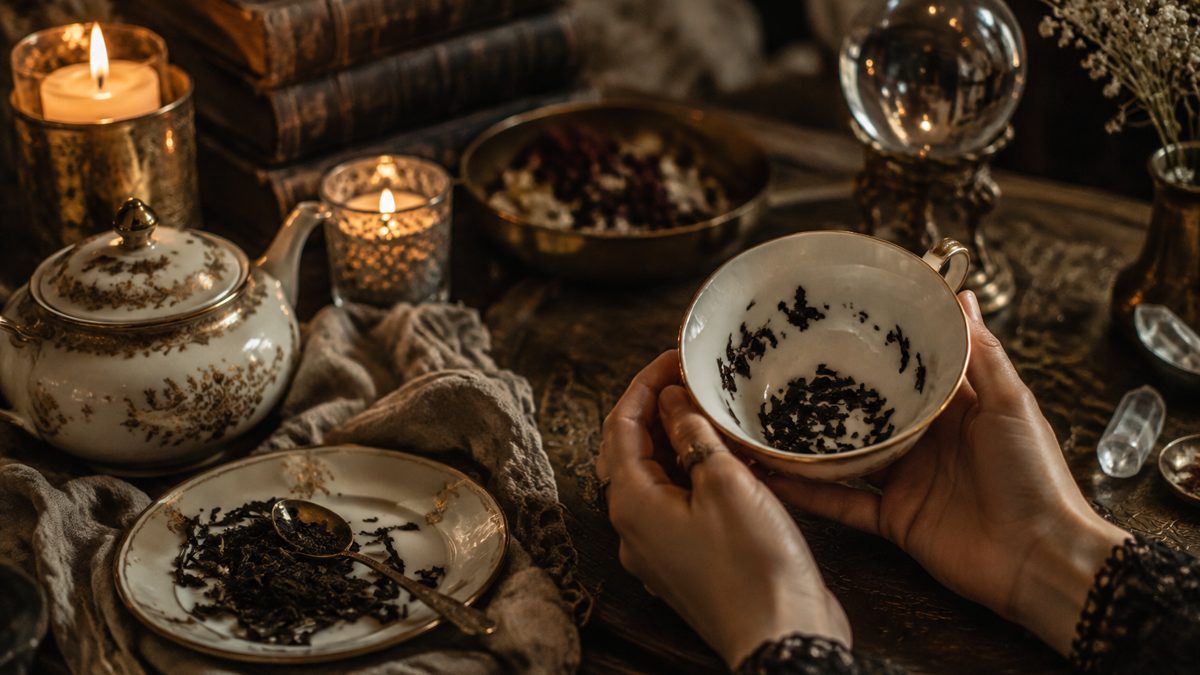
Reading tea leaves begins with an ordinary pleasure: making a cup of tea and giving yourself time to notice it. After the tea is mostly finished, the leaves left behind form shapes that a reader interprets through symbolism, association, and context. You do not need an elaborate collection of tools or a special gift to begin exploring this traditional practice.
Das Teeblätterlesen, oft Tasseografie oder Tasseomantie genannt, gehört zu einer größeren Familie von Praktiken, die Muster in Tassen deuten. Manche Menschen betrachten es als Wahrsagekunst, andere als nachdenkliches Ritual oder als kreatives Gespräch mit sich selbst. Es gibt keinen gesicherten wissenschaftlichen Beleg dafür, dass Teeblätter zukünftige Ereignisse vorhersagen. Ihr praktischer Wert kann in den Fragen, Verbindungen und Möglichkeiten liegen, die sie dich bedenken lassen.
This guide takes you from choosing a suitable cup to recording a complete reading. Along the way, you will learn how different traditions organize the cup, how to recognize shapes without forcing them, and how to turn an impression into a thoughtful interpretation. The aim is not to memorize every possible symbol, but to develop a consistent, gentle way of looking.
Keep the companion reference page, Tea Leaf Symbols and Meanings, nearby when you want ideas for a particular image. Use it as a starting point rather than a final authority: a bird, bridge, or tree can mean different things in different contexts. Your question, personal associations, and the surrounding patterns all deserve a place in the reading.
Looking for the meaning of a single card or ingredient? Keep our Tea leaf symbols guide open beside you.
1. Verstehe die Geschichte, ohne sie zu einer einzigen Ursprungsgeschichte zu machen
Tea-leaf reading has no neatly documented beginning that explains every modern practice. Tea drinking has a long history in China, but that fact alone does not establish where the familiar method of swirling leaves in a handled cup originated. Accounts that give one ancient date, one inventor, or an unbroken universal lineage usually simplify a more complicated story.
Die in vielen englischsprachigen Leitfäden erkennbare Form entwickelte sich parallel zur Verbreitung des Teetrinkens in Europa und Britannien. Häusliche Unterhaltung, Wahrsagebräuche und spätere gedruckte Handbücher trugen dazu bei, Methoden und Symbollisten zu verbreiten. Auch kommerzielle Teestuben und spezialisierte Deuter erhöhten ihre Bekanntheit. Verschiedene Haushalte konnten den Grundvorgang teilen und sich dennoch in nahezu jedem Detail der Deutung uneinig sein.
Related practices read coffee grounds or other beverage sediment, including traditions associated with Turkish coffee and communities across the Balkans and Middle East. These practices have their own histories and social settings; they should not be treated as interchangeable versions of one generic ritual. Learning from a particular community means respecting its terminology, customs, and boundaries.
You may encounter instructions to use the left hand, turn the cup clockwise, or swirl exactly three times. Such rules can be meaningful within a family or teaching tradition, but they are not universal requirements. When learning, distinguish between a documented custom, a modern reader's preference, and your own adaptation. That distinction keeps the practice both honest and welcoming.
2. Gather a simple, workable tea-reading kit
Start with a clean, light-colored cup and a matching saucer. A broad bowl with a smooth interior makes leaves easier to see than a narrow mug with dark glaze or busy decoration. A handle provides a convenient reference point for mapping the cup. Ordinary household crockery is perfectly suitable; you do not need an antique fortune-telling cup.
Loose-leaf black tea is a useful beginner choice because its darker pieces usually stand out against a pale cup. Choose small or medium leaves rather than powdery tea dust or very large rolled leaves. Large leaves can make a few bulky clumps, while fine dust can coat the surface so evenly that distinct shapes become difficult to recognize.
You will also need drinking water, a kettle, a teaspoon, a timer if you use one, and a notebook. A tray or washable cloth can catch drips during inversion. Good daylight or a steady lamp helps you see the actual pattern. A phone camera is optional, but photographs make it easier to revisit your observations without reconstructing them from memory.
Use tea sold for drinking, and check its ingredients if it contains flavorings, flowers, or herbs. Avoid adding glitter, essential oils, unknown plants, or craft materials to a cup you will drink from. If you prefer not to consume caffeine, a familiar food-grade caffeine-free infusion can work, though its pieces may behave differently. Safety matters more than achieving a traditional appearance.
3. Prepare your space and choose a useful question
Wähle einen stabilen Tisch, an dem du bequem mit heißem Wasser umgehen und die Tasse betrachten kannst. Schaffe genug Platz für Wasserkocher, Untertasse und Notizbuch. Schalte Benachrichtigungen stumm, wenn dir das beim Ankommen hilft, aber verwechsle eine aufwendige Atmosphäre nicht mit einer Voraussetzung. Ein ruhiger Küchentisch ist ebenso geeignet wie ein sorgfältig gestalteter Ritualraum.
Entscheide vor dem Aufbrühen, was die Deutung erkunden soll. Offene Fragen führen meist zu nützlicherer Reflexion als Forderungen nach einer festen Vorhersage. Frage zum Beispiel, was bei einem kreativen Projekt Aufmerksamkeit verdient, wie du eine bevorstehende Veränderung angehen könntest oder welche Unterstützung du übersehen hast. Halte die Frage eng genug, dass die Bilder einen bedeutsamen Zusammenhang haben.
Avoid using the cup to establish someone else's private thoughts, prove infidelity, diagnose an illness, or settle an urgent financial decision. Tea patterns cannot verify those things. If a situation requires evidence, professional advice, or a direct conversation, begin there. A reading can explore your feelings about the situation without pretending to supply missing facts.
Take a few easy breaths and notice your present mood. There is no need to empty your mind or enter a special state. Simply recording that you feel hopeful, anxious, tired, or distracted can help later, because mood influences which shapes you notice and what stories you attach to them.
- 1. Clear and wipe the table, then arrange the cup, saucer, tea, and notebook within comfortable reach.
- 2. Write one open-ended question in your notebook before looking for any symbols.
- 3. Note your mood and any outcome you are especially hoping for or afraid of.
- 4. Entscheide, dass du aufhören, pausieren oder die Deutung offenlassen darfst.
4. Brew the tea and drink it comfortably
For a first attempt, use roughly half a teaspoon of loose tea in a small cup, then adjust future servings to suit the leaf size and your taste. Too many leaves can cover the interior; too few may leave little to examine. This is a practical starting point, not a spiritually significant measurement or a strict brewing rule.
Heat the water according to the tea's instructions and pour carefully, leaving room below the rim. Let the tea steep as directed, remembering that unstrained leaves will continue brewing while you drink. If it becomes unpleasantly strong, use fewer leaves or a milder tea next time. There is no benefit in forcing yourself to finish a bitter cup.
For the clearest first reading, keep the tea plain. Milk can obscure the interior, and undissolved sweeteners or other additions may create marks that are not leaves. If you need a sweetener, dissolve it fully and note that choice. This recommendation is about visibility, not ritual purity; your comfort and dietary needs remain more important.
Allow the tea to cool to a safe drinking temperature. Sip slowly, letting the leaves settle between sips, and leave a small amount of liquid with the sediment. You do not need to swallow any leaves. If loose leaves bother you, brew strained tea for drinking and add a small spoonful of the cooled, wet leaves afterward, clearly treating this as an adapted method.
- 1. Put a modest amount of food-grade loose tea into the clean cup.
- 2. Gieße Wasser mit der empfohlenen Temperatur auf und lass den Tee ziehen.
- 3. Wait until it is comfortable to drink, then sip without deliberately swallowing leaves.
- 4. Stop with the leaves and about a teaspoon or two of liquid remaining; adjust if the leaves cannot move freely.
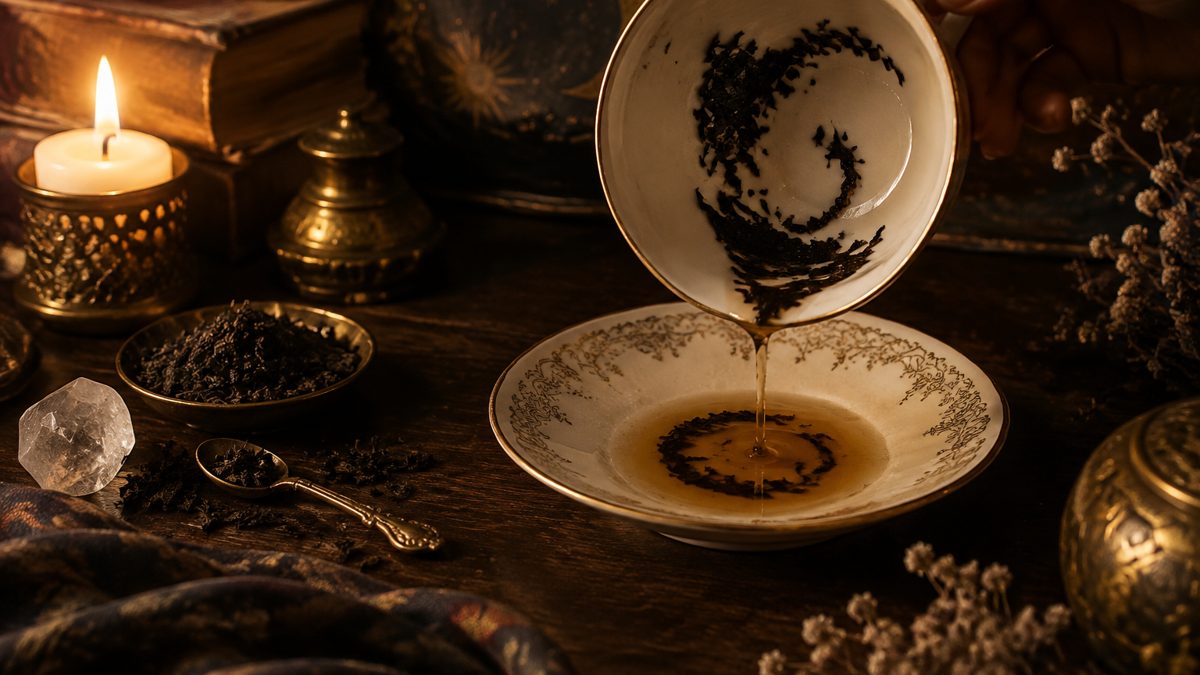
5. Schwenken, abgießen und das Muster enthüllen
Once only a little liquid remains, gently rotate the cup so the wet leaves travel around its interior. The aim is to distribute them, not fling them over the rim. Many modern instructions suggest three swirls, sometimes with a particular hand or direction. You may follow that convention, but consistency matters more than the number.
Place the saucer on a stable surface before turning the cup over. If the cup still holds enough liquid to spill widely, carefully pour off a little first. Invert the cup onto the saucer and allow it to drain briefly. Around half a minute is a useful experiment, although leaf size and cup shape will affect the result.
Lift the cup slowly and keep the saucer beneath it until any final drips stop. Some leaves will cling to the walls, some will gather near the base, and some may fall onto the saucer. For a first reading, focus only on the cup. Including the saucer is an optional extension, not something you must interpret.
Resist the urge to rearrange awkward leaves or repeat the process until you get an attractive image. The original arrangement is your observation material, including its blank spaces and ambiguity. If everything slides into one wet lump, you can acknowledge a preparation problem and try again later rather than inventing a meaning for a technical mishap.
- 1. Halte die abgekühlte Tasse sicher fest und schwenke die restliche Flüssigkeit sanft an der Innenwand entlang.
- 2. If following a three-swirl convention, complete three comfortable rotations without splashing.
- 3. Stülpe die Tasse auf die Untertasse und lass die überschüssige Flüssigkeit abtropfen.
- 4. Lift it carefully, photograph the untouched pattern, and begin with a whole-cup observation.
6. Choose a cup map before interpreting individual symbols
Eine Tassenkarte gibt Positionen eine beständige symbolische Rolle. Eine verbreitete moderne Konvention behandelt den Henkel als Bezugspunkt für die Person, die die Deutung erhält, oft Fragende genannt. Muster in seiner Nähe können dann mit persönlichen Anliegen, dem Zuhause oder unmittelbarer Erfahrung verbunden werden. Andere Deuter weisen andere Bedeutungen zu; halte daher die gewählte Karte fest, statt sie für allgemeingültig zu halten.
Another familiar convention associates the rim with matters close at hand, the middle walls with developing situations, and the base with longer-term or deeper concerns. These are symbolic categories, not reliable clocks. Avoid converting a leaf's exact distance from the rim into a promised date. A broad distinction between immediate and background concerns is usually sufficient.
Some systems interpret the left and right sides as past and future, inner and outer life, or what is leaving and arriving. You do not need all these layers at once. In fact, combining several incompatible maps can let you justify almost any conclusion. Begin with the handle reference and three height zones, then add complexity only if it remains useful.
Set the handle toward you when you first record positions. You can rotate the cup to inspect a shape, but note where that shape sits in the original orientation. Otherwise, a cluster may migrate from one symbolic area to another simply because you turned the cup. A quick sketch with a marked handle prevents this common confusion.
7. Suche nach Formen, ohne das Erkennen zu erzwingen
Begin with the whole arrangement rather than hunting immediately for a heart or a familiar animal. Is the cup sparse or crowded? Are most leaves near the rim, scattered across the walls, or concentrated at the base? Notice lines, clusters, gaps, and connections. These observations give individual shapes a setting instead of leaving them as isolated dictionary entries.
Next, identify two or three clear forms. A branching line might resemble a tree; an arch might suggest a bridge; a compact cluster with an extending point could look like a bird. Describe the visible features before naming the object. Writing 'curved line joining two clumps' is more precise than jumping straight to 'a successful reunion.'
Menschen erkennen in mehrdeutigen Mustern ganz natürlich vertraute Formen, eine Neigung, die oft Pareidolie genannt wird. Das macht die Übung nicht wertlos, erklärt aber, warum verschiedene Deuter in derselben Tasse Unterschiedliches sehen können. Betrachte das Erkennen als fantasievolle Deutung und nicht als Beweis dafür, dass eine äußere Botschaft eigens für dich dorthin gelegt wurde.
If a shape only appears after repeated turning, squinting, and persuasion, mark it as uncertain or leave it out. You are allowed to see nothing recognizable in part of the cup. Empty space does not automatically mean loneliness, and an untidy cluster does not automatically signal trouble. Good observation includes knowing when there is too little information.
8. Deute Symbole aus dem Zusammenhang, nicht als feste Urteile
Once you have identified a plausible image, explore three sources of meaning: the associations found in a chosen reference, your personal response, and the reading's question. A tree, for example, can suggest growth, roots, family, shelter, or gradual development. In a question about studying, steady learning might be a more relevant association than family history.
Consult Tea Leaf Symbols and Meanings for possibilities, but do not keep searching through references until you find the answer you want. Symbol lists often disagree because they reflect different authors and traditions. Choose an interpretation that fits the visible shape and question, while acknowledging reasonable alternatives. A reference should broaden your thinking, not overrule your judgment.
Consider how images relate spatially. A bridge beside two separate clusters could invite reflection on connection between groups. A winding line near a tree might suggest a gradual route toward stability. These are constructed symbolic narratives, not facts about future events. Keep the language exploratory: 'This could reflect' is more responsible than 'This proves.'
Schließe ab, indem du die Deutung in eine Frage oder in eine Handlung umsetzt, die in deiner Hand liegt. Wenn ein Vogel an Kommunikation denken lässt, musst du vielleicht eine E-Mail entwerfen oder um Klärung bitten. Die Tasse kann keine Antwort garantieren. Eine nützliche Deutung vergrößert deine Fähigkeit, bedacht zu wählen, statt dich von Zeichen abhängig zu machen.
9. Follow a worked example from cup to practical action
Stell dir eine Übungsdeutung mit der Frage vor: „Was verdient meine Aufmerksamkeit, wenn ich ein gemeinsames Schreibprojekt beginne?“ Dies ist ein anschauliches Beispiel, kein Bericht über die Erfahrung einer tatsächlichen Klientin oder eines Klienten. Die Deutende nimmt den Henkel als persönlichen Bezugspunkt, den Rand für unmittelbare Anliegen, die Mitte für sich entwickelnde Angelegenheiten und den Boden für Hintergrundthemen.
Near the rim and handle, a small cluster resembles a bird, though it could also be a leaf. Halfway down the opposite wall, an arch appears to join two groups of tea leaves. At the base, a branching shape looks more clearly like a tree. The reader records those observations and labels the bird identification as uncertain.
Using familiar symbolic associations, the reader considers communication for the bird, cooperation for the bridge, and steady growth for the tree. In the context of a shared project, those ideas suggest discussing expectations, connecting different working styles, and allowing time for development. Another plausible tree association is established habits, which raises a useful question about whose routines will shape the collaboration.
The final interpretation is modest: 'This pattern invites me to clarify communication and create a workable structure before expecting quick progress.' Nothing in the cup establishes whether the project will succeed or whether the collaborator is trustworthy. The practical outcome is to arrange a planning conversation, agree on responsibilities, and set a review date based on the actual schedule.
- 1. Record the question and chosen cup map before interpreting.
- 2. List the bird-like cluster, connecting arch, and branching base shape, including their locations and uncertainty.
- 3. Compare relevant meanings and note at least one alternative interpretation.
- 4. Wähle einen konkreten nächsten Schritt: Besprich Rollen, Fristen und Kommunikationsvorlieben mit der Person, mit der du zusammenarbeitest.
10. Recognize common mistakes and troubleshoot gently
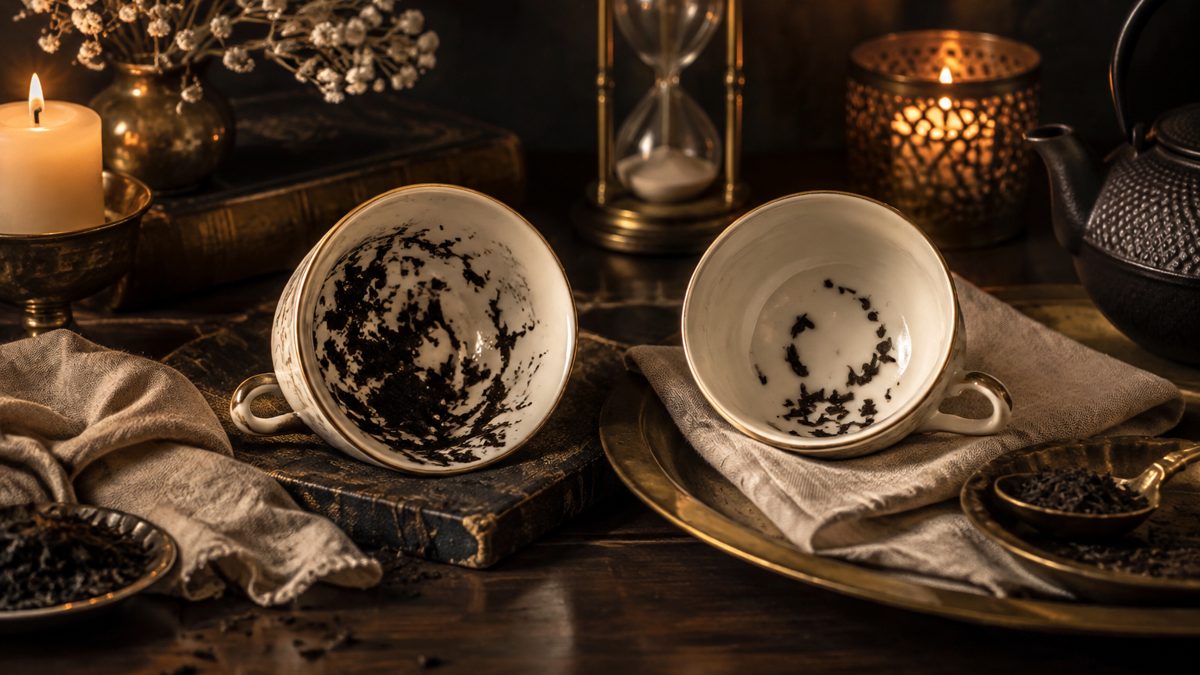
A cup covered in sludge usually calls for a practical adjustment, not a dramatic interpretation. Try less tea, larger leaf pieces, or slightly less remaining liquid. If all the leaves fall onto the saucer, experiment with retaining a little more moisture before inversion. Change one variable at a time so you can learn what works with your particular cup.
Another common mistake is trying to interpret every fragment. A single cup can contain dozens of suggestive marks, and assigning all of them significance produces a confusing story. Choose a few clear images and one or two overall features. A short, coherent reading is often more useful than an elaborate catalogue of symbols that contradict one another.
Be alert to confirmation bias: the tendency to notice details that support what you already believe. If you expect an argument, a pointed cluster may become a weapon while a connecting line goes unnoticed. Write an alternative reading before settling on your preferred one. Ask what you would see if the question concerned friendship rather than conflict.
Repeatedly reading the same question can also turn reflection into reassurance-seeking. If you feel compelled to make another cup until the answer becomes comforting, stop for the day. Return to the real-world information available to you. An unclear reading is not a failure, and you do not owe any pattern a conclusion.
11. Keep the practice physically safe and ethically grounded
Die unmittelbarsten Risiken sind gewöhnliche: Verbrennungen, Verschüttetes, zerbrochenes Geschirr und ungeeignete Zutaten. Verwende eine unbeschädigte Tasse, die für Lebensmittel gedacht ist; antike oder dekorative Stücke eignen sich möglicherweise nicht für heiße Getränke. Halte heißes Wasser von Kindern und Haustieren fern. Warte, bis sich die Tasse angenehm anfassen lässt, bevor du sie schwenkst oder umdrehst.
Check tea blends for allergens, caffeine, and herbs that may be unsuitable during pregnancy, with particular conditions, or alongside medicines. Familiarity in folklore does not establish safety for ingestion. Ask a pharmacist or qualified clinician when uncertain, and do not drink unidentified foraged plants. Drinking tea is optional; an adapted practice with cooled leaves avoids pressure to consume it.
Candles, incense, and ritual additives are unnecessary. If you use a candle, place it in a stable holder away from loose fabric and never leave it unattended. Avoid smoke where it affects breathing or exposes pets. Never add essential oils or nonfood ritual materials to drinking tea. If your separate ritual uses salt water, do not pour it onto plants or garden soil.
When reading for someone else, ask permission, agree on the topic, and make clear that the reading is interpretive rather than verified prediction. Never announce death, illness, pregnancy, curses, or inevitable disaster from a shape. Do not frighten someone into buying a remedy. Protect their privacy, avoid promises, and support their right to reject any interpretation that does not feel useful.
12. Keep a journal that preserves what you actually saw
Ein Teesatz-Tagebuch hilft, Beobachtung von Deutung und nachträglicher Rückschau zu trennen. Notiere das Datum, die Frage, die Teesorte, die ungefähre Menge, die verwendete Tasse und die Zubereitungsart. Füge deine Stimmung und die Tassenkarte hinzu. Diese Angaben mögen banal wirken, können aber erklären, warum eine Sitzung deutliche Formen hervorbringt und eine andere kaum mehr als einen dichten Klumpen Blätter.
Photograph the cup before much handling, ideally from above and from an angle that shows the walls. Note the handle position in each image or sketch. Then list the shapes in plain descriptive language, marking unclear ones. Keep this original record intact rather than rewriting it after subsequent events make one interpretation feel especially compelling.
In a separate paragraph, write the associations you considered and the interpretation you chose. Include alternatives, questions raised, and any action you plan to take. Later, record what happened without treating a broad resemblance as proof of prediction. Remember to notice mismatches, forgotten symbols, and ordinary explanations as carefully as apparent correspondences.
Review several entries for usefulness rather than supernatural accuracy. Did the practice help you identify a concern, prepare a conversation, or slow down before reacting? Did it leave you more anxious? Your journal can show whether the practice supports you. If it repeatedly encourages fear or dependency, changing your approach or taking a break is sensible.
- 1. Record preparation, mood, question, and the mapping convention used.
- 2. Add an unedited photograph or sketch and a factual description of the visible shapes.
- 3. Write possible meanings, uncertainty, and one practical takeaway in a separate interpretation entry.
- 4. Kehre später zurück, um Ergebnisse und Nützlichkeit festzuhalten, ohne die ursprünglichen Notizen zu verändern.
13. Close the reading and develop your own steady practice
Schließe ab, indem du die Deutung in zwei oder drei Sätzen zusammenfasst. Benenne das Hauptthema, erkenne an, was ungewiss bleibt, und nenne einen nützlichen nächsten Schritt. Du brauchst kein dramatisches Abschlussritual. Ein schlichter Moment des Dankes, ein ruhiger Atemzug oder das Schließen des Notizbuchs kann den Übergang zurück zum Alltag markieren.
Entsorge die Blätter mit Bedacht und spüle Tasse und Untertasse. Reine Teeblätter können in der Regel in ein geeignetes Heimkompostsystem gegeben werden, doch häufe nasse Blätter nicht wiederholt direkt um Zimmerpflanzen, wo sie Schimmel begünstigen können. Lass gebrauchten Tee nicht lange stehen und halte koffeinhaltige Blätter von Haustieren fern.
For practice, use the same cup and map for several sessions while varying only what needs practical adjustment. Read occasionally rather than turning every decision into a consultation. You might examine a cup with a trusted friend and compare observations before discussing meanings. Different impressions can teach flexibility, provided neither person insists that their interpretation is the only valid one.
The heart of tea-leaf reading is attentive looking joined with thoughtful storytelling. Tradition offers a framework, reference pages offer possibilities, and experience helps you recognize your own habits of interpretation. Let the cup open a conversation rather than close a decision. The most grounded reading leaves you with room to think, ask questions, and choose your next step freely.
These practices are shared as tradition and personal reflection, not as a substitute for medical, legal or financial advice.
Weiterlernen
- Tea leaf symbols
- How to read tarot cards
- How to use angel oracle cards
- So liest du Spielkarten
- So verwendest du Kristalle in Zaubern
- So verwendest du Kräuter in der Hexerei
- How to read the Dr. Moorne Egyptian Tarot
- How to read dice
- How to read tea leaves
- So benutzt du ein Pendel
- Wie man einen Kerzenzauber wirkt
- How to make a spell jar
- How to make a sigil
- How to cleanse your home
- How to set up an ancestor altar
- How to open a sacred space
- How to time spells with the moon
- How to work with water and salt
- How to make a protection charm bag
- Read the Journal oder besuche die shops