How-To Guide
How to Make a Sigil
Por Seraphina
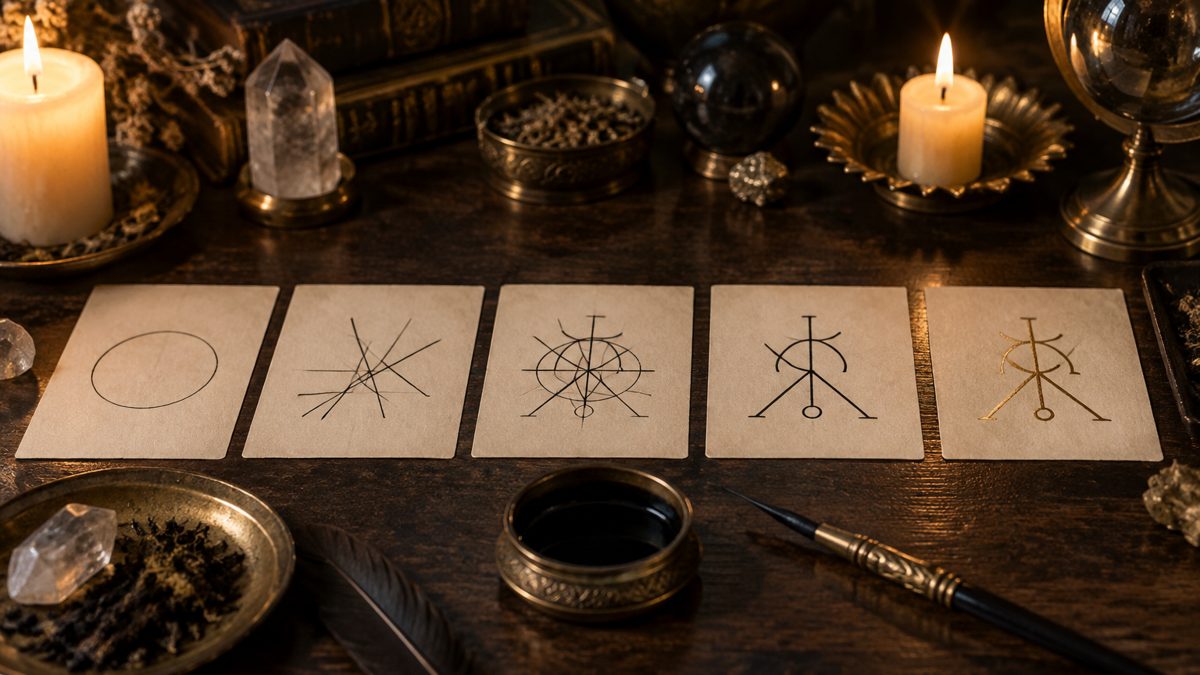
A sigil is a symbol created or chosen to represent an intention, name, power, or idea. In contemporary personal practice, making one often means turning a short statement into an abstract design, then using that design in a meaningful ritual. Some people understand this as magic; others approach it as creative reflection or a reminder of a commitment. You do not need to settle that question before picking up a pencil.
En Crossroads Journal abordamos la creación de sigilos como un punto de encuentro entre la tradición, la creencia y la práctica personal. Un símbolo puede ayudarte a dar forma a algo difícil de expresar, pero no puede garantizar un resultado ni reemplazar la acción práctica. Un sigilo para encontrar trabajo va junto a las solicitudes y la preparación de entrevistas. Un sigilo para la calma puede acompañar una rutina tranquila sin ocupar el lugar de la atención adecuada a la salud mental.
Esta guía enseña un método accesible basado en letras, y explica dónde se sitúa ese método dentro de una historia mucho más amplia. Pasarás de elegir una intención a dibujar, usar y revisar tu símbolo. También hay un ejemplo práctico que puedes seguir sin copiar su diseño final. La habilidad artística es opcional: una marca algo torcida que signifique algo para ti es totalmente adecuada para este ejercicio.
Treat the instructions as a framework rather than a test of spiritual ability. You can omit candles, change the wording, keep the finished design, or stop if the process becomes uncomfortable. For alternative approaches, use the companion reference page, Sigil Methods. Here, the emphasis is on making one thoughtful, manageable sigil from beginning to end, with enough context to understand your choices.
Looking for the meaning of a single card or ingredient? Keep our Métodos de sigilos guide open beside you.
1. Understand What a Sigil Is
The word sigil comes from the Latin sigillum, meaning a seal or small sign. Historically, the term has been applied to different kinds of symbolic marks, including signs associated with spirits, planetary powers, and ritual authority. These were not all made by reducing an intention to letters. A symbol copied from a historical magical text and a personal design made this afternoon may both be called sigils, but their purposes and contexts can differ considerably.
En la magia ritual europea medieval y de principios de la era moderna, los sellos y caracteres podían formar parte de sistemas elaborados que implicaban oraciones, momentos precisos, materiales y supuestos religiosos o cosmológicos específicos. Otras culturas tienen sus propios diseños talismánicos, sagrados y protectores, que no deberían reetiquetarse automáticamente como sigilos. Una apariencia similar no establece un significado compartido. Al estudiar un símbolo desconocido, busca su nombre, su origen y su uso antes de suponer que es una decoración mágica de uso general.
The intention-based method popular today is strongly associated with the English artist and occultist Austin Osman Spare, whose work influenced later chaos magic practitioners. Many contemporary versions simplify or adapt those ideas, sometimes combining them with journaling, meditation, or art. This guide presents one such modern adaptation, not an unchanged ancient formula. If historical accuracy matters to your practice, distinguish what a source actually teaches from later interpretations and your own additions.
2. Choose an Intention Within Your Influence
Begin with one area of life where you want to act differently or bring more attention. Useful starting points include preparing for an exam, maintaining a creative habit, speaking clearly in meetings, or protecting time for rest. Broad wishes such as happiness or success can be meaningful, but they are difficult to translate into a workable practice. Ask what a small, recognizable expression of that wish would look like during an ordinary week.
Keep the intention centered on your choices rather than another person's obedience. Instead of trying to make a particular person love you, consider your readiness for reciprocal connection or your willingness to communicate honestly. Instead of trying to defeat a colleague, focus on preparing your work and asserting appropriate boundaries. This does not mean you control every outcome. It means your sigil points toward something you can support without overriding someone else's autonomy.
Choose a scale that leaves room for real life. An intention to study regularly is more useful than a demand never to feel distracted again. Consider resources, disability, caring responsibilities, and circumstances outside your control. For a first attempt, select a low-stakes habit rather than a frightening emergency. If your situation involves danger, serious illness, debt, or legal trouble, prioritize qualified help and practical safeguards; symbolic work can be an optional accompaniment.
- 1. Escribe en una sola frase el área de la vida que quieres abordar.
- 2. Identifica un comportamiento o una decisión que podría respaldarla.
- 3. Check that the intention respects consent and does not depend on controlling someone else.
- 4. Choose a modest time frame for reviewing your actions, such as one or two weeks.
3. Gather Simple, Suitable Materials
The basic materials are paper, a pencil or pen, and a surface on which to draw. Scrap paper is useful for experiments, and an eraser can help if you enjoy revising. A notebook gives you a place to record your intention and later observations. You do not need special ink, crystals, expensive tools, or purchased spellwork. Keeping the setup simple makes it easier to notice whether the practice itself suits you.
Optional materials might include a ruler, tracing paper, colored pencils, or a small envelope for storing the finished symbol. Choose additions because they help you work comfortably or carry a personal association. Blue might suggest steadiness to you, while a circle might suggest continuity. Such associations vary between people and traditions; they are not universal instructions. Ordinary paper and black ink are as appropriate as a carefully decorated ritual journal.
Planifica según tu entorno real. Si compartes casa, usa un cuaderno portátil en lugar de una exhibición permanente que pueda provocar preguntas no deseadas. Si el trabajo de motricidad fina te resulta difícil, prueba con formas grandes, una herramienta de dibujo digital o la disposición de trozos de papel. Evita aplicar tintas comunes sobre la piel, los alimentos o los recipientes para beber. Las velas y el incienso son innecesarios, sobre todo si hay sensibilidades respiratorias, mascotas curiosas, niños o normas de alquiler que prohíban las llamas.
4. Prepare Your Space and Attention
La preparación puede ser ordinaria y breve. Despeja el espacio suficiente para tus materiales, silencia las notificaciones evitables y date un punto de parada razonable. Diez o veinte minutos sin prisa pueden bastar para un primer diseño. No necesitas dejar tu casa impecable ni esperar un estado de ánimo perfecto. El propósito es reducir las distracciones, no demostrar que estás espiritualmente limpio o limpia o que mereces empezar.
Algunos practicantes prefieren lavarse las manos, decir una breve oración o colocar un objeto significativo cerca. Otros simplemente se sientan y escriben la fecha. Estas acciones pueden marcar la transición hacia un trabajo enfocado, pero ninguna es un requisito para que sea eficaz. Si usas una oración o una forma ritual propia de una tradición, comprende su contexto en lugar de tomar prestadas palabras desconocidas por la atmósfera. Basta con una declaración sencilla de que te tomas un tiempo para reflexionar.
Settle into a comfortable posture and notice your surroundings. Breathe normally rather than forcing deep breaths or holding your breath. If closing your eyes feels unpleasant, keep them open. You should remain able to stop, move, or answer a necessary interruption. If you feel panicky, unreal, or overwhelmed, put the work aside and return to something familiar. Intensity is not a measure of skill, and distress does not mean a ritual is progressing.
- 1. Clear a small drawing area and place your supplies within reach.
- 2. Decide cuánto tiempo quieres dedicar y qué harás después.
- 3. Notice your feet, your seat, and a few ordinary objects around you.
- 4. Lee la intención que elegiste y comprueba que todavía te parezca apropiada.

5. Turn Your Intention Into a Clear Sentence
Write a short sentence expressing what you want to practice or encourage. Concrete language is usually easier to work with than a complicated declaration. For example, I begin my writing session with ten minutes of work identifies an action more clearly than I unlock limitless creative greatness. You can keep qualifications and practical details in your journal rather than squeezing every concern into the sentence that will become your design.
Many modern instructions recommend present-tense, affirmative wording. You may find that useful because it emphasizes a desired action rather than an unwanted condition. However, there is no established rule that negations confuse a supernatural mechanism or that a particular tense guarantees results. Choose wording that is honest enough to sit with comfortably. I practice speaking clearly may feel more believable and useful than I am perfectly confident in every conversation.
Read the sentence aloud or silently and look for hidden pressure. Words such as always, never, instantly, and perfectly can turn a supportive intention into an impossible demand. Also check for accidental bargains: you do not need to promise pain, deprivation, or sacrifice in exchange for success. Once the sentence expresses your aim, stop polishing. Endless rewriting can become a way of avoiding the ordinary action the sigil was meant to support.
- 1. Draft two or three short versions of your intention.
- 2. Choose the version that most clearly describes a helpful direction or behavior.
- 3. Remove unnecessary demands, exaggerated promises, and attempts to control others.
- 4. Copy the final sentence into your journal before transforming its letters.
6. Reduce the Sentence to a Set of Letters
One common modern method removes spaces, punctuation, vowels, and repeated letters, leaving a smaller set of forms to combine. Other versions retain vowels or use different reduction rules. There is no single universally correct sequence. For your first attempt, choose one convention and follow it consistently. Here, we will remove A, E, I, O, and U, then keep only the first occurrence of each remaining letter.
Write the sentence in capitals if that makes the shapes easier to see. Cross out vowels, then scan the remaining letters from left to right, recording each different letter once. Treat Y as a consonant for this exercise; another method may handle it differently. The result is a design toolkit, not a secret code that must be decoded later. You may rotate, overlap, simplify, or partially merge these letterforms during drawing.
If your intention uses a different language or writing system, do not force it into English spelling unless you want to. Vowel removal does not translate neatly across all scripts. You can instead simplify selected written forms, combine meaningful words visually, or use an image-based approach from Sigil Methods. The important point is to understand your chosen process, rather than assuming a method designed around the Latin alphabet must apply everywhere.
- 1. Copia tu intención final de forma claramente legible.
- 2. Elimina los espacios, la puntuación y las vocales A, E, I, O y U.
- 3. Move from left to right and keep each remaining letter only the first time it appears.
- 4. Write the reduced letter set separately so you can experiment without losing your place.
7. Build and Refine the Symbol
Begin by treating the letters as shapes rather than as readable text. An M offers diagonals, an R offers a curve and a slanting leg, and a T offers a crossbar. Place two forms on top of each other and look for shared lines. Rotate a letter, lengthen a curve, or let one stroke serve more than one purpose. Your first sketches can be awkward; exploration matters more than producing an impressive emblem.
Haz varias versiones pequeñas en lugar de corregir una y otra vez un dibujo grande. Prueba un diseño compacto, uno más abierto y una versión construida en torno a una sola línea vertical. Conserva suficiente conexión con tu conjunto de letras para que el proceso resulte significativo, pero no te preocupes si cada letra se vuelve difícil de identificar. Algunos practicantes prefieren la abstracción completa, mientras que otros conservan una inicial visible o un motivo reconocible. Ninguna de las dos opciones establece un mayor poder mágico.
Select the design that feels coherent and is reasonably easy to redraw. Remove stray details that contribute nothing, then test it at the size you intend to use. Avoid mistaking complexity for significance. If the result resembles a familiar hate symbol, commercial logo, or sacred emblem you did not mean to invoke, revise it, especially before displaying it publicly. Accidental resemblance is a design issue, not evidence that an outside force has intervened.
- 1. Dibuja de tres a seis combinaciones rápidas con tus letras reducidas.
- 2. Experimenta con la rotación, los trazos compartidos, las curvas y el espaciado.
- 3. Choose one version and simplify any unnecessary marks.
- 4. Redraw it on clean paper, leaving enough space around it to see the whole design.
8. Sigue un ejemplo completo paso a paso
Suppose your aim is to establish a small creative routine. Your practical plan is to keep a notebook beside your breakfast place and write for five minutes afterward. For the sigil itself, you choose the concise sentence I WRITE DAILY. This is a direction for practice, not a prediction that illness, travel, or fatigue will never interrupt you. In your journal, you also note that missing a day will not require punishment or starting everything over.
Removing spaces produces IWRITEDAILY. Removing A, E, I, O, and U leaves WRTDLY. There are no repeated consonants in that sequence, so the final set remains W, R, T, D, L, Y. You can check the reduction once, then move on. If you notice a harmless copying difference later, you may revise it or keep the design as a personal variation; a clerical mistake is not a dangerous omen.
For one possible design, use a tall stem shared by T, D, and L. Add a short crossbar near its top, curve the D around its right side, and give the base a small rightward foot. Place a shallow W beneath it, fork the top into a Y, and add a diagonal leg suggesting R. Simplify any crowded area. Your drawing will likely differ from someone else's interpretation, which is entirely acceptable.
- 1. Record the intention I WRITE DAILY and the supporting five-minute writing plan.
- 2. Reduce la frase a WRTDLY con el método anterior.
- 3. Sketch three arrangements, then choose the easiest one to recognize and redraw.
- 4. Dedica un breve momento de atención al símbolo terminado y luego completa una sesión de escritura de cinco minutos.
- 5. Revisa la rutina después de una semana, anotando oportunidades, obstáculos y sesiones de escritura reales.
9. Give the Sigil a Deliberate Moment of Attention
Muchos practicantes llaman a esta etapa carga o activación. Dentro de la creencia mágica, puede entenderse como dirigir la intención hacia el símbolo. En una interpretación no sobrenatural, puede ser una transición deliberada de la planificación al compromiso. Ninguna de las explicaciones exige afirmar que el proceso tenga efectos comprobados sobre los acontecimientos externos. Para quien empieza, un ejercicio tranquilo y acotado es más apropiado que un intento de inducir un estado extremo o desconocido.
Place the sigil where you can see it comfortably. Read your intention once, then look at the design without trying to force a sensation. Notice its outline, the movement of its strokes, and what the intention asks of you in daily life. After a short interval, mark the end by putting down your pen, closing your notebook, or saying that the exercise is complete. Feeling ordinary afterward is not a failure.
Puedes incluir una breve oración si eso forma parte de tu práctica, pero evita inventar obligaciones que te sientas forzado a cumplir más tarde. No hace falta dolor, privación de sueño, intoxicación, hiperventilación ni ayunos prolongados. Un temporizador puede ayudar si tiendes a repetir los rituales hasta que se sientan exactamente bien. Termina con algo concreto y amable, como estirarte, beber agua o realizar la primera acción práctica asociada a tu intención.
- 1. Sit comfortably with the finished symbol in view.
- 2. Read the intention once and reflect on the action it represents.
- 3. Mira el diseño durante unos treinta segundos a dos minutos, deteniéndote antes si te resulta incómodo.
- 4. Close the exercise with a simple gesture and return to ordinary activity.
10. Decide Whether to Keep, Display, or Release It
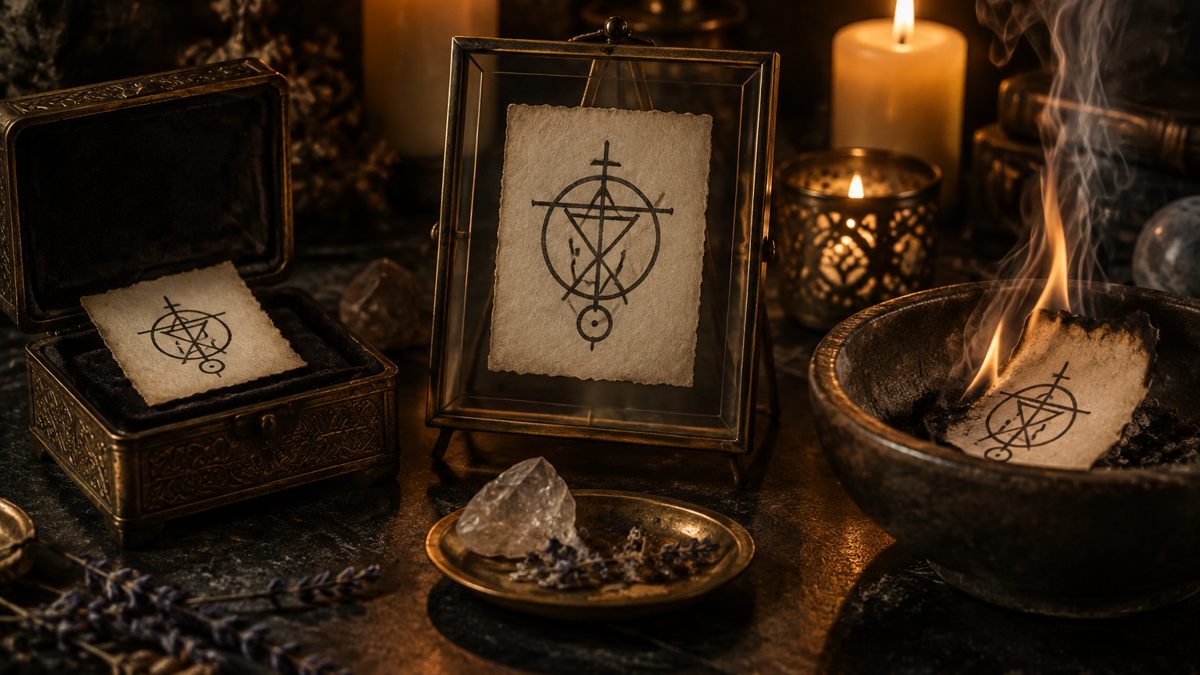
Distintos métodos dan consejos diferentes sobre lo que sucede después. Algunos enfoques de la magia del caos enfatizan sacar la intención de la atención consciente tras el ritual. Otras prácticas personales mantienen el sigilo visible como recordatorio. Son modelos de trabajo distintos, no instrucciones que debas cumplir de algún modo simultáneamente. Elige un papel antes de empezar: el símbolo puede ser un objeto ritual privado, una señal práctica o una obra de arte asociada con tu intención.
For a reminder-based practice, place the design near the relevant activity: inside a study notebook, beside a musical instrument, or on your own calendar. Avoid displaying confidential intentions in shared workplaces or homes unless you are comfortable discussing them. For a release-based practice, put it in an envelope or close the journal. You do not need to force yourself to forget. Remembering your intention is normal and does not invalidate the exercise.
La destrucción es opcional. Romper papel común o reciclarlo, donde las normas locales lo permitan, puede dar un final claro sin fuego. No arrojes papel, listones, cera ni purpurina a cursos de agua o espacios al aire libre. Enterrar los materiales también puede introducir basura o sustancias no deseadas en el suelo. Si la intención cambia, puedes retirar el sigilo con una breve nota en tu diario. No necesitas una limpieza de pago, un contrahechizo ni un elaborado ritual de desecho.
11. Interpret Results Without Turning Everything Into a Sign
Evaluate the practice by returning to the intention and the actions you recorded. Did you write more often, prepare more consistently, or remember a boundary at a useful moment? Also note what did not change. A favorable event after a ritual does not demonstrate that the ritual caused it. Timing, chance, other people's choices, and your own behavior all matter, and a personal journal cannot isolate those influences with scientific certainty.
Dreams, coincidences, and emotional shifts may feel meaningful, and you can record them as experiences without treating them as instructions or predictions. Distinguish observation from interpretation: noticing a repeated image is one thing; concluding it guarantees a job offer is another. If an apparent sign would lead you to spend money, abandon treatment, confront someone, or take a serious risk, pause and seek ordinary evidence and appropriate advice.
Si el resultado deseado no se produce, no supongas que te faltó fe o que atrajiste el fracaso. Revisa si la intención era realista y si el plan de apoyo necesitaba más tiempo, recursos o ayuda. A veces el resultado más útil es darte cuenta de que no quieres la meta original. Volver a dibujar un símbolo una y otra vez para aliviar el miedo puede resultar angustiante en lugar de reconfortante. Si el ritual se siente obligatorio o interfiere con la vida diaria, da un paso atrás y considera buscar apoyo profesional.
12. Avoid Common Mistakes and Keep the Practice Safe
Common beginner mistakes include crowding several goals into one sigil, searching endlessly for the perfect shape, and making new symbols instead of taking practical steps. Another is believing that every extra ingredient increases effectiveness. Start with one intention and one design, then allow time to observe your experience. If the activity becomes expensive, exhausting, or frightening, simplify it. No seller or practitioner can legitimately guarantee supernatural results, and threats of unavoidable misfortune are a warning sign.
El fuego es innecesario. Si eliges una vela, usa un soporte estable y resistente al calor sobre una superficie despejada, bien lejos del papel, la tela, los niños y las mascotas, y nunca la dejes sin vigilancia. Evita quemar el sigilo, sobre todo si contiene tintas, recubrimientos, pegamento o materiales sintéticos desconocidos. El incienso y el humo pueden irritar los pulmones y afectar a los animales; la ventilación no vuelve seguros todos los productos. Una vela sin encender o una lámpara de escritorio común pueden marcar la ocasión sin combustión.
Las hierbas, los aceites y la sal también requieren cuidado. Natural no significa seguro para tragar, quemar o aplicar sobre la piel. No ingieras mezclas rituales ni añadas sustancias desconocidas al agua del baño, a la comida o a las bebidas; los aceites esenciales y algunas plantas pueden ser dañinos, en particular para las mascotas. Mantén la sal y el agua salada lejos de plantas y suelo. Respeta el consentimiento y la propiedad: no escondas sigilos entre las pertenencias de otra persona, no marques espacios compartidos sin permiso ni uses materiales corporales de otra persona.
13. Keep a Useful Journal and Develop Your Own Approach
A useful journal entry records the date, intention, reduction rule, sketch, and reason for choosing the final design. Add the practical action that will accompany it and the date you plan to review. You may record mood or personal associations, but you do not need to document every passing thought. Keep sensitive information secure, especially if your notes involve relationships, health, or work. Initials and general descriptions can protect other people's privacy.
At review time, compare your experience with the original aim rather than rewriting the aim to fit whatever happened. Include uneventful attempts as well as memorable ones. Ask whether the symbol helped you remember a commitment, whether the process was enjoyable, and whether any part created pressure. Your record may reveal that a visible reminder suits you better than a release ritual, or that drawing alone provides the reflection you were seeking.
Desarrolla tu enfoque poco a poco. Cambia una característica a la vez si quieres comparar experiencias, y usa Métodos de sigilos cuando estés listo o lista para explorar un proceso de construcción diferente. Lee las fuentes históricas prestando atención al contexto y mantén claramente identificadas como tuyas las adaptaciones personales. También puedes decidir que hacer sigilos no te resulta útil. Una práctica reflexiva deja espacio para la curiosidad, la revisión y el abandono; no exige miedo ni certeza.
- 1. Record what you made, how you made it, and what you intended to do alongside it.
- 2. Choose a review date that discourages constant checking.
- 3. Note concrete actions and outcomes separately from feelings and symbolic interpretations.
- 4. Decide whether to continue, revise, retire, or simply enjoy the design as artwork.
These practices are shared as tradition and personal reflection, not as a substitute for medical, legal or financial advice.
Sigue aprendiendo
- Métodos de sigilos
- How to read tarot cards
- How to use angel oracle cards
- Cómo leer las cartas de la baraja
- Cómo usar cristales en hechizos
- Cómo usar hierbas en la brujería
- How to read the Dr. Moorne Egyptian Tarot
- How to read dice
- How to read tea leaves
- Cómo usar un péndulo
- Cómo lanzar un hechizo con velas
- How to make a spell jar
- How to make a sigil
- How to cleanse your home
- How to set up an ancestor altar
- How to open a sacred space
- How to time spells with the moon
- How to work with water and salt
- How to make a protection charm bag
- Read the Journal o visita la shops