How-To Guide
How to Read Tea Leaves
Por Seraphina
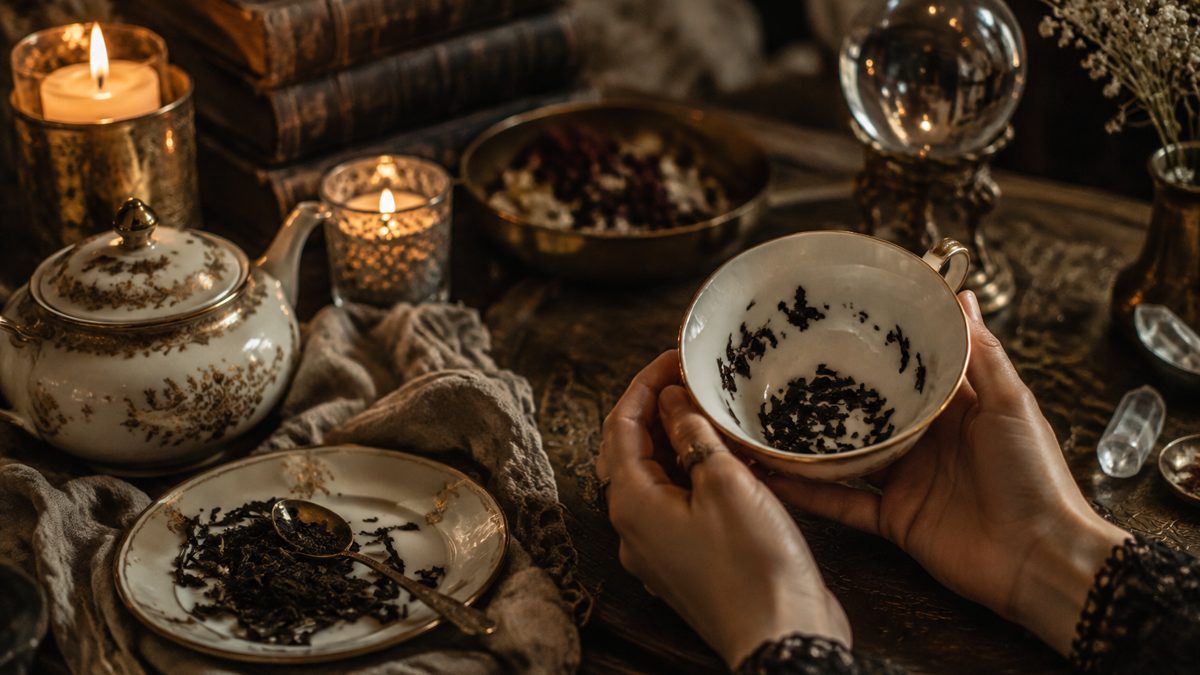
Reading tea leaves begins with an ordinary pleasure: making a cup of tea and giving yourself time to notice it. After the tea is mostly finished, the leaves left behind form shapes that a reader interprets through symbolism, association, and context. You do not need an elaborate collection of tools or a special gift to begin exploring this traditional practice.
Llamada a menudo tasografía o tasomancia, la lectura de hojas de té pertenece a una familia más amplia de prácticas que interpretan patrones en tazas. Algunas personas la abordan como adivinación; otras, como un ritual reflexivo o una conversación creativa consigo mismas. No existe evidencia científica establecida de que las hojas de té predigan acontecimientos futuros. Su valor práctico puede residir en las preguntas, conexiones y posibilidades que te ayudan a considerar.
This guide takes you from choosing a suitable cup to recording a complete reading. Along the way, you will learn how different traditions organize the cup, how to recognize shapes without forcing them, and how to turn an impression into a thoughtful interpretation. The aim is not to memorize every possible symbol, but to develop a consistent, gentle way of looking.
Keep the companion reference page, Tea Leaf Symbols and Meanings, nearby when you want ideas for a particular image. Use it as a starting point rather than a final authority: a bird, bridge, or tree can mean different things in different contexts. Your question, personal associations, and the surrounding patterns all deserve a place in the reading.
Looking for the meaning of a single card or ingredient? Keep our Símbolos de las hojas de té guide open beside you.
1. Comprende la historia sin convertirla en un único relato de origen
Tea-leaf reading has no neatly documented beginning that explains every modern practice. Tea drinking has a long history in China, but that fact alone does not establish where the familiar method of swirling leaves in a handled cup originated. Accounts that give one ancient date, one inventor, or an unbroken universal lineage usually simplify a more complicated story.
La forma reconocible en muchas guías en inglés se desarrolló junto con la expansión del consumo de té por Europa y Gran Bretaña. El entretenimiento doméstico, las costumbres de adivinación y los manuales impresos posteriores ayudaron a difundir métodos y listas de símbolos. Las salas de té comerciales y los lectores especializados también contribuyeron a su visibilidad. Distintos hogares podían compartir el proceso básico y discrepar en casi todos los detalles de la interpretación.
Related practices read coffee grounds or other beverage sediment, including traditions associated with Turkish coffee and communities across the Balkans and Middle East. These practices have their own histories and social settings; they should not be treated as interchangeable versions of one generic ritual. Learning from a particular community means respecting its terminology, customs, and boundaries.
You may encounter instructions to use the left hand, turn the cup clockwise, or swirl exactly three times. Such rules can be meaningful within a family or teaching tradition, but they are not universal requirements. When learning, distinguish between a documented custom, a modern reader's preference, and your own adaptation. That distinction keeps the practice both honest and welcoming.
2. Gather a simple, workable tea-reading kit
Start with a clean, light-colored cup and a matching saucer. A broad bowl with a smooth interior makes leaves easier to see than a narrow mug with dark glaze or busy decoration. A handle provides a convenient reference point for mapping the cup. Ordinary household crockery is perfectly suitable; you do not need an antique fortune-telling cup.
El té negro en hebras es una buena opción para empezar porque sus trozos más oscuros suelen destacar contra una taza clara. Elige hojas pequeñas o medianas en lugar de polvo fino de té o de hojas enrolladas muy grandes. Las hojas grandes pueden formar unos pocos cúmulos voluminosos, mientras que el polvo fino puede cubrir la superficie de manera tan pareja que resulta difícil reconocer formas distintas.
You will also need drinking water, a kettle, a teaspoon, a timer if you use one, and a notebook. A tray or washable cloth can catch drips during inversion. Good daylight or a steady lamp helps you see the actual pattern. A phone camera is optional, but photographs make it easier to revisit your observations without reconstructing them from memory.
Use tea sold for drinking, and check its ingredients if it contains flavorings, flowers, or herbs. Avoid adding glitter, essential oils, unknown plants, or craft materials to a cup you will drink from. If you prefer not to consume caffeine, a familiar food-grade caffeine-free infusion can work, though its pieces may behave differently. Safety matters more than achieving a traditional appearance.
3. Prepare your space and choose a useful question
Elige una mesa estable donde puedas manejar agua caliente y examinar la taza con comodidad. Despeja espacio suficiente para la tetera, el platillo y el cuaderno. Silencia las notificaciones si eso te ayuda a serenarte, pero no confundas una atmósfera elaborada con un requisito. Una tranquila mesa de cocina es tan adecuada como un espacio ritual cuidadosamente dispuesto.
Antes de preparar el té, decide qué quieres que explore la lectura. Las preguntas abiertas suelen conducir a una reflexión más útil que las exigencias de una predicción fija. Prueba a preguntar qué merece atención en un proyecto creativo, cómo podrías abordar un cambio próximo o qué apoyo has pasado por alto. Mantén la pregunta lo bastante acotada para que las imágenes tengan un contexto significativo.
Evita usar la taza para establecer los pensamientos privados de otra persona, demostrar una infidelidad, diagnosticar una enfermedad o resolver una decisión financiera urgente. Los patrones del té no pueden verificar esas cosas. Si una situación requiere pruebas, asesoramiento profesional o una conversación directa, empieza por ahí. Una lectura puede explorar tus sentimientos sobre la situación sin fingir que aporta los datos que faltan.
Take a few easy breaths and notice your present mood. There is no need to empty your mind or enter a special state. Simply recording that you feel hopeful, anxious, tired, or distracted can help later, because mood influences which shapes you notice and what stories you attach to them.
- 1. Clear and wipe the table, then arrange the cup, saucer, tea, and notebook within comfortable reach.
- 2. Write one open-ended question in your notebook before looking for any symbols.
- 3. Note your mood and any outcome you are especially hoping for or afraid of.
- 4. Decide que puedes detenerte, hacer una pausa o dejar la lectura sin concluir.
4. Prepara el té y bébelo con comodidad
For a first attempt, use roughly half a teaspoon of loose tea in a small cup, then adjust future servings to suit the leaf size and your taste. Too many leaves can cover the interior; too few may leave little to examine. This is a practical starting point, not a spiritually significant measurement or a strict brewing rule.
Heat the water according to the tea's instructions and pour carefully, leaving room below the rim. Let the tea steep as directed, remembering that unstrained leaves will continue brewing while you drink. If it becomes unpleasantly strong, use fewer leaves or a milder tea next time. There is no benefit in forcing yourself to finish a bitter cup.
For the clearest first reading, keep the tea plain. Milk can obscure the interior, and undissolved sweeteners or other additions may create marks that are not leaves. If you need a sweetener, dissolve it fully and note that choice. This recommendation is about visibility, not ritual purity; your comfort and dietary needs remain more important.
Allow the tea to cool to a safe drinking temperature. Sip slowly, letting the leaves settle between sips, and leave a small amount of liquid with the sediment. You do not need to swallow any leaves. If loose leaves bother you, brew strained tea for drinking and add a small spoonful of the cooled, wet leaves afterward, clearly treating this as an adapted method.
- 1. Put a modest amount of food-grade loose tea into the clean cup.
- 2. Añade agua a la temperatura recomendada y deja reposar el té.
- 3. Wait until it is comfortable to drink, then sip without deliberately swallowing leaves.
- 4. Stop with the leaves and about a teaspoon or two of liquid remaining; adjust if the leaves cannot move freely.
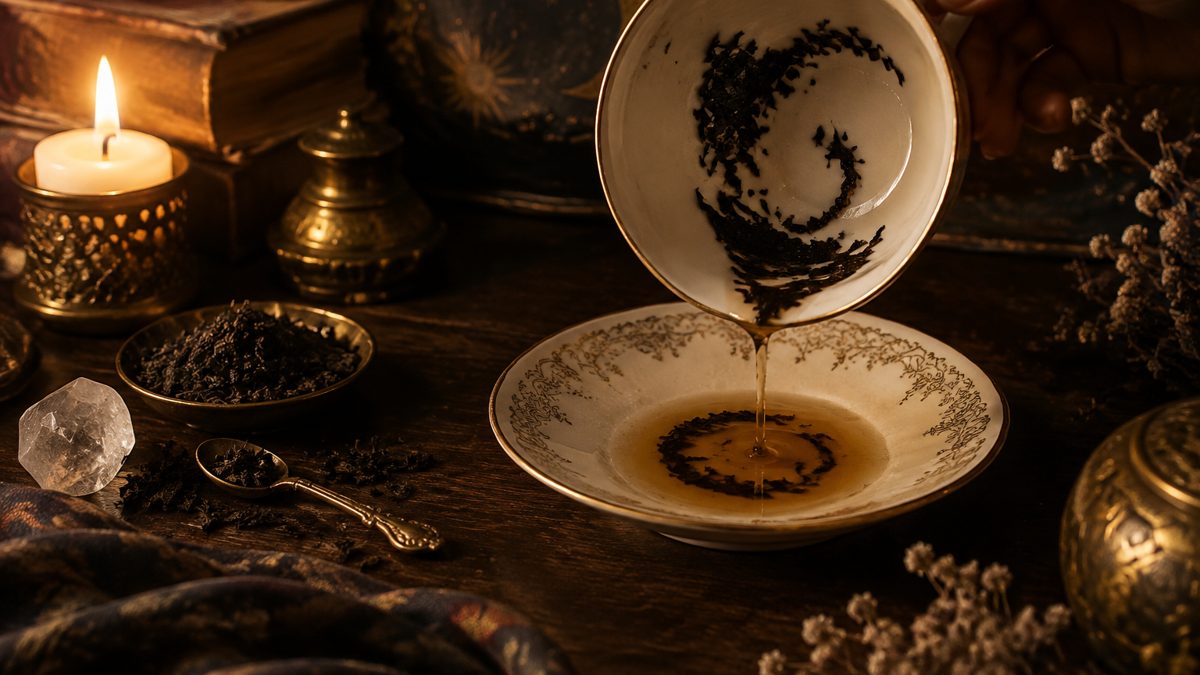
5. Gira, escurre y revela el patrón
Once only a little liquid remains, gently rotate the cup so the wet leaves travel around its interior. The aim is to distribute them, not fling them over the rim. Many modern instructions suggest three swirls, sometimes with a particular hand or direction. You may follow that convention, but consistency matters more than the number.
Place the saucer on a stable surface before turning the cup over. If the cup still holds enough liquid to spill widely, carefully pour off a little first. Invert the cup onto the saucer and allow it to drain briefly. Around half a minute is a useful experiment, although leaf size and cup shape will affect the result.
Lift the cup slowly and keep the saucer beneath it until any final drips stop. Some leaves will cling to the walls, some will gather near the base, and some may fall onto the saucer. For a first reading, focus only on the cup. Including the saucer is an optional extension, not something you must interpret.
Resist the urge to rearrange awkward leaves or repeat the process until you get an attractive image. The original arrangement is your observation material, including its blank spaces and ambiguity. If everything slides into one wet lump, you can acknowledge a preparation problem and try again later rather than inventing a meaning for a technical mishap.
- 1. Sostén con firmeza la taza ya enfriada y haz girar suavemente el líquido restante por el interior.
- 2. If following a three-swirl convention, complete three comfortable rotations without splashing.
- 3. Voltea la taza boca abajo sobre el platillo y deja que escurra el exceso de líquido.
- 4. Lift it carefully, photograph the untouched pattern, and begin with a whole-cup observation.
6. Choose a cup map before interpreting individual symbols
Un mapa de la taza da a las posiciones un papel simbólico constante. Una convención moderna común trata el asa como referencia de la persona que recibe la lectura, a menudo llamada consultante. Los patrones cercanos a ella pueden asociarse entonces con preocupaciones personales, el hogar o la experiencia inmediata. Otros lectores asignan significados distintos, así que anota el mapa que elijas en lugar de suponer que es universal.
Otra convención conocida asocia el borde con los asuntos cercanos, las paredes medias con las situaciones en desarrollo y la base con las preocupaciones más duraderas o profundas. Son categorías simbólicas, no relojes fiables. Evita convertir la distancia exacta de una hoja al borde en una fecha prometida. Por lo general basta una distinción amplia entre las preocupaciones inmediatas y las de fondo.
Algunos sistemas interpretan los lados izquierdo y derecho como pasado y futuro, vida interior y exterior, o lo que se va y lo que llega. No necesitas todas estas capas a la vez. De hecho, combinar varios mapas incompatibles puede permitirte justificar casi cualquier conclusión. Empieza con la referencia del asa y tres zonas de altura, y añade complejidad solo si sigue siendo útil.
Set the handle toward you when you first record positions. You can rotate the cup to inspect a shape, but note where that shape sits in the original orientation. Otherwise, a cluster may migrate from one symbolic area to another simply because you turned the cup. A quick sketch with a marked handle prevents this common confusion.
7. Busca formas sin forzar el reconocimiento
Begin with the whole arrangement rather than hunting immediately for a heart or a familiar animal. Is the cup sparse or crowded? Are most leaves near the rim, scattered across the walls, or concentrated at the base? Notice lines, clusters, gaps, and connections. These observations give individual shapes a setting instead of leaving them as isolated dictionary entries.
Next, identify two or three clear forms. A branching line might resemble a tree; an arch might suggest a bridge; a compact cluster with an extending point could look like a bird. Describe the visible features before naming the object. Writing 'curved line joining two clumps' is more precise than jumping straight to 'a successful reunion.'
Las personas reconocemos naturalmente formas familiares en patrones ambiguos, una tendencia que a menudo se llama pareidolia. Eso no hace que el ejercicio carezca de valor, pero explica por qué distintos lectores pueden ver cosas diferentes en la misma taza. Trata el reconocimiento como una interpretación imaginativa y no como prueba de que un mensaje externo se ha colocado ahí específicamente para ti.
If a shape only appears after repeated turning, squinting, and persuasion, mark it as uncertain or leave it out. You are allowed to see nothing recognizable in part of the cup. Empty space does not automatically mean loneliness, and an untidy cluster does not automatically signal trouble. Good observation includes knowing when there is too little information.
8. Interpreta los símbolos según el contexto, no con veredictos fijos
Once you have identified a plausible image, explore three sources of meaning: the associations found in a chosen reference, your personal response, and the reading's question. A tree, for example, can suggest growth, roots, family, shelter, or gradual development. In a question about studying, steady learning might be a more relevant association than family history.
Consult Tea Leaf Symbols and Meanings for possibilities, but do not keep searching through references until you find the answer you want. Symbol lists often disagree because they reflect different authors and traditions. Choose an interpretation that fits the visible shape and question, while acknowledging reasonable alternatives. A reference should broaden your thinking, not overrule your judgment.
Consider how images relate spatially. A bridge beside two separate clusters could invite reflection on connection between groups. A winding line near a tree might suggest a gradual route toward stability. These are constructed symbolic narratives, not facts about future events. Keep the language exploratory: 'This could reflect' is more responsible than 'This proves.'
Termina traduciendo la lectura en una pregunta o una acción bajo tu control. Si un pájaro te hace pensar en comunicación, quizá necesites redactar un correo o pedir una aclaración. La taza no puede garantizar una respuesta. Una interpretación útil aumenta tu capacidad de elegir con reflexión en lugar de hacerte sentir dependiente de las señales.
9. Sigue un ejemplo práctico desde la taza hasta la acción concreta
Imagina una lectura de práctica con la pregunta: “¿Qué merece mi atención al comenzar un proyecto de escritura compartido?”. Es un ejemplo ilustrativo, no el relato de la experiencia de un cliente real. El lector usa el asa como punto de referencia personal, el borde para las preocupaciones inmediatas, la parte media para los asuntos en desarrollo y la base para los temas de fondo.
Near the rim and handle, a small cluster resembles a bird, though it could also be a leaf. Halfway down the opposite wall, an arch appears to join two groups of tea leaves. At the base, a branching shape looks more clearly like a tree. The reader records those observations and labels the bird identification as uncertain.
Using familiar symbolic associations, the reader considers communication for the bird, cooperation for the bridge, and steady growth for the tree. In the context of a shared project, those ideas suggest discussing expectations, connecting different working styles, and allowing time for development. Another plausible tree association is established habits, which raises a useful question about whose routines will shape the collaboration.
The final interpretation is modest: 'This pattern invites me to clarify communication and create a workable structure before expecting quick progress.' Nothing in the cup establishes whether the project will succeed or whether the collaborator is trustworthy. The practical outcome is to arrange a planning conversation, agree on responsibilities, and set a review date based on the actual schedule.
- 1. Record the question and chosen cup map before interpreting.
- 2. List the bird-like cluster, connecting arch, and branching base shape, including their locations and uncertainty.
- 3. Compare relevant meanings and note at least one alternative interpretation.
- 4. Elige un siguiente paso concreto: conversa con el colaborador sobre funciones, plazos y preferencias de comunicación.
10. Recognize common mistakes and troubleshoot gently
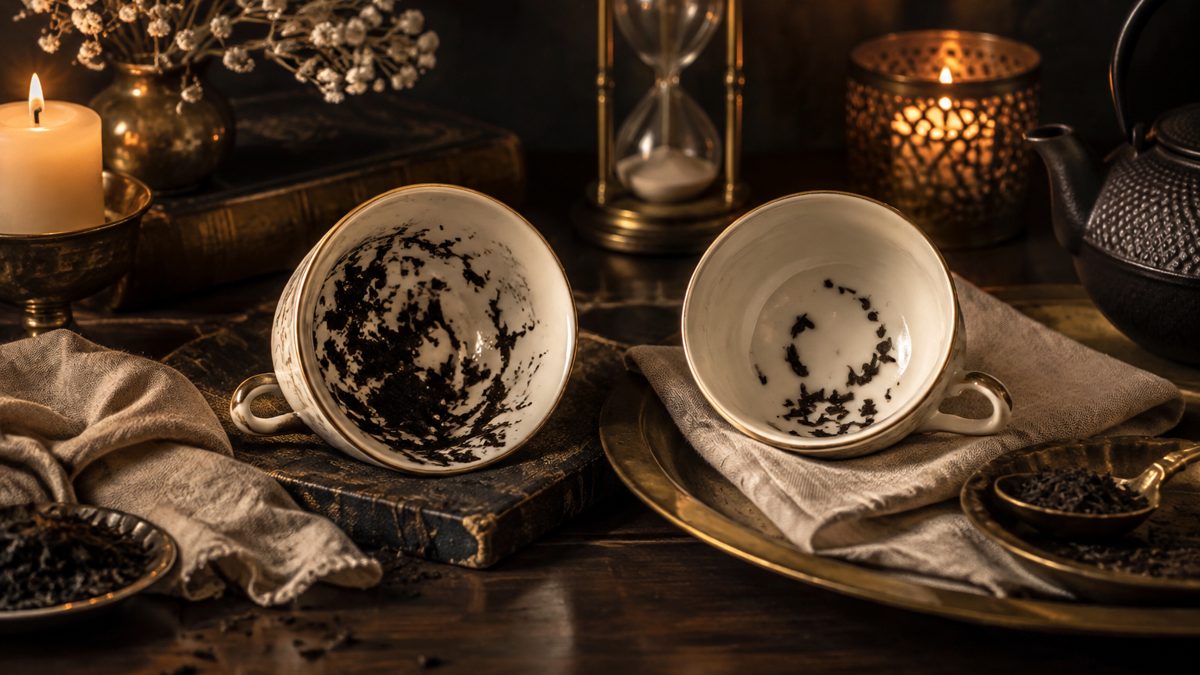
A cup covered in sludge usually calls for a practical adjustment, not a dramatic interpretation. Try less tea, larger leaf pieces, or slightly less remaining liquid. If all the leaves fall onto the saucer, experiment with retaining a little more moisture before inversion. Change one variable at a time so you can learn what works with your particular cup.
Another common mistake is trying to interpret every fragment. A single cup can contain dozens of suggestive marks, and assigning all of them significance produces a confusing story. Choose a few clear images and one or two overall features. A short, coherent reading is often more useful than an elaborate catalogue of symbols that contradict one another.
Be alert to confirmation bias: the tendency to notice details that support what you already believe. If you expect an argument, a pointed cluster may become a weapon while a connecting line goes unnoticed. Write an alternative reading before settling on your preferred one. Ask what you would see if the question concerned friendship rather than conflict.
Repeatedly reading the same question can also turn reflection into reassurance-seeking. If you feel compelled to make another cup until the answer becomes comforting, stop for the day. Return to the real-world information available to you. An unclear reading is not a failure, and you do not owe any pattern a conclusion.
11. Keep the practice physically safe and ethically grounded
Los riesgos más inmediatos son los comunes: quemaduras, derrames, vajilla rota e ingredientes inadecuados. Usa una taza intacta destinada a uso alimentario; las piezas antiguas o decorativas pueden no ser aptas para bebidas calientes. Mantén el agua caliente lejos de niños y mascotas. Espera a que la taza esté cómoda de sostener antes de girarla o voltearla.
Check tea blends for allergens, caffeine, and herbs that may be unsuitable during pregnancy, with particular conditions, or alongside medicines. Familiarity in folklore does not establish safety for ingestion. Ask a pharmacist or qualified clinician when uncertain, and do not drink unidentified foraged plants. Drinking tea is optional; an adapted practice with cooled leaves avoids pressure to consume it.
Candles, incense, and ritual additives are unnecessary. If you use a candle, place it in a stable holder away from loose fabric and never leave it unattended. Avoid smoke where it affects breathing or exposes pets. Never add essential oils or nonfood ritual materials to drinking tea. If your separate ritual uses salt water, do not pour it onto plants or garden soil.
Cuando leas para otra persona, pide permiso, acuerden el tema y deja claro que la lectura es interpretativa y no una predicción verificada. Nunca anuncies muerte, enfermedad, embarazo, maldiciones o un desastre inevitable a partir de una forma. No asustes a nadie para que compre un remedio. Protege su privacidad, evita las promesas y respeta su derecho a rechazar cualquier interpretación que no le resulte útil.
12. Keep a journal that preserves what you actually saw
Un diario de lectura de té ayuda a separar la observación de la interpretación y de la visión retrospectiva posterior. Anota la fecha, la pregunta, el tipo de té, la cantidad aproximada, la taza utilizada y el método de preparación. Incluye tu estado de ánimo y el mapa de la taza. Estos detalles pueden parecer triviales, pero pueden explicar por qué una sesión produce formas definidas y otra apenas un denso grumo de hojas.
Photograph the cup before much handling, ideally from above and from an angle that shows the walls. Note the handle position in each image or sketch. Then list the shapes in plain descriptive language, marking unclear ones. Keep this original record intact rather than rewriting it after subsequent events make one interpretation feel especially compelling.
In a separate paragraph, write the associations you considered and the interpretation you chose. Include alternatives, questions raised, and any action you plan to take. Later, record what happened without treating a broad resemblance as proof of prediction. Remember to notice mismatches, forgotten symbols, and ordinary explanations as carefully as apparent correspondences.
Review several entries for usefulness rather than supernatural accuracy. Did the practice help you identify a concern, prepare a conversation, or slow down before reacting? Did it leave you more anxious? Your journal can show whether the practice supports you. If it repeatedly encourages fear or dependency, changing your approach or taking a break is sensible.
- 1. Record preparation, mood, question, and the mapping convention used.
- 2. Add an unedited photograph or sketch and a factual description of the visible shapes.
- 3. Write possible meanings, uncertainty, and one practical takeaway in a separate interpretation entry.
- 4. Vuelve más tarde para anotar los resultados y su utilidad sin alterar las notas originales.
13. Close the reading and develop your own steady practice
Termina resumiendo la lectura en dos o tres frases. Nombra el tema principal, reconoce lo que sigue siendo incierto e identifica cualquier siguiente paso útil. No necesitas un ritual de cierre dramático. Un sencillo momento de gratitud, una respiración tranquila o cerrar el cuaderno pueden marcar la transición de vuelta a la actividad cotidiana.
Desecha las hojas con cuidado y lava la taza y el platillo. Las hojas de té natural suelen poder ir a un sistema de compostaje doméstico adecuado, pero evita amontonar repetidamente hojas húmedas directamente alrededor de las plantas de interior, donde pueden favorecer el moho. No dejes el té usado reposando mucho tiempo y mantén las hojas con cafeína donde las mascotas no puedan comerlas.
For practice, use the same cup and map for several sessions while varying only what needs practical adjustment. Read occasionally rather than turning every decision into a consultation. You might examine a cup with a trusted friend and compare observations before discussing meanings. Different impressions can teach flexibility, provided neither person insists that their interpretation is the only valid one.
The heart of tea-leaf reading is attentive looking joined with thoughtful storytelling. Tradition offers a framework, reference pages offer possibilities, and experience helps you recognize your own habits of interpretation. Let the cup open a conversation rather than close a decision. The most grounded reading leaves you with room to think, ask questions, and choose your next step freely.
These practices are shared as tradition and personal reflection, not as a substitute for medical, legal or financial advice.
Sigue aprendiendo
- Símbolos de las hojas de té
- How to read tarot cards
- How to use angel oracle cards
- Cómo leer las cartas de la baraja
- Cómo usar cristales en hechizos
- Cómo usar hierbas en la brujería
- How to read the Dr. Moorne Egyptian Tarot
- How to read dice
- How to read tea leaves
- Cómo usar un péndulo
- Cómo lanzar un hechizo con velas
- How to make a spell jar
- How to make a sigil
- How to cleanse your home
- How to set up an ancestor altar
- How to open a sacred space
- How to time spells with the moon
- How to work with water and salt
- How to make a protection charm bag
- Read the Journal o visita la shops