How-To Guide
Como Lançar um Feitiço com Vela
Por Seraphina
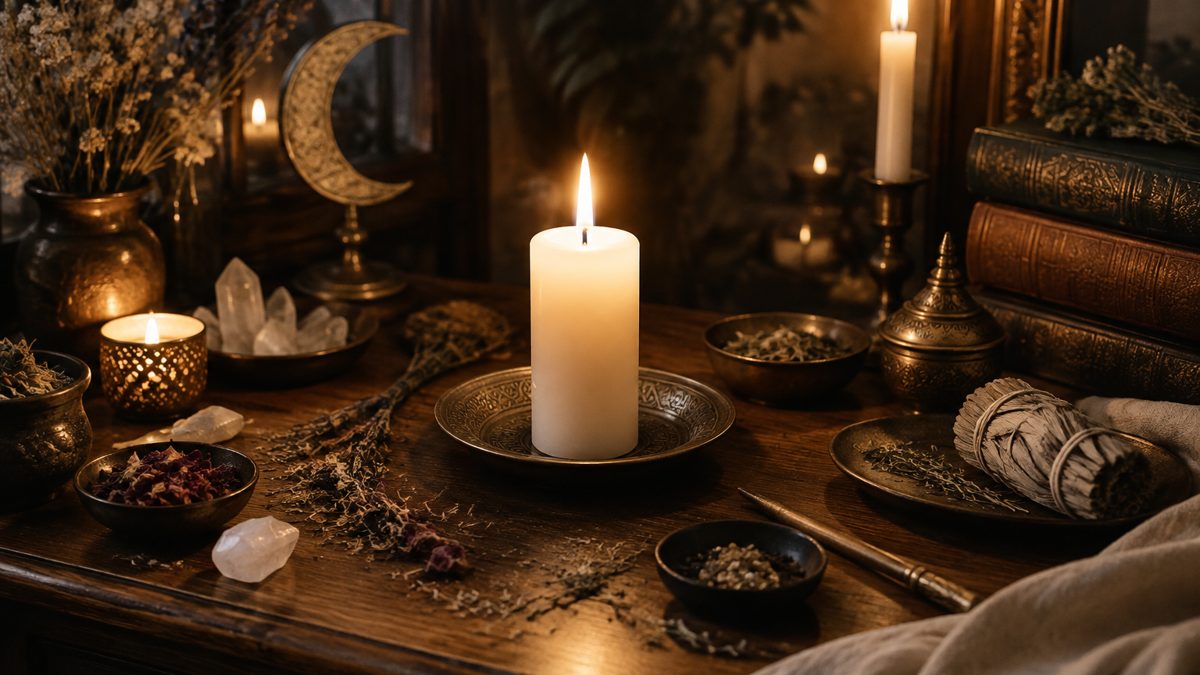
A candle spell is a ritual that uses a candle, a clear intention, and focused attention to mark a hoped-for change. Some people approach it as spiritual work; others value it as a symbolic practice that helps them reflect, settle their thoughts, and commit to action. Neither approach requires you to promise yourself a supernatural result. The useful starting point is knowing what you want to bring into your life and what you can realistically do about it.
Os rituais com velas podem ser belamente simples. Você não precisa de um altar elaborado, de uma vela rara nem de um cômodo cheio de ervas. Uma vela comum em um suporte adequado, um lugar seguro para se sentar e algumas palavras sinceras bastam para uma prática básica. O cuidado que você dedica ao processo importa mais do que o preço dos seus materiais ou do quanto o seu espaço se parece com a fotografia de outra pessoa.
In this Crossroads Journal guide, we will walk through the background of candle magic, choose materials, prepare a safe working space, and build a complete ritual. You will also find a worked example, guidance on interpreting your experience without jumping to conclusions, and a practical way to keep a spell journal. Our companion reference page, Candle Color Meanings, can help when you want a closer look at color symbolism.
Em todo o processo, trate a magia como uma questão de tradição, crença e prática pessoal, e não como uma forma garantida de controlar os acontecimentos. Um feitiço de vela não deve substituir cuidados médicos, decisões financeiras sensatas, orientação jurídica ou conversas necessárias. Pense no ritual como um companheiro significativo do esforço cotidiano: um momento para nomear sua direção, reunir sua atenção e dar o próximo passo útil.
Looking for the meaning of a single card or ingredient? Keep our Candle color meanings guide open beside you.
1. Understand the traditions behind candle spells
People have used lamps, candles, and other lights in religious and domestic observances for centuries. Light can signify remembrance, prayer, protection, hope, or the presence of something sacred. These uses overlap in imagery, but they are not interchangeable. Lighting a devotional candle in a church, keeping a memorial light, and performing a contemporary candle spell can involve very different intentions and beliefs.
A magia moderna com velas bebe de várias correntes, incluindo práticas populares europeias, o ocultismo cerimonial, tradições pagãs contemporâneas e o hoodoo ou conjure afro-americano. Alguns praticantes trabalham dentro de uma tradição específica, herdada ou ensinada; outros adotam uma abordagem eclética. É mais exato falar de tradições de velas, no plural, do que imaginar um único método universal transmitido sem alterações desde a Antiguidade.
The familiar combination of a colored candle, a written intention, and a spoken affirmation is common in contemporary practice, but specific correspondences differ. Green may suggest money to someone who associates it with currency, while another person connects prosperity with gold or harvest colors. There is no single historical chart that settles every meaning for every culture.
If you are learning from a named tradition, seek sources that explain its cultural setting as well as its techniques. Avoid treating sacred names, ceremonies, or initiation-based practices as decorative additions. For a beginner's personal ritual, you can simply acknowledge that you are using modern symbolic candle work rather than claiming membership, lineage, or authority you do not have.
2. Choose an intention that is clear and ethical
An intention gives the ritual its direction. Begin with one subject rather than asking a single candle to transform your finances, relationships, health, and home all at once. A manageable intention might concern preparing for an interview, maintaining a study habit, processing a transition, or making room for mutually respectful friendship. Specificity helps you connect the ritual with observable choices.
Formule a intenção em torno da sua capacidade de agir. Em vez de pedir para fazer uma pessoa específica amar você, considere pedir confiança, discernimento e oportunidades de conexão recíproca. Em vez de tentar forçar a decisão de um recrutador, concentre-se em apresentar sua experiência com clareza e em encontrar um trabalho adequado. Os outros continuam livres para fazer escolhas, quer a sua prática inclua crenças espirituais ou não.
Positive wording can be helpful, but it is not a magical grammar test. Saying that you want freedom from an exhausting pattern does not automatically attract that pattern. Choose language that feels honest rather than artificially cheerful. If an affirmation feels impossible to believe, soften it: 'I am learning to speak clearly' may serve you better than 'I am always fearless.'
Finally, give your intention a practical companion. If you seek steadier finances, identify a budgeting task or an application to complete. If you seek rest, plan a realistic evening boundary. This connection protects the ritual from becoming a substitute for action and gives you something useful to evaluate afterward, regardless of how you understand the spiritual side.
- 1. Write the concern in ordinary language, without trying to make it sound mystical.
- 2. Identifique a parte que você pode influenciar por meio do seu comportamento, da preparação ou dos limites.
- 3. Turn that into one brief intention that respects other people's choices.
- 4. Add one concrete action and a realistic time to complete it.
3. Gather a small, practical set of supplies
For a basic candle spell, gather one candle, a holder made for that candle's size and type, a lighter or matches, and a clear, heat-resistant surface. Have a suitable way to extinguish the flame. A notebook and pen are useful for recording your intention. These simple materials are sufficient; everything else should earn its place rather than create pressure to buy more.
Choose a candle you can supervise comfortably. A small, purpose-made ritual candle may suit a short working, but you do not need to finish it in one sitting. Tea lights require appropriate holders and can become very hot. Container candles should remain in their original, intact, heat-rated containers and be used according to the manufacturer's instructions.
Wax type is a practical preference, not a test of spiritual worth. Beeswax, soy, paraffin, and blends have different burning characteristics, and no material guarantees a safer or more powerful spell. Unscented candles are often easier to tolerate in shared spaces. People with asthma, migraines, or fragrance sensitivity may prefer a flameless candle, which can carry the same chosen symbolism.
Optional items might include a photograph representing your goal, a meaningful stone placed well away from heat, or a written intention kept beside the working area. Avoid putting paper beneath a candle or holder. Loose herbs, glitter, thread, and decorative objects should stay away from the flame and melt pool. A simple arrangement is easier to supervise and clean.
4. Select a candle color and sensible timing
Color can make an intention feel tangible. In many contemporary correspondence systems, white suggests clarity or peace, red suggests courage or vitality, pink suggests affection, and green suggests growth or prosperity. Blue is often linked with calm communication, while black may represent boundaries, release, or protection. These are associations used by practitioners, not scientifically established properties of colored wax.
Comece pela página complementar Significados das Cores das Velas se quiser uma referência mais ampla e depois considere as suas próprias associações. Se o azul lembra você de uma experiência difícil em vez de calma, outra cor pode combinar melhor. O branco costuma ser tratado como uma escolha adaptável, mas qualquer vela disponível pode servir a uma prática simbólica pessoal quando você explica claramente a si mesmo o seu propósito.
Some traditions coordinate spells with moon phases, weekdays, planetary hours, or seasonal observances. A waxing moon may symbolize building something, while a waning moon may symbolize letting go. Such timing can deepen the atmosphere or connect you with a tradition, but there is no established evidence that it makes a spell produce external results.
A praticidade do momento vem primeiro. Escolha um período em que você esteja atento, sem pressa e capaz de ficar com a vela. Não comece só porque chegou uma hora supostamente perfeita se você está exausto ou prestes a sair. Uma janela tranquila de vinte minutos numa tarde comum é mais adequada do que um trabalho elaborado à meia-noite que você não consegue supervisionar com segurança.
5. Prepare o seu espaço e acalme a sua atenção
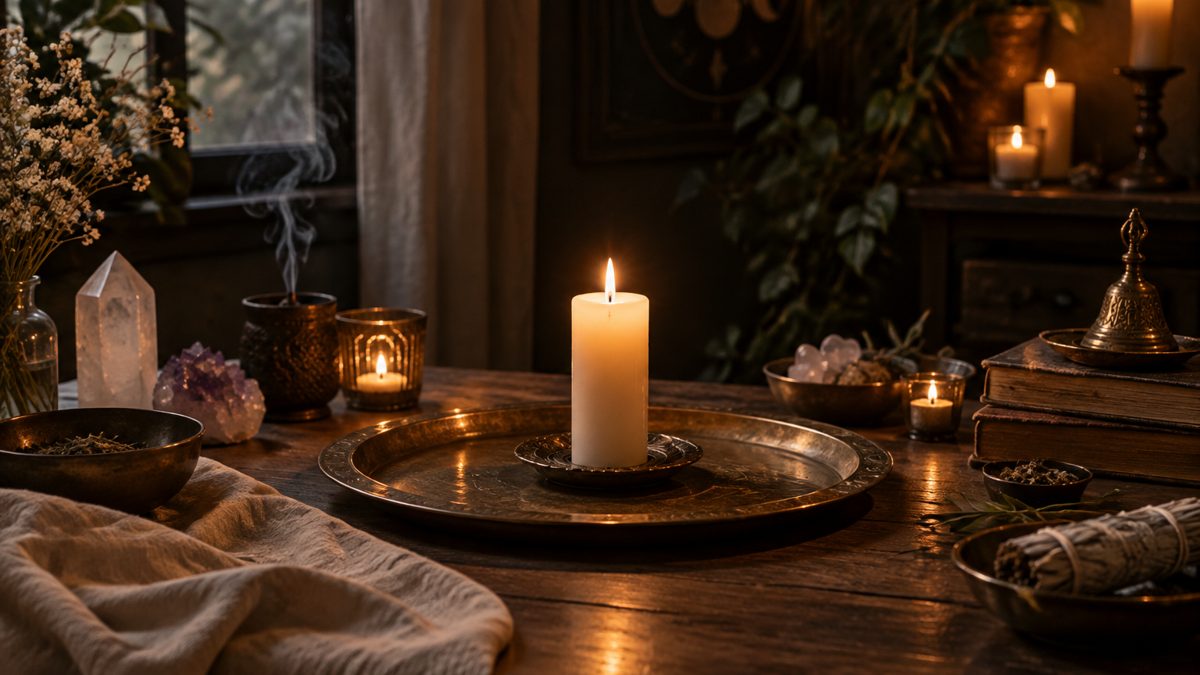
Comece com uma limpeza comum. Retire a bagunça, limpe a superfície e afaste cortinas, papéis, flores secas e outros materiais combustíveis. Coloque o suporte em uma superfície estável, onde não possa ser derrubado. Mantenha pelo menos trinta centímetros entre a chama e qualquer coisa que possa queimar, e siga qualquer distância maior exigida pelas instruções da vela.
Consider everyone who shares the space. Keep children and animals away from the candle and its supplies, and avoid locations where a pet could jump onto the working surface. Keep the room comfortably ventilated without directing a draft across the flame. If open flames are prohibited by your housing rules or unsuitable for your household, use a flameless alternative.
You may also want a symbolic cleansing. This can be as simple as washing your hands, ringing a bell softly, or saying, 'I set this space aside for careful attention.' Smoke is not necessary. Incense and burned herbs add fire and respiratory risks, and some essential oils can harm animals. Avoid assuming that a natural substance is automatically harmless.
Settle yourself before lighting anything. Sit comfortably, notice your surroundings, and take a few easy breaths without forcing them. Read your intention aloud or silently. If you feel highly distressed, it is reasonable to postpone the ritual and seek grounding or support instead. You do not have to reach a special emotional state to practice.
- 1. Clear the surface and check the holder, candle, and surrounding space.
- 2. Move distractions aside while keeping an easy way to call for help accessible.
- 3. Place optional symbolic objects outside the candle's heat and flame area.
- 4. Sit down, breathe naturally, and review your intention and practical next step.
6. Prepare the candle without creating hazards
Some candle traditions include carving words or applying oil, often called dressing the candle. These are optional practices, not prerequisites. For a first spell, an undecorated candle is the safest and simplest choice. You can establish its meaning by holding the unlit candle briefly and saying what it represents, then placing it securely in its holder.
Se a gravação for importante para a sua prática, trabalhe apenas em uma vela adequada, apagada e independente. Faça marcas rasas com uma ferramenta sem ponta, dirigindo-a para longe do corpo. Não corte fundo, não danifique o pavio nem grave velas dentro de recipientes. Escrever a sua palavra em um caderno ao lado da vela é uma alternativa mais segura, com o mesmo propósito simbólico.
Óleos e ervas merecem cautela especial. O óleo acrescentado pode alterar a queima, e material vegetal seco pode inflamar-se ou virar um pavio secundário. Para este método de iniciante, deixe óleos essenciais, óleos aromáticos, ervas, pós e glitter totalmente fora da vela. Se quiser o simbolismo das ervas, desenhe a planta ou coloque um pacotinho fechado bem fora da área aquecida.
Follow the manufacturer's wick-trimming instructions before lighting; many candles call for a wick around one-quarter inch long. Remove packaging and any debris from the wax. Examine container candles for cracks or damage. Do not use an unstable holder or try to secure a poorly fitting candle with paper, fabric, or other combustible material.
7. Cast the spell: a complete beginner method
A useful candle ritual has a beginning, a period of focused attention, and a deliberate ending. It does not need elaborate language. Before you start, decide on a short supervised session that stays within the candle's instructions. You may set a gentle timer, but a timer is only a reminder, not a substitute for watching the candle.
Once the candle is lit, speak your intention in a natural voice. You can address a deity or spiritual presence if that belongs to your established practice, but you do not need to invoke unfamiliar beings. A secular version might simply say, 'This light marks my commitment to prepare carefully and act with courage.' Use words you understand and mean.
During the quiet portion, picture yourself taking the relevant action rather than imagine controlling every detail of the outcome. For a communication spell, rehearse speaking calmly and listening well. If mental pictures do not come easily, repeat a sentence, notice a feeling, or read your written plan. Visualization is an option, not a requirement.
Encerre enquanto ainda estiver atento. Você não precisa queimar a vela por completo, manter uma concentração perfeita nem sustentar uma emoção intensa. Pensamentos que vagueiam são normais; volte suavemente à intenção quando os notar. Se algo na chama se tornar inseguro, pare imediatamente. Proteger a si mesmo e à sua casa tem precedência sobre completar uma sequência ritual.
- 1. Check the candle and surroundings, then read your intention and planned action.
- 2. Light the wick carefully, keeping hair, sleeves, and your face away from the flame.
- 3. Say your intention once or several times, using repetition only if it helps you focus.
- 4. Spend a few minutes reflecting on the choices that support your goal. Rest your gaze naturally rather than staring into the flame.
- 5. Name the next action you will take and when you will take it.
- 6. Termine com uma frase simples de encerramento, como 'Esta prática está completa por hoje.'
- 7. Extinguish the candle safely and remain nearby until you have checked that the wick is fully out.
8. Worked example: confidence for a job interview
Suppose you have an interview later in the week and want to feel better prepared. The purpose of this working is not to compel an employer to choose you. It is to mark your commitment to preparation, steady communication, and clear judgment about whether the role suits you. A blue candle might represent calm speech, or white might represent clarity.
Keep the materials minimal: an unscented candle, a proper holder, a notebook, and your interview notes positioned away from the flame. Write this original intention: 'I prepare thoughtfully, explain my experience clearly, and approach this conversation with self-respect.' Adjust the wording if it feels stiff. The sentence should support you, not demand that you become a completely different person.
Durante o ritual, imagine-se apresentando-se sem pressa. Pense em um exemplo de problema que você resolveu no trabalho ou em outro contexto relevante. Imagine-se fazendo uma pergunta ponderada e concedendo-se uma breve pausa antes de responder. Essas reflexões também são ensaio; sua utilidade prática não depende de aceitar uma explicação sobrenatural.
Afterward, prepare two or three examples of your skills, research the organization, and confirm the interview arrangements. You might still feel nervous, and the job may go to someone else. Neither outcome proves that you performed the spell incorrectly. Review the experience in terms of preparation and conduct as well as the hiring decision.
- 1. Schedule a brief ritual before a planned interview-preparation session.
- 2. Light the safely positioned candle and read your intention.
- 3. Reflita por alguns minutos sobre falar com clareza, ouvir e descrever uma conquista relevante.
- 4. Declare sua próxima tarefa: 'Esta noite vou preparar três exemplos e duas perguntas.'
- 5. Extinguish the candle, check it is out, and move on to the preparation task.
9. Close, store, and dispose of materials responsibly
Closing gives the practice a clear boundary. You might thank a spiritual figure you already honor, acknowledge your own effort, or simply sit quietly for a moment. There is no need to perform a complicated dismissal if your ritual did not involve one. A straightforward ending can help you return to everyday responsibilities rather than remain preoccupied with whether something invisible has happened.
Extinguish the candle according to its instructions. A suitable snuffer can help; gentle blowing may also be appropriate for some candles, provided you avoid splashing wax. Claims that blowing out a candle necessarily ruins a spell are matters of particular belief, not universal rules. Never pour water onto hot wax or a hot container, and do not move the candle while it is hot.
You may reuse the remaining candle for the same intention or another personal working if that suits your practice. Let it cool fully before storing it away from heat, children, and pets. Observe the manufacturer's maximum burn time and stop-use point. There is no need to burn a candle down to its base to establish commitment.
Dispose of cooled wax and unsuitable remnants through local household-waste guidance. Do not pour wax down a drain or leave wax, glass, plastic, or foil in natural places. Burying ritual remains can harm wildlife and create litter. If salt or salt water was used separately, keep it away from gardens, houseplants, and waterways; symbolic disposal should not damage living things.
10. Interpret results without turning accidents into omens
After a candle spell, you may feel calmer, more hopeful, disappointed, or much the same. Any of these responses is possible. A strong emotional experience does not prove that an external result is coming, and an ordinary-feeling ritual is not necessarily meaningless. Give yourself permission to value the reflection without needing a dramatic sign to validate it.
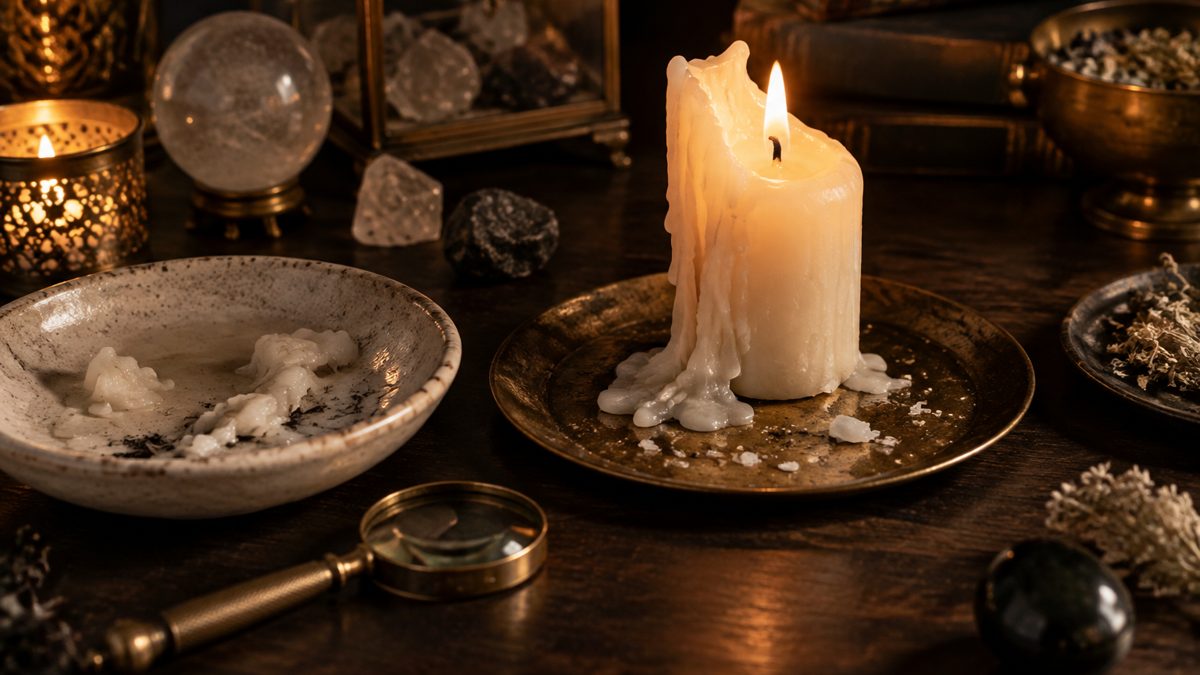
Some practitioners read flames, soot, or wax shapes symbolically. If you do this, first consider physical causes. Drafts can make flames flicker; wick length and fuel conditions affect flame size; dyes, fragrances, and wick problems may contribute to soot. A struggling candle is a reason to check safety and instructions, not evidence that someone is attacking you spiritually.
Treat wax imagery as a reflective prompt rather than a factual prediction. A shape that reminds you of a doorway might lead you to ask what opportunity you are avoiding. It does not establish that a specific event will occur. Avoid declaring curses, illnesses, infidelity, or future disasters from candle behavior; those conclusions are unsupported and can cause real distress.
Avalie os resultados ao longo de um período razoável. Registre o que você fez, o que mudou e o que ficou fora do seu controle. Considere explicações comuns, a coincidência e os efeitos de suas ações práticas. Se você aprecia a interpretação espiritual, ela pode conviver com essas possibilidades sem substituí-las. A incerteza não é uma falha de crença; faz parte de julgar com cuidado.
11. Recognize common mistakes and make adjustments
Um erro comum é acrescentar demais. Várias velas, múltiplas intenções, invocações desconhecidas e pilhas de ingredientes podem tornar um trabalho mais difícil de entender e menos seguro. Simplifique até conseguir explicar o propósito de cada elemento. Uma única chama e uma frase clara costumam oferecer uma experiência mais coerente do que um arranjo abarrotado, montado a partir de instruções conflitantes.
Another mistake is treating mood as a performance requirement. You do not need to feel powerful, serene, or completely certain. Doubt does not automatically cancel a ritual, and sadness is not contamination. If the practice becomes a test you fear failing, shorten it, use a flameless candle, or take a break from spellwork altogether.
Repeatedly casting the same spell out of panic can turn reflection into compulsive checking. Before repeating a working, ask whether you have completed the practical action attached to the first one. Set a review date instead of relighting a candle every time anxiety rises. If ritual begins to interfere with sleep, finances, relationships, or daily functioning, seek appropriate support.
Finally, avoid blaming yourself when the desired outcome does not happen. Illness, unemployment, discrimination, grief, and other difficult circumstances are not evidence that you lacked positivity or spiritual skill. Revise your plan using available information. Sometimes the healthiest adjustment is an ordinary conversation, professional help, rest, or accepting that a particular outcome cannot be secured.
12. Keep safety, consent, and spending boundaries
Never leave a burning candle unattended, sleep while it burns, or continue when you are drowsy or impaired. Keep working smoke alarms in your home and know your escape routes. If a flame grows unusually large or the container becomes damaged, extinguish it safely if possible. If a fire spreads or you are unsure you can handle it, leave and call emergency services.
Do not ingest candle wax, oils, ritual powders, or herbs sold for magical use. They may be unsuitable for food use, contaminated, irritating, or toxic. Avoid skin contact with unknown mixtures as well. If an ingestion or significant exposure occurs, contact your local poison service or medical care. Keep all supplies labeled and away from food-preparation areas.
Do ponto de vista ético, prefira trabalhos sobre as suas próprias escolhas, limites e bem-estar. Peça consentimento antes de envolver diretamente outra pessoa ou de usar seus pertences. Não administre substâncias em segredo, não invada propriedades para deixar objetos rituais nem interprete um feitiço como permissão para ignorar uma recusa. Se estiver em perigo, priorize um plano de segurança e o apoio adequado em vez de confiar apenas em simbolismo protetor.
Set financial boundaries, too. You do not need costly supplies or repeated paid services to correct an alleged spiritual defect. Be wary of anyone promising guaranteed results, demanding secrecy, or claiming that escalating payments are necessary to remove a curse. A reputable presentation of spiritual practice should leave room for uncertainty and your right to decline without threats.
13. Mantenha um diário e desenvolva uma prática sustentável
Um diário de feitiços de vela ajuda você a lembrar o que realmente fez, e não o que mais tarde imagina ter feito. Comece com a data, a intenção, o tipo de vela, a duração aproximada da sessão e a ação planejada. Anote quaisquer circunstâncias relevantes, como cansaço ou um prazo se aproximando. Você não precisa de artes elaboradas nem de papelaria cara; um caderno simples ou um arquivo digital privado funciona.
Separate observations from interpretations. 'The flame flickered when the window opened' is an observation. 'I associated the movement with uncertainty' is a personal interpretation. Keeping these distinct allows symbolic meaning without confusing it with evidence. Record safety issues as plainly as emotional responses so that your next working can be more practical and comfortable.
At your chosen review date, look at effort as well as outcome. Did you follow through? Did the ritual help you clarify a boundary or notice an unrealistic expectation? Did you spend more time worrying about signs than taking action? Include disappointments and uneventful sessions, not only apparent successes. A balanced record is more useful than a collection of confirmations.
Over time, keep the elements that support thoughtful attention and let go of those that create fear, expense, or unnecessary complexity. Your practice may become more traditional, more personal, or entirely flameless. What matters is approaching it honestly: respecting its cultural influences, protecting yourself and others, and connecting intention with action. A small, careful ritual is enough to begin.
- 1. Before the ritual, record your intention, practical action, and review date.
- 2. Immediately afterward, note what happened and how you felt without forcing an interpretation.
- 3. At the review date, record actions taken, outcomes observed, and plausible ordinary explanations.
- 4. Choose one adjustment for next time, whether that means simplifying the ritual, changing the action plan, or taking a break.
These practices are shared as tradition and personal reflection, not as a substitute for medical, legal or financial advice.
Continue aprendendo
- Candle color meanings
- How to read tarot cards
- How to use angel oracle cards
- Como ler cartas de baralho
- Como usar cristais em feitiços
- Como usar ervas na bruxaria
- How to read the Dr. Moorne Egyptian Tarot
- How to read dice
- How to read tea leaves
- Como usar um pêndulo
- Como lançar um feitiço de vela
- How to make a spell jar
- How to make a sigil
- How to cleanse your home
- How to set up an ancestor altar
- How to open a sacred space
- How to time spells with the moon
- How to work with water and salt
- How to make a protection charm bag
- Read the Journal ou visite o shops