How-To Guide
How to Read Dice for Divination
Por Seraphina
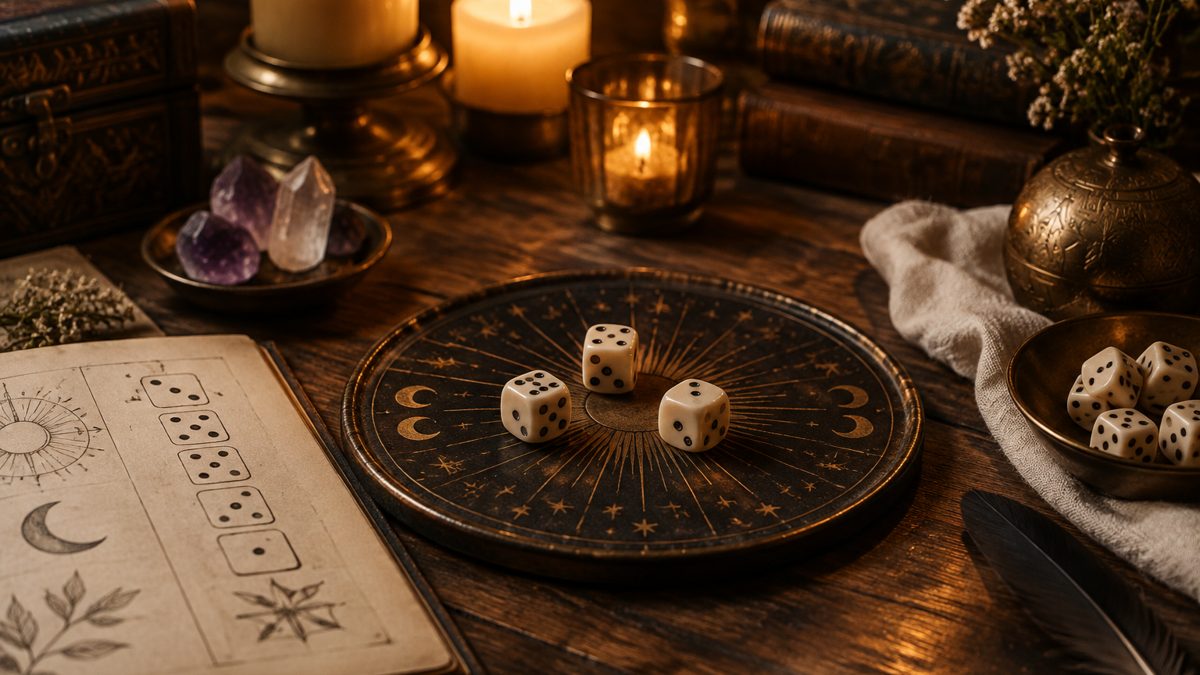
A handful of dice can turn an ordinary tabletop into a place for reflection. Their appeal is simple: you ask a question, let the dice fall, and consider what their numbers might suggest. In divination, this becomes a symbolic conversation with uncertainty rather than a reliable way to establish facts or predict what must happen.
A adivinhação com dados costuma ser chamada de cleromancia, embora o termo abranja uma família mais ampla de práticas que envolvem sortes lançadas. Algumas pessoas a abordam de forma espiritual, como um modo de buscar orientação por meio de suas crenças. Outras a usam como um estímulo criativo que interrompe o pensamento habitual. Você não precisa resolver essa questão filosófica antes de aprender o método prático.
This guide uses ordinary six-sided dice and a clearly defined reading system. It is an approachable modern framework, not a claim to recover one universal ancient tradition. You will learn how to prepare, choose a useful question, cast the dice, interpret a result, and translate your reflections into a sensible next step.
Keep the companion reference page, Dice Divination Meanings, nearby when you want to explore number symbolism in more depth. Here, the emphasis is on how to conduct a complete reading without becoming overwhelmed by competing rules. The aim is a practice that feels thoughtful, grounded, and genuinely useful, whether you read occasionally or keep a regular journal.
Looking for the meaning of a single card or ingredient? Keep our Dice divination meanings guide open beside you.
1. Understand the History Without Flattening the Traditions
People have used lots, marked objects, knucklebones, and dice-like pieces for decision-making and divination in many societies. These objects are related in function, but they are not interchangeable. A bone cast in a ritual setting, a numbered gaming die, and a sacred lot drawn by a religious specialist can belong to very different systems of meaning.
No Mediterrâneo antigo, os astrágalos, ou ossos de articulação de animais, eram usados em jogos e em algumas práticas divinatórias. Sua forma irregular criava um sistema de lançamento diferente dos dados cúbicos modernos. As evidências que sobreviveram incluem também oráculos numerados associados aos lançamentos. Essa história mostra que lançar objetos em busca de orientação é uma prática antiga, mas não estabelece um método único e ininterrupto compartilhado por todos os leitores modernos.
The word cleromancy is useful as an umbrella term for divination by lots. Astragalomancy refers more specifically to divination associated with knucklebones, although popular modern writing sometimes uses it loosely for dice reading. Terminology varies between sources, so look for an explanation of the actual objects and rules rather than assuming a label tells the whole story.
When studying a particular tradition, ask who recorded it, where it was practiced, and whether the source distinguishes historical evidence from later interpretation. Respect community boundaries around restricted religious practices. You can create a personal dice ritual without presenting it as inherited Slavic, Greek, Roman, or any other culturally specific practice you have not actually learned.
2. Gather a Simple, Reliable Reading Kit
Begin with three ordinary six-sided dice, a notebook, and a flat surface. Different-colored dice make positional readings easier because you can assign a separate role to each color. If yours are identical, roll them individually into labeled spaces instead. The goal is to know which die answers which part of the question without rearranging the result afterward.
Escolha dados com faces nítidas e legíveis e sem danos evidentes. Dados de jogo equilibrados são uma opção prática; pedras caras ou símbolos elaborados não são necessários. Dados decorativos podem ser lindos, mas bordas arredondadas, construção irregular ou marcações difíceis de ler podem tornar os resultados menos claros. Nenhum material específico tem vantagem sobrenatural comprovada sobre outro.
A shallow tray or folded cloth can keep the dice from bouncing across the room. Leave enough room for them to tumble rather than simply slide out of your hand. A small cup is useful if gripping or shaking dice is difficult. You can also use a digital random-number generator, provided you decide its settings and rules before beginning.
Objetos opcionais podem incluir uma fotografia significativa, uma vela apagada ou um pequeno objeto ligado à sua pergunta. Trate-os como apoios pessoais para a atenção, não como fontes de poder obrigatórias. Seu kit básico deve continuar fácil de usar, barato e acessível. Uma preparação complicada costuma criar mais oportunidades de distração do que uma mesa simples e três dados.
3. Choose Your Rules Before You Cast
Uma leitura fica mais clara quando o método está definido antes de você ver os números. Neste guia, use três dados com papéis fixos: situação, desafio e resposta útil. Leia cada dado separadamente usando os mesmos seis temas numéricos. Isso lhe dá uma estrutura completa, semelhante a uma frase, em vez de um total sem explicação que poderia significar quase qualquer coisa.
Nossos significados de trabalho são deliberadamente amplos: o um sugere iniciativa; o dois sugere relacionamento ou equilíbrio; o três sugere expressão ou crescimento; o quatro sugere estrutura; o cinco sugere mudança ou atrito; e o seis sugere cuidado ou responsabilidade. São escolhas interpretativas deste método, não leis universais. Anote-as para não alterar discretamente o seu significado a fim de favorecer uma resposta preferida.
Other systems read the sum of several dice, use a marked casting cloth, or assign special meanings to doubles and triples. Those approaches can be valid parts of a chosen symbolic practice, but they should not be mixed casually. A meaning written for a total of eleven does not automatically explain an individual die, and positional rules cannot be reconstructed after a cast.
For your first several readings, ignore where dice land beyond keeping them inside the tray. Do not add bonus meanings for proximity, direction, noise, or the time on the clock. You can experiment later, but a stable starting framework makes it easier to learn what you are actually doing and recognize where your own interpretation enters.
- 1. Assign one die or labeled space to situation, one to challenge, and one to helpful response.
- 2. Copy the six working meanings into your notebook before casting.
- 3. Decide that a die outside the tray, stacked on another die, or tilted without a clear upper face will be rerolled by itself.
- 4. Set a limit of one main cast and, only if necessary, one clearly framed clarifying cast.
4. Ask a Question That Leaves Room for Choice
The most useful questions focus on something you can examine or influence. Instead of asking whether your life will improve, ask what deserves attention as you work toward a specific goal. Instead of asking what another person secretly thinks, ask how you can communicate more clearly or decide what boundaries you need in that relationship.
Perguntas abertas costumam combinar melhor com leituras simbólicas do que exigências de um veredicto de sim ou não. Um número pode convidá-lo a considerar estrutura, negociação ou mudança, mas não pode confirmar uma condição médica, revelar uma conversa privada nem estabelecer se alguém é digno de confiança. Trate esses assuntos como questões para evidências, conversa direta ou orientação profissional adequada.
Give the reading a reasonable scope. What will help me prepare for next week's conversation is easier to explore than what is my destiny. A timeframe describes the period you intend to reflect on; it does not make the dice capable of forecasting events within that period. Narrowing the question simply makes your interpretation less vague.
Write the question exactly as you intend to ask it. If it contains several separate problems, choose one or plan separate readings on another occasion. You may discover that the act of refining the question already provides useful clarity. That is not a failed divination session; it is one of the practical benefits of slowing down.
- 1. Nomeie o tema em uma frase, como preparar-se para uma discussão difícil.
- 2. Identifique o que está sob o seu controle: preparação, comunicação, momento oportuno ou limites.
- 3. Turn the concern into an open question beginning with what or how.
- 4. Confira se a pergunta não pede que os dados forneçam fatos que você precisa verificar em outro lugar.

5. Prepare Yourself and the Reading Space
Escolha um lugar onde possa se sentar com conforto e ouvir os próprios pensamentos. Libere espaço suficiente para a bandeja e o caderno e, se for viável, deixe de lado notificações que distraem. Você não precisa de silêncio completo nem de um humor perfeito. A preparação é simplesmente uma forma de distinguir este período de reflexão deliberada do resto do seu dia.
Notice your emotional state before starting. If you are frightened, exhausted, angry, or urgently hoping for one particular answer, name that in your notes. You may still choose to reflect, but consider postponing the cast when disappointment would feel unbearable. Dice are not a dependable way to regulate a crisis or obtain certainty under pressure.
Some practitioners like to cleanse their tools symbolically. A dry cloth, a spoken intention, or a minute of quiet can serve that purpose without smoke or liquids. If cleansing has spiritual meaning for you, frame it as your ritual belief. Dice do not need supernatural purification to function as randomizing objects or reflective prompts.
Keep physical safety straightforward. An electric candle avoids an open flame; if using a real candle, place it in a stable holder away from fabric and never leave it unattended. Smoke can aggravate respiratory conditions and affect pets. Avoid soaking dice in salt water, which may damage finishes or metal, and do not pour salt water onto plants or garden soil.
6. Cast the Dice: A Complete Step-by-Step Method
Quando a pergunta e as regras estiverem prontas, respire algumas vezes de forma comum e confortável. Leia a pergunta em voz alta ou em silêncio. Você pode acrescentar uma intenção, como o desejo de ver a situação com mais clareza, mas uma redação especial é desnecessária. Evite prometer a si mesmo que o lançamento revelará uma verdade inquestionável; essa expectativa torna mais difícil lidar com a ambiguidade normal.
Shake the dice in your hand or cup and release them onto the prepared surface. If you are using identical dice, cast one at a time into the corresponding labeled spaces. Let each die settle naturally. There is no required number of shakes, no ideal casting hand, and no need to repeat the action until it feels sufficiently dramatic.
Record the raw result before interpreting anything. Write the role and number together, such as situation four, challenge two, helpful response five. This preserves the actual cast and prevents later memory from blurring into the story you developed. If a die needed rerolling under your advance rules, record that briefly without treating the mishap as an omen.
Agora leia uma posição de cada vez e depois conecte-as. Comece pelo tema simples do número, considere como esse tema poderia aparecer no papel que lhe foi atribuído e compare a interpretação com o que você já sabe. Termine com uma ação modesta em vez de uma previsão. Uma boa sessão deve deixar você com algo para examinar ou experimentar, não com uma ordem que você se sinta obrigado a obedecer.
- 1. Date the entry and copy your question and positional assignments.
- 2. Settle your attention and cast the three dice using the method you chose.
- 3. Aplique apenas as suas regras previamente escritas para dados indefinidos ou fora dos limites.
- 4. Record every number in its correct position before consulting meanings.
- 5. Interpret the positions separately, then write a short combined reading.
- 6. Choose one proportionate next step and close the session.
7. Leia os Seis Números em Contexto
One can prompt questions about beginnings, independence, initiative, or excessive self-reliance. Two can point toward partnership, exchange, balance, or hesitation between alternatives. Neither is automatically favorable or unfavorable. In a challenge position, one might invite you to examine whether you are carrying everything alone, while two might raise the issue of compromise that has become avoidance.
Three can suggest expression, experimentation, social connection, or scattered effort. Four can suggest routines, foundations, limits, or rigidity. If four appears as helpful response, you might benefit from a schedule or clear agreement. If it describes the challenge, the same number may invite you to question a rule that no longer serves its purpose.
Five can suggest movement, disruption, curiosity, or friction. Six can suggest care, responsibility, repair, or overextension. A five is not a warning that disaster is coming, and a six does not guarantee harmony. Their usefulness lies in the questions they generate: what needs to change, whose needs are being considered, and which responsibilities are genuinely yours?
Use the companion page, Dice Divination Meanings, to deepen your vocabulary, while checking that any interpretation matches the method you chose. Readings become richer through specificity, not through collecting every possible association. For each number, select one or two themes that fit the position and explain why. If nothing fits, it is acceptable to leave the result unresolved.
8. Follow a Worked Example From Question to Action
Imagine que você está se preparando para conversar com um colega de casa sobre tarefas domésticas desiguais. Sua pergunta é: Como posso abordar a conversa desta semana sobre dividir o trabalho doméstico de forma mais construtiva? Ela é adequada porque diz respeito à sua preparação e ao seu comportamento. Não pede que os dados revelem os motivos íntimos do colega nem garantam o resultado da conversa.
Suppose the cast is situation four, challenge two, and helpful response five. Four suggests looking at existing structure: perhaps there is no agreed schedule, or tasks have accumulated around whoever notices them first. That is a hypothesis to compare with your experience. The die itself does not establish that your household arrangements are unfair or ineffective.
Two in the challenge position suggests examining negotiation and balance. You might realize you have been avoiding disagreement by saying everything is fine. Alternatively, both people may have different understandings of equal effort. Five as helpful response invites flexibility and a change in approach, perhaps trying a new task arrangement rather than arguing over who is naturally more responsible.
The combined reading could be: Make the current arrangement visible, discuss differences directly, and propose a short experiment. Your practical action is to list recurring tasks, ask for the housemate's perspective, and agree on a two-week trial with a review date. This is a reasonable plan even without divination, which is a useful test of whether the reading supports sound judgment.
- 1. Write down known facts separately from assumptions about the other person.
- 2. Translate each number into a question relevant to its position.
- 3. Combine the answers into a tentative interpretation, using language such as might or could.
- 4. Escolha uma ação prática e avalie-a depois por meio da conversa real, não de outro lançamento.
9. Lide com Repetições, Contradições e Esclarecimentos
Repeated numbers naturally attract attention, but repetition is not evidence of an urgent message. If two or three dice show the same number, you can explore that theme across the assigned roles. Three fours, for instance, might invite reflection on structure as the present condition, excessive rigidity as the challenge, and a better-designed routine as the response.
Different numbers can appear to pull in opposite directions. Four may suggest stability while five suggests change. Rather than forcing one to cancel the other, ask whether they describe different needs: maintaining a dependable foundation while changing one unhelpful habit. The assigned positions help you distinguish these functions without inventing a secret rule to resolve the tension.
If you choose a sum-based method later, remember that totals from multiple dice are not equally likely. With two fair six-sided dice, seven has more possible combinations than two or twelve. Likewise, striking patterns eventually occur by chance. Probability does not prevent symbolic reflection, but it does undermine claims that an ordinary repeat proves a supernatural intervention.
Use a clarifier only when you can name what remains unclear. Under this guide's rules, one additional single die may answer: What quality could help me carry out the response? Use the same six meanings. If the result adds confusion, stop rather than building a chain of clarifiers. Uncertainty is a legitimate conclusion, not a fault that endless casting will necessarily fix.

10. Avoid the Most Common Reading Mistakes
O erro mais fácil é lançar de novo até receber algo reconfortante. Isso transforma a prática numa busca por permissão e faz os resultados indesejados parecerem ameaçadores. Mantenha o ponto de parada combinado. Se a leitura original for perturbadora, deixe-a de lado e examine sua reação, em vez de tratar outro lançamento como a única forma de recuperar a paz.
Another mistake is changing the interpretive system after seeing the result. A reader might begin with individual numbers, switch to totals, then add doubles or spatial directions because one version sounds more appealing. Experimentation is fine when it is planned and recorded. Retrofitting rules makes it difficult to tell whether a method is helpful or merely accommodating.
Watch for confirmation bias: the tendency to notice matches and overlook misses. Broad statements can fit many situations, especially after events have occurred. Write your interpretation before the outcome is known, include plausible alternatives, and record when a reading was vague or unhelpful. Honest uncertainty is more valuable than making every entry appear remarkably accurate.
Finally, avoid dividing numbers into lucky promises and unlucky threats. A difficult theme does not predict punishment, and a gentle theme does not remove the need for caution. If every cast seems to announce betrayal, danger, or destiny, step back from the method. Good reflection should expand your choices rather than narrow them through fear.
11. Practice Safety, Consent, and Ethical Boundaries
Use os dados para reflexão, não para diagnóstico, avaliação de emergência, conclusões jurídicas ou garantias financeiras. Nunca use uma leitura para decidir se deve interromper um medicamento, ignorar sintomas, fazer um investimento arriscado ou desconsiderar sinais de perigo. Para decisões importantes, busque informações confiáveis e ajuda qualificada. Um estímulo simbólico pode ajudar você a preparar perguntas, mas não pode substituir as respostas que essas situações exigem.
Ao ler para outra pessoa, obtenha consentimento claro e explique os limites do método. Pergunte o que ela quer explorar e permita que rejeite uma interpretação. Evite pronunciamentos sobre morte, gravidez, doença, infidelidade, maldições ou intenções ocultas de terceiros. Apresente possibilidades sem alegar autoridade especial sobre os relacionamentos, o futuro ou a capacidade de escolha da pessoa.
Protect privacy as carefully as you would in any sensitive conversation. Do not share someone else's question, identifying details, or journal entry without permission. If payment is involved, explain the price and scope in advance. Claims that a frightening cast requires an urgent, expensive cleansing are a serious warning sign; no dice result establishes that such a service is necessary.
Keep dice away from young children and animals because they are choking hazards. Herbs and oils are optional and may irritate skin or harm pets; natural does not mean harmless. Do not ingest ritual preparations or add unknown substances to drinks. If reading becomes compulsive, disrupts sleep, or increases anxiety, pause and seek support rather than adding more rituals.
12. Keep a Journal That Encourages Honest Learning
A useful journal separates the cast, the interpretation, and the later outcome. These are three different things. The cast is what the dice showed; the interpretation is the meaning you proposed; the outcome is what actually happened afterward. Keeping those layers distinct makes it harder to reshape an old reading until it appears to have predicted everything.
Record your question, method, number assignments, raw results, and emotional state. Then write a brief interpretation and one intended action. You can include a photograph of the cast if that helps, but a simple written record is enough. Avoid making documentation so elaborate that keeping the journal becomes a burden or distracts you from ordinary life.
At a later review, ask whether the session helped you notice something specific, make a thoughtful choice, or communicate more clearly. Also note when it increased confusion or had no practical value. A helpful reflection does not demonstrate supernatural accuracy, and an outcome that resembles your interpretation may have several explanations, including your own actions and chance.
Review patterns across several entries rather than drawing conclusions from one memorable match. You may discover that work questions lead you toward useful planning, while romantic uncertainty encourages repetitive checking. That distinction can guide healthier boundaries. Your journal should teach you about your attention, habits, and decisions, not become a ledger of omens you feel required to obey.
- 1. Create headings for date, question, method, cast, interpretation, and next action.
- 2. Acrescente uma nota de confiança descrevendo o quanto a interpretação parece clara ou incerta.
- 3. Defina uma data de revisão adequada à pergunta, sem esperar um acontecimento previsto.
- 4. Registre o resultado real, as explicações alternativas e se a leitura ajudou.
- 5. Ajuste a sua prática se sessões repetidas produzirem ansiedade em vez de reflexão útil.
13. Build a Sustainable Personal Practice
Begin with occasional readings on manageable topics rather than consulting the dice about every choice. A weekly session or a reading before a planned conversation may be enough. Keep using the same framework for several sessions so you can learn its strengths and limitations. Familiarity often produces more thoughtful interpretation than constantly switching to a new system.
Se quiser desenvolver o método, mude um elemento de cada vez. Você pode experimentar uma reflexão diária com um único dado, um sistema baseado em somas ou um pano com zonas predefinidas. Registre as novas regras antes de lançar os dados e distinga o que você acrescentou das práticas de origem histórica. A criatividade pessoal não precisa de uma falsa linhagem ancestral para ter significado.
Encerre cada sessão com intenção. Guarde os dados, escreva sua próxima ação e volte ao mundo onde você pode reunir informações, conversar com pessoas e fazer escolhas. Uma frase de encerramento ou um momento de silêncio pode ajudar, mas não é necessário para evitar algum mal. Deixar uma leitura inacabada ou sem resposta não o coloca em perigo sobrenatural.
No melhor dos casos, a adivinhação com dados pode oferecer uma pausa modesta entre a incerteza e a reação. Você lança, observa, questiona e decide o que merece mais atenção. Mantenha o simbolismo flexível, os limites práticos firmes e o seu próprio discernimento à frente. Os dados podem oferecer um estímulo; a responsabilidade e a liberdade de escolher continuam sendo suas.
These practices are shared as tradition and personal reflection, not as a substitute for medical, legal or financial advice.
Continue aprendendo
- Dice divination meanings
- How to read tarot cards
- How to use angel oracle cards
- Como ler cartas de baralho
- Como usar cristais em feitiços
- Como usar ervas na bruxaria
- How to read the Dr. Moorne Egyptian Tarot
- How to read dice
- How to read tea leaves
- Como usar um pêndulo
- Como lançar um feitiço de vela
- How to make a spell jar
- How to make a sigil
- How to cleanse your home
- How to set up an ancestor altar
- How to open a sacred space
- How to time spells with the moon
- How to work with water and salt
- How to make a protection charm bag
- Read the Journal ou visite o shops