How-To Guide
How to Use a Pendulum
Por Seraphina
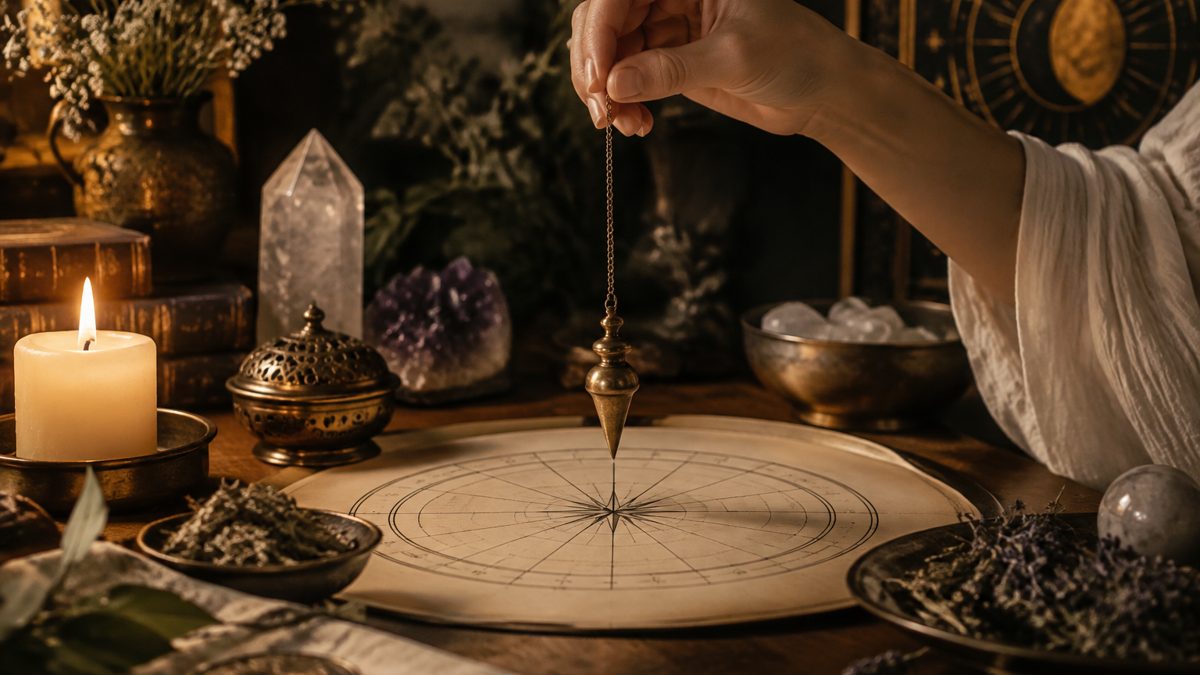
Um pêndulo é um pequeno peso suspenso por uma corrente ou cordão. Segurado sobre uma superfície, pode balançar para a frente e para trás, mover-se de lado ou traçar círculos. Nas tradições divinatórias, as pessoas interpretam esses movimentos como respostas a perguntas. Você não precisa de um altar elaborado, de um cristal caro nem de uma identidade espiritual específica para explorar a prática.
At Crossroads Journal, we approach pendulum work as a meeting place between tradition, belief, and personal reflection. Some practitioners understand it as a way of listening to intuition; others give it a spiritual meaning. Neither interpretation makes it a proven method for discovering hidden facts or predicting events. Its most grounded use is as a prompt for examining your own thoughts.
There is also a well-established physical explanation for much pendulum movement: the ideomotor effect. Expectations, attention, and mental imagery can produce tiny muscle movements without conscious intention. A suspended weight makes those movements more visible. Knowing this does not prevent you from finding a session meaningful, but it should shape how much authority you give the result.
This guide takes you from choosing a pendulum to asking a careful question, interpreting movement, and keeping useful records. The companion reference page, Pendulum Movements and Charts, offers a place to review patterns and chart layouts. Begin with curiosity rather than certainty, and remember that you remain responsible for your choices, whatever the pendulum appears to say.
Looking for the meaning of a single card or ingredient? Keep our Pendulum movements and charts guide open beside you.
1. Entenda a história e as tradições
A adivinhação com pêndulo costuma ser discutida junto com a radiestesia, um amplo grupo de práticas que envolvem varetas, objetos suspensos ou outras ferramentas usadas para buscar informações. As formas históricas de radiestesia incluíam tentativas de localizar água e depósitos minerais. Essas práticas pertencem a uma história variada de crenças; sua existência não estabelece que as ferramentas detectem de forma confiável o que os praticantes procuram.
European mining traditions helped make divining rods familiar in early modern accounts. Pendulums later appeared in occult writing and in practices sometimes called radiesthesia, whose adherents proposed that people could detect subtle influences. Claims that pendulum work comes from one unchanged ancient system should be treated cautiously. Its modern forms draw on different sources and interpretations.
Today, pendulums appear in contemporary witchcraft, spiritualist settings, New Age practices, and private routines that have no formal religious affiliation. One person may offer a prayer before beginning, while another simply sits quietly with a notebook. There is no single preparation method or movement code shared by every practitioner.
You can acknowledge these traditions without presenting yourself as an inheritor of a lineage you have not studied. If you borrow a prayer, symbol, or ritual from a specific community, learn its context and respect any boundaries around its use. For a beginner, a plain object and a personally meaningful intention are sufficient.
2. Choose a pendulum and gather simple supplies
A useful beginner pendulum has a secure attachment, a comfortable chain or cord, and a weight that can hang freely. Metal, wood, glass, and stone versions are common. A pendant or washer tied firmly to string can also work. Material does not establish accuracy, and a costly crystal does not make an answer more trustworthy.
Choose something heavy enough to hang steadily but light enough to hold without strain. A clearly visible tip can help when using a chart, although it is not essential. Adjust the length until the weight clears the table comfortably and the movement is easy to watch. There is no universally correct chain length.
Gather a notebook, a pen, and an uncluttered surface. A glass of drinking water and a comfortable chair may be more useful than additional ritual supplies. If you want a chart later, ordinary paper is enough. Avoid buying a large kit before you know whether the basic practice suits you.
Check the cord, clasp, and stone setting before each session. Small weights and beads can pose choking hazards, so store them away from young children and pets. Avoid sharp points near your face, and choose materials that do not irritate your skin. A pendulum should be easy to handle, not a physical distraction.
- 1. Inspect the weight and its attachment for cracks, loose fittings, or fraying.
- 2. Adjust the cord so the weight hangs above the table without touching it.
- 3. Deixe o caderno ao alcance e retire tudo em que o pêndulo possa bater.
3. Prepare seu corpo, seu espaço e suas expectativas
Choose a relatively quiet place where you can sit without being rushed. Turn off a nearby fan and avoid a surface that shakes when someone walks past. These practical adjustments reduce obvious interference. They do not create a special state of truthfulness; they simply make it easier to observe what the pendulum does.
Sit with your feet supported and your shoulders relaxed. You may rest your elbow on the table if that feels comfortable. Hold the chain gently between your thumb and forefinger, keeping your wrist neutral. If you have pain, tremor, fatigue, or limited hand mobility, adapt your grip or choose a different reflective practice.
Before asking anything, notice your emotional state. Are you curious, anxious, hopeful, or urgently seeking reassurance? Strong expectations can influence subtle movements and how you interpret them. If a particular answer feels necessary for you to feel safe, this is probably not a useful moment to consult a pendulum.
Algumas pessoas gostam de começar com uma breve intenção, como usar a sessão para refletir mantendo o próprio discernimento. Você também pode dar algumas respirações comuns, sem esforço, e perceber o ambiente ao redor. Não é preciso esvaziar a mente, alcançar uma transe nem interpretar cada sensação como uma mensagem.
- 1. Set a brief time limit, perhaps five to ten minutes for a first session.
- 2. Acomode-se em uma postura confortável e deixe o peso ficar imóvel.
- 3. Write down your mood and what you hope to learn about your own preferences.
- 4. Decide in advance that unclear movement and no answer are acceptable outcomes.
4. Ask questions that support reflection
Pendulums are commonly used with yes-or-no questions, but not every question becomes useful when reduced to two answers. Start with something low-stakes and within your control. Asking whether you feel drawn to spend ten minutes drawing is more appropriate than asking whether a stranger is trustworthy or an investment will succeed.
Write the question before lifting the pendulum. Use one idea, plain language, and a relevant time frame. A question about whether you want quiet time this evening is easier to examine than one about whether solitude is your destiny. Avoid double negatives, which make both the wording and the response harder to follow.
Separe preferência de fato. Você pode explorar se quer se inscrever em um curso, mas o pêndulo não pode estabelecer se você será aceito nem se o curso é credenciado. Essas perguntas exigem inscrições, registros e fontes confiáveis. Uma resposta reflexiva pode sugerir o que investigar, não o que presumir.
Some questions deserve to remain open. Grief, relationship conflict, and major life changes rarely become clearer through a forced binary answer. If the issue needs a conversation, a budget, or professional advice, take that route. You can use a journal to explore the feelings underneath the question without asking the pendulum to settle it.
- 1. Escreva a pergunta exatamente como pretende fazê-la.
- 2. Check that it concerns a low-stakes preference or action you can choose.
- 3. Remove vague wording, predictions, and claims about someone else's private thoughts.
- 4. Identify what real-world information you still need, regardless of the response.
5. Establish a movement convention
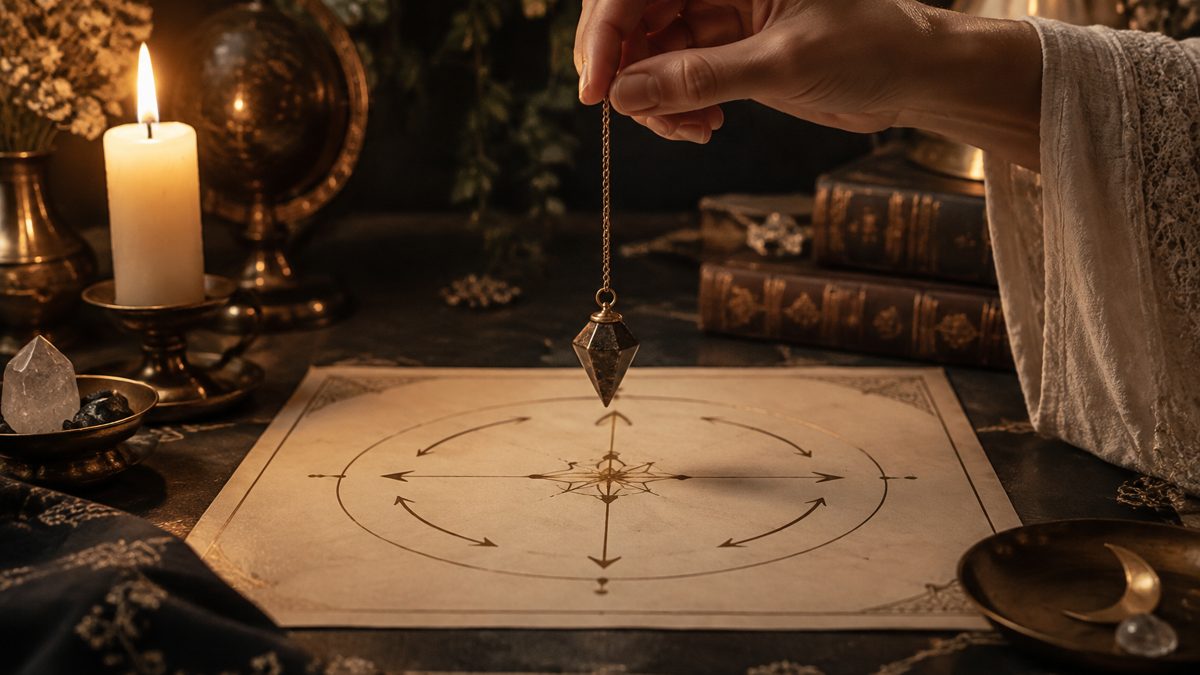
There is no universal rule that clockwise means yes or that a sideways swing means no. Different practitioners use different conventions. Before interpreting anything, decide how you will label the movements during this session. The companion page, Pendulum Movements and Charts, can help you compare common layouts without treating any one of them as mandatory.
One approach is to assign a pattern deliberately: forward and back for yes, side to side for no, and unclear movement for no usable response. Another traditional approach is to ask the pendulum to show each signal. If you use that method, remember that expectation can influence the pattern that emerges.
Dê à incerteza um lugar claro em seu sistema. Quietude, movimento misto ou um padrão fraco demais para distinguir não precisam significar um aviso oculto. Podem simplesmente significar que você não tem um resultado interpretável. Evite inventar uma nova categoria no meio de uma pergunta só porque a convenção original não produz a resposta que você deseja.
Some beginners ask questions with obvious answers as a warm-up. That can help them recognize movement, but it is not a test of paranormal accuracy: already knowing the answer can guide unconscious muscle movements. Treat this stage as learning a visual vocabulary, not as proving that the pendulum is a reliable source.
- 1. Registre suas convenções para sim e não antes de fazer uma pergunta pessoal.
- 2. Observe cada padrão sem forçar um balanço amplo.
- 3. Record an uncertainty category rather than requiring every movement to mean yes or no.
- 4. Pare se os padrões continuarem difíceis de distinguir.
6. Siga uma sessão simples, passo a passo
For your first session, use one question rather than a long list. Hold the pendulum over a blank part of the table and wait for the movement from lifting it to settle. Keep the weight clear of your notebook and clothing. The aim is a comfortable, repeatable routine, not perfect bodily stillness.
Read your prepared question once, either silently or aloud. Watch without deliberately steering the weight. You may still influence the swing unconsciously; trying hard to eliminate every tiny movement will usually make you tense. Instead, observe honestly and avoid claiming more independence from your expectations than the method can provide.
Use uma janela de observação curta, como vinte a trinta segundos. É um limite prático, não uma exigência tradicional. Se um padrão não estiver evidente até lá, registre-o como incerto. Esperar indefinidamente estimula o cansaço e lhe dá mais oportunidades de escolher qualquer movimento que pareça mais significativo.
Afterward, put the pendulum down before deciding what to do. Notice whether you feel relief, resistance, disappointment, or indifference. That reaction may tell you more about your preference than the swing itself. Make any next step through ordinary judgment, including practical constraints and other people's consent.
- 1. Write one low-stakes question and your movement convention.
- 2. Hold the pendulum comfortably and allow the initial motion to settle.
- 3. Faça a pergunta uma só vez e observe durante o breve intervalo que você escolheu.
- 4. Record the movement as yes, no, or unclear without embellishing it.
- 5. Largue a ferramenta e escreva sua reação emocional imediata.
- 6. Choose a small, reversible action, or choose not to act.
7. Trabalhe com um exemplo de baixo risco
Imagine que você tem meia hora livre depois do jantar e está decidindo entre desenhar ou ler. Ambas as opções são acessíveis, seguras e possíveis. Você escreve uma pergunta estreita: quero passar os primeiros dez minutos desenhando esta noite? Você está explorando uma preferência atual, não perguntando qual atividade o destino escolheu.
Before beginning, you note that you feel tired but would like a break from screens. Your convention is forward and back for yes, side to side for no, and an indistinct pattern for unclear. You also decide that you will ask only once and will stop after about thirty seconds.
Suppose the pendulum develops a forward-and-back swing. You record the visible pattern rather than writing that a spirit ordered you to draw. When you put it down, you notice a little relief. That feeling suggests that sketching was already appealing, though it does not prove the movement came from a source beyond you.
You sketch for ten minutes and then check how you feel. If you enjoy it, continue; if not, switch to reading. A no or unclear response would not forbid sketching either. The useful outcome is a manageable experiment and greater awareness of your preference, not obedience to a moving object.
- 1. Pergunta: Quero dedicar os primeiros dez minutos desta noite a fazer esboços?
- 2. Observação: Um balanço para a frente e para trás apareceu dentro da janela de observação.
- 3. Reflexão: senti alívio e percebi que queria algo mais prático.
- 4. Action: Try sketching briefly, then reassess based on the actual experience.
8. Interpret movement without adding certainty
Interprete apenas o que a sua convenção original permite. Se ir para a frente e para trás significa sim, esse é o rótulo que você pode registrar dentro do exercício. Isso não significa automaticamente com certeza, imediatamente ou para sempre. Significados adicionais precisam de justificativa própria, e o pêndulo não pode fornecer evidência apenas por se mover de forma mais dramática.
Um balanço amplo não é medida de verdade. O comprimento da corrente, a postura, pequenos movimentos das mãos e o acúmulo de movimento podem afetar o tamanho. Da mesma forma, uma resposta lenta não indica necessariamente relutância, energia bloqueada ou perigo espiritual. A variação física comum basta para explicar muitas mudanças.
Mixed movement is a reason to pause, not an invitation to construct a complicated story. The pendulum may shift from an ellipse to a line as your hand position changes. If you cannot confidently describe the visible pattern, write unclear. You do not lose anything important by leaving a question unanswered.
When a response conflicts with verifiable information, trust the information. When it conflicts with your values, consent, or safety, do not follow it. You can still ask what your reaction reveals: perhaps you dislike an option more than you realized. That insight belongs to reflection, not proof of an external message.
9. Use as tábuas com cuidado
A pendulum chart places possible responses around a central resting point. Simple charts may show yes, no, and unclear; others include several activities or themes. Charts can organize a reflection, but adding labels does not make the method more accurate. A complicated diagram can instead create more opportunities for ambiguous interpretation.
Comece com um conjunto pequeno e bem espaçado de opções de baixo risco. Por exemplo, uma tábua pode listar ler, desenhar, alongar-se e descansar. Inclua uma opção de não escolher nada ou de decidir de outra maneira. Evite tábuas que afirmem identificar doenças, alergias, doses de suplementos, pessoas desaparecidas ou outros assuntos que exijam avaliação confiável.
Remember that a back-and-forth swing follows an axis and points in two directions. If your layout places different answers at opposite ends of that axis, the result may be impossible to distinguish. Many semicircular layouts reduce this problem by putting response labels on only one side of the resting point.
Coloque a tabela plana e mantenha o ponto de suspensão acima do seu centro marcado. Não deslize a mão em direção a uma opção preferida. Consulte Movimentos e Tabelas do Pêndulo como referência, mas mantenha suas próprias anotações sobre a disposição usada. Se o balanço cair entre duas opções, registre a ambiguidade em vez de arredondar para a resposta que você esperava.
- 1. Draw a simple semicircle with a marked suspension point and widely spaced labels.
- 2. Include an unclear or no-selection option.
- 3. Hold the pendulum above the center without touching the paper.
- 4. Ask one reflective question and record only a clearly distinguishable axis.

10. Recognize common mistakes
The most common trap is asking repeatedly until the answer feels reassuring. A different swing on the fifth attempt does not reveal a deeper truth than the first four. Repetition increases fatigue and allows you to select a preferred result. Set a one-question, one-attempt boundary whenever you notice this temptation.
Another mistake is asking loaded questions. Wording that assumes betrayal, danger, or a curse can make an anxious interpretation feel inevitable. A pendulum cannot establish that someone is deceiving you or that supernatural harm has occurred. Look for observable facts and supportive conversation instead of building a chain of questions around an unverified premise.
Os problemas técnicos também são comuns. Uma manga solta, um cotovelo instável, uma corrente longa, ar em movimento ou contato com a mesa podem alterar o movimento. Resolva esses fatores antes de buscar explicações simbólicas. Se a mão ficar dolorida ou o peso nunca se acomodar bem, pare em vez de forçar a sessão a funcionar.
Selective memory can make results seem more impressive than they were. People naturally remember striking matches and forget vague or mistaken answers. Record uncertainty and contradictions as carefully as satisfying responses. Do not rewrite the question afterward to fit what happened; preserve the original wording so your notes remain honest.
11. Acrescente um ritual opcional e cuide da ferramenta
Some practitioners symbolically cleanse a pendulum before using it. Others consider ordinary physical cleaning sufficient. A brief intention, a quiet pause, or placing the tool on a clean cloth can mark a transition into reflective time. These gestures may feel meaningful without being necessary or scientifically established ways to remove unseen influences.
Clean according to the material rather than following a universal ritual recipe. A soft, dry cloth is often the simplest choice. Water, salt, oils, and cleaning products can damage some stones, finishes, cords, and metal fittings. If you do not know what your pendulum is made from, avoid soaking it.
Candles, incense, and herbs are optional, not requirements. If you use a candle, place it in a stable holder away from curtains and never leave it unattended. Smoke can aggravate respiratory conditions and harm some pets. Do not burn unfamiliar plants, ingest ritual herbs, or drink water used to soak a stone.
Evite despejar água salgada ritual em plantas de casa ou no solo do jardim, onde o sal pode danificar as raízes. Nem é preciso preparar misturas especiais de limpeza. Depois do uso, seque a ferramenta, se necessário, e guarde-a com segurança em um saquinho ou caixa. Um gesto simples de encerramento pode ajudar a deixar a sessão para trás.
- 1. Inspect and gently clean the pendulum using material-appropriate care.
- 2. Choose a harmless symbolic opening if you want one.
- 3. After the session, put the pendulum away and return to an ordinary activity.
12. Keep safety, consent, and ethics central
Never use a pendulum to diagnose illness, determine pregnancy, choose medication doses, test whether food is safe, or decide whether emergency care is necessary. It cannot reliably answer those questions. Use appropriate tests and qualified health professionals. If you are facing immediate danger or concerning symptoms, seek help rather than consulting a divination tool.
The same boundary applies to legal judgments, major financial commitments, and accusations against other people. A pendulum response is not evidence of theft, infidelity, abuse, or deception. Make decisions from reliable information, direct communication where safe, and relevant professional advice. Do not let the ritual give unsupported suspicions an appearance of authority.
Respect other people's privacy and autonomy. Asking about someone's secret thoughts does not grant access to them, and a movement cannot establish their consent. If you practice with another adult, explain that the exercise is interpretive and not a dependable source of facts. Do not present frightening predictions or pressure anyone into purchases or further sessions.
Pay attention to your own relationship with the tool. If you feel unable to make ordinary decisions without it, repeatedly seek reassurance, or become frightened by its responses, take a break. Speak with someone you trust or a mental health professional if distress persists. A worthwhile personal practice should leave room for freedom, uncertainty, and ordinary life.
13. Journal, review, and build a balanced practice
A useful pendulum journal separates observation from interpretation. Record the date, the exact question, your mood, your movement convention, and what visibly happened. Then note what you thought it meant. Keeping those categories distinct makes it easier to see where a simple swing became a larger story.
Record your expectation before the session whenever possible. Afterward, note your emotional reaction and the action you actually chose. If you later review an outcome, describe what occurred without stretching the original wording to make it fit. For preference questions, the important result may be whether a small experiment helped you understand yourself.
Review several entries together rather than judging the practice by one memorable session. Do your responses tend to match what you already hoped? Are questions becoming repetitive or more anxious? Informal journaling cannot establish paranormal accuracy, but it can reveal habits of attention, reassurance seeking, and decision-making that deserve care.
You do not need a daily schedule. Occasional, brief sessions may be enough, and stopping altogether is a valid choice. Let the pendulum remain one optional reflective object alongside conversation, writing, rest, and direct experience. The strongest foundation for using it is not certainty about unseen forces, but honesty about what you observe and responsibility for what you do.
- 1. Before: Record your question, mood, expected answer, and movement convention.
- 2. During: Describe the movement plainly, including stillness or ambiguity.
- 3. After: Note your feelings and any small, reversible action you choose.
- 4. Later: Record the actual experience without changing the original entry.
- 5. Periodicamente: avalie se a prática apoia a reflexão ou cria dependência.
These practices are shared as tradition and personal reflection, not as a substitute for medical, legal or financial advice.
Continue aprendendo
- Pendulum movements and charts
- How to read tarot cards
- How to use angel oracle cards
- Como ler cartas de baralho
- Como usar cristais em feitiços
- Como usar ervas na bruxaria
- How to read the Dr. Moorne Egyptian Tarot
- How to read dice
- How to read tea leaves
- Como usar um pêndulo
- Como lançar um feitiço de vela
- How to make a spell jar
- How to make a sigil
- How to cleanse your home
- How to set up an ancestor altar
- How to open a sacred space
- How to time spells with the moon
- How to work with water and salt
- How to make a protection charm bag
- Read the Journal ou visite o shops