How-To Guide
Como Ler Cartas de Baralho para Adivinhação (Cartomancia)
Por Seraphina
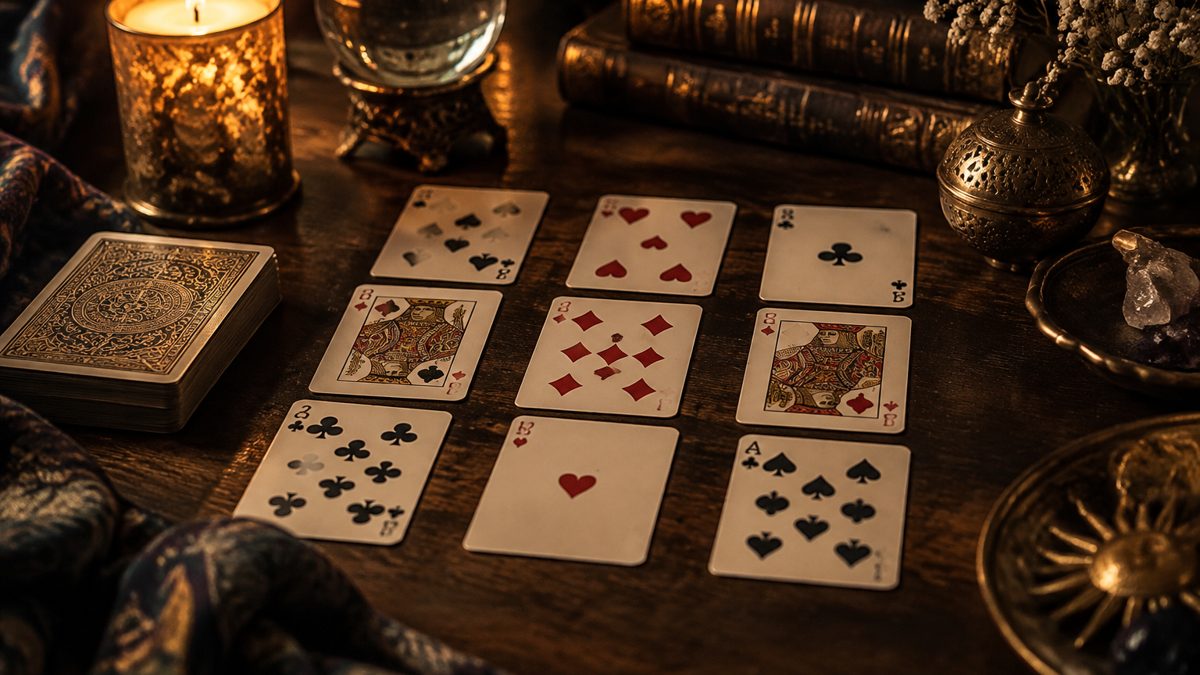
Há algo maravilhosamente acolhedor em um baralho comum sobre a mesa da cozinha. Ele não precisa de embrulho de veludo nem de ilustrações elaboradas para parecer cheio de possibilidades. Seus conhecidos copas e espadas já pertencem a uma linguagem de jogos, acaso e companhia humana. Aqui no Crossroads Journal, gosto de abordar a cartomancia nesse mesmo espírito acolhedor: como uma prática simbólica tradicional que pode abrir espaço para a reflexão, a imaginação e um pouco de cerimônia cotidiana.
I’m Seraphina, and this is the beginner’s guide I would want beside me when opening an ordinary deck for the first time. We will explore the history of playing-card divination, build a practical vocabulary for the suits and ranks, prepare a deck, and try both three-card and nine-card layouts. I will also explain the significator, show how cards modify one another, and walk through a complete example without pretending there is only one correct interpretation.
Um limite gentil antes de começarmos: as pessoas entendem a adivinhação de maneiras diferentes. Algumas a consideram uma prática espiritual; outras a tratam como narrativa, contemplação ou um jeito de perceber as próprias suposições. Não há evidência confiável de que cartas embaralhadas prevejam acontecimentos futuros. Ao longo deste guia, as associações mágicas são apresentadas como tradições e crenças, não como fatos comprovados, e nenhuma leitura deve ser tratada como promessa ou como uma instrução que se sobreponha ao seu discernimento.
You need only a standard 52-card deck, a clear surface, and something to write on. Remove the jokers for the system below. Bring curiosity rather than a demand for certainty, and choose an everyday question with room for your own agency. My favorite starting point is not “What must happen?” but “What might be useful to consider?” That small change makes the whole practice more generous.
Looking for the meaning of a single card or ingredient? Keep our Playing card meanings guide open beside you.
Como Ler Cartas de Baralho para Adivinhação (Cartomancia)
Cartomancy means divination using cards. In everyday usage, the word often refers specifically to reading ordinary playing cards, although it can describe a wider family of card-based practices. Playing cards existed before the familiar modern systems of fortune-telling attached to them. Their earlier history reaches into Asia, and cards arrived in Europe by the late fourteenth century, where different regions developed distinctive suits, designs, and games.
The hearts, diamonds, clubs, and spades used here belong to the French-suited tradition. Those symbols became widely familiar through the spread of French-style decks. European playing-card divination is documented in early modern sources, with printed methods becoming especially visible in the eighteenth and nineteenth centuries. Professional readers, household traditions, and popular manuals all helped shape the practice. That history is varied rather than a single unbroken system handed down unchanged.
Tarot and ordinary playing-card reading are related, but they are not interchangeable. Tarot developed as a card game in fifteenth-century Europe, and its widespread association with occult divination came later. A standard playing deck has no major arcana and has three court ranks per suit rather than tarot’s four. You can borrow ideas across traditions, but I find it clearer to learn the particular deck in your hands before mixing systems.
O mais importante: os métodos históricos de cartomancia não concordam em todos os significados. Um livro pode tratar certa carta como uma visita, outro como notícia, outro como determinado tipo de relacionamento. Os significados deste guia formam um quadro coerente para iniciantes, não uma pretensão de autoridade universal. Se a sua família ou tradição cultural usa outro sistema, não precisa descartá-lo. A coerência dentro de uma leitura importa mais do que colecionar todas as definições possíveis.
1. Ask a Question That Leaves You Room to Choose
Before thinking about meanings, decide what kind of conversation you want to have with the cards. A narrow prediction can encourage you to squeeze a complex life into an unhelpful yes or no. An exploratory question gives the symbols something more useful to do. Instead of “Will my new neighbor become my best friend?” try “How can I approach getting to know my new neighbor?” The second question keeps the focus on your conduct, expectations, and available choices.
Good beginner questions are specific enough to anchor the reading but open enough to invite several perspectives. “What should I notice about starting a creative project?” is more workable than “Tell me everything about my life.” You might also ask what supports a situation, what complicates it, and what small next step deserves consideration. Avoid repeatedly rephrasing the same question until you receive the card you were hoping for.
A reading is not a reliable way to discover another person’s private thoughts, confirm accusations, or establish facts. If a question concerns a relationship, keep it on your side of the fence: what you have observed, how you communicate, and which boundaries matter to you. Cards cannot substitute for a direct conversation. They also should not guide medical, legal, or financial decisions; those belong with appropriate information and qualified support.
When reading for someone else, explain your approach and ask permission before beginning. Make clear that interpretations are symbolic and uncertain, and let the person decline any topic. I would rather offer one thoughtful possibility than deliver a dramatic pronouncement. The reader’s responsibility is not to sound all-knowing, but to keep the exchange respectful, grounded, and open to correction.
2. Learn the Four Suits as Areas of Everyday Life
Hearts concern affection, belonging, pleasure, hospitality, and emotional connection in this framework. They do not automatically mean romance. A heart might point toward friendship, family rituals, enjoying your own company, or the atmosphere you create when welcoming someone. In practice, ask: where is feeling or connection central to this question? A heart in a position called “support” might suggest encouragement or companionship, while the same suit in “complication” could invite reflection on expectations of closeness.
Clubs concern activity, learning, effort, collaboration, and the development of skills. Think of hands making something, people organizing a shared task, or a beginner practicing until a movement becomes familiar. Although some traditions connect clubs strongly with business, I use them more broadly for purposeful engagement. In a question about joining a choir, clubs might bring attention to rehearsals, regular attendance, or learning to contribute to a group.
Ouros dizem respeito a coisas tangíveis: posses, materiais, arranjos práticos, trocas e o que valorizamos. Algumas tradições de cartomancia enfatizam o dinheiro aqui, mas este guia usa os ouros como um lembrete mais amplo dos recursos cotidianos. Um ouros pode simbolizar os materiais de um projeto artesanal, o espaço disponível em um cômodo ou um acordo sobre dividir equipamentos. Não estabelece se um investimento terá sucesso nem se uma compra é sensata. Mantenha o simbolismo no nível da reflexão prática.
Spades concern difficulty, limits, disagreement, separation, and necessary clarification. They deserve attention, but not dread. A spade might suggest that a plan needs a boundary, that an assumption needs questioning, or that something is asking for closure. In some traditional systems, spades receive severe meanings; I do not treat any card as evidence of death, illness, betrayal, or disaster. As a quick memory aid, hearts connect, clubs engage, diamonds make things tangible, and spades examine what resists or needs defining.
3. Dê às Cartas Numéricas um Vocabulário Prático
In this method, a card’s working meaning comes from combining its suit with its rank. The suit supplies the area of life; the number supplies a movement or pattern. These number associations are an interpretive scaffold, not a universal code. Learn them in small groups, and test them against ordinary situations. You are not trying to memorize fifty-two rigid predictions. You are learning to construct a sensible phrase, such as “a beginning in connection” or “effort meeting resistance.”
Aces suggest an opening, a seed, or a concentrated expression of the suit. The ace of hearts might represent an invitation to connect; the ace of clubs, the first impulse toward an activity. Twos suggest a pair, an exchange, a choice, or the task of balancing two elements. Threes suggest growth, expression, participation, or the complication that arrives when something expands beyond a pair. A three of diamonds, for instance, might prompt you to consider how several practical contributions fit together.
Fours suggest structure, stability, routine, or a boundary. Stability can be comforting or restrictive depending on the question. Fives suggest disturbance, adjustment, friction, or a change that requires a response. Sixes suggest cooperation, accommodation, or a workable rhythm after adjustment. Imagine these ranks as a small sequence: a structure forms, something disrupts it, and a new arrangement becomes possible. The six does not promise resolution; it invites you to look for ways a situation might become more workable.
Os setes sugerem avaliação, incerteza, paciência ou o teste de uma abordagem. Os oitos sugerem movimento, repetição, esforço focado ou impulso. Os noves sugerem acúmulo, intensidade ou a aproximação de um ponto de plenitude. Os dez sugerem culminação, a expressão plena do naipe ou a transição para outra fase. Um nove, portanto, pode parecer satisfatório ou sufocante; um dez pode parecer completo ou pronto para ser deixado para trás. As cartas ao redor e a posição na tiragem ajudam você a decidir qual aspecto merece atenção.
For a brief practice, compare the four fours: hearts might suggest familiar emotional comforts; clubs, an established practice routine; diamonds, an orderly arrangement of materials; spades, a firm limit. Notice that the rank stays recognizable while the suit changes its setting. If you cannot find a natural connection, write down two tentative possibilities rather than forcing an answer. Fluency comes from comparing interpretations with lived context, not from making every draw sound profound.
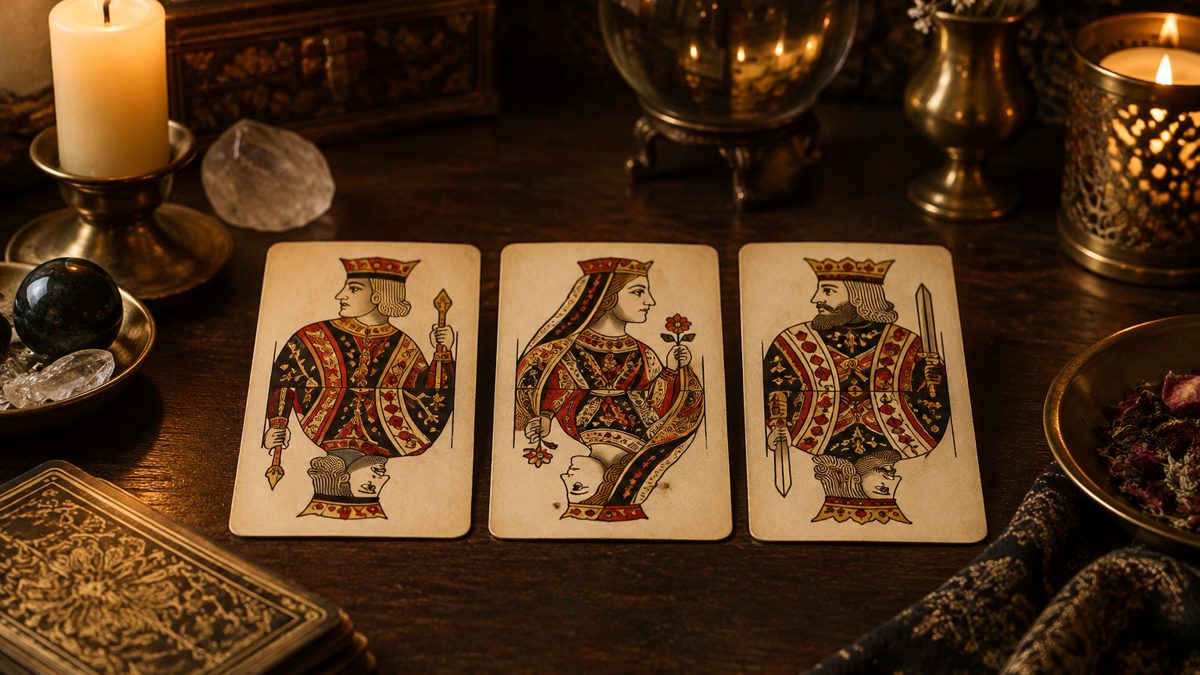
4. Read Jacks, Queens, and Kings Without Stereotypes
As figuras da corte costumam ser onde os iniciantes se enrolam. Manuais mais antigos podem descrever pessoas por meio de suposições rígidas sobre gênero, estado civil, aparência ou posição social. Você não precisa dessas suposições para ler um baralho. Prefiro tratar as figuras primeiro como papéis ou estilos de envolvimento, e só em segundo lugar como possíveis pessoas. Isso as torna mais adaptáveis e evita fingir que uma carta possa identificar o caráter de um desconhecido pela aparência.
Jacks suggest curiosity, messages, experimentation, or someone entering a situation with developing experience. Queens suggest cultivation, discernment, attentiveness, and the ability to sustain an atmosphere or practice. Kings suggest stewardship, direction, responsibility, and decisions that shape a wider setting. These are symbolic roles, not a hierarchy of personal worth. Anyone, of any gender or age, can embody any of them, and the same person may occupy different roles in different situations.
Combine figura e naipe da mesma forma que combina número e naipe. Um valete de paus pode sugerir um aprendiz ávido ou um convite para experimentar uma atividade. Uma dama de copas pode representar uma hospitalidade atenciosa. Um rei de ouros pode apontar para a responsabilidade por materiais compartilhados, enquanto uma dama de espadas pode sugerir discernimento claro e limites bem cuidados. São frases de partida, não retratos fixos. A pergunta diz se a qualidade da carta é útil, excessiva, ausente ou simplesmente perceptível.
If a court seems to represent someone, ask what supports that interpretation. Does the person actually occupy the relevant role, or are you attaching their name because you wanted them to appear? When several courts turn up, consider multiple approaches or competing responsibilities before declaring a cast of characters. My favorite question is “What role is needed here?” It usually creates a more useful reading than “Who exactly is this?”
5. Prepare Your Deck and Make a Simple Reading Ritual
Any complete, readable 52-card deck will do. A well-used pack from the cupboard is just as suitable for learning as a new one. Check that all four suits are present from ace through king and set the jokers aside. Some traditions use jokers, but their meanings vary; leaving them out makes this beginner’s system easier to follow. There is no requirement to buy a dedicated divination deck.
Some practitioners believe in cleansing or consecrating cards through ritual. You might instead regard preparation as a way of settling your attention. Neither interpretation requires elaborate equipment. I suggest straightening the deck, clearing a space, and taking a quiet breath. If you enjoy symbolism, place a meaningful object nearby or wrap the deck in a favorite cloth afterward. These actions can mark the occasion without being presented as necessary for supernatural accuracy.
Embaralhe da maneira que for confortável e acessível. Você pode embaralhar de modo tradicional, misturar suavemente as cartas sobre a mesa ou dividir e juntar o baralho de novo. Nenhuma contagem exata é necessária. Antes de tirar as cartas, decida se usará apenas os significados na posição direita; recomendo fazê-lo no início, pois muitas cartas de baralho comum não têm um topo claramente marcado. Decida também que as cartas que caírem por acidente durante o embaralhamento simplesmente voltarão ao baralho, em vez de se tornarem automaticamente mensagens.
Write down the question and the spread positions before turning anything over. Shuffle, cut if you wish, and deal from the top. You do not need a special sensation to tell you when the deck is ready. A consistent procedure helps you avoid changing the rules to favor an appealing result. Stop or postpone the reading if you feel distressed or compelled to keep drawing. The cards will still be there when curiosity feels more spacious.
6. Decide Whether to Use a Significator
Um significador é uma carta escolhida deliberadamente para representar a pessoa, a situação ou o tema central de uma leitura. Serve como ponto de referência, não como previsão. Os sistemas tradicionais costumam escolher uma figura conforme as características pessoais, mas você pode escolher por função ou intenção. Quem está começando um passatempo desconhecido pode escolher o valete de paus; quem explora a hospitalidade pode escolher a dama de copas.
Uma carta numerada pode funcionar igualmente bem. O dois de copas pode representar uma conexão em desenvolvimento, enquanto o quatro de ouros poderia representar a organização prática de um espaço compartilhado. Escolha uma carta porque o simbolismo dela combina com a pergunta, e não porque você acha que ela captura a sua identidade permanente. Você é muito mais complexo do que um único pedaço de papelão impresso. O significador é um rótulo temporário sobre a mesa.
For beginners, the simplest method is to place the significator face up above the spread and then shuffle the remaining fifty-one cards. It is a chosen anchor, so do not count its presence as an independently drawn message. Alternatively, write its name in your notebook and keep the full deck intact. Some traditions leave a significator in the shuffled deck and interpret cards around it, but that requires a different procedure from the spreads taught here.
You can also skip the significator entirely. I often do when a clear written question already provides enough focus. If you use one, decide before shuffling and record the choice. Do not search through the deck afterward for a card you hoped would appear. The purpose is to orient the reading, not to manufacture confirmation.
7. Begin with a Three-Card Spread
A three-card spread is small enough to keep you honest. It gives each card a clear job and leaves less room for wandering into unrelated stories. My preferred beginner’s layout is situation, complication, and constructive response. It explores what is being considered, what makes it less straightforward, and an approach worth weighing. The third position is not an order, and it does not guarantee that a suggested action will produce a particular result.
You can also use past influence, present focus, and possible direction. If you choose that version, keep the final card conditional: it suggests a theme to consider if the current approach continues, not a future already written. I generally favor the first layout because it stays close to choice and observation. Whatever you select, write the position names first rather than deciding what they mean after seeing the cards.
Read each card through its assigned position before combining the three. A heart in the complication position does not automatically make the reading cheerful; it could bring attention to a wish for approval or an unspoken emotional expectation. A spade in the constructive-response position is not necessarily discouraging; a clear limit might be precisely the useful idea. The position changes the question you ask of the symbol.
Finish with a short summary and one grounded reflection. For example: “This looks like enthusiasm complicated by too many assumptions; I could ask a clearer question before proceeding.” Then check whether that interpretation fits what you actually know. If it does not, let it remain unhelpful. Not every arrangement needs to become a revelation, and a reading gains nothing from being forced.
- Write one question and label three positions: situation, complication, constructive response.
- Embaralhe e distribua três cartas com a face para baixo, da esquerda para a direita, e depois vire-as.
- Write one sentence per card using its position, suit, and rank.
- Connect the sentences, note an alternative interpretation, and identify one optional next step.
8. Amplie para uma Tiragem de Nove Cartas
Once three cards feel manageable, try a nine-card box arranged in three rows of three. There are many traditions for reading this layout; here is one consistent beginner’s version. The top row represents background influences, the middle row represents the present situation, and the bottom row represents possible approaches. The columns, from left to right, represent your perspective, the point of interaction, and the surrounding conditions.
Read each position as the intersection of its row and column. The top-left card concerns background influences on your perspective. The top-middle card concerns the background of the interaction, and the top-right concerns earlier surrounding conditions. The center card focuses on the current interaction itself. The bottom-right card suggests an approach to the surrounding conditions, rather than predicting what the environment will inevitably do.
Begin with the center, then read each row from left to right. Afterward, read the columns downward to trace how a background theme relates to the present and to a possible response. This is a lot of information, so keep each individual interpretation short. You can note a dominant suit or repeated rank, but do not add diagonals, special corner rules, and extra layers merely because the layout has room for them.
The nine cards are best treated as a structured conversation, not nine separate forecasts. If the top row emphasizes clubs and the bottom row emphasizes hearts, one possible reading is a shift from doing and practicing toward connection and enjoyment. That is a reflective comparison, not proof of an approaching event. If the spread becomes muddy, return to the question and the center card instead of drawing more cards to explain every uncertainty.
- Escreva no caderno os significados das linhas e das colunas antes de tirar as cartas.
- Deal cards one through three across the top, four through six across the middle, and seven through nine across the bottom.
- Interprete a carta cinco como o ponto atual de interação e depois leia as três fileiras.
- Leia de cima para baixo, coluna por coluna, e anote quaisquer naipes ou valores que se repitam.
- Summarize the whole spread in three sentences and separate observations from speculation.
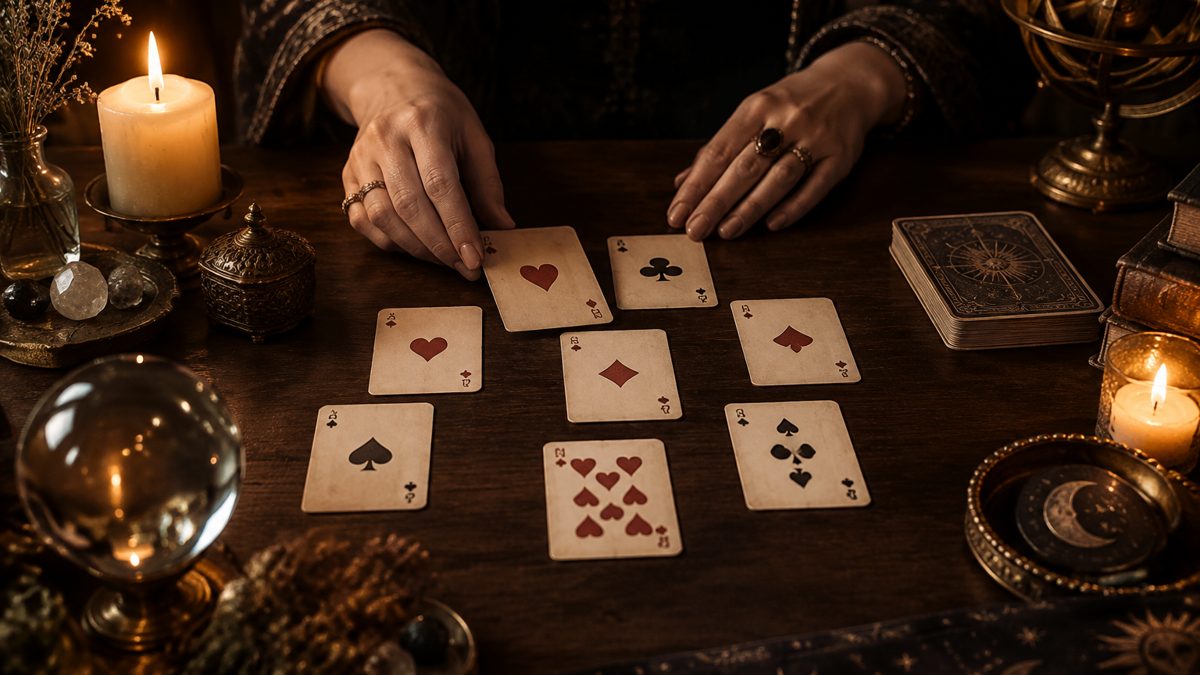
9. Combine Cards Without Losing the Question
Combining cards is less like looking up a secret password and more like making a sentence. Start with each card’s assigned position, then let nearby cards qualify the interpretation. A two of hearts beside an eight of clubs could suggest connection developed through repeated shared activity. Reverse the emphasis, and it might suggest that an activity works better with cooperation. Neither combination guarantees friendship; both offer a way to think about participation.
Contrast is especially useful. A four of hearts next to a five of clubs might place emotional comfort beside disruption in an activity. You could ask whether a familiar routine is resisting an experiment, or whether a new task is unsettling an otherwise comfortable group. The question and positions should help you choose between those possibilities. Avoid adding dramatic details, named people, or precise dates that the symbolic framework cannot establish.
Valores repetidos sugerem um tema que vale a pena examinar. Vários dois podem destacar trocas ou escolhas; vários quatro podem trazer estrutura e limites para o foco. Uma concentração de um naipe pode, da mesma forma, enfatizar uma área da vida. No entanto, cartas de todos os naipes têm uma chance comum de aparecer, e a ausência de um naipe não prova que algo falta na sua vida. Perceber padrões é uma técnica de leitura, não evidência de significado sobrenatural.
Mantenha as cartas contraditórias em diálogo, em vez de anular uma com outra. Um copas e um espadas podem convidar tanto ao calor humano quanto a limites. Um paus e um ouros podem sugerir equilibrar o entusiasmo com arranjos práticos. Quando estiver em dúvida, escreva “uma possibilidade é” e ofereça uma segunda leitura. Também evito regras de tempo neste método para iniciantes: as associações de naipe e número variam demais para justificar tratar uma carta como um calendário confiável.
10. Walk Through a Complete Sample Reading
Here is a hypothetical example, not a testimonial or a prediction. Imagine I am considering a small neighborhood craft afternoon and ask, “What should I consider when inviting people to make things together?” I choose the three-card layout: situation, complication, constructive response. I use no significator. The cards are the three of hearts, the seven of diamonds, and the king of clubs. Before interpreting, I write down the facts: the gathering is only an idea, and nobody has yet been invited.
O três de copas na posição de situação combina crescimento ou participação com conexão e prazer. Uma leitura direta é que a ideia gira em torno do prazer compartilhado, e não de resultados impressionantes. Posso me perguntar se quero uma tarde genuinamente descontraída ou se estou esperando, em silêncio, uma intimidade instantânea. A carta não mostra que os convidados vão se divertir; ela me ajuda a nomear a esperança social por trás do plano.
The seven of diamonds in the complication position combines assessment or uncertainty with tangible arrangements. Perhaps the useful question is whether the practical details are settled: available table space, materials, and how much preparation I can comfortably manage. I would check those things directly rather than assuming the card has discovered a hidden problem. An alternative interpretation is that I am spending so long evaluating every detail that I have not yet made a simple invitation.
The king of clubs in the constructive-response position combines stewardship with purposeful activity. I read this as an invitation to provide a clear, manageable structure: choose one accessible activity, describe what people can expect, and avoid overloading the afternoon. I do not need to identify a literal king-like person who will arrive and organize everything. The role may simply be one I can take on for this occasion.
Em conjunto, as cartas sugerem este resumo provisório: “Que o prazer compartilhado seja o objetivo, confira os arranjos práticos e ofereça estrutura suficiente para facilitar a participação.” Meu próximo passo poderia ser perguntar a dois vizinhos se a ideia lhes interessa antes de planejar mais. Nada aqui promete presença, amizade ou uma tarde bem-sucedida. O valor da leitura, se houver algum, está nas perguntas que ela ajudou a organizar e nas suposições que tornou visíveis.
11. Mantenha um Diário e Deixe sua Prática Permanecer Suave
A reading journal is useful because memory can quietly polish a vague interpretation into something that seems uncannily exact. Record the date, question, spread positions, cards, and your initial wording before events have a chance to color it. Include what did not fit and any alternative interpretations. Later, distinguish between an actual observation and a resemblance you noticed after the fact. A journal should preserve uncertainty, not become a scrapbook of supposed proof.
For practice, draw one card and describe its symbolism in an ordinary scene rather than asking for a daily prediction. The six of clubs might become people finding a comfortable rhythm while rehearsing; the four of diamonds, a neatly arranged shelf of shared supplies. This builds vocabulary without encouraging constant monitoring for signs. You can also compare two cards and explain how changing either the suit or rank changes the story.
Se sentir a tentação de repetir uma leitura até que ela o tranquilize, guarde o baralho. Mais cartas não criam necessariamente mais clareza. Tampouco cartas de aspecto difícil exigem compras de proteção, rituais caros ou obediência aos avisos de quem lê. Quem afirma que você precisa pagar para remover uma maldição revelada nas cartas está lhe dando um motivo para recuar, não para abrir mão do seu discernimento.
Meu ritual de encerramento é deliberadamente simples: escrever uma frase sobre o que foi útil, recolher as cartas e voltar ao dia. A cartomancia pode ser abordada como tradição herdada, simbolismo pessoal ou uma prática imaginativa silenciosa. Ela não precisa se tornar uma autoridade sobre a sua vida. Aqui no Crossroads Journal, é esse o tipo de magia para a qual abro espaço: o ritual moldado pela crença, a pergunta ponderada e a liberdade humana de deixar a mesa e escolher por nós mesmos.
These practices are shared as tradition and personal reflection, not as a substitute for medical, legal or financial advice.
Continue aprendendo
- Playing card meanings
- How to read tarot cards
- How to use angel oracle cards
- Como ler cartas de baralho
- Como usar cristais em feitiços
- Como usar ervas na bruxaria
- How to read the Dr. Moorne Egyptian Tarot
- How to read dice
- How to read tea leaves
- Como usar um pêndulo
- Como lançar um feitiço de vela
- How to make a spell jar
- How to make a sigil
- How to cleanse your home
- How to set up an ancestor altar
- How to open a sacred space
- How to time spells with the moon
- How to work with water and salt
- How to make a protection charm bag
- Read the Journal ou visite o shops