How-To Guide
How to Use Angel Oracle Cards: A Step-by-Step Guide
Por Seraphina
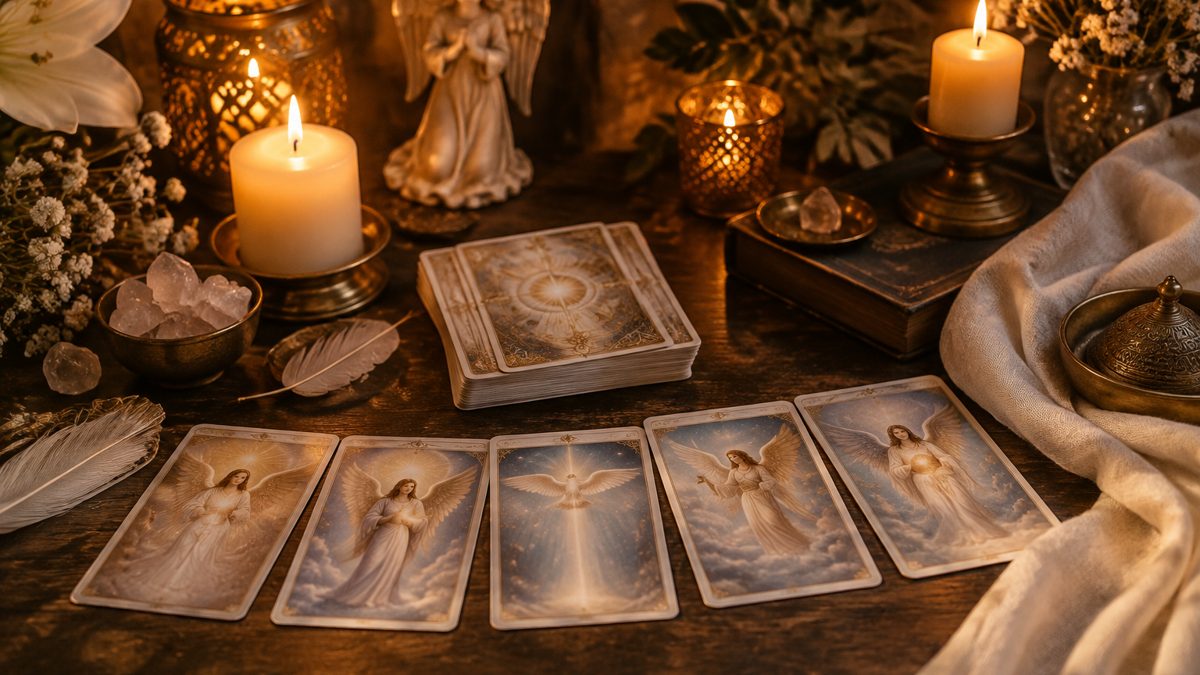
How to Use Angel Oracle Cards: A Step-by-Step Guide
There is something quietly inviting about a deck of cards waiting on a table: the painted wings, the unfamiliar symbols, the possibility of pausing long enough to hear yourself think. At Crossroads Journal, I like to approach practices like this with warmth and curiosity, but also with both feet on the ground. Angel oracle cards can belong to a spiritual tradition, a personal ritual, or a reflective journaling practice. You do not have to pretend certainty about the unseen to explore what the images bring to mind.
Sou Seraphina, e minha abordagem é simples: deixar que as cartas abram uma conversa em vez de encerrar uma pergunta. Alguns leitores acreditam que um baralho oracular de anjos oferece orientação de anjos ou de outros seres espirituais benévolos. Outros entendem a experiência por meio do simbolismo, da intuição e do modo como uma pergunta bem pensada pode revelar algo que já se agitava sob as distrações do dia a dia. Essas perspectivas não são idênticas, mas ambas podem sustentar uma prática deliberada e significativa, desde que você seja honesto sobre o que acredita e o que não sabe.
This guide will take you from choosing your first deck to making a small reading your own. We will cover intention and prayer, daily draws, beginner-friendly spreads, interpretation, archangel traditions, journaling, and a complete sample reading. There is no requirement to buy elaborate tools, memorize a hidden system, or receive a dramatic sign. A deck, a little time, and permission to stay curious are enough to begin.
Looking for the meaning of a single card or ingredient? Keep our Angel oracle card meanings guide open beside you.
1. Understand what angel oracle cards are
As cartas oraculares dos anjos são cartas ilustradas, concebidas em torno de imagens angélicas, temas espirituais ou mensagens associadas à orientação e ao encorajamento. Uma carta pode trazer uma palavra como paciência, coragem ou renovação. Outra pode nomear um arcanjo ou retratar uma porta, um jardim, uma lanterna ou um par de asas. A maioria dos baralhos inclui um guia que explica o simbolismo pretendido pelo criador e sugere maneiras de ler as cartas. Não existe uma estrutura única que governe: o número de cartas, a linguagem e as crenças subjacentes variam de baralho para baralho.
Within angel-oriented spiritual practice, readers may regard drawing a card as an invitation to receive a message from a benevolent presence. That is a matter of belief, not an established mechanism or a guarantee of supernatural communication. I find it helpful to make that distinction early. A reading can feel moving, timely, or deeply personal without proving where the experience came from. You can honor its emotional significance while leaving the larger metaphysical question open.
You can also use these cards without treating them as divination. A picture of a bridge might prompt you to consider a transition; a card about kindness might encourage you to examine your tone in a difficult conversation. In that approach, the deck supplies a subject for reflection rather than information about hidden events. The usefulness lies in the attention you bring to the prompt and the choices you make afterward.
Before your first reading, write one sentence describing your own starting point. Perhaps you believe angels can offer spiritual guidance. Perhaps you are exploring a family tradition. Perhaps you simply enjoy symbolic art. None of those positions requires performing conviction you do not feel. I would rather begin with an honest question than build a ritual around someone else’s certainty.
2. Know how oracle cards differ from tarot
Tarot and oracle cards share a family resemblance: both use images that can be arranged and interpreted. Their structures, however, differ. A conventional tarot deck contains 78 cards, divided into 22 Major Arcana cards and 56 Minor Arcana cards. The Minor Arcana usually comprises four suits, each with numbered and court cards. Decks vary in naming and imagery, but that underlying framework gives tarot readers a shared vocabulary across many editions.
Oracle decks do not follow one universal pattern. A creator might build a small collection of brief affirmations or a larger system with several categories and layered symbolism. An angel oracle deck might focus entirely on archangels, organize its cards around virtues, or mix angels with broader contemporary spiritual themes. Its guidebook is therefore especially useful: you are learning that particular creator’s system rather than assuming the rules of another deck apply.
Angel oracle cards often emphasize reassurance and constructive reflection, although not every deck is gentle in tone. Tarot can accommodate a broader dramatic range within its established symbolism, including conflict, endings, uncertainty, and change. Neither format is inherently more spiritually powerful, more accurate, or more suitable for everyone. The better starting point is the one whose imagery and structure help you ask thoughtful questions without feeling pressured or confused.
Você não precisa aprender tarô antes de usar um baralho oracular de anjos. Também não precisa importar técnicas do tarô para ele. Significados invertidos, disposições elaboradas e correspondências com a astrologia ou outros sistemas são opcionais, a menos que o baralho os inclua especificamente. Para quem está começando, sugiro aprender primeiro o baralho em seus próprios termos. Uma carta clara e uma pergunta atenta ensinarão mais sobre seus hábitos de leitor do que um arranjo elaborado que você não consegue interpretar com conforto.
3. Choose a deck you can meet with curiosity
Comece pela arte, mas não pare aí. Você passará tempo olhando de perto essas imagens, por isso observe se elas convidam à atenção ou o deixam disperso. Alguns baralhos usam imagens religiosas tradicionais; outros apresentam anjos por meio de ilustração fantástica contemporânea, luz abstrata ou cenas da natureza. Não há uma estética obrigatória. Eu escolheria um baralho que me faça querer demorar diante de uma imagem, e não um que sinto que deveria admirar.
A seguir, leia várias mensagens de exemplo das cartas e um trecho do guia, se disponível. A linguagem deixa espaço para o discernimento? Soa compassiva sem insistir que toda dificuldade tem uma explicação espiritual simples? Prefiro palavras que convidam à reflexão àquelas que anunciam um destino inevitável. Tenha cautela com baralhos ou serviços associados que usam o medo, alegam acesso exclusivo à verdade ou sugerem que você precisa comprar outra coisa para remover uma ameaça invisível.
Considere também os detalhes práticos. Você consegue segurar e embaralhar as cartas com conforto? A impressão é legível? O guia explica como o baralho foi desenvolvido e como usá-lo? Se você se interessa por uma tradição religiosa específica, examine as fontes do criador em vez de supor que imagens angélicas significam que o baralho representa fielmente essa tradição. Os sistemas oraculares contemporâneos costumam misturar ideias de vários lugares.
You do not need an expensive deck, and you do not need someone else to give you your first one. Buying your own is perfectly reasonable. A borrowed or secondhand deck can also work if its condition and provenance are acceptable to you. Set a modest limit before browsing, choose one deck, and give yourself time to learn it. Familiarity usually offers more to a reflective practice than a rapidly growing collection.
- Look at several actual cards, not only the cover artwork.
- Read the deck description and a guidebook sample to understand its tone and beliefs.
- Check card size, readability, availability, and price.
- Choose a deck that encourages reflection without demanding unquestioning obedience.
4. Prepare um espaço de leitura simples e confortável
A reading space need not resemble an altar in a photograph. A clear corner of a kitchen table can be enough. The purpose is to create a little room for attention, not to impress an imagined spiritual audience. Put down your phone if possible, move anything that might spill, and gather your deck, guidebook, and notebook. If your household is busy, even a few uninterrupted minutes may be more practical than waiting for perfect silence.
Alguns leitores limpam ou abençoam seus baralhos antes de usá-los. Em diversas práticas espirituais contemporâneas, isso pode envolver uma oração, uma batida simbólica no baralho, um som ou colocar as cartas ao lado de um objeto significativo. Essas ações são compreendidas por meio da tradição e da crença pessoal; não são necessárias para que um baralho possa ser usado. Se você gosta de um ritual de boas-vindas, escolha um simples e seguro. Evite fumaça onde ela incomodaria pessoas ou animais e mantenha as cartas longe de chamas, água e luz solar que danifique.
I like the idea of beginning by getting acquainted rather than trying to activate anything. Look through the cards in order. Notice repeated colors, recurring symbols, and words that feel particularly inviting or uncomfortable. Read the creator’s introduction. This first pass helps you recognize the visual language of the deck and reduces the pressure to produce an immediate, meaningful reading. It is also a chance to spot themes you may want to approach carefully.
Decide how long your session will last before you start. Ten quiet minutes can hold a complete reading: settle, ask, draw, reflect, close. A time boundary helps prevent a simple question from becoming an afternoon of repeated draws. If the setting is distracting or you are too tired to engage, you can put the deck away. Missing a session does not damage a relationship with your cards or require a corrective ritual.
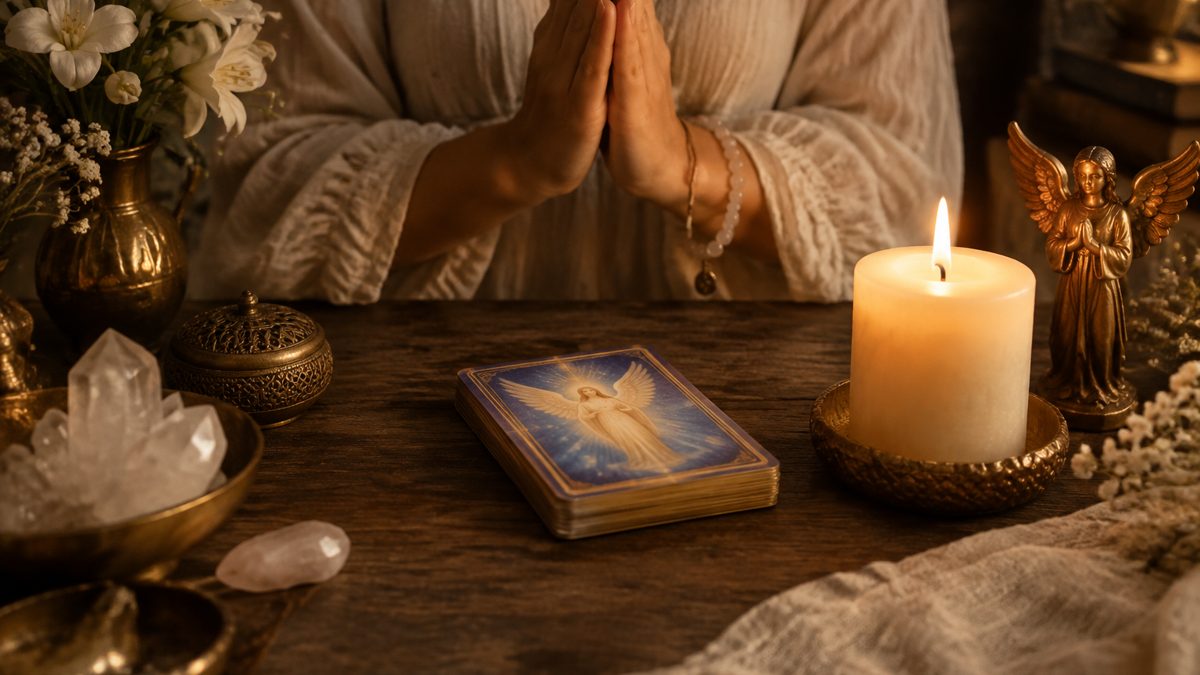
5. Set an intention or offer a prayer
Uma intenção dá direção à leitura. Não precisa ser elaborada e não obriga um resultado específico. Antes de embaralhar, pergunte-se o que você realmente busca: conforto, perspectiva, um assunto para o diário ou um modo de pensar sua próxima ação cotidiana. Esse pequeno esclarecimento importa. Uma pergunta sobre como abordar uma conversa permite uma reflexão mais útil do que a exigência de saber exatamente o que outra pessoa pensa em segredo.
If prayer belongs to your spiritual practice, you may begin by addressing God, angels, or a benevolent presence in language consistent with your beliefs. A simple prayer could ask for clarity, compassion, and the wisdom to keep your own judgment. You might also ask that the practice remain grounded in kindness toward yourself and others. No particular wording is required, and an awkward sentence is not a spiritual mistake.
Se preferir uma abordagem não religiosa, declare seu propósito com simplicidade: você está dedicando alguns minutos para refletir, observar suas reações e considerar um próximo passo útil. Você pode apoiar as mãos no baralho ou respirar fundo, com conforto. Esses gestos podem marcar a passagem da atividade cotidiana para a atenção focada, sem afirmar nada sobre forças invisíveis. Escolha o que parecer sincero, em vez de tomar emprestado um ritual que o deixe inquieto.
Keep your question open-ended and within your own sphere of action. Ask what deserves your attention, what perspective you might be overlooking, or what quality you want to bring to a situation. Avoid treating the cards as a way to obtain consent, read someone’s private thoughts, or settle factual matters that require evidence. When your question concerns another person, turn it gently toward your own communication, boundaries, or assumptions.
- Name the topic in one sentence, without trying to solve every part of it.
- Escolha uma pergunta aberta como: O que me ajudaria a abordar isto com cuidado?
- Offer a prayer if it fits your beliefs, or state a secular intention.
- Remind yourself that the cards are prompts to consider, not commands to obey.
6. Shuffle and begin with a daily one-card draw
There is no universally correct way to shuffle an oracle deck. You can use an overhand shuffle, cut the cards into piles, or spread them face down and mix them gently on a clean surface. Choose a method that suits your hands and does not damage the cards. Once you have shuffled, draw from the top or select one from a face-down fan. The method need not be mysterious to feel intentional.
Tirar uma carta por dia é uma das formas mais simples de aprender. Em vez de pedir uma previsão, pergunte sobre que tema você poderia refletir hoje. Coloque a carta onde possa vê-la, leia seu título e observe a imagem antes de abrir o guia. Dê a si mesmo um momento para formar uma primeira impressão. Você não está fazendo uma prova, e não há prêmio por reproduzir a explicação do criador palavra por palavra.
Se várias cartas caírem enquanto você embaralha, você tem opções. Alguns leitores as tratam como significativas; outros as consideram escorregões comuns e as devolvem ao baralho. Escolha uma regra com antecedência para não mudar de método só porque gostou mais de um resultado do que de outro. O mesmo vale para cartas de cabeça para baixo. A menos que o seu baralho forneça significados invertidos ou que você os tenha adotado deliberadamente, vire a carta para a posição direita.
Most importantly, let one card be enough. If the message feels puzzling or disappointing, note that response instead of immediately replacing it. Repeatedly drawing until you receive reassurance can make the practice less reflective and more urgent. You may also decide that a card does not resonate today. That is an acceptable result. A daily practice is an invitation, not an obligation, and occasional draws work just as well for learning at your own pace.
- Reserve cerca de cinco minutos e escolha uma pergunta simples.
- Shuffle in a comfortable way, then draw one card.
- Write down its title and your first observation.
- Leia o guia e escolha uma reflexão ou ação concreta.
- No fim do dia, releia brevemente a anotação sem forçar uma conexão.
7. Try a few clear, beginner-friendly spreads
Uma tiragem é simplesmente uma disposição em que cada carta tem uma função definida. As posições ajudam a delimitar uma interpretação que de outro modo seria ampla. Em vez de pedir a três cartas que expliquem tudo, você pode atribuir uma à situação, outra a uma perspectiva negligenciada e outra a um possível próximo passo. Anote as posições antes de tirar as cartas. Isso evita que você reorganize discretamente a pergunta para se ajustar às cartas que aparecerem.
For a two-card reading, try: what I am noticing, and what else I could consider. The first position gives you a place to examine your current focus; the second invites a wider view. It is a useful arrangement when you feel caught between a familiar reaction and a more thoughtful response. Neither card needs to describe objective reality. Both can function as lenses through which to examine your understanding.
For three cards, I like: where my attention is, what could support me, and one action I can choose. The final position is deliberately modest. It asks for a possibility within your control rather than an instruction from an unquestionable authority. Another useful three-card spread is: what I appreciate, what I am learning, and what I am ready to simplify. That version works especially well for a weekly reflection.
Keep the positions visible while you interpret. A courage card in a support position might prompt you to remember a skill you already have; in an action position, it might suggest preparing for an honest conversation. Resist expanding every reading with extra clarifying cards. If a position remains unclear, return to its question, consult the guidebook, or leave a note to revisit it. Uncertainty is not a failure of the spread.
- Choose a two- or three-card layout and write down the meaning of each position.
- Shuffle while holding the overall question in mind.
- Disponha as cartas da esquerda para a direita, na ordem em que foram tiradas.
- Interpret each card within its assigned position before looking for connections.
- Summarize the reading in one or two sentences.
8. Interpret messages without surrendering your judgment
Start with what is actually on the card. Describe the image as though you were explaining it to someone who cannot see it: a figure stands beside an open gate, the background is blue, a lantern hangs from one hand. Then notice your associations. Perhaps the gate suggests opportunity to you, while the lantern suggests preparation. Separating observation from interpretation makes it easier to see how your own experiences shape the reading.
Next, read the guidebook. Treat it as the creator’s explanation, not an infallible verdict. You may discover a symbol you overlooked or find that the written message differs from your first impression. Hold those possibilities side by side. Ask which interpretation best fits the question without stretching the facts. A card about forgiveness, for example, need not mean reconciliation, renewed access, or abandoning a boundary.
Look for practical meaning rather than dramatic certainty. A rest card does not establish why you feel tired, and a card about abundance does not predict material gain. It might instead prompt you to notice what you already have or reconsider an expectation. Cards are not substitutes for medical, legal, or financial expertise, and they cannot establish facts about those subjects. Use appropriate information and qualified help when a decision calls for them.
Be especially careful with fear-based interpretations. A dark image is not evidence of a curse, an approaching disaster, or a hostile presence. Likewise, a comforting image cannot promise safety or a particular outcome. Our minds naturally notice patterns and remember striking matches; keeping track of misses and ambiguous results helps preserve perspective. I ask three questions before accepting an interpretation: Is it compassionate? Is it plausible as reflection? Does it leave me free to choose?
9. Explore archangels as a spiritual tradition
Many angel oracle decks feature archangels, but the traditions behind those figures are not uniform. Angels appear in Jewish, Christian, and Islamic traditions, with differences in names, roles, texts, and devotional practices. Contemporary oracle creators may also draw on later esoteric teachings and modern spiritual systems. A deck that presents a neat list of archangels and corresponding colors is offering a particular framework, not necessarily a universal religious teaching.
Em muitos contextos cristãos, Miguel é associado à proteção e à luta espiritual, Gabriel às mensagens divinas e Rafael à cura, especialmente por meio do Livro de Tobias, cujo status escritural difere entre as tradições. As práticas angélicas modernas podem adaptar essas associações em temas reflexivos como coragem, comunicação e cuidado. Esses temas simbólicos não estabelecem que invocar uma figura produzirá um resultado externo. Quando um baralho faz uma afirmação específica sobre tradição, vale a pena examinar as suas fontes.
If archangel devotion fits your beliefs, you might choose one figure to learn about through reputable sources from the relevant tradition. Read about the historical or textual context before adding correspondences from a deck. You could then offer a respectful prayer, draw a card, and reflect on a quality associated with that figure. Avoid assuming that traditions are interchangeable or that one guidebook speaks for every community that honors angels.
Você também pode trabalhar com as imagens de forma simbólica, deixando claro que isso difere da prática devocional. A imagem de Miguel pode convidar à reflexão sobre um limite; a de Gabriel pode levar a prestar atenção em como você se expressa. Não há exigência de contatar um ser nomeado, sentir uma presença ou receber um sinal. Se uma prática entra em conflito com a sua fé ou o deixa desconfortável, deixe-a de lado. O respeito inclui respeitar os próprios limites.
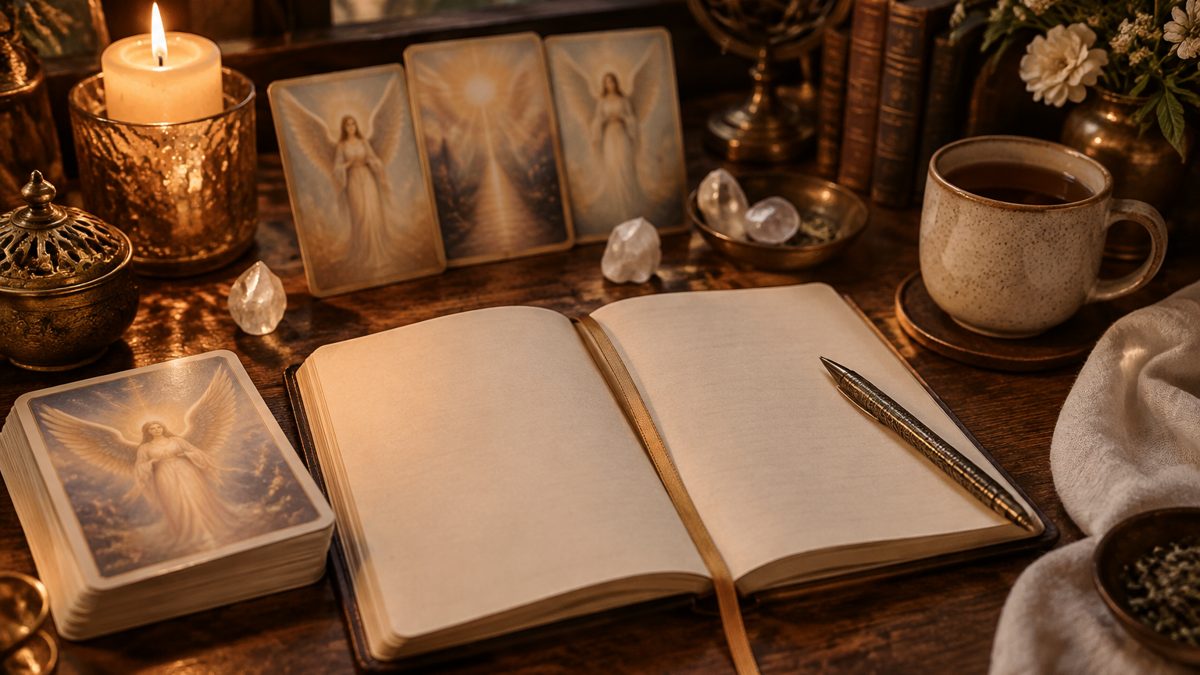
10. Keep a journal that welcomes honest observation
An oracle journal does not need to be beautiful to be useful. A plain notebook or a simple digital document will do. Record the date, your question, the deck, the card or cards drawn, and a few sentences about your response. Include the spread positions if you used them. These details give you a reliable record rather than relying on memory, which tends to highlight the most striking or emotionally satisfying moments.
Separate the card’s wording from your interpretation. You might note that the card’s title is Patience, while your response is that you feel rushed about a creative project. Then add what the guidebook contributed and what you actually intend to do. This distinction prevents a personal association from gradually becoming something you remember as an explicit message. It also helps you recognize which parts of the reading came from your existing knowledge of the situation.
Leave room for disagreement. Write down when a reading felt irrelevant, when you could not make sense of it, and when a suggested action did not suit your circumstances. Honest notes are more valuable than a record edited into a string of apparent confirmations. If the same card appears repeatedly, it may be interesting to reflect on, but repetition alone does not prove an outside message. You can explore the theme without assigning it special authority.
Revise seu diário depois de algumas semanas. Procure padrões em suas perguntas e reações, em vez de tentar calcular o poder do baralho. Você busca repetidamente permissão para descansar? Continua perguntando sobre uma conversa para a qual poderia se preparar diretamente? A descoberta mais útil pode dizer respeito aos seus próprios hábitos de atenção. Proteja a privacidade do diário, especialmente se escrever sobre outras pessoas, e evite apresentar suas impressões como fatos a respeito delas.
- Registre a pergunta, as cartas e as posições da tiragem.
- Descreva sua primeira reação antes de acrescentar a interpretação do guia.
- Choose one small action, or note that no action is needed.
- Volte à anotação mais tarde e registre o que aconteceu, sem reescrever a leitura original.
- Notice recurring concerns while allowing for coincidence and ordinary repetition.
11. Walk through a sample three-card reading
Here is an illustrative reading using invented card titles, not a quotation from a published deck or a report of an actual supernatural message. Imagine that you have been postponing a personal writing project. You ask: What could help me return to this project in a thoughtful, manageable way? Your positions are where my attention is, what could support me, and one action I can choose. You draw Listening, Kindness, and Open Door.
In the first position, Listening might prompt you to examine how much advice you have been collecting. Perhaps you have read so many suggestions that you can no longer hear your own preferences clearly. That is one interpretation, not a fact established by the card. You test it against your experience: have you really been seeking more input instead of beginning? If not, Listening could invite another relevant reflection, such as noticing what originally attracted you to the project.
In the support position, Kindness might suggest changing the standard by which you judge a first attempt. Instead of expecting a polished piece immediately, you could allow an untidy draft. Notice how the interpretation stays connected to the question. It does not promise that kindness will make the project successful, and it does not claim that every obstacle is merely an attitude problem. It offers a possible way to make returning less intimidating.
Na posição de ação, Porta Aberta poderia sugerir criar uma pequena abertura em vez de planejar uma transformação completa. Você decide dedicar quinze minutos a esboçar uma cena amanhã. Seu resumo fica assim: posso estar sobrecarregado(a) por conselhos externos; um padrão mais gentil poderia me ajudar a começar; vou tentar uma sessão curta de escrita. Você registra esse plano e encerra a leitura. Amanhã, escreva ou não, você poderá examinar o que ajudou e o que atrapalhou. O valor da leitura está na reflexão e no experimento, não em tratar três cartas como uma previsão.
12. Encerre a leitura e construa uma prática sustentável
Closing a reading can be very simple. Gather the cards, write your final thought, and return the deck to its box or another suitable place. If gratitude belongs to your practice, offer thanks in your own words. If you prefer a secular closing, acknowledge the time you gave yourself. A closing ritual marks the end of the session; it does not need to seal an invisible doorway or protect you from consequences for doing something incorrectly.
Choose a rhythm that fits your life. You might draw one card on quiet mornings, use a three-card spread each weekend, or reach for the deck only when you want a journaling prompt. There is no spiritual attendance record. If daily draws become repetitive, try reading less often or spending more time with a single image. Learning the deck includes noticing when it supports reflection and when another activity would serve you better.
Keep a few boundaries visible. Do not let a card override clear evidence, another person’s consent, or your own considered judgment. Avoid repeatedly checking the same question in search of certainty. If you notice that you feel unable to make ordinary choices without drawing, or that readings leave you increasingly frightened or preoccupied, put the cards away and reconnect with everyday sources of support. A reflective tool should remain something you can freely choose not to use.
What I hope you carry from this guide is not a perfect technique, but a gentle balance: imagination alongside discernment, tradition alongside curiosity, and meaningful ritual alongside ordinary action. Angel oracle cards can offer a language for reflection if that language speaks to you. They do not have to explain your future or solve your life. Sometimes the most worthwhile reading ends with a modest sentence in a notebook, a clearer question, and the willingness to take one thoughtful step.
These practices are shared as tradition and personal reflection, not as a substitute for medical, legal or financial advice.
Continue aprendendo
- Angel oracle card meanings
- How to read tarot cards
- How to use angel oracle cards
- Como ler cartas de baralho
- Como usar cristais em feitiços
- Como usar ervas na bruxaria
- How to read the Dr. Moorne Egyptian Tarot
- How to read dice
- How to read tea leaves
- Como usar um pêndulo
- Como lançar um feitiço de vela
- How to make a spell jar
- How to make a sigil
- How to cleanse your home
- How to set up an ancestor altar
- How to open a sacred space
- How to time spells with the moon
- How to work with water and salt
- How to make a protection charm bag
- Read the Journal ou visite o shops