How-To Guide
How to Work with Water and Salt in Spells
By Seraphina
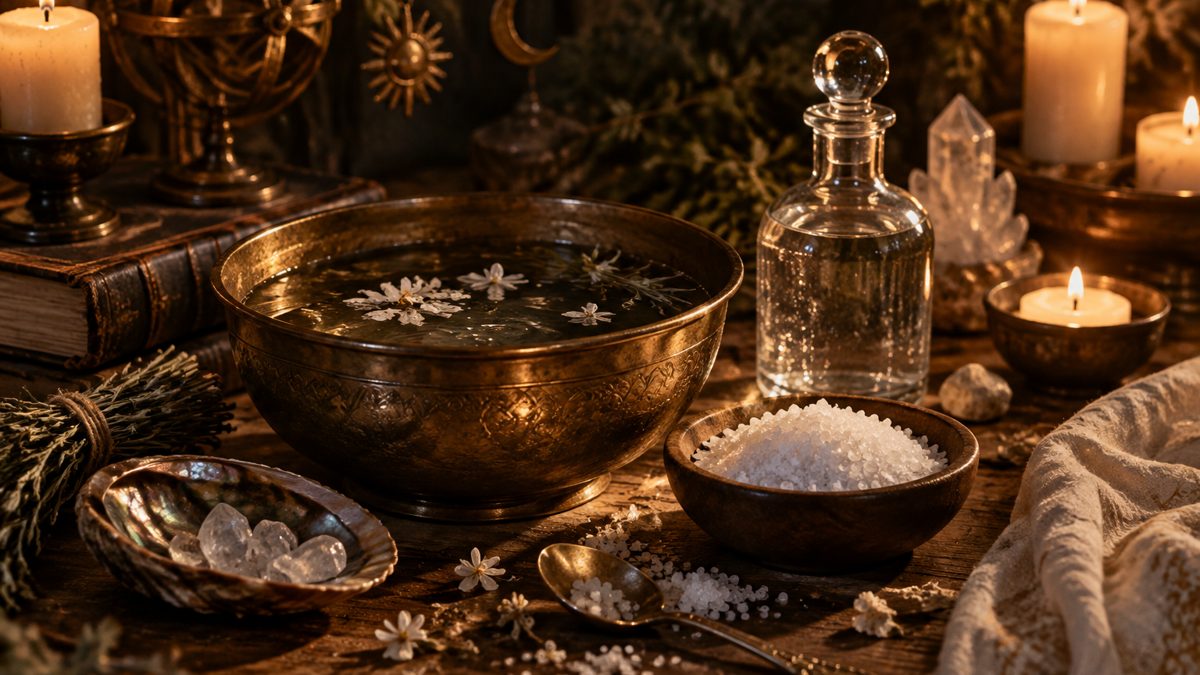
Water and salt are ordinary materials with a long place in human ritual life. Water washes, nourishes, carries, and changes shape; salt seasons, preserves, and, in some traditions, represents protection or lasting commitment. Those everyday qualities help explain their symbolic appeal. Working with them can be a simple way to mark a fresh start, establish a personal boundary, or give focused attention to something you want to change.
This guide treats spellwork as tradition, belief, and personal practice, not as a proven way to control events or other people. Some practitioners understand a ritual as spiritual work; others use it as a symbolic exercise that helps them reflect and act deliberately. You do not need to settle every question about how magic works before making a meaningful ritual. You do need realistic expectations and a willingness to support your intention with practical action.
The approach here is deliberately modest: a bowl, clean water, a small amount of salt, and a clear purpose. Elaborate tools, rare ingredients, paid services, and strict lunar timing are optional, not requirements. We will look at historical context, preparation, a complete method, and a worked example, then consider results, mistakes, safety, and recordkeeping. The companion reference page, Water and Salt Magic, can sit alongside this practical guide as a place to revisit the broader subject.
Above all, let care guide the work. A ritual should not leave damaged plants, a frightened household, an injured pet, or a feeling that you must keep repeating it to prevent disaster. The most useful practice is one you can perform safely, adapt honestly, and finish without fear. Think of the water as an invitation to move and the salt as an invitation to choose what deserves to remain.
Looking for the meaning of a single card or ingredient? Keep our Water and salt magic guide open beside you.
1. Understand the history without flattening the traditions
Water appears in religious and folk practices across many regions, but its meanings are not interchangeable. Christian baptism, Jewish immersion in a mikveh, Islamic ablution, and Hindu bathing practices belong to distinct theological and communal settings. They are not simply versions of a universal cleansing spell. Learning about them can deepen respect for ritual water without turning a living religious practice into an ingredient for an unrelated personal ceremony.
Salt also has varied histories. Its practical importance in preserving food and sustaining households helps explain why it can signify endurance, hospitality, or protection. Salt appears in some European household customs and folk practices, including certain practices described as Slavic. However, there is no single Slavic salt ritual, and customs differ by locality, family, period, and religious background. Be cautious when a modern source presents one recipe as an unchanged ancient rule.
Contemporary witchcraft often combines water and salt for symbolic cleansing, consecration, or boundary setting. Particular correspondences, such as water with emotion or salt with earth, are useful within some systems but are not universal facts. If you inherit a practice, identify its source as clearly as you can. If you create your own, call it a personal adaptation. Honest attribution gives a ritual firmer foundations than an impressive but unsupported origin story.
2. Choose one purpose and define what success means
Start with an intention that concerns your own choices, space, or conduct. Suitable examples include ending the workday deliberately, preparing for a difficult conversation, or establishing a calmer bedtime routine. An intention such as making someone love you shifts attention toward controlling another person. Reword it around what is yours to do: communicating honestly, meeting people respectfully, or recognizing a relationship that is not right for you.
Keep the purpose small enough to translate into action. Cleansing every negative influence from your life is too broad to evaluate and can encourage anxious scanning for threats. Clearing your desk and setting tomorrow's first task is concrete. Spiritual language can still matter: you might describe the ritual as welcoming clarity while identifying the visible behavior that will accompany it. Symbolism and ordinary problem-solving do not need to compete.
Before gathering materials, write down what would count as a useful outcome and when you will review it. You might hope to feel ready to stop answering work messages tonight, then check whether you followed through. A feeling of relief is worth noticing, but it does not prove that an outside force changed. Defining success beforehand helps prevent every pleasant coincidence, setback, or cloudy patch of water from becoming evidence for a preferred explanation.
3. Gather simple, suitable materials
For the basic method, use a stable bowl, a little clean water, ordinary food-grade salt, a spoon, a tray or towel, and a notebook. Glass or glazed ceramic is usually convenient, provided the vessel is intact and suitable for holding water. A small pinch of salt is enough for symbolic work. There is no established magical advantage to making the mixture strongly saline, and using less makes cleanup easier.
Tap water is generally the simplest choice where the local supply is safe. Bottled drinking water is an alternative if needed. Rain, river, sea, and pond water may carry microorganisms or pollutants even when they look clear. You do not need them to make a ritual meaningful. Sea salt, rock salt, and table salt can each serve a personal symbolic purpose; iodized salt is not spiritually defective. Product quality and affordability matter more than dramatic labeling.
Optional materials might include a written intention or an electric candle. Avoid adding ingredients merely because a recipe sounds incomplete without them. Herbs can irritate skin, trigger allergies, or endanger pets, and essential oils do not dissolve safely into plain water. Bath salts and cleaning salts are not substitutes for food-grade salt in this method. Never assume that a crystal, metal charm, or antique vessel is safe to soak; salt water can damage objects and encourage corrosion.
4. Prepare the place and yourself
Choose a surface that will not be damaged by an accidental splash, and place the bowl on a tray. Move electronics, important papers, and delicate objects away. If your intention concerns a doorway, keep the bowl on a nearby table rather than on the floor, where someone might kick it. You do not need to scatter salt across a threshold. A contained representation of a boundary avoids residue, slipping hazards, and damage to finishes.
Ordinary cleaning comes first. Wipe the surface, wash your hands, and deal with anything that needs practical attention. Ritual water is not a disinfectant, and it does not replace appropriate cleaning products or their instructions. If you are sharing the space, ask before using common surfaces or moving belongings. Choose a time when a short interruption will not create tension, and keep children and animals from accessing the materials.
Prepare your attention without demanding a special state. You can sit, stand, keep your eyes open, or use silent words. Take a few comfortable breaths, but avoid forced breathwork or holding your breath. If body-focused exercises feel unpleasant, simply describe the objects in front of you. Being distracted does not invalidate the work. The aim is enough attention to make a deliberate choice, not perfect concentration or a dramatic sensation.
- 1. Clear a small surface and set down a tray or washable towel.
- 2. Place the clean bowl, water, salt, spoon, and notebook within easy reach.
- 3. Remove hazards and confirm that other household members consent to any shared-space activity.
- 4. Read your intention once and identify the practical action that will follow.
- 5. Pause briefly, then begin when you feel ready enough rather than perfectly ready.
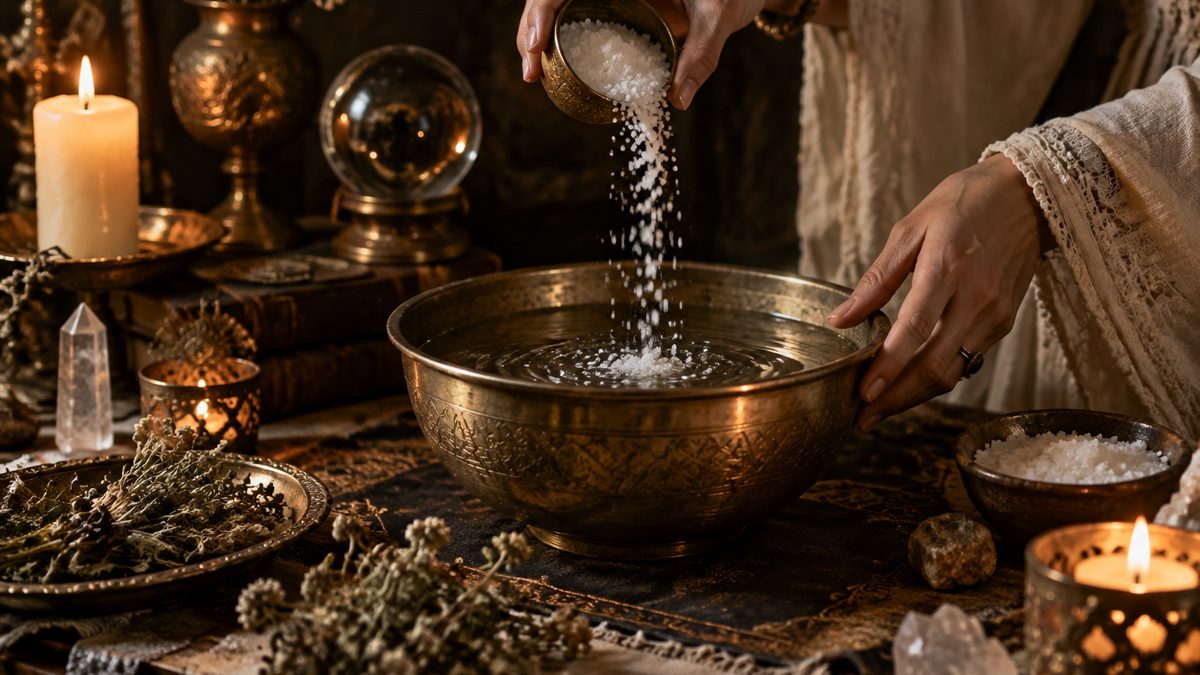
5. Perform the basic water and salt spell
This method uses water to represent movement or renewal and salt to represent steadiness or a chosen boundary. These are proposed meanings, not compulsory correspondences. If your tradition assigns them differently, adapt the explanation rather than forcing a mismatch. The important point is to know what each gesture means to you. A few coherent actions are usually more useful than a long sequence copied without understanding.
The spoken words below are newly written examples for this guide, not a historical charm. Replace them freely, or work silently. Likewise, stirring clockwise or counterclockwise has particular meanings in some traditions, but neither direction is required here. Stir simply to dissolve the salt. You are not trying to create a special chemical state or prove that the mixture has acquired supernatural properties.
Keep the water in the bowl throughout the procedure. Touching it, drinking it, sprinkling a room, or applying it to the body is unnecessary. This contained method makes the practice accessible to people with sensitive skin and reduces household damage. When you finish, let the ritual end. You do not have to wait for a sign, repeat the words until they feel perfect, or leave the bowl standing overnight.
- 1. Pour about half a cup of clean water into the bowl.
- 2. State your purpose in one sentence, such as, I am making room for a calmer evening.
- 3. Consider the water as a symbol of the change you are willing to make.
- 4. Add one small pinch of food-grade salt, naming the boundary or commitment you want to keep.
- 5. Stir gently until most or all of the salt dissolves, without treating any remaining grains as an omen.
- 6. Rest your attention on the bowl for a minute and picture yourself carrying out your chosen action.
- 7. Say a closing sentence, such as, This practice is complete; my next step is mine to take.
- 8. Carry out the practical action, dispose of the mixture appropriately, and wash and dry the equipment.
6. Worked example: leave the workday behind
Imagine that you work at home and keep checking messages after dinner, even when your job does not require evening availability. You want a transition between paid work and personal time. The intention is not to make your employer behave differently or guarantee a peaceful night. It is to support a decision: finish necessary tasks, communicate your availability appropriately, and stop reopening work applications out of habit.
Set the bowl on a kitchen counter away from food preparation, rather than beside your computer. Before beginning, write tomorrow's first task on a separate piece of paper. Let the water represent the shift into evening and the salt represent the boundary around your attention. A suitable original phrase is, My work has a place, and my rest has a place. I will return at the time I have chosen.
The meaningful follow-through is practical: close the laptop, mute nonessential notifications, and move into another activity. Adapt the boundary if you have agreed on-call responsibilities; a ritual should not encourage you to neglect safety or contractual duties. Later, note whether the transition helped and what interrupted it. If you still felt restless, that is information about your habits or workload, not proof that the spell failed or someone opposed it.
- 1. Confirm what genuinely needs finishing and record tomorrow's first task.
- 2. Prepare the water and pinch of salt using the basic method.
- 3. Speak your boundary and name the time you intend to return to work.
- 4. Close work applications and adjust notifications within your actual responsibilities.
- 5. Empty and wash the bowl, then begin a specific evening activity.
- 6. Review the experience the next morning without judging yourself for every distraction.
7. Adapt the method without adding unnecessary complexity
For a personal fresh start, let the water represent movement away from an unhelpful routine and the salt represent one commitment you want to retain. Pair the ritual with changing the environment: remove a distracting shortcut, lay out walking shoes, or schedule a manageable task. Avoid framing yourself as dirty or spiritually contaminated. A renewal practice can acknowledge fatigue, mistakes, or grief without turning ordinary human experiences into impurity.
For a household boundary, keep the bowl near the area you are considering while you clarify a shared agreement. That might mean quiet hours, privacy, or a workable cleaning schedule. Do not secretly sprinkle another person's room or belongings. If household members do not want ritual involvement, use the practice privately to prepare for a respectful conversation. A boundary becomes workable through communication and consent, not through symbolism alone.
For remembrance, the water might stand for changing feelings and the salt for what remains important. Place a written memory beside the bowl, not inside it, and give yourself a few minutes to reflect. You do not need to seek contact with the dead or interpret sensations as messages. If grief becomes overwhelming, stop, do something grounding, and seek support. A ritual can accompany care from friends, community, or professionals, but should not replace it.
8. Decide whether timing, water sources, and correspondences help
Some practitioners favor a waning moon for release, a waxing moon for growth, or sunrise for beginnings. These are symbolic conventions within particular modern and inherited practices, not proven conditions for effectiveness. Use them if they enrich your experience without creating pressure. A calm Tuesday afternoon when you have privacy may be more useful than a midnight observance that disrupts sleep or leaves you too tired to clean up.
Water collected from a meaningful place may carry personal associations, but collecting it can raise safety, ecological, and access concerns. Observe local rules, avoid protected or culturally restricted sites, and never enter dangerous water to obtain an ingredient. There is no need to take water from a sacred source belonging to another community. A photograph, memory, or written place-name beside a bowl of tap water can express a connection without extraction.
If you expose water to moonlight or sunlight as a personal observance, keep it covered and clearly labeled for ritual use only. Exposure does not disinfect water, and direct sunlight can heat containers or create other hazards depending on placement. An indoor windowsill is optional, not a requirement. Do not keep prepared water indefinitely because you fear losing its significance. You can preserve the meaning in a journal and make a fresh mixture next time.
9. Interpret results with curiosity and restraint
First distinguish observations from interpretations. An observation might be that your breathing became easier, you finished tidying the table, or you resisted checking your phone for an hour. An interpretation might be that the ritual helped you feel committed. A stronger claim, such as the water removed an outside influence, cannot be established by those observations. You can respect a spiritual understanding while being clear about what the experience does and does not demonstrate.
Changes in the bowl usually have ordinary explanations. Bubbles may be trapped air; cloudiness can come from additives, minerals, or residue; crystals can form as water evaporates. Salt dissolves differently depending on temperature, grain size, and concentration. None of these effects reliably diagnoses a curse, predicts danger, or reveals another person's intentions. If a pattern inspires reflection, use it as a prompt rather than an instruction you must obey.
Review outcomes over the period you chose beforehand. Consider sleep, stress, conversations, practical changes, and chance alongside the ritual. No noticeable result is a valid entry, and an unpleasant day afterward is not evidence of backlash. If interpreting signs makes you increasingly fearful, suspicious, or unable to make decisions without another ritual, pause the practice. Talk with someone grounded and trustworthy, and seek mental health support if the distress persists or interferes with daily life.
10. Recognize common mistakes and make simple corrections
One common mistake is assuming that more ingredients produce stronger work. Extra salt creates more residue, extra herbs complicate disposal, and multiple intentions make reflection harder. Return to one bowl, one pinch, one purpose, and one practical action. Likewise, an expensive salt or special bottle is not necessary. Choose materials you can afford and handle safely rather than treating shopping as a prerequisite for spiritual seriousness.
Another mistake is mixing instructions from unrelated traditions without noticing their context. A prayer, direction of stirring, or sacred name may mean something specific in its original setting. You do not have to assemble every appealing detail into one ceremony. Read carefully, identify what you actually practice, and leave out elements you do not understand or have no appropriate basis to use. A plainly described personal ritual is enough.
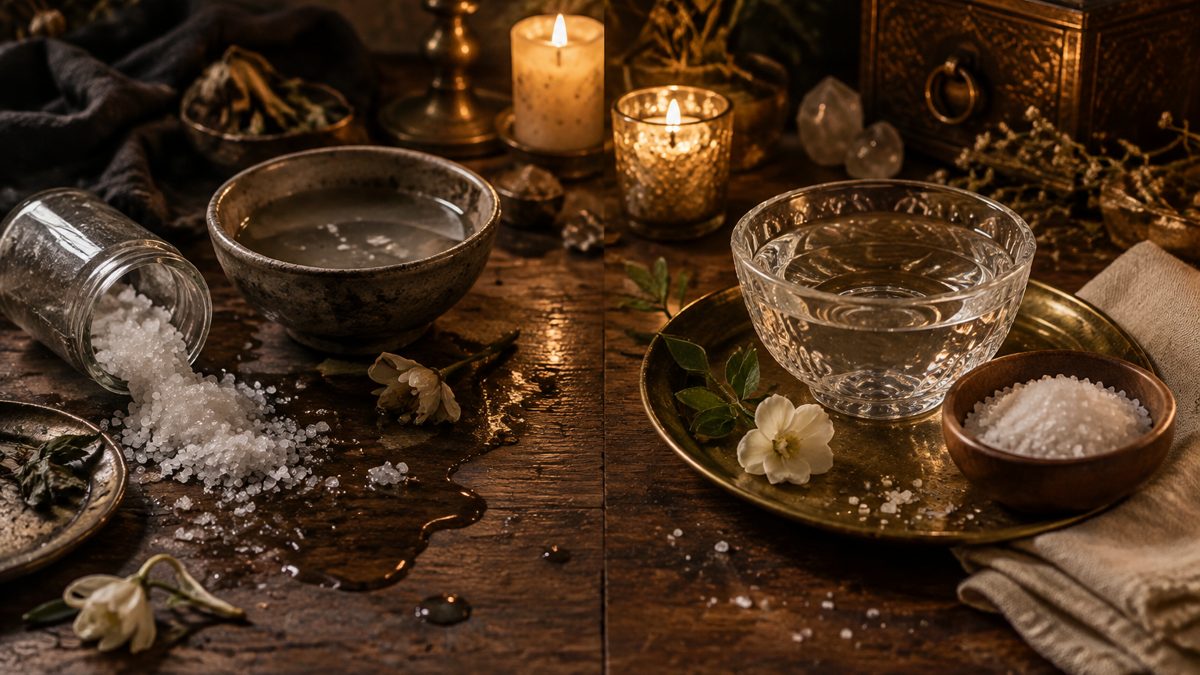
Perfectionism can also turn a short practice into a burden. Spilling water, forgetting a line, or being interrupted does not require a corrective spell. Clean up, decide whether to continue, and finish normally. Avoid repeating the ritual whenever you feel uncertain; reassurance can become a loop rather than a resolution. If you set a repetition schedule, keep it modest and optional, and change the underlying plan when repeated ritual is substituting for needed action.
11. Handle water, salt, herbs, and fire safely
Keep ritual mixtures out of reach of children and animals, and do not drink them. Food-grade starting ingredients do not make a bowl left out for ritual safe to consume. Never use salt water to induce vomiting or treat an illness. Avoid application to eyes, wounds, mucous membranes, or irritated skin. This guide does not require bathing or skin contact; leaving the water in its bowl is a complete method.
Leave herbs and essential oils out unless you have researched the specific ingredient and exposure route. Natural does not mean harmless, and some plants and oils pose particular risks to pets, pregnancy, or people with allergies. Avoid unidentified plants, concentrated extracts, and any ingestion of ritual preparations. Do not add bleach, ammonia, or household cleaners, and never mix cleaning products. Ritual cleansing and hygienic cleaning are separate activities with different purposes.
An electric candle is the easiest lighting option. If you use a flame, place it in a stable, heat-resistant holder away from curtains, paper, sleeves, and dried plants. Never leave it unattended. Keep the water bowl separate from electrical equipment, and wipe spills promptly. Salt water can corrode metal, mark wood and stone, damage finishes, and harm plants. Do not pour it into plant pots or scatter salt on lawns, garden beds, or outdoor thresholds.
12. Respect consent, limits, and responsible disposal
Ethical spellwork begins with recognizing that your wishes do not override another person's autonomy. Avoid putting ritual mixtures in anyone's food, drink, bath, or personal space without informed permission. Even a well-meant blessing can be intrusive if it involves unwanted substances or spiritual participation. For someone who has asked for support, agree on what you will do and keep promises realistic. You can offer care without guaranteeing protection, reconciliation, healing, or a specific result.
Keep practical protections in place. A boundary ritual does not replace locks, a safety plan, legal advice, medical treatment, or professional help. If someone threatens you, respond to the real-world risk rather than relying on salt at a doorway. Be equally cautious about sellers who claim that only an urgent purchase can remove a curse or prevent disaster. Price, elaborate language, and dramatic certainty are not evidence of spiritual authority or effectiveness.
For the small, lightly salted mixture in this guide, disposal into a household sink connected to sanitary wastewater is generally appropriate, with a little fresh water afterward; follow local restrictions and system guidance. Do not pour it into a storm drain, stream, pond, or soil. Remove any solids first and dispose of them according to what they are. Leaving jars, salt, herbs, or offerings outdoors is not automatically respectful or environmentally harmless. Washing the bowl is a sufficient closing act.
13. Keep a useful journal and build a sustainable practice
A journal is most helpful when it records enough detail to reveal patterns without becoming a catalogue of omens. Note the date, intention, ingredients, approximate amounts, actions, and your mood before and after. Record relevant circumstances, such as poor sleep or an important conversation. If you adapted a source, name it. If you invented the practice, say so. These ordinary details make later reflection more reliable than a polished account written from memory.
Include the practical outcome and what you would change. Perhaps the bowl helped you pause, but the spoken words felt awkward; next time, use silence. Perhaps you felt calm during the ritual but still needed to renegotiate an unrealistic workload. That is useful learning, not spiritual failure. Review several entries together before drawing conclusions, and do not credit the ritual for every improvement while blaming yourself for every setback.
Over time, keep the parts that support attention, care, and responsible action. Let unnecessary rules fall away, and take breaks whenever the practice becomes demanding or fearful. There is no obligation to maintain a streak or repeat a ceremony to keep ordinary misfortune away. Water and salt can provide a small, meaningful structure for change: name what matters, mark the choice, clean up, and return to life prepared to do your part.
- 1. Before the ritual, record one intention, your current mood, and the practical action you plan.
- 2. Afterward, describe what actually happened, separating observations from spiritual interpretations.
- 3. At your chosen review time, note the outcome and any ordinary factors that influenced it.
- 4. Choose one adjustment, or decide that no further ritual is needed.
- 5. Store the journal privately if it contains sensitive information about you or other people.
These practices are shared as tradition and personal reflection, not as a substitute for medical, legal or financial advice.
Keep learning
- Water and salt magic
- How to read tarot cards
- How to use angel oracle cards
- How to read playing cards
- How to use crystals in spells
- How to use herbs in witchcraft
- How to read the Dr. Moorne Egyptian Tarot
- How to read dice
- How to read tea leaves
- How to use a pendulum
- How to cast a candle spell
- How to make a spell jar
- How to make a sigil
- How to cleanse your home
- How to set up an ancestor altar
- How to open a sacred space
- How to time spells with the moon
- How to work with water and salt
- How to make a protection charm bag
- Read the Journal or visit the shops