Guide
Dice Divination Meanings
By Seraphina
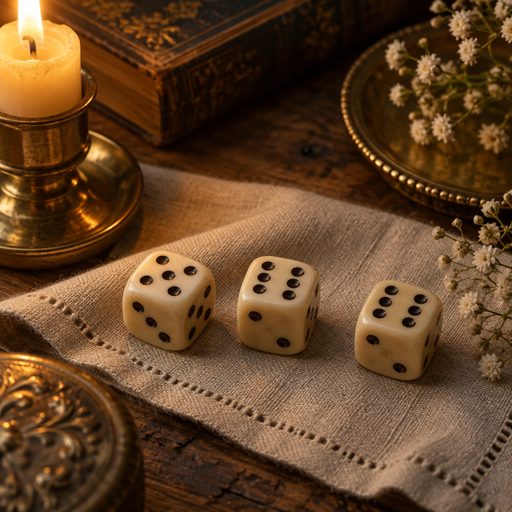
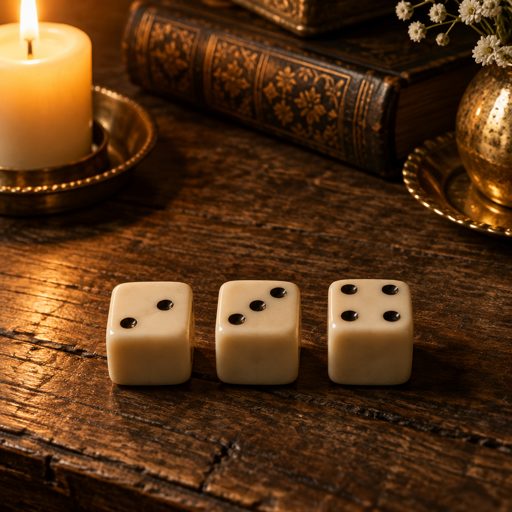
A handful of dice can offer a simple starting point for reflection: ask a question, roll, and consider what the result brings to mind. Divination with dice is often called cleromancy, although that broader term also includes casting other kinds of lots. People have used casting practices in different cultures and periods, but there is no single universal dictionary of dice meanings. At Crossroads Journal, we approach the practice as a meeting place between tradition, belief, chance, and personal interpretation, rather than a method that can promise knowledge of the future.
This guide offers one consistent, modern symbolic framework for ordinary six-sided dice. It is not presented as an ancient or specifically Slavic system. Use the single-die meanings for a focused prompt, and the three-dice totals for a broader picture. Doubles and other patterns add emphasis when you choose to include them. These interpretations are suggestions, not verdicts: a challenging number can highlight something worth tending, while an encouraging number can point toward an opportunity that still requires practical effort.
Before rolling, choose your method and write a clear, open question, such as “What deserves my attention in this situation?” Decide whether patterns will count before seeing the dice. Roll onto a level tray, record the result, and read the relevant entry alongside your own circumstances. Notice both what resonates and what does not; you do not need to force a match. A useful reading ends with a grounded next step, not repeated rolls until chance supplies the answer you hoped to receive.
Single Die: Numbers 1–6
Roll one die and use its uppermost face as your main prompt. These six meanings also provide the foundation for the pattern interpretations below.
- 1 — Initiative
- MeaningOne represents beginnings, independence, and a clear first move. It invites attention to what is within your own control.
- UseAsk what small action you can take without waiting for perfect conditions.
- 2 — Cooperation
- MeaningTwo suggests partnership, balance, and the space between different viewpoints. It can also represent a decision that needs careful comparison.
- UseConsider whose perspective is missing and where clearer communication would help.
- 3 — Expression
- MeaningThree points toward creativity, conversation, and growth through exchange. An idea may benefit from being shared or tested.
- UseChoose a manageable way to express what you have been keeping in your head.
- 4 — Foundations
- MeaningFour emphasizes structure, routine, and dependable support. It asks whether the basics are strong enough to carry your plans.
- UseReview your schedule, resources, or boundaries before adding another commitment.
- 5 — Change
- MeaningFive symbolizes movement, experimentation, and uncertainty. Flexibility may be more useful than insisting on one route.
- UseIdentify a low-risk experiment rather than making an impulsive, irreversible change.
- 6 — Care
- MeaningSix centers care, responsibility, and harmony in everyday life. It can prompt reflection on both giving support and receiving it.
- UseAsk whether your responsibilities leave enough room for your own needs.
Three Dice: Totals 3–18
Roll three six-sided dice together and add their uppermost faces. Read the total first; these meanings belong to this guide’s framework, not a universally accepted historical table.
- 3 — A Small Beginning
- MeaningThree suggests starting with the simplest workable version of an intention. Small beginnings deserve attention without being burdened by grand expectations.
- UseName one first step you can complete with the resources already available.
- 4 — Preparation
- MeaningFour points toward groundwork and practical readiness. Enthusiasm benefits from a supporting plan.
- UseCheck what information, permission, or equipment you need before proceeding.
- 5 — Productive Friction
- MeaningFive invites you to examine a mismatch between expectations and circumstances. Discomfort can become a prompt for adjustment rather than a forecast of trouble.
- UseSeparate the part you can change from the part you may need to accept.
- 6 — Practical Support
- MeaningSix highlights help, cooperation, and the value of shared effort. Support is most useful when needs are clearly stated.
- UseMake one specific request or offer assistance within a reasonable boundary.
- 7 — Reflection
- MeaningSeven suggests a pause for observation, study, or inward attention. You may benefit from understanding more before acting.
- UseWrite down what you know, what you assume, and what still needs checking.
- 8 — Steady Effort
- MeaningEight emphasizes persistence and the quiet value of repeated practice. Progress need not be dramatic to matter.
- UseChoose a sustainable routine and a realistic way to review its usefulness.
- 9 — Release
- MeaningNine invites consideration of what has served its purpose. Finishing, simplifying, or letting go may create needed space.
- UseIdentify one unnecessary obligation or unfinished task you can responsibly resolve.
- 10 — Reassessment
- MeaningTen marks a symbolic checkpoint between what has happened and what comes next. Your earlier plan may need updating.
- UseReview your aim in light of current facts rather than past expectations.
- 11 — Clear Conversation
- MeaningEleven foregrounds communication, listening, and clarification. Unspoken assumptions deserve a closer look.
- UsePrepare a direct, respectful question instead of guessing what another person thinks.
- 12 — Shared Work
- MeaningTwelve suggests coordination and a workable division of responsibility. A shared purpose still needs clear agreements.
- UseClarify who is doing what and whether the arrangement feels fair.
- 13 — Revision
- MeaningThirteen symbolizes changing a form that no longer fits. This guide does not treat it as inherently unlucky.
- UseKeep what remains useful while revising one outdated habit or expectation.
- 14 — Moderation
- MeaningFourteen points toward proportion, pacing, and balancing competing demands. More effort is not always the best answer.
- UseLook for a sustainable middle course that does not ignore your limits.
- 15 — Desire and Choice
- MeaningFifteen asks what you want and what pursuing it would cost. Attraction and enthusiasm are worth noticing without surrendering judgment.
- UseCompare immediate satisfaction with your longer-term values and commitments.
- 16 — Reality Check
- MeaningSixteen invites scrutiny of a weak assumption or an overextended plan. It is a prompt to check foundations, not a prediction of disaster.
- UseVerify an important detail and build a practical backup option.
- 17 — Renewed Possibility
- MeaningSeventeen emphasizes hope grounded in available possibilities. It encourages noticing openings without assuming success is assured.
- UseChoose one promising option and investigate what pursuing it would actually involve.
- 18 — Integration
- MeaningEighteen symbolizes bringing experience together and acknowledging a completed stage. Completion can include rest as well as celebration.
- UseRecord what you learned and decide what you want to carry forward.
Doubles and Other Patterns
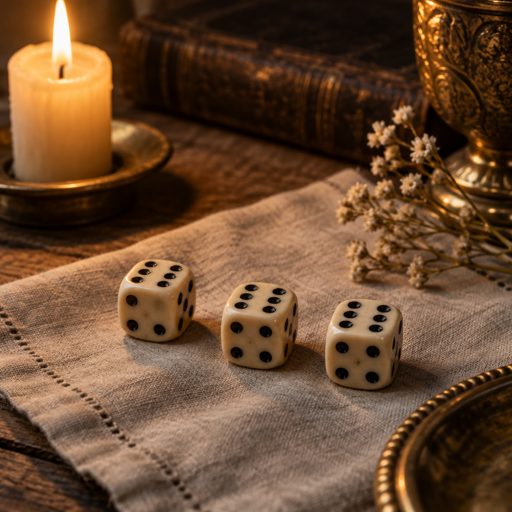
For a three-dice reading, a double means exactly two matching faces; three matching faces count as a triple instead. Treat patterns as optional modifiers, not messages that override the total.
- Double 1 — Focused Initiative
- MeaningTwo ones emphasize independence and the urge to begin. They can prompt a check on whether determination has become impatience.
- UseRead the total first, then ask where a clear first move would help without shutting out advice.
- Double 2 — Mutuality
- MeaningTwo twos bring partnership, reciprocity, and negotiation into focus. They do not establish another person’s feelings or intentions.
- UseConsider whether both sides have space to express preferences and set boundaries.
- Double 3 — Amplified Expression
- MeaningTwo threes emphasize ideas, creativity, and social exchange. Many possibilities may need sorting into a clearer message.
- UseChoose one idea to develop rather than scattering attention across every possibility.
- Double 4 — Strong Structures
- MeaningTwo fours highlight stability, boundaries, and established routines. Consider whether a structure supports you or has become unnecessarily rigid.
- UseKeep the useful boundary while adjusting one rule that no longer serves its purpose.
- Double 5 — Restlessness
- MeaningTwo fives emphasize movement and the desire for something different. Restlessness is worth exploring, but it is not an instruction to take a risk.
- UseTest a reversible change before committing money, time, or trust.
- Double 6 — Care and Boundaries
- MeaningTwo sixes draw attention to caregiving, belonging, and responsibility. They invite a distinction between freely chosen care and overextension.
- UseAsk what support you need and which responsibilities genuinely belong to you.
- Triples — Concentrated Theme
- MeaningThree matching faces symbolically concentrate the single-die theme: initiative for ones, cooperation for twos, expression for threes, foundations for fours, change for fives, and care for sixes.
- UseCombine that theme with the total of 3, 6, 9, 12, 15, or 18. A triple is not evidence that a message is more accurate or urgent.
- Straights — Step-by-Step Movement
- MeaningThree consecutive values suggest sequence and gradual development. The possible straights are 1–2–3, 2–3–4, 3–4–5, and 4–5–6, regardless of where the dice land.
- UseAsk which step comes next rather than trying to reach the end immediately. Other nonmatching combinations need no extra pattern meaning.

Practical Reading and Safety Notes
Keep the ritual simple, consistent, and grounded in everyday judgment.
- Choose one die or three dice before rolling. For three dice, decide in advance whether you will read patterns as well as the total.
- Use ordinary, unweighted six-sided dice and a level tray. Set a rule beforehand for dice that fall out or land tilted, such as rerolling the whole cast.
- Three-dice totals are not equally likely: 10 and 11 occur more often than 3 and 18 with fair dice. Neither rarity nor repetition proves supernatural significance.
- Write down the question, result, interpretation, and one practical next step. Allow an interpretation not to fit rather than reshaping every event to match it.
- Avoid repeated rolls for reassurance. If a reading increases anxiety or feels compulsory, put the dice away and turn to a grounding activity or trusted support.
- Do not use dice to diagnose illness, determine pregnancy, establish another person’s consent, or make consequential medical, legal, financial, or safety decisions.
- Dice are small choking hazards. Keep them away from young children and pets, and store them securely after use.
- No candles, herbs, or cleansing substances are necessary. If using a candle, keep it in a stable holder away from fabric and never leave it burning unattended.
- Do not ingest ritual herbs or oils; check plant toxicity around pets and children. Avoid soaking dice in salt water, which may damage finishes, and never pour salt water onto plants or garden soil.
Dice divination is a symbolic personal practice, not a proven way to predict events or a substitute for professional advice.
Step-by-step how-to guides
- How to read tarot cards
- How to use angel oracle cards
- How to read playing cards
- How to use crystals in spells
- How to use herbs in witchcraft
- The Dr. Moorne Egyptian Tarot deck and how to read it
- How to read dice · Dice meanings
- How to read tea leaves · Tea leaf symbols
- How to use a pendulum · Pendulum meanings
- How to cast a candle spell · Candle color meanings
- How to make a spell jar · Spell jar recipes
- How to make a sigil · Sigil methods
- How to cleanse your home · Home cleansing methods
- How to set up an ancestor altar · Ancestor altar items
- How to open a sacred space · Sacred space tools
- How to time spells with the moon · Moon phase meanings
- How to work with water and salt · Water and salt magic
- How to make a protection charm bag · Charm bag recipes
Keep exploring
See the tarot card meanings, angel oracle cards, playing card meanings, crystals for spells and herbs in witchcraft guides, read the Journal, or visit the shops for a reading or spell from our partner practitioners.