How-To Guide
Comment jeter un sortilège à la bougie
Par Seraphina
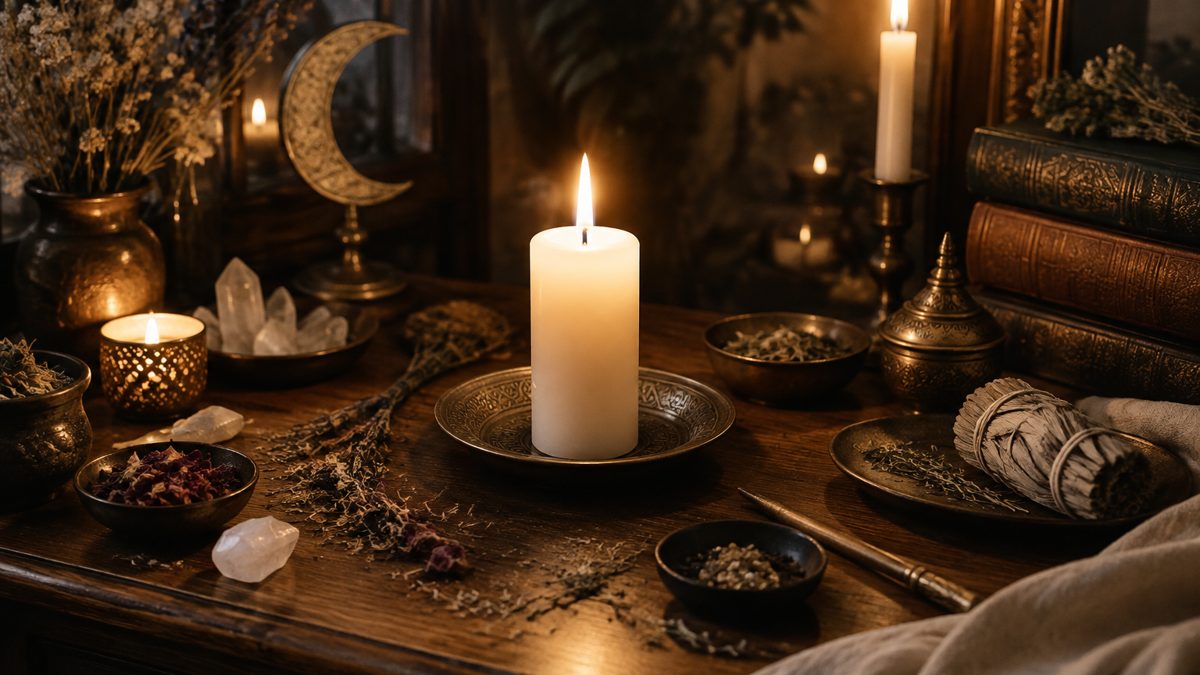
A candle spell is a ritual that uses a candle, a clear intention, and focused attention to mark a hoped-for change. Some people approach it as spiritual work; others value it as a symbolic practice that helps them reflect, settle their thoughts, and commit to action. Neither approach requires you to promise yourself a supernatural result. The useful starting point is knowing what you want to bring into your life and what you can realistically do about it.
Les rituels de bougie peuvent être merveilleusement simples. Vous n'avez besoin ni d'un autel élaboré, ni d'une bougie rare, ni d'une pièce remplie d'herbes. Une bougie ordinaire dans un support adapté, un endroit sûr où s'asseoir et quelques mots sincères suffisent pour une pratique de base. L'attention que vous portez au processus compte plus que le prix de votre matériel ou la ressemblance de votre espace avec la photo de quelqu'un d'autre.
In this Crossroads Journal guide, we will walk through the background of candle magic, choose materials, prepare a safe working space, and build a complete ritual. You will also find a worked example, guidance on interpreting your experience without jumping to conclusions, and a practical way to keep a spell journal. Our companion reference page, Candle Color Meanings, can help when you want a closer look at color symbolism.
Tout au long, considérez la magie comme une affaire de tradition, de croyance et de pratique personnelle, plutôt que comme un moyen garanti de maîtriser les événements. Un sort à la bougie ne doit pas remplacer les soins médicaux, des décisions financières avisées, un conseil juridique ou les conversations nécessaires. Voyez le rituel comme un compagnon porteur de sens de l'effort ordinaire : un moment pour nommer votre direction, rassembler votre attention et accomplir la prochaine étape utile.
Looking for the meaning of a single card or ingredient? Keep our Candle color meanings guide open beside you.
1. Understand the traditions behind candle spells
People have used lamps, candles, and other lights in religious and domestic observances for centuries. Light can signify remembrance, prayer, protection, hope, or the presence of something sacred. These uses overlap in imagery, but they are not interchangeable. Lighting a devotional candle in a church, keeping a memorial light, and performing a contemporary candle spell can involve very different intentions and beliefs.
La magie moderne des bougies puise à plusieurs sources, notamment les pratiques populaires européennes, l'occultisme cérémoniel, les traditions païennes contemporaines et le hoodoo ou conjure afro-américain. Certains praticiens œuvrent dans une tradition particulière héritée ou transmise ; d'autres adoptent une approche éclectique. Il est plus juste de parler de traditions de la bougie au pluriel que d'imaginer une méthode universelle unique transmise inchangée depuis l'Antiquité.
The familiar combination of a colored candle, a written intention, and a spoken affirmation is common in contemporary practice, but specific correspondences differ. Green may suggest money to someone who associates it with currency, while another person connects prosperity with gold or harvest colors. There is no single historical chart that settles every meaning for every culture.
If you are learning from a named tradition, seek sources that explain its cultural setting as well as its techniques. Avoid treating sacred names, ceremonies, or initiation-based practices as decorative additions. For a beginner's personal ritual, you can simply acknowledge that you are using modern symbolic candle work rather than claiming membership, lineage, or authority you do not have.
2. Choose an intention that is clear and ethical
An intention gives the ritual its direction. Begin with one subject rather than asking a single candle to transform your finances, relationships, health, and home all at once. A manageable intention might concern preparing for an interview, maintaining a study habit, processing a transition, or making room for mutually respectful friendship. Specificity helps you connect the ritual with observable choices.
Formulez l'intention autour de votre propre capacité d'agir. Plutôt que de demander de faire en sorte qu'une personne précise vous aime, envisagez de demander de la confiance, du discernement et des occasions de lien réciproque. Plutôt que de tenter de forcer la décision d'un recruteur, concentrez-vous sur la présentation claire de votre expérience et la recherche d'un travail qui vous convient. Les autres restent libres de leurs choix, que votre pratique inclue ou non des croyances spirituelles.
Positive wording can be helpful, but it is not a magical grammar test. Saying that you want freedom from an exhausting pattern does not automatically attract that pattern. Choose language that feels honest rather than artificially cheerful. If an affirmation feels impossible to believe, soften it: 'I am learning to speak clearly' may serve you better than 'I am always fearless.'
Finally, give your intention a practical companion. If you seek steadier finances, identify a budgeting task or an application to complete. If you seek rest, plan a realistic evening boundary. This connection protects the ritual from becoming a substitute for action and gives you something useful to evaluate afterward, regardless of how you understand the spiritual side.
- 1. Write the concern in ordinary language, without trying to make it sound mystical.
- 2. Repérez la part que vous pouvez influencer par votre comportement, votre préparation ou vos limites.
- 3. Turn that into one brief intention that respects other people's choices.
- 4. Add one concrete action and a realistic time to complete it.
3. Gather a small, practical set of supplies
For a basic candle spell, gather one candle, a holder made for that candle's size and type, a lighter or matches, and a clear, heat-resistant surface. Have a suitable way to extinguish the flame. A notebook and pen are useful for recording your intention. These simple materials are sufficient; everything else should earn its place rather than create pressure to buy more.
Choose a candle you can supervise comfortably. A small, purpose-made ritual candle may suit a short working, but you do not need to finish it in one sitting. Tea lights require appropriate holders and can become very hot. Container candles should remain in their original, intact, heat-rated containers and be used according to the manufacturer's instructions.
Wax type is a practical preference, not a test of spiritual worth. Beeswax, soy, paraffin, and blends have different burning characteristics, and no material guarantees a safer or more powerful spell. Unscented candles are often easier to tolerate in shared spaces. People with asthma, migraines, or fragrance sensitivity may prefer a flameless candle, which can carry the same chosen symbolism.
Optional items might include a photograph representing your goal, a meaningful stone placed well away from heat, or a written intention kept beside the working area. Avoid putting paper beneath a candle or holder. Loose herbs, glitter, thread, and decorative objects should stay away from the flame and melt pool. A simple arrangement is easier to supervise and clean.
4. Select a candle color and sensible timing
Color can make an intention feel tangible. In many contemporary correspondence systems, white suggests clarity or peace, red suggests courage or vitality, pink suggests affection, and green suggests growth or prosperity. Blue is often linked with calm communication, while black may represent boundaries, release, or protection. These are associations used by practitioners, not scientifically established properties of colored wax.
Commencez par la page d'accompagnement Signification des couleurs des bougies si vous souhaitez une référence plus large, puis tenez compte de vos propres associations. Si le bleu vous rappelle une expérience difficile plutôt que le calme, une autre couleur vous conviendra peut-être mieux. Le blanc est souvent considéré comme un choix adaptable, mais n'importe quelle bougie disponible peut servir une pratique symbolique personnelle lorsque vous vous en expliquez clairement le but.
Some traditions coordinate spells with moon phases, weekdays, planetary hours, or seasonal observances. A waxing moon may symbolize building something, while a waning moon may symbolize letting go. Such timing can deepen the atmosphere or connect you with a tradition, but there is no established evidence that it makes a spell produce external results.
Le moment pratique passe en premier. Choisissez une période où vous êtes alerte, sans hâte, et capable de rester auprès de la bougie. Ne commencez pas parce qu'une heure soi-disant parfaite est arrivée si vous êtes épuisé ou sur le point de partir. Une plage tranquille de vingt minutes lors d'un après-midi ordinaire convient mieux qu'un travail élaboré à minuit que vous ne pouvez pas surveiller en sécurité.
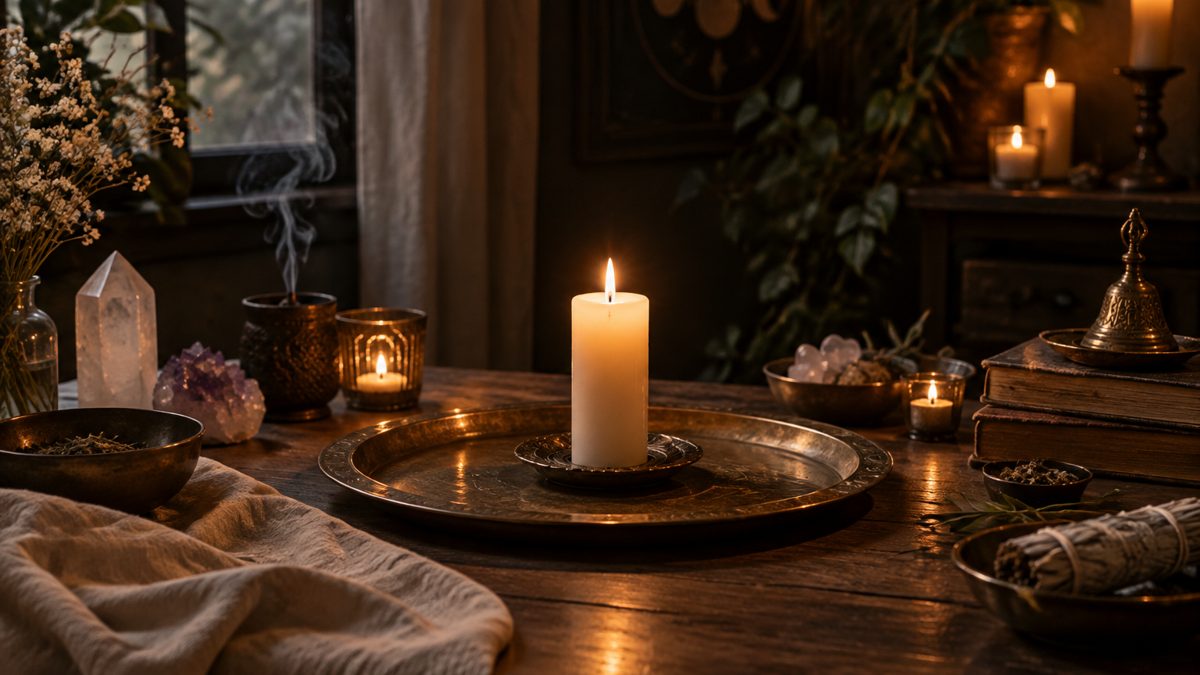
5. Préparez votre espace et apaisez votre attention
Commencez par un nettoyage ordinaire. Dégagez l'encombrement, essuyez la surface et éloignez rideaux, papiers, fleurs séchées et autres matériaux combustibles. Posez le support sur une surface stable où il ne risque pas d'être renversé. Gardez au moins trente centimètres entre la flamme et tout ce qui peut brûler, et respectez toute distance plus grande exigée par les instructions de la bougie.
Consider everyone who shares the space. Keep children and animals away from the candle and its supplies, and avoid locations where a pet could jump onto the working surface. Keep the room comfortably ventilated without directing a draft across the flame. If open flames are prohibited by your housing rules or unsuitable for your household, use a flameless alternative.
You may also want a symbolic cleansing. This can be as simple as washing your hands, ringing a bell softly, or saying, 'I set this space aside for careful attention.' Smoke is not necessary. Incense and burned herbs add fire and respiratory risks, and some essential oils can harm animals. Avoid assuming that a natural substance is automatically harmless.
Settle yourself before lighting anything. Sit comfortably, notice your surroundings, and take a few easy breaths without forcing them. Read your intention aloud or silently. If you feel highly distressed, it is reasonable to postpone the ritual and seek grounding or support instead. You do not have to reach a special emotional state to practice.
- 1. Clear the surface and check the holder, candle, and surrounding space.
- 2. Move distractions aside while keeping an easy way to call for help accessible.
- 3. Place optional symbolic objects outside the candle's heat and flame area.
- 4. Sit down, breathe naturally, and review your intention and practical next step.
6. Prepare the candle without creating hazards
Some candle traditions include carving words or applying oil, often called dressing the candle. These are optional practices, not prerequisites. For a first spell, an undecorated candle is the safest and simplest choice. You can establish its meaning by holding the unlit candle briefly and saying what it represents, then placing it securely in its holder.
Si la gravure compte dans votre pratique, travaillez uniquement sur une bougie non allumée, autoportante et adaptée. Faites des marques peu profondes avec un outil émoussé, en dirigeant l'outil à l'opposé de votre corps. Ne coupez pas profondément, n'abîmez pas la mèche et ne gravez pas de bougies placées dans un contenant. Écrire votre mot dans un carnet à côté de la bougie est une alternative plus sûre au but symbolique identique.
Les huiles et les herbes demandent une prudence particulière. Une huile ajoutée peut modifier la combustion, et la matière végétale séchée peut s'enflammer ou devenir une mèche secondaire. Pour cette méthode de débutant, laissez entièrement de côté les huiles essentielles, les huiles parfumées, les herbes, les poudres et les paillettes sur la bougie. Si vous voulez une symbolique végétale, dessinez la plante ou placez un petit paquet fermé bien en dehors de la zone chauffée.
Follow the manufacturer's wick-trimming instructions before lighting; many candles call for a wick around one-quarter inch long. Remove packaging and any debris from the wax. Examine container candles for cracks or damage. Do not use an unstable holder or try to secure a poorly fitting candle with paper, fabric, or other combustible material.
7. Cast the spell: a complete beginner method
A useful candle ritual has a beginning, a period of focused attention, and a deliberate ending. It does not need elaborate language. Before you start, decide on a short supervised session that stays within the candle's instructions. You may set a gentle timer, but a timer is only a reminder, not a substitute for watching the candle.
Once the candle is lit, speak your intention in a natural voice. You can address a deity or spiritual presence if that belongs to your established practice, but you do not need to invoke unfamiliar beings. A secular version might simply say, 'This light marks my commitment to prepare carefully and act with courage.' Use words you understand and mean.
During the quiet portion, picture yourself taking the relevant action rather than imagine controlling every detail of the outcome. For a communication spell, rehearse speaking calmly and listening well. If mental pictures do not come easily, repeat a sentence, notice a feeling, or read your written plan. Visualization is an option, not a requirement.
Concluez tant que vous êtes encore attentif. Vous n'avez pas à laisser la bougie brûler entièrement, à maintenir une concentration parfaite ni une émotion intense. Les pensées vagabondes sont ordinaires ; revenez doucement à l'intention quand vous les remarquez. Si quoi que ce soit devient dangereux du côté de la flamme, arrêtez immédiatement. Vous protéger, vous et votre maison, passe avant l'achèvement d'une séquence rituelle.
- 1. Check the candle and surroundings, then read your intention and planned action.
- 2. Light the wick carefully, keeping hair, sleeves, and your face away from the flame.
- 3. Say your intention once or several times, using repetition only if it helps you focus.
- 4. Spend a few minutes reflecting on the choices that support your goal. Rest your gaze naturally rather than staring into the flame.
- 5. Name the next action you will take and when you will take it.
- 6. Terminez par une phrase de clôture simple, comme « Cette pratique est terminée pour aujourd'hui. »
- 7. Extinguish the candle safely and remain nearby until you have checked that the wick is fully out.
8. Worked example: confidence for a job interview
Suppose you have an interview later in the week and want to feel better prepared. The purpose of this working is not to compel an employer to choose you. It is to mark your commitment to preparation, steady communication, and clear judgment about whether the role suits you. A blue candle might represent calm speech, or white might represent clarity.
Keep the materials minimal: an unscented candle, a proper holder, a notebook, and your interview notes positioned away from the flame. Write this original intention: 'I prepare thoughtfully, explain my experience clearly, and approach this conversation with self-respect.' Adjust the wording if it feels stiff. The sentence should support you, not demand that you become a completely different person.
Pendant le rituel, imaginez-vous en train de vous présenter sans hâte. Repensez à un exemple de problème que vous avez résolu au travail ou dans un autre contexte pertinent. Visualisez-vous en train de poser une question réfléchie et de vous accorder une brève pause avant de répondre. Ces réflexions sont aussi une répétition ; leur utilité pratique ne dépend pas de l'adhésion à une explication surnaturelle.
Afterward, prepare two or three examples of your skills, research the organization, and confirm the interview arrangements. You might still feel nervous, and the job may go to someone else. Neither outcome proves that you performed the spell incorrectly. Review the experience in terms of preparation and conduct as well as the hiring decision.
- 1. Schedule a brief ritual before a planned interview-preparation session.
- 2. Light the safely positioned candle and read your intention.
- 3. Réfléchissez quelques minutes à parler clairement, à écouter et à décrire une réussite pertinente.
- 4. Énoncez votre prochaine tâche : « Ce soir, je préparerai trois exemples et deux questions. »
- 5. Extinguish the candle, check it is out, and move on to the preparation task.
9. Close, store, and dispose of materials responsibly
Closing gives the practice a clear boundary. You might thank a spiritual figure you already honor, acknowledge your own effort, or simply sit quietly for a moment. There is no need to perform a complicated dismissal if your ritual did not involve one. A straightforward ending can help you return to everyday responsibilities rather than remain preoccupied with whether something invisible has happened.
Extinguish the candle according to its instructions. A suitable snuffer can help; gentle blowing may also be appropriate for some candles, provided you avoid splashing wax. Claims that blowing out a candle necessarily ruins a spell are matters of particular belief, not universal rules. Never pour water onto hot wax or a hot container, and do not move the candle while it is hot.
You may reuse the remaining candle for the same intention or another personal working if that suits your practice. Let it cool fully before storing it away from heat, children, and pets. Observe the manufacturer's maximum burn time and stop-use point. There is no need to burn a candle down to its base to establish commitment.
Dispose of cooled wax and unsuitable remnants through local household-waste guidance. Do not pour wax down a drain or leave wax, glass, plastic, or foil in natural places. Burying ritual remains can harm wildlife and create litter. If salt or salt water was used separately, keep it away from gardens, houseplants, and waterways; symbolic disposal should not damage living things.
10. Interpret results without turning accidents into omens
After a candle spell, you may feel calmer, more hopeful, disappointed, or much the same. Any of these responses is possible. A strong emotional experience does not prove that an external result is coming, and an ordinary-feeling ritual is not necessarily meaningless. Give yourself permission to value the reflection without needing a dramatic sign to validate it.
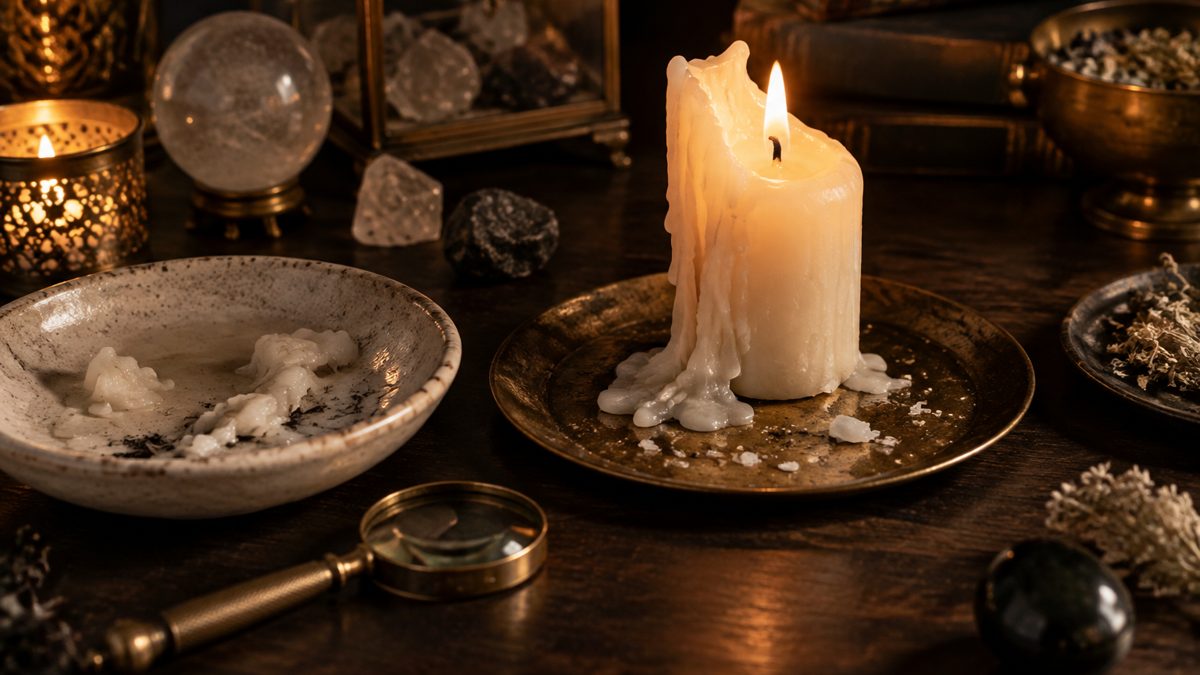
Some practitioners read flames, soot, or wax shapes symbolically. If you do this, first consider physical causes. Drafts can make flames flicker; wick length and fuel conditions affect flame size; dyes, fragrances, and wick problems may contribute to soot. A struggling candle is a reason to check safety and instructions, not evidence that someone is attacking you spiritually.
Treat wax imagery as a reflective prompt rather than a factual prediction. A shape that reminds you of a doorway might lead you to ask what opportunity you are avoiding. It does not establish that a specific event will occur. Avoid declaring curses, illnesses, infidelity, or future disasters from candle behavior; those conclusions are unsupported and can cause real distress.
Évaluez les résultats sur une période raisonnable. Notez ce que vous avez fait, ce qui a changé et ce qui est resté hors de votre contrôle. Envisagez les explications ordinaires, la coïncidence et les effets de vos actions concrètes. Si l'interprétation spirituelle vous plaît, elle peut coexister avec ces possibilités sans les remplacer. L'incertitude n'est pas un échec de la foi ; elle fait partie d'un jugement prudent.
11. Recognize common mistakes and make adjustments
Une erreur courante consiste à en faire trop. Plusieurs bougies, de multiples intentions, des invocations inconnues et des piles d'ingrédients peuvent rendre un rituel plus difficile à comprendre et moins sûr. Simplifiez jusqu'à pouvoir expliquer le rôle de chaque élément. Une seule flamme et une phrase claire offrent souvent une expérience plus cohérente qu'un dispositif chargé, assemblé à partir d'instructions contradictoires.
Another mistake is treating mood as a performance requirement. You do not need to feel powerful, serene, or completely certain. Doubt does not automatically cancel a ritual, and sadness is not contamination. If the practice becomes a test you fear failing, shorten it, use a flameless candle, or take a break from spellwork altogether.
Repeatedly casting the same spell out of panic can turn reflection into compulsive checking. Before repeating a working, ask whether you have completed the practical action attached to the first one. Set a review date instead of relighting a candle every time anxiety rises. If ritual begins to interfere with sleep, finances, relationships, or daily functioning, seek appropriate support.
Finally, avoid blaming yourself when the desired outcome does not happen. Illness, unemployment, discrimination, grief, and other difficult circumstances are not evidence that you lacked positivity or spiritual skill. Revise your plan using available information. Sometimes the healthiest adjustment is an ordinary conversation, professional help, rest, or accepting that a particular outcome cannot be secured.
12. Keep safety, consent, and spending boundaries
Never leave a burning candle unattended, sleep while it burns, or continue when you are drowsy or impaired. Keep working smoke alarms in your home and know your escape routes. If a flame grows unusually large or the container becomes damaged, extinguish it safely if possible. If a fire spreads or you are unsure you can handle it, leave and call emergency services.
Do not ingest candle wax, oils, ritual powders, or herbs sold for magical use. They may be unsuitable for food use, contaminated, irritating, or toxic. Avoid skin contact with unknown mixtures as well. If an ingestion or significant exposure occurs, contact your local poison service or medical care. Keep all supplies labeled and away from food-preparation areas.
Sur le plan éthique, privilégiez les rituels qui concernent vos propres choix, vos limites et votre bien-être. Demandez le consentement avant d'impliquer directement une autre personne ou d'utiliser ses affaires. N'administrez pas de substances en secret, ne vous introduisez pas sur une propriété pour y laisser des objets rituels, et n'interprétez pas un sortilège comme une permission d'ignorer un refus. Si vous êtes en danger, donnez la priorité à un plan de sécurité et à un soutien approprié plutôt que de vous fier à la seule symbolique protectrice.
Set financial boundaries, too. You do not need costly supplies or repeated paid services to correct an alleged spiritual defect. Be wary of anyone promising guaranteed results, demanding secrecy, or claiming that escalating payments are necessary to remove a curse. A reputable presentation of spiritual practice should leave room for uncertainty and your right to decline without threats.
13. Tenez un journal et développez une pratique durable
Un journal de sorts à la bougie vous aide à vous souvenir de ce que vous avez réellement fait plutôt que de ce que vous imaginez ensuite avoir fait. Commencez par la date, l'intention, le type de bougie, la durée approximative de la séance et l'action prévue. Notez les circonstances pertinentes, comme la fatigue ou une échéance proche. Nul besoin d'illustrations élaborées ni de papeterie coûteuse ; un simple cahier ou un fichier numérique privé convient.
Separate observations from interpretations. 'The flame flickered when the window opened' is an observation. 'I associated the movement with uncertainty' is a personal interpretation. Keeping these distinct allows symbolic meaning without confusing it with evidence. Record safety issues as plainly as emotional responses so that your next working can be more practical and comfortable.
At your chosen review date, look at effort as well as outcome. Did you follow through? Did the ritual help you clarify a boundary or notice an unrealistic expectation? Did you spend more time worrying about signs than taking action? Include disappointments and uneventful sessions, not only apparent successes. A balanced record is more useful than a collection of confirmations.
Over time, keep the elements that support thoughtful attention and let go of those that create fear, expense, or unnecessary complexity. Your practice may become more traditional, more personal, or entirely flameless. What matters is approaching it honestly: respecting its cultural influences, protecting yourself and others, and connecting intention with action. A small, careful ritual is enough to begin.
- 1. Before the ritual, record your intention, practical action, and review date.
- 2. Immediately afterward, note what happened and how you felt without forcing an interpretation.
- 3. At the review date, record actions taken, outcomes observed, and plausible ordinary explanations.
- 4. Choose one adjustment for next time, whether that means simplifying the ritual, changing the action plan, or taking a break.
These practices are shared as tradition and personal reflection, not as a substitute for medical, legal or financial advice.
Continuez d'apprendre
- Candle color meanings
- How to read tarot cards
- How to use angel oracle cards
- Comment lire les cartes à jouer
- Comment utiliser les cristaux dans les sortilèges
- Comment utiliser les herbes en sorcellerie
- How to read the Dr. Moorne Egyptian Tarot
- How to read dice
- How to read tea leaves
- Comment utiliser un pendule
- Comment lancer un sort à la bougie
- How to make a spell jar
- How to make a sigil
- How to cleanse your home
- How to set up an ancestor altar
- How to open a sacred space
- How to time spells with the moon
- How to work with water and salt
- How to make a protection charm bag
- Read the Journal ou visitez la shops