How-To Guide
How to Read Tarot Cards: A Complete Beginner's Guide
Par Seraphina
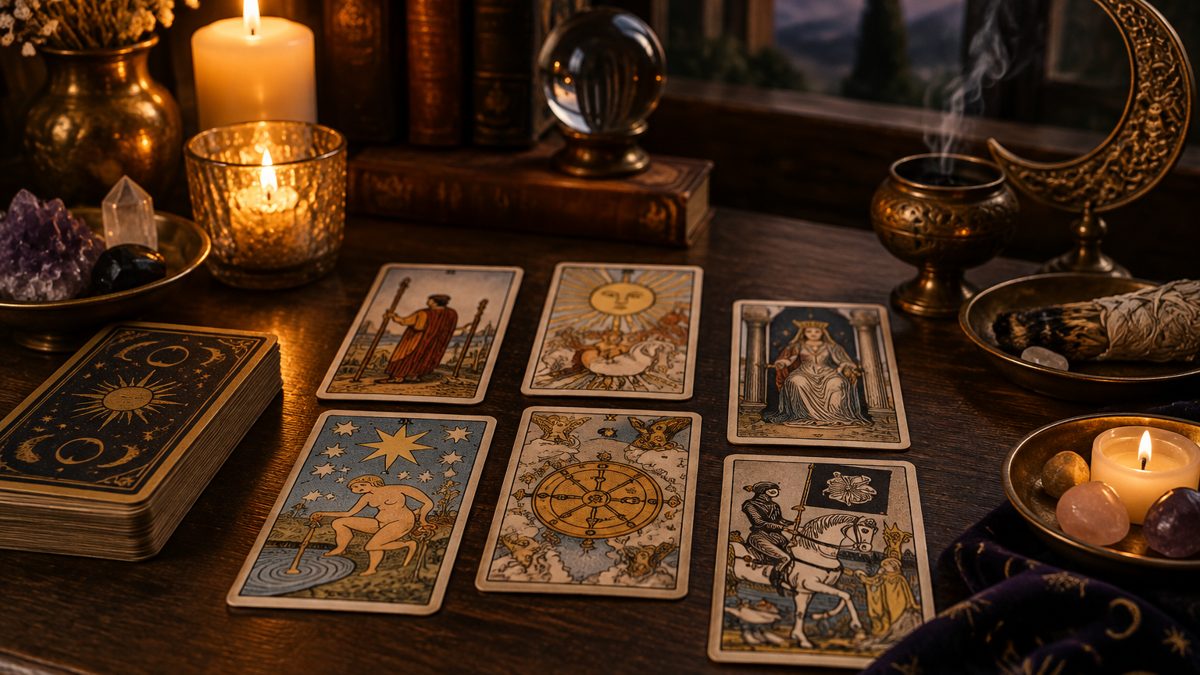
How to Read Tarot Cards: A Complete Beginner's Guide The first thing I want you to know about tarot is that you do not need to memorize seventy-eight definitions before you begin. You need a deck, a little uninterrupted time, and a willingness to look closely. Welcome to Crossroads Journal. I’m Seraphina, and my approach to tarot starts with curiosity rather than certainty: What do you notice? What does an image bring to mind? What might it help you consider?
Le tarot a une histoire de jeu de cartes, les traditions divinatoires et occultes s'étant développées plus tard. Aujourd'hui, certains l'abordent comme une pratique spirituelle, d'autres comme un outil de réflexion, d'autres encore comme les deux. Les croyances sur la magie, l'énergie et la divination relèvent de traditions particulières et de visions du monde personnelles ; ce ne sont pas des garanties établies sur le fonctionnement des cartes. Vous pouvez y participer avec discernement sans adopter des croyances qui ne vous conviennent pas.
In this guide, I’ll walk you through a standard seventy-eight-card deck, from choosing and cleansing it to laying out your first spreads. We’ll explore reversals, connect cards into a coherent story, and work through an illustrative reading together. Most importantly, we’ll keep your judgment and freedom of choice at the center. A tarot reading can offer a perspective to examine, not a verdict you must obey.
Looking for the meaning of a single card or ingredient? Keep our Significations des cartes de tarot guide open beside you.
1. Get to Know the Seventy-Eight-Card Deck
A standard tarot deck contains twenty-two Major Arcana cards and fifty-six Minor Arcana cards. The Major Arcana include familiar figures such as the Fool, the Magician, the Hermit, and the World. Readers commonly associate these cards with broad themes: beginnings, agency, solitude, change, and completion. I think of them as wide-angle images. They can give a reading a larger thematic frame, but their appearance does not prove that something destined or extraordinary is happening.
The Minor Arcana bring the focus closer to everyday experience. They are divided into four suits, commonly called Wands, Cups, Swords, and Pentacles. Each suit contains an Ace through Ten and four court cards: Page, Knight, Queen, and King. Names vary across decks. You might find Coins instead of Pentacles, or a different set of court titles. Your guidebook should explain the system your deck uses.
In many modern reading traditions, Wands suggest creativity, initiative, and enthusiasm; Cups concern feelings, relationships, and imagination; Swords address thought, language, decisions, and conflict; and Pentacles concern practical activity, resources, routines, and the material world. These are starting points rather than sealed compartments. A Cups card can appear in a creative question, and a Pentacles card can speak to the everyday effort involved in maintaining a friendship.
Court cards can describe people, approaches, roles, or qualities you are developing. They need not represent a person of a particular gender or age. A Queen might suggest a receptive, sustained relationship with a suit’s qualities; a Knight might emphasize how those qualities move into action. Different traditions interpret these roles differently. Begin with your deck’s framework, then let the question, imagery, and surrounding cards refine your interpretation.
2. Choisissez un jeu avec lequel vous avez envie de passer du temps
Pour un premier jeu, je recommande de chercher des illustrations claires, des titres de cartes lisibles et un guide qui explique à la fois les cartes individuelles et les méthodes de lecture de base. Un jeu de style Rider-Waite-Smith est souvent pratique, car de nombreuses ressources pour débutants en utilisent l'imagerie et la structure. D'autres systèmes, dont le Tarot de Marseille et le Thoth, ont leurs propres traditions d'interprétation. Aucun n'est automatiquement supérieur, mais l'apprentissage est plus simple quand votre jeu et vos documents de référence parlent un langage visuel semblable.
Before buying, look at several cards rather than judging only the cover or the Major Arcana. Can you make out what is happening in the numbered Minor Arcana? Do the images invite attention, or do they leave you feeling disconnected? Consider practical details, too: card size, print contrast, durability, and whether your hands can comfortably shuffle the deck. A beautiful deck that is difficult to handle may be better suited to occasional study than daily practice.
You do not have to receive your first deck as a gift. That is a custom some readers share, not a universal requirement. Nor do you need a rare edition, an expensive cloth, or an elaborate collection of accessories. Choose within your means, preferably from a reputable seller or the creator. One deck you know well can support a rich practice. I would rather see you become familiar with a modest, well-loved deck than feel pressured to assemble a perfect altar before drawing a card.
- Browse sample images of the Major Arcana, numbered Minor Arcana, and court cards.
- Confirm that the deck has seventy-eight cards and identify its underlying tradition.
- Check the guidebook, card dimensions, and ease of reading the artwork.
- Choose the deck that balances accessibility, personal interest, and practical comfort.
3. Cleanse Your Deck and Settle Into the Practice
In some tarot traditions, cleansing is understood as clearing unwanted energy or preparing a deck for spiritual work. Other readers use the same actions symbolically, as a way to mark a fresh beginning. There is no established evidence that cards accumulate spiritual contamination, and cleansing is not required for an accurate or meaningful conversation with the images. If the ritual appeals to you, let it support attention rather than become a rule you are afraid to break.
Je préfère quelque chose de simple : dégager un espace, aligner le jeu et marquer une pause avant de commencer. Vous pouvez trier les cartes dans l'ordre, tapoter doucement le paquet ou le placer près d'un objet qui vous rappelle votre intention. Certaines traditions utilisent la fumée, le son ou la lumière de la lune. Pensez à la sécurité incendie, aux allergies, aux animaux et aux matériaux du jeu avant d'adopter une méthode. La fumée peut laisser des résidus, la lumière du soleil peut décolorer l'impression et l'humidité peut abîmer les cartes. Mieux vaut tenir le sel et l'eau à l'écart du jeu lui-même.
L'entretien physique est distinct de la purification rituelle. Commencez avec les mains propres et sèches, suivez les conseils d'entretien du fabricant et rangez les cartes dans un endroit sec. Pour votre propre préparation, prenez quelques respirations confortables et remarquez la pièce autour de vous. Vous n'avez pas à vider votre esprit ni à atteindre un état particulier. Si vous êtes distrait(e), notez ce qui vous occupe. Si vous avez peur ou ressentez le besoin compulsif de revérifier les cartes, vous éloigner est peut-être le plus utile de tous les rituels d'ouverture.
- Choose a clear, comfortable surface with enough room for your intended spread.
- Use a brief symbolic cleansing ritual if you want one; otherwise, simply organize the deck.
- Nommez votre intention en langage ordinaire, par exemple : « Je veux envisager cette situation avec patience. »
- Decide how long you will spend reading and give yourself permission to stop.
4. Ask Questions That Leave Room for Choice
Une bonne question de tarot vous donne quelque chose à explorer sans prétendre que le jeu peut établir des faits cachés. Je privilégie les questions qui commencent par quoi ou comment : Qu'est-ce que je néglige ? Comment aborder cette conversation ? Qu'est-ce qui soutiendrait ma prochaine étape ? Elles invitent à réfléchir à votre point de vue et à votre comportement. Elles facilitent aussi l'évaluation d'une lecture après coup, car vous pouvez vous demander si l'interprétation a mené à un éclairage pertinent plutôt que de savoir si une vague prédiction a fini par sembler correspondre.
Try shifting a fixed-outcome question toward agency. Instead of “Will my creative project succeed?” ask, “What can help me develop this project, and what obstacle deserves attention?” Instead of “Does this person secretly dislike me?” ask, “What assumptions am I making about this relationship, and what could I clarify directly?” The cards cannot verify another person’s private thoughts. A spread about your own experience can still help you prepare for a respectful, real-world conversation.
Keep the scope manageable. “What should I do with my entire life?” asks a small arrangement of cards to carry an enormous burden. “What deserves attention as I plan my next month of creative work?” is easier to explore. You can include a time frame as a boundary for reflection, not as a deadline for a prediction. Before shuffling, write the question down and decide which spread positions will address it. That small act prevents the reading from wandering wherever the most dramatic image points.
- Describe the situation in one or two factual sentences.
- Separate what you know from what you suspect or fear.
- Écrivez une question ouverte centrée sur vos choix, votre attention ou votre comportement.
- Choose a spread that matches the question rather than making the question fit an elaborate spread.
5. Mélangez, coupez et tirez sans trop réfléchir
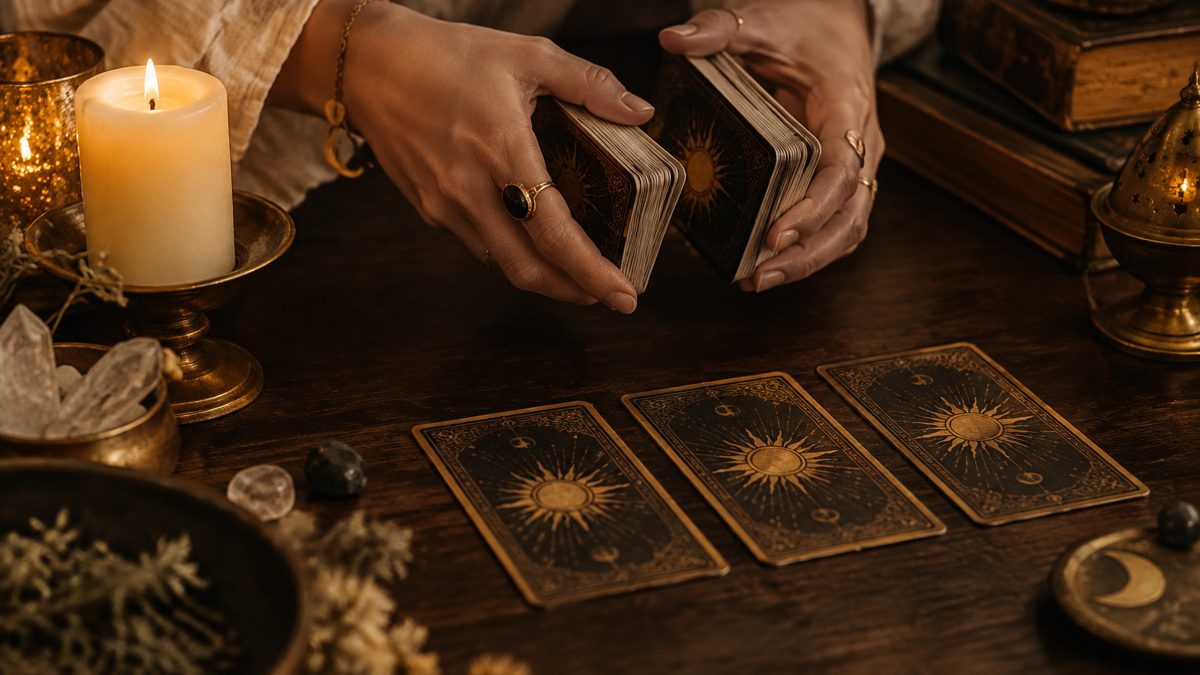
Shuffling mixes the cards and gives you a moment to focus. It does not require a particular flourish. An overhand shuffle works well for many decks; gently spreading the cards face down and mixing them across a clean surface is another option. A riffle shuffle may bend or wear stiff cards, so use it only if the deck and your hands tolerate it. You can also divide the deck into smaller piles and recombine them when a large stack is uncomfortable.
Décidez avant de commencer si vous utiliserez les cartes renversées, c'est-à-dire à l'envers. Si vous souhaitez des lectures uniquement à l'endroit, gardez les cartes orientées dans le même sens pendant le mélange. Si vous voulez des renversées, faites pivoter une partie du jeu avant de le recomposer. Nul besoin d'obtenir une proportion précise. De même, vous pouvez piocher sur le dessus ou choisir des cartes dans un éventail face cachée. Aucune des deux méthodes n'est établie comme plus révélatrice ; la constance facilite simplement l'apprentissage.
Les lecteurs appellent parfois « sauteuses » les cartes qui tombent pendant le mélange. Certains les interprètent, d'autres les remettent dans le jeu. Choisissez votre approche à l'avance pour que chaque carte tombée ne devienne pas un message urgent. Je suggère aussi de fixer une règle modeste pour les cartes de clarification : peut-être une carte supplémentaire après avoir interprété le tirage initial. Tirer sans cesse jusqu'à ce que la réponse rassure peut transformer une pratique exploratoire en une boucle qui crée plus d'incertitude.
- Read your question and remind yourself of the spread positions.
- Shuffle using a comfortable method, with or without reversals.
- Stop at a practical point; you do not need a special sensation to tell you when.
- Cut the deck if you wish, then draw the planned number of cards.
- Place each card in its assigned position and record the layout before interpreting it.
6. Commencez par des tirages à une et à trois cartes
A one-card reading is a complete practice, not merely a beginner exercise. Give the position a clear purpose, such as “A quality to practice today” or “An aspect of this project to notice.” Look at the card before opening the guidebook. Describe the scene literally: a person carrying something, a doorway, a distant landscape, an overflowing cup. Then move toward interpretation. This sequence helps distinguish what is actually pictured from what you are bringing to the image.
For a three-card reading, label the positions before drawing. Situation, challenge, and helpful approach is a versatile combination. What to acknowledge, what to reconsider, and what to try also works well. Past, present, and future is traditional, but I suggest reading the final position as a possible direction if present patterns continue, not a fixed event. Even then, the cards do not establish what happened in the past or what will happen next.
Lisez chaque carte dans sa position, puis considérez l'ensemble de la disposition. Une même carte peut signifier des choses différentes en tant que défi et en tant qu'approche utile. Par exemple, le Quatre d'Épées en position de défi peut vous inviter à vous demander si la pause est devenue de l'évitement ; en position d'approche utile, il peut suggérer de ménager un espace de réflexion. Aucune de ces significations n'est automatique. Votre situation et les images environnantes doivent déterminer laquelle est pertinente.
- For a one-card spread, write one focused prompt and draw one card.
- List three visible details, consult the guidebook, and write a sentence connecting the card to your prompt.
- For a three-card spread, assign the positions situation, challenge, and helpful approach.
- Draw three cards and interpret each according to its position.
- Finish with one summary sentence and one small action you can choose to take.
7. Lay Out the Celtic Cross Step by Step
The Celtic Cross is a ten-card spread with several established variations. There is no single universally correct set of position names. What matters is choosing a version before drawing and using it consistently. Because this spread offers many interpretive possibilities, I save it for questions with several connected dimensions. For a small daily concern, ten cards can create more noise than insight. You are not becoming a better reader simply by putting more cards on the table.
In the version below, six cards form a central cross and four form a vertical column to its right. Card two lies sideways across card one to identify the crossing influence; that sideways placement is not itself a reversal. If you use reversals, note card two’s original orientation before placing it across the center. Positions concerned with background or environment describe themes to examine, not independently verified facts about events or other people.
Once the spread is laid out, resist interpreting everything at once. Begin with the central pair, then add the foundation and conscious focus. Compare the background with the emerging direction, and only then move up the right-hand column. Read the final card in light of the whole spread. An encouraging final image is not a promise, and a difficult one is not a sentence. End by returning to what the reading suggests you might notice, question, or choose.
- Place card one in the center: the situation as you are currently experiencing it.
- Placez la carte deux en travers : un défi, une tension ou une influence qui complique les choses.
- Place card three below the center: an underlying pattern or foundation to examine.
- Place card four to the left: relevant background or a recent influence.
- Placez la carte cinq au-dessus du centre : votre attention consciente, votre intention ou votre aspiration.
- Place card six to the right: a possible near-term direction if current patterns continue.
- Start a separate vertical column farther right. Place card seven at the bottom: your approach or role.
- Place card eight above card seven: environmental influences or support to consider.
- Place card nine above card eight: hopes and fears, which may overlap.
- Place card ten at the top: a possible trajectory or concluding theme, not a guaranteed outcome.
- Summarize the central tension, available support, and one practical point for reflection.
8. Lisez les cartes renversées comme des nuances, non comme de mauvaises nouvelles automatiques
Les cartes renversées sont facultatives. De nombreux lecteurs expérimentés ne travaillent qu'avec des cartes à l'endroit et trouvent la complexité dans les positions du tirage et les cartes voisines. Si vous apprenez encore le jeu, lire uniquement à l'endroit peut réduire le nombre de variables. Vous ne pratiquez pas une version incomplète du tarot. Une position difficile peut déjà révéler une expression ardue d'une carte par ailleurs accueillante, tandis qu'une position de soutien peut montrer une réponse constructive à une image troublante.
If you do read reversals, choose a small interpretive framework. An upside-down card might suggest a quality that is blocked, internalized, excessive, diminished, or being reconsidered. It does not necessarily mean the exact opposite of the upright meaning. The reversed Sun, for instance, could invite reflection on difficulty recognizing satisfaction rather than predict unhappiness. A reversed Knight might raise questions about pace or direction rather than identify a bad person.
Évitez de passer en revue toutes les significations possibles d'une carte renversée jusqu'à ce que l'une paraisse assez dramatique. Demandez-vous quelle interprétation convient à la question et à la position avec le moins d'hypothèses non fondées. Puis tenez-la avec légèreté. Vous pourriez écrire : « Je lis ce renversement comme une attention tournée vers l'intérieur, parce que la question concerne un processus créatif privé. » Cette explication rend votre méthode visible. Avec le temps, votre journal montrera quelles approches produisent une réflexion utile et lesquelles vous poussent seulement à étirer une carte pour l'adapter à n'importe quelle situation.
9. Combinez les cartes et racontez une histoire ancrée dans le réel
Start combining cards by noticing patterns. Are several cards from one suit? Are there many court cards or Major Arcana? Does the imagery feel still, busy, open, crowded, solitary, or communal? These observations can guide attention without becoming rigid formulas. Several Swords cards might emphasize thought and communication, but they do not establish that conflict is inevitable. An absent suit is simply an absence in a small selection of cards, not proof that something is missing from your life.
Next, look at relationships between images. A figure facing another card may suggest engagement; a figure turned away may suggest distance. A heavy burden beside a communal scene might invite questions about sharing responsibility. Numbers can add another layer if your reading tradition uses them, but avoid importing so many symbolic systems that you lose sight of the actual question. Visual details are prompts for interpretation, not secret evidence.
Pour construire un récit, donnez à chaque carte un rôle distinct. Avec la situation, le défi et l'approche utile, votre résumé peut suivre cette structure : « Je vis ceci ; cette tension le complique ; cette réponse mérite peut-être d'être essayée. » Utilisez des formules comme « pourrait suggérer » et « je me demande si » lorsque le lien est incertain. Un récit cohérent doit éclairer le tirage, non déguiser une conjecture en savoir. Si deux interprétations restent plausibles, nommez-les toutes les deux plutôt que de forcer une seule réponse.
I also look for the least sensational interpretation that still respects the imagery. Death often concerns endings and transition in modern tarot practice; it should not be treated as a literal prediction of death. The Tower can invite examination of unstable assumptions without forecasting catastrophe. When an image unsettles you, describe it, consult your guidebook, and reconnect it to the question. You can stop the reading if it is no longer helpful.
10. Walk Through a Complete Sample Reading
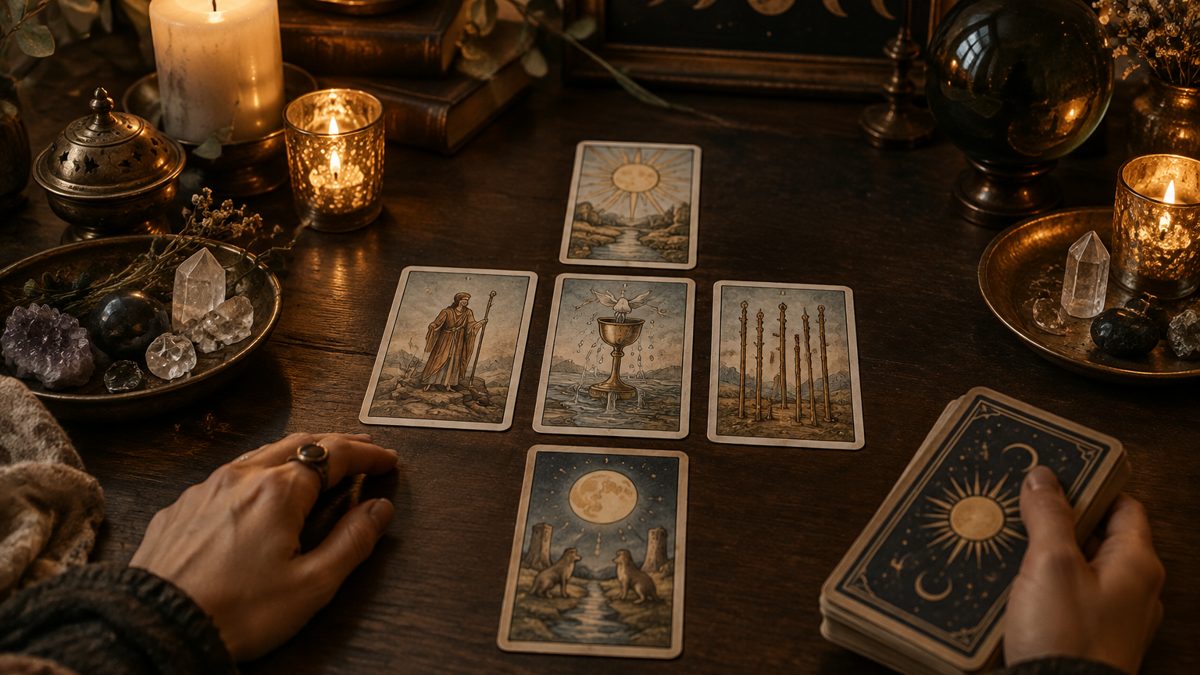
Voici un exemple inventé à des fins d'apprentissage, et non un témoignage ni une prédiction. Supposons que la question soit : « Qu'est-ce qui pourrait m'aider à reprendre un projet d'écriture personnel ? » Avant de tirer, je note le contexte : le manuscrit n'a pas été touché depuis plusieurs semaines et la prochaine étape semble floue. Je choisis trois positions : la situation, le défi et l'approche utile. Les cartes données en exemple sont le Huit de Deniers à l'endroit, le Sept de Coupes à l'endroit et la Reine d'Épées à l'endroit.
For the situation, the Eight of Pentacles shows a craftsperson engaged in repeated work in familiar Rider–Waite–Smith imagery. I notice attention, repetition, and a tangible task. Its conventional association with practice suggests viewing the project as something developed through manageable effort. I would not conclude that the card proves talent or promises publication. I would ask, “Which part of this project becomes easier when I treat it as a skill to practice rather than a test of my worth?”
For the challenge, the Seven of Cups presents several enticing or confusing possibilities. I connect that image to the stated problem cautiously: perhaps the project feels vague because too many versions are competing for attention. That is a hypothesis to check, not a fact revealed by the deck. If the writer actually has one clear plan but little available time, this interpretation needs revision. The card might instead invite reflection on imagined expectations or the distance between planning and doing.
Pour l'approche utile, la Reine d'Épées suggère le discernement, un langage clair et des limites, dans cette tradition de lecture. Ensemble, les cartes proposent une histoire possible : un travail concret est disponible, des possibilités concurrentes le compliquent, et un choix clair pourrait aider. Une prochaine étape proportionnée serait de choisir une section, de définir ce qu'un premier jet doit contenir et de réserver une période d'écriture raisonnable. La valeur réside dans la vérification de l'utilité de cette action, non dans la preuve que les cartes connaissaient la réponse.
- Record the question, factual context, position names, cards, and orientations.
- Décrivez chaque image avant de lui attacher une signification conventionnelle.
- Check whether each proposed interpretation fits the known situation.
- Réunissez les cartes en un seul résumé provisoire plutôt qu'en trois définitions déconnectées.
- Choose a small, reversible action: for example, draft one scene before reconsidering the project’s whole structure.
- Return later to assess the action and interpretation without rewriting the original notes.
11. Keep a Tarot Journal That Helps You Learn
Your tarot journal does not need to be beautiful. A notebook, a plain document, or a simple table is enough. Record the date, deck, question, spread positions, cards, and orientations. Add a few literal observations, the meanings you consulted, your initial interpretation, and any action you chose. Separating observation from interpretation is especially useful. “The figure faces away” describes the artwork; “I am avoiding a conversation” is an inference that deserves examination.
Leave room for follow-up. After an appropriate interval, ask what was useful, what did not fit, and what you might interpret differently now. Keep the original entry intact so you can distinguish your first impression from later knowledge. People naturally remember striking matches and overlook misses; a written record helps counter that tendency. A reading that did not resonate is not a failure you must explain away. It can show that a question was too broad or an interpretation too elaborate.
For steady learning, try studying one card at a time alongside occasional small spreads. Notice how a card’s meaning changes with its position, and compare your own associations with the guidebook rather than replacing one with the other. Protect the privacy of anyone whose reading you record. If your practice begins to feel compulsory, take a break. Familiarity grows through thoughtful attention, not through asking the deck the same question every hour.
- Create a repeatable entry with space for context, observations, interpretation, and follow-up.
- Mark guidebook meanings separately from your personal associations.
- Consignez l'incertitude et les interprétations alternatives au lieu de les lisser.
- Review several entries periodically for useful patterns, strained connections, and repeated questions.
- Adjust your practice toward what supports reflection and away from what increases dependence.
12. Read Ethically and Keep Your Own Authority
If you read for someone else, begin with consent and a clear explanation of your approach. Ask what they want to explore, whether any topics are off limits, and whether they prefer a reflective or tradition-based spiritual framing. Make clear that interpretations are uncertain and that they can disagree, decline a question, or stop. Do not assume that a person who enjoys tarot shares your beliefs about divination. The reading should leave them with room to think, not pressure to accept your worldview.
Keep boundaries around subjects the cards cannot responsibly settle. Do not use tarot to diagnose conditions, determine pregnancy, predict death, establish legal facts, or direct financial decisions. Refer medical, legal, and financial questions to appropriately qualified professionals. Likewise, cards cannot establish that someone has cheated, committed a crime, or concealed a particular intention. Redirect third-party questions toward the querent’s own observations, boundaries, and options rather than claiming access to another person’s private life.
Never tell someone they are cursed or must purchase a service to prevent misfortune. Do not use frightening imagery to create dependency, and do not promise a particular relationship, achievement, or outcome. If you charge for readings, disclose prices, scope, and relevant terms beforehand. Respect confidentiality, and obtain explicit permission before sharing a reading, even anonymously. When someone is in immediate danger or acute distress, prioritize appropriate real-world support rather than drawing more cards.
Pour vos propres lectures, la même bienveillance et la même retenue s'appliquent. Vous pouvez mettre le jeu de côté, changer d'interprétation ou décider qu'un tirage n'a rien offert d'utile aujourd'hui. J'espère, ici au Crossroads Journal, que le tarot devienne une pratique d'attention rapprochée : aux images, aux présupposés et aux choix réellement à votre portée. Commencez par une question et une carte. Laissez le livret vous aider, laissez l'expérience affiner votre compréhension et souvenez-vous que la prochaine étape reste la vôtre.
These practices are shared as tradition and personal reflection, not as a substitute for medical, legal or financial advice.
Continuez d'apprendre
- Significations des cartes de tarot
- How to read tarot cards
- How to use angel oracle cards
- Comment lire les cartes à jouer
- Comment utiliser les cristaux dans les sortilèges
- Comment utiliser les herbes en sorcellerie
- How to read the Dr. Moorne Egyptian Tarot
- How to read dice
- How to read tea leaves
- Comment utiliser un pendule
- Comment lancer un sort à la bougie
- How to make a spell jar
- How to make a sigil
- How to cleanse your home
- How to set up an ancestor altar
- How to open a sacred space
- How to time spells with the moon
- How to work with water and salt
- How to make a protection charm bag
- Read the Journal ou visitez la shops