How-To Guide
How to Make a Sigil
Par Seraphina
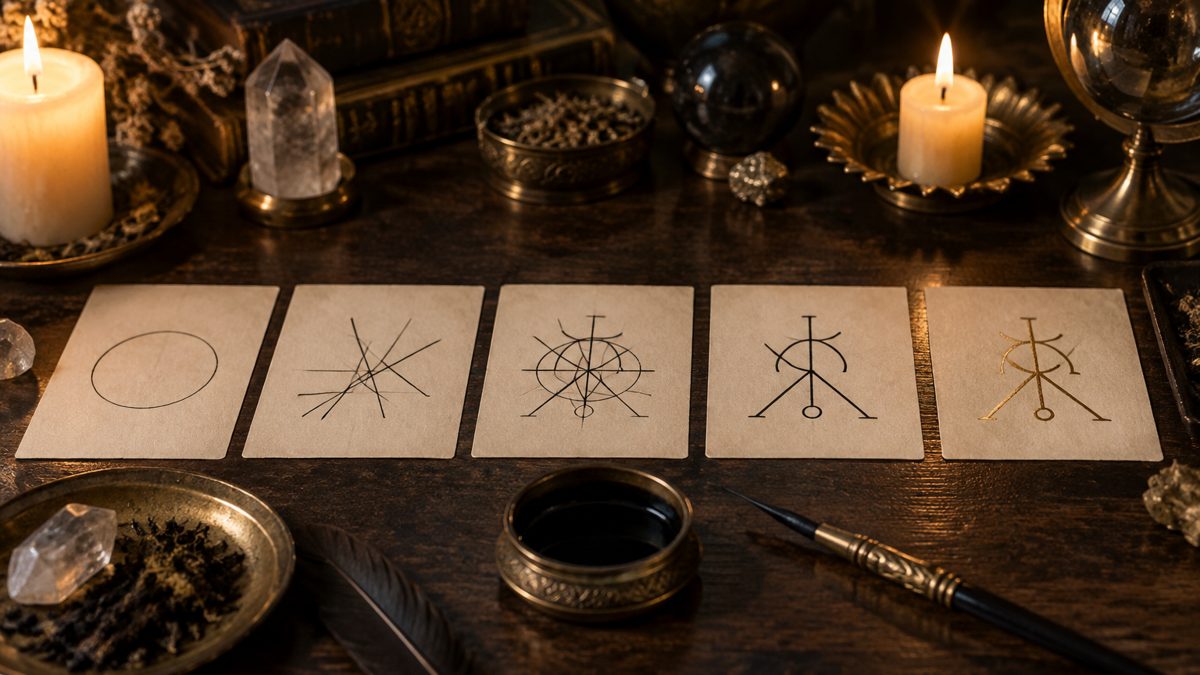
A sigil is a symbol created or chosen to represent an intention, name, power, or idea. In contemporary personal practice, making one often means turning a short statement into an abstract design, then using that design in a meaningful ritual. Some people understand this as magic; others approach it as creative reflection or a reminder of a commitment. You do not need to settle that question before picking up a pencil.
Au Crossroads Journal, nous abordons la création de sigils comme un lieu de rencontre entre tradition, croyance et pratique personnelle. Un symbole peut vous aider à donner forme à quelque chose de difficile à exprimer, mais il ne peut ni garantir un résultat ni remplacer l'action concrète. Un sigil pour trouver un emploi a sa place à côté des candidatures et de la préparation aux entretiens. Un sigil pour le calme peut accompagner une routine paisible sans remplacer des soins de santé mentale appropriés.
Ce guide enseigne une méthode accessible fondée sur les lettres, tout en expliquant la place de cette méthode dans une histoire bien plus vaste. Vous passerez du choix d'une intention au dessin, à l'usage et au réexamen de votre symbole. Un exemple concret est également proposé, que vous pouvez suivre sans en copier le dessin final. Le talent artistique est facultatif : un trait un peu de travers qui a du sens pour vous convient parfaitement à cet exercice.
Treat the instructions as a framework rather than a test of spiritual ability. You can omit candles, change the wording, keep the finished design, or stop if the process becomes uncomfortable. For alternative approaches, use the companion reference page, Sigil Methods. Here, the emphasis is on making one thoughtful, manageable sigil from beginning to end, with enough context to understand your choices.
Looking for the meaning of a single card or ingredient? Keep our Méthodes de sigils guide open beside you.
1. Understand What a Sigil Is
The word sigil comes from the Latin sigillum, meaning a seal or small sign. Historically, the term has been applied to different kinds of symbolic marks, including signs associated with spirits, planetary powers, and ritual authority. These were not all made by reducing an intention to letters. A symbol copied from a historical magical text and a personal design made this afternoon may both be called sigils, but their purposes and contexts can differ considerably.
Dans la magie rituelle européenne médiévale et du début de l'ère moderne, les sceaux et les caractères pouvaient faire partie de systèmes élaborés impliquant prières, calendrier, matériaux et présupposés religieux ou cosmologiques précis. D'autres cultures ont leurs propres dessins talismaniques, sacrés et protecteurs, qu'il ne faut pas automatiquement rebaptiser sigils. Une apparence similaire n'établit pas une signification commune. Lorsque vous étudiez un symbole inconnu, cherchez son nom, son origine et son usage avant de supposer qu'il s'agit d'une décoration magique à usage général.
The intention-based method popular today is strongly associated with the English artist and occultist Austin Osman Spare, whose work influenced later chaos magic practitioners. Many contemporary versions simplify or adapt those ideas, sometimes combining them with journaling, meditation, or art. This guide presents one such modern adaptation, not an unchanged ancient formula. If historical accuracy matters to your practice, distinguish what a source actually teaches from later interpretations and your own additions.
2. Choose an Intention Within Your Influence
Begin with one area of life where you want to act differently or bring more attention. Useful starting points include preparing for an exam, maintaining a creative habit, speaking clearly in meetings, or protecting time for rest. Broad wishes such as happiness or success can be meaningful, but they are difficult to translate into a workable practice. Ask what a small, recognizable expression of that wish would look like during an ordinary week.
Keep the intention centered on your choices rather than another person's obedience. Instead of trying to make a particular person love you, consider your readiness for reciprocal connection or your willingness to communicate honestly. Instead of trying to defeat a colleague, focus on preparing your work and asserting appropriate boundaries. This does not mean you control every outcome. It means your sigil points toward something you can support without overriding someone else's autonomy.
Choose a scale that leaves room for real life. An intention to study regularly is more useful than a demand never to feel distracted again. Consider resources, disability, caring responsibilities, and circumstances outside your control. For a first attempt, select a low-stakes habit rather than a frightening emergency. If your situation involves danger, serious illness, debt, or legal trouble, prioritize qualified help and practical safeguards; symbolic work can be an optional accompaniment.
- 1. Écrivez en une seule phrase le domaine de vie que vous voulez aborder.
- 2. Identify one behavior or choice that could support it.
- 3. Check that the intention respects consent and does not depend on controlling someone else.
- 4. Choose a modest time frame for reviewing your actions, such as one or two weeks.
3. Gather Simple, Suitable Materials
The basic materials are paper, a pencil or pen, and a surface on which to draw. Scrap paper is useful for experiments, and an eraser can help if you enjoy revising. A notebook gives you a place to record your intention and later observations. You do not need special ink, crystals, expensive tools, or purchased spellwork. Keeping the setup simple makes it easier to notice whether the practice itself suits you.
Optional materials might include a ruler, tracing paper, colored pencils, or a small envelope for storing the finished symbol. Choose additions because they help you work comfortably or carry a personal association. Blue might suggest steadiness to you, while a circle might suggest continuity. Such associations vary between people and traditions; they are not universal instructions. Ordinary paper and black ink are as appropriate as a carefully decorated ritual journal.
Tenez compte de votre environnement réel. Si vous partagez un logement, utilisez un carnet portable plutôt qu'une exposition permanente qui pourrait susciter des questions indésirables. Si le travail de précision est difficile, essayez de grandes formes, un outil de dessin numérique ou l'assemblage de morceaux de papier. Évitez d'appliquer des encres ordinaires sur la peau, les aliments ou les récipients à boire. Les bougies et l'encens ne sont pas nécessaires, surtout en cas de sensibilité respiratoire, d'animaux curieux, d'enfants ou de règlement de location interdisant les flammes.
4. Prepare Your Space and Attention
La préparation peut être simple et brève. Dégagez assez de place pour votre matériel, coupez les notifications évitables et donnez-vous un point d'arrêt raisonnable. Dix ou vingt minutes sans hâte peuvent suffire pour un premier motif. Nul besoin de rendre votre maison impeccable ni d'attendre une humeur parfaite. Le but est de réduire les distractions, non de prouver que vous êtes spirituellement pur(e) ou digne de commencer.
Certains praticiens préfèrent se laver les mains, dire une courte prière ou placer un objet significatif à proximité. D'autres s'assoient simplement et écrivent la date. Ces gestes peuvent marquer le passage vers un travail concentré, mais aucun n'est indispensable à l'efficacité. Si vous utilisez une prière ou une forme rituelle propre à une tradition, comprenez son contexte plutôt que d'emprunter des mots inconnus pour l'ambiance. Une simple déclaration indiquant que vous prenez le temps de réfléchir suffit.
Settle into a comfortable posture and notice your surroundings. Breathe normally rather than forcing deep breaths or holding your breath. If closing your eyes feels unpleasant, keep them open. You should remain able to stop, move, or answer a necessary interruption. If you feel panicky, unreal, or overwhelmed, put the work aside and return to something familiar. Intensity is not a measure of skill, and distress does not mean a ritual is progressing.
- 1. Clear a small drawing area and place your supplies within reach.
- 2. Décidez combien de temps vous voulez y consacrer et ce que vous ferez ensuite.
- 3. Notice your feet, your seat, and a few ordinary objects around you.
- 4. Lisez l'intention choisie et vérifiez qu'elle vous semble toujours appropriée.

5. Turn Your Intention Into a Clear Sentence
Write a short sentence expressing what you want to practice or encourage. Concrete language is usually easier to work with than a complicated declaration. For example, I begin my writing session with ten minutes of work identifies an action more clearly than I unlock limitless creative greatness. You can keep qualifications and practical details in your journal rather than squeezing every concern into the sentence that will become your design.
Many modern instructions recommend present-tense, affirmative wording. You may find that useful because it emphasizes a desired action rather than an unwanted condition. However, there is no established rule that negations confuse a supernatural mechanism or that a particular tense guarantees results. Choose wording that is honest enough to sit with comfortably. I practice speaking clearly may feel more believable and useful than I am perfectly confident in every conversation.
Read the sentence aloud or silently and look for hidden pressure. Words such as always, never, instantly, and perfectly can turn a supportive intention into an impossible demand. Also check for accidental bargains: you do not need to promise pain, deprivation, or sacrifice in exchange for success. Once the sentence expresses your aim, stop polishing. Endless rewriting can become a way of avoiding the ordinary action the sigil was meant to support.
- 1. Draft two or three short versions of your intention.
- 2. Choose the version that most clearly describes a helpful direction or behavior.
- 3. Remove unnecessary demands, exaggerated promises, and attempts to control others.
- 4. Copy the final sentence into your journal before transforming its letters.
6. Reduce the Sentence to a Set of Letters
One common modern method removes spaces, punctuation, vowels, and repeated letters, leaving a smaller set of forms to combine. Other versions retain vowels or use different reduction rules. There is no single universally correct sequence. For your first attempt, choose one convention and follow it consistently. Here, we will remove A, E, I, O, and U, then keep only the first occurrence of each remaining letter.
Write the sentence in capitals if that makes the shapes easier to see. Cross out vowels, then scan the remaining letters from left to right, recording each different letter once. Treat Y as a consonant for this exercise; another method may handle it differently. The result is a design toolkit, not a secret code that must be decoded later. You may rotate, overlap, simplify, or partially merge these letterforms during drawing.
If your intention uses a different language or writing system, do not force it into English spelling unless you want to. Vowel removal does not translate neatly across all scripts. You can instead simplify selected written forms, combine meaningful words visually, or use an image-based approach from Sigil Methods. The important point is to understand your chosen process, rather than assuming a method designed around the Latin alphabet must apply everywhere.
- 1. Recopiez votre intention définitive sous une forme clairement lisible.
- 2. Supprimez les espaces, la ponctuation et les voyelles A, E, I, O et U.
- 3. Move from left to right and keep each remaining letter only the first time it appears.
- 4. Write the reduced letter set separately so you can experiment without losing your place.
7. Build and Refine the Symbol
Begin by treating the letters as shapes rather than as readable text. An M offers diagonals, an R offers a curve and a slanting leg, and a T offers a crossbar. Place two forms on top of each other and look for shared lines. Rotate a letter, lengthen a curve, or let one stroke serve more than one purpose. Your first sketches can be awkward; exploration matters more than producing an impressive emblem.
Réalisez plusieurs petites versions plutôt que de corriger sans cesse un grand dessin. Essayez un dessin compact, un dessin plus ouvert et une version construite autour d'une seule ligne verticale. Gardez assez de lien avec votre jeu de lettres pour que le processus ait du sens, mais ne vous inquiétez pas si chaque lettre devient difficile à identifier. Certains praticiens préfèrent l'abstraction complète, d'autres conservent une initiale visible ou un motif reconnaissable. Aucun des deux choix n'établit un pouvoir magique supérieur.
Select the design that feels coherent and is reasonably easy to redraw. Remove stray details that contribute nothing, then test it at the size you intend to use. Avoid mistaking complexity for significance. If the result resembles a familiar hate symbol, commercial logo, or sacred emblem you did not mean to invoke, revise it, especially before displaying it publicly. Accidental resemblance is a design issue, not evidence that an outside force has intervened.
- 1. Dessinez de trois à six combinaisons rapides à partir de vos lettres réduites.
- 2. Expérimentez avec la rotation, les traits partagés, les courbes et l'espacement.
- 3. Choose one version and simplify any unnecessary marks.
- 4. Redraw it on clean paper, leaving enough space around it to see the whole design.
8. Suivez un exemple complet
Suppose your aim is to establish a small creative routine. Your practical plan is to keep a notebook beside your breakfast place and write for five minutes afterward. For the sigil itself, you choose the concise sentence I WRITE DAILY. This is a direction for practice, not a prediction that illness, travel, or fatigue will never interrupt you. In your journal, you also note that missing a day will not require punishment or starting everything over.
Removing spaces produces IWRITEDAILY. Removing A, E, I, O, and U leaves WRTDLY. There are no repeated consonants in that sequence, so the final set remains W, R, T, D, L, Y. You can check the reduction once, then move on. If you notice a harmless copying difference later, you may revise it or keep the design as a personal variation; a clerical mistake is not a dangerous omen.
For one possible design, use a tall stem shared by T, D, and L. Add a short crossbar near its top, curve the D around its right side, and give the base a small rightward foot. Place a shallow W beneath it, fork the top into a Y, and add a diagonal leg suggesting R. Simplify any crowded area. Your drawing will likely differ from someone else's interpretation, which is entirely acceptable.
- 1. Record the intention I WRITE DAILY and the supporting five-minute writing plan.
- 2. Réduisez la phrase à WRTDLY selon la méthode ci-dessus.
- 3. Sketch three arrangements, then choose the easiest one to recognize and redraw.
- 4. Accordez au symbole terminé un bref moment d'attention, puis faites une séance d'écriture de cinq minutes.
- 5. Faites le bilan de la routine au bout d'une semaine, en notant les occasions, les obstacles et les séances d'écriture réellement accomplies.
9. Give the Sigil a Deliberate Moment of Attention
Many practitioners call this stage charging or activation. Within magical belief, it may be understood as directing intention into the symbol. In a non-supernatural interpretation, it can be a deliberate transition from planning to commitment. Neither explanation requires claiming that the process has proven effects on external events. For a beginner, a quiet, bounded exercise is more appropriate than an attempt to induce an extreme or unfamiliar state.
Place the sigil where you can see it comfortably. Read your intention once, then look at the design without trying to force a sensation. Notice its outline, the movement of its strokes, and what the intention asks of you in daily life. After a short interval, mark the end by putting down your pen, closing your notebook, or saying that the exercise is complete. Feeling ordinary afterward is not a failure.
Vous pouvez inclure une brève prière si elle fait partie de votre pratique, mais évitez d'inventer des obligations que vous vous sentiriez contraint d'honorer plus tard. Il n'est nécessaire ni de souffrir, ni de se priver de sommeil, ni de s'enivrer, ni d'hyperventiler, ni de jeûner longtemps. Un minuteur peut aider si vous avez tendance à répéter les rituels jusqu'à ce qu'ils vous paraissent parfaits. Terminez par quelque chose de concret et de doux, comme vous étirer, boire de l'eau ou accomplir la première action pratique associée à votre intention.
- 1. Sit comfortably with the finished symbol in view.
- 2. Read the intention once and reflect on the action it represents.
- 3. Regardez le dessin pendant environ trente secondes à deux minutes, en vous arrêtant plus tôt si cela vous met mal à l'aise.
- 4. Close the exercise with a simple gesture and return to ordinary activity.
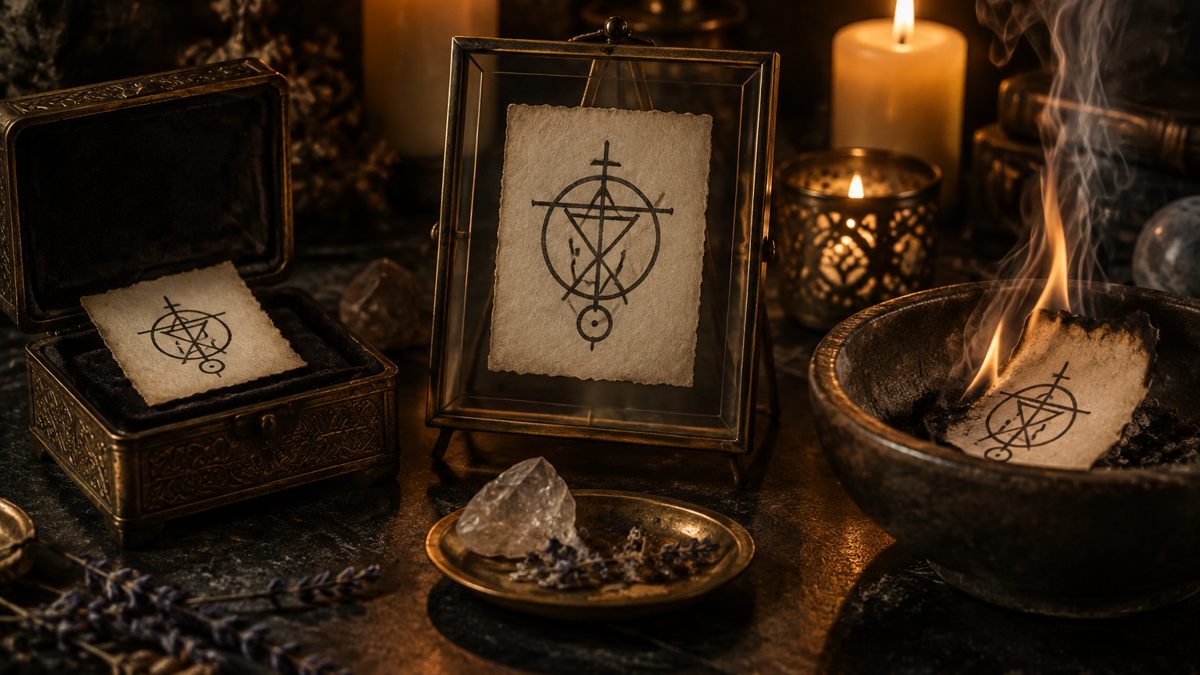
10. Decide Whether to Keep, Display, or Release It
Les méthodes divergent sur ce qui se passe ensuite. Certaines approches de la magie du chaos recommandent de sortir l'intention de l'attention consciente après le rituel. D'autres pratiques personnelles gardent le sigil visible comme rappel. Ce sont des modèles de travail différents, non des consignes à satisfaire simultanément. Choisissez un rôle avant de commencer : le symbole peut être un objet rituel privé, un repère pratique ou une œuvre associée à votre intention.
For a reminder-based practice, place the design near the relevant activity: inside a study notebook, beside a musical instrument, or on your own calendar. Avoid displaying confidential intentions in shared workplaces or homes unless you are comfortable discussing them. For a release-based practice, put it in an envelope or close the journal. You do not need to force yourself to forget. Remembering your intention is normal and does not invalidate the exercise.
La destruction est facultative. Déchirer du papier ordinaire ou le recycler, là où les règles locales le permettent, peut offrir une fin nette sans feu. Ne jetez ni papier, ni rubans, ni cire, ni paillettes dans les cours d'eau ou les espaces extérieurs. Enterrer des matériaux peut aussi introduire des déchets ou des substances indésirables dans le sol. Si l'intention change, vous pouvez retirer le sigil avec une brève note dans votre journal. Nul besoin d'une purification payante, d'un contre-sort ou d'un rituel d'élimination élaboré.
11. Interpret Results Without Turning Everything Into a Sign
Evaluate the practice by returning to the intention and the actions you recorded. Did you write more often, prepare more consistently, or remember a boundary at a useful moment? Also note what did not change. A favorable event after a ritual does not demonstrate that the ritual caused it. Timing, chance, other people's choices, and your own behavior all matter, and a personal journal cannot isolate those influences with scientific certainty.
Dreams, coincidences, and emotional shifts may feel meaningful, and you can record them as experiences without treating them as instructions or predictions. Distinguish observation from interpretation: noticing a repeated image is one thing; concluding it guarantees a job offer is another. If an apparent sign would lead you to spend money, abandon treatment, confront someone, or take a serious risk, pause and seek ordinary evidence and appropriate advice.
Si le résultat souhaité ne se produit pas, ne supposez pas que vous manquiez de foi ou que vous ayez attiré l'échec. Examinez si l'intention était réaliste et si le plan qui l'accompagnait demandait plus de temps, de ressources ou d'aide. Parfois, le résultat le plus utile est de comprendre que vous ne voulez pas l'objectif de départ. Redessiner sans cesse un symbole pour apaiser la peur peut devenir angoissant plutôt que soutenant. Si le rituel semble obligatoire ou interfère avec la vie quotidienne, prenez du recul et envisagez un soutien professionnel.
12. Avoid Common Mistakes and Keep the Practice Safe
Common beginner mistakes include crowding several goals into one sigil, searching endlessly for the perfect shape, and making new symbols instead of taking practical steps. Another is believing that every extra ingredient increases effectiveness. Start with one intention and one design, then allow time to observe your experience. If the activity becomes expensive, exhausting, or frightening, simplify it. No seller or practitioner can legitimately guarantee supernatural results, and threats of unavoidable misfortune are a warning sign.
Le feu n'est pas nécessaire. Si vous choisissez une bougie, utilisez un support stable et résistant à la chaleur sur une surface dégagée, bien loin du papier, des tissus, des enfants et des animaux, et ne la laissez jamais sans surveillance. Évitez de brûler le sigil, surtout s'il contient des encres, des revêtements, de la colle ou des matériaux synthétiques inconnus. L'encens et la fumée peuvent irriter les poumons et affecter les animaux ; la ventilation ne rend pas tous les produits sûrs. Une bougie éteinte ou une lampe de bureau ordinaire peut marquer l'occasion sans combustion.
Les herbes, les huiles et le sel exigent aussi des précautions. Naturel ne veut pas dire sans danger à avaler, à brûler ou à appliquer sur la peau. N'ingérez pas de mélanges rituels et n'ajoutez pas de substances inconnues à l'eau du bain, aux aliments ou aux boissons ; les huiles essentielles et certaines plantes peuvent être nocives, surtout pour les animaux. Gardez le sel et l'eau salée à l'écart des plantes et de la terre. Respectez le consentement et la propriété : ne cachez pas de sigils dans les affaires de quelqu'un d'autre, ne marquez pas des espaces partagés sans permission et n'utilisez pas de matières corporelles d'autrui.
13. Keep a Useful Journal and Develop Your Own Approach
A useful journal entry records the date, intention, reduction rule, sketch, and reason for choosing the final design. Add the practical action that will accompany it and the date you plan to review. You may record mood or personal associations, but you do not need to document every passing thought. Keep sensitive information secure, especially if your notes involve relationships, health, or work. Initials and general descriptions can protect other people's privacy.
At review time, compare your experience with the original aim rather than rewriting the aim to fit whatever happened. Include uneventful attempts as well as memorable ones. Ask whether the symbol helped you remember a commitment, whether the process was enjoyable, and whether any part created pressure. Your record may reveal that a visible reminder suits you better than a release ritual, or that drawing alone provides the reflection you were seeking.
Develop your approach gradually. Change one feature at a time if you want to compare experiences, and use Sigil Methods when you are ready to explore a different construction process. Read historical sources with attention to context, and keep personal adaptations clearly identified as your own. You may also decide that sigil making is not useful to you. A thoughtful practice leaves room for curiosity, revision, and stopping; it does not demand fear or certainty.
- 1. Record what you made, how you made it, and what you intended to do alongside it.
- 2. Choose a review date that discourages constant checking.
- 3. Note concrete actions and outcomes separately from feelings and symbolic interpretations.
- 4. Decide whether to continue, revise, retire, or simply enjoy the design as artwork.
These practices are shared as tradition and personal reflection, not as a substitute for medical, legal or financial advice.
Continuez d'apprendre
- Méthodes de sigils
- How to read tarot cards
- How to use angel oracle cards
- Comment lire les cartes à jouer
- Comment utiliser les cristaux dans les sortilèges
- Comment utiliser les herbes en sorcellerie
- How to read the Dr. Moorne Egyptian Tarot
- How to read dice
- How to read tea leaves
- Comment utiliser un pendule
- Comment lancer un sort à la bougie
- How to make a spell jar
- How to make a sigil
- How to cleanse your home
- How to set up an ancestor altar
- How to open a sacred space
- How to time spells with the moon
- How to work with water and salt
- How to make a protection charm bag
- Read the Journal ou visitez la shops