How-To Guide
How to Read Tea Leaves
Par Seraphina
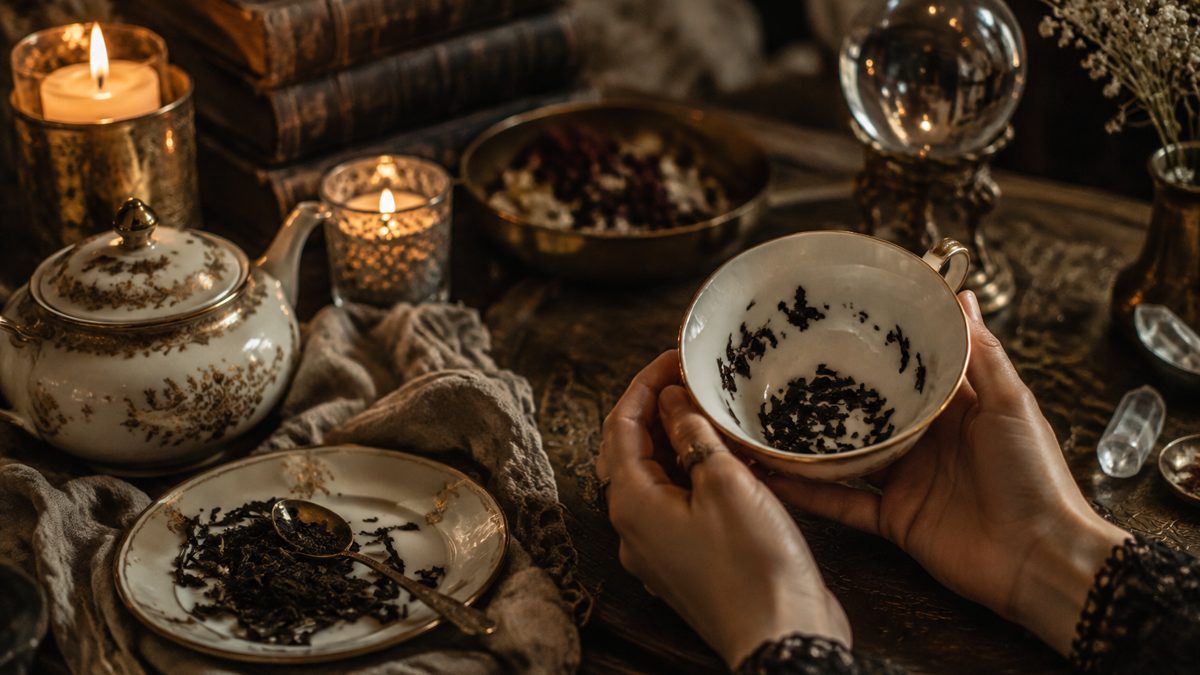
Reading tea leaves begins with an ordinary pleasure: making a cup of tea and giving yourself time to notice it. After the tea is mostly finished, the leaves left behind form shapes that a reader interprets through symbolism, association, and context. You do not need an elaborate collection of tools or a special gift to begin exploring this traditional practice.
Souvent appelée tasséographie ou tasséomancie, la lecture des feuilles de thé appartient à une vaste famille de pratiques qui interprètent des motifs dans des tasses. Certains l'abordent comme une divination, d'autres comme un rituel de réflexion ou une conversation créative avec soi-même. Aucune preuve scientifique établie ne montre que les feuilles de thé prédisent l'avenir. Leur valeur pratique peut résider dans les questions, les liens et les possibilités qu'elles vous aident à envisager.
This guide takes you from choosing a suitable cup to recording a complete reading. Along the way, you will learn how different traditions organize the cup, how to recognize shapes without forcing them, and how to turn an impression into a thoughtful interpretation. The aim is not to memorize every possible symbol, but to develop a consistent, gentle way of looking.
Keep the companion reference page, Tea Leaf Symbols and Meanings, nearby when you want ideas for a particular image. Use it as a starting point rather than a final authority: a bird, bridge, or tree can mean different things in different contexts. Your question, personal associations, and the surrounding patterns all deserve a place in the reading.
Looking for the meaning of a single card or ingredient? Keep our Symboles des feuilles de thé guide open beside you.
1. Comprenez l'histoire sans la réduire à une seule histoire d'origine
Tea-leaf reading has no neatly documented beginning that explains every modern practice. Tea drinking has a long history in China, but that fact alone does not establish where the familiar method of swirling leaves in a handled cup originated. Accounts that give one ancient date, one inventor, or an unbroken universal lineage usually simplify a more complicated story.
La forme reconnaissable dans de nombreux guides anglophones s'est développée parallèlement à la diffusion de la consommation du thé en Europe et en Grande-Bretagne. Les divertissements domestiques, les coutumes de divination et, plus tard, les manuels imprimés ont contribué à faire circuler méthodes et listes de symboles. Les salons de thé commerciaux et les lecteurs spécialisés ont aussi accru sa visibilité. Des foyers différents pouvaient partager le processus de base tout en divergeant sur presque tous les détails d'interprétation.
Related practices read coffee grounds or other beverage sediment, including traditions associated with Turkish coffee and communities across the Balkans and Middle East. These practices have their own histories and social settings; they should not be treated as interchangeable versions of one generic ritual. Learning from a particular community means respecting its terminology, customs, and boundaries.
You may encounter instructions to use the left hand, turn the cup clockwise, or swirl exactly three times. Such rules can be meaningful within a family or teaching tradition, but they are not universal requirements. When learning, distinguish between a documented custom, a modern reader's preference, and your own adaptation. That distinction keeps the practice both honest and welcoming.
2. Gather a simple, workable tea-reading kit
Start with a clean, light-colored cup and a matching saucer. A broad bowl with a smooth interior makes leaves easier to see than a narrow mug with dark glaze or busy decoration. A handle provides a convenient reference point for mapping the cup. Ordinary household crockery is perfectly suitable; you do not need an antique fortune-telling cup.
Loose-leaf black tea is a useful beginner choice because its darker pieces usually stand out against a pale cup. Choose small or medium leaves rather than powdery tea dust or very large rolled leaves. Large leaves can make a few bulky clumps, while fine dust can coat the surface so evenly that distinct shapes become difficult to recognize.
You will also need drinking water, a kettle, a teaspoon, a timer if you use one, and a notebook. A tray or washable cloth can catch drips during inversion. Good daylight or a steady lamp helps you see the actual pattern. A phone camera is optional, but photographs make it easier to revisit your observations without reconstructing them from memory.
Use tea sold for drinking, and check its ingredients if it contains flavorings, flowers, or herbs. Avoid adding glitter, essential oils, unknown plants, or craft materials to a cup you will drink from. If you prefer not to consume caffeine, a familiar food-grade caffeine-free infusion can work, though its pieces may behave differently. Safety matters more than achieving a traditional appearance.
3. Prepare your space and choose a useful question
Choisissez une table stable où vous pouvez manipuler confortablement l'eau chaude et examiner la tasse. Dégagez assez de place pour la bouilloire, la soucoupe et le carnet. Coupez les notifications si cela vous aide à vous poser, mais ne confondez pas une atmosphère élaborée avec une exigence. Une table de cuisine tranquille convient tout autant qu'un espace rituel soigneusement aménagé.
Avant d'infuser, décidez ce que vous voulez explorer par la lecture. Les questions ouvertes conduisent généralement à une réflexion plus utile que les demandes de prédiction figée. Essayez de demander ce qui mérite attention dans un projet créatif, comment aborder un changement à venir ou quel soutien vous avez négligé. Gardez la question assez précise pour que les images aient un contexte significatif.
Évitez d'utiliser la tasse pour établir les pensées privées de quelqu'un d'autre, prouver une infidélité, diagnostiquer une maladie ou trancher une décision financière urgente. Les motifs du thé ne peuvent pas vérifier ces choses. Si une situation exige des preuves, un avis professionnel ou une conversation directe, commencez par là. Une lecture peut explorer vos sentiments face à la situation sans prétendre fournir les faits manquants.
Take a few easy breaths and notice your present mood. There is no need to empty your mind or enter a special state. Simply recording that you feel hopeful, anxious, tired, or distracted can help later, because mood influences which shapes you notice and what stories you attach to them.
- 1. Clear and wipe the table, then arrange the cup, saucer, tea, and notebook within comfortable reach.
- 2. Write one open-ended question in your notebook before looking for any symbols.
- 3. Note your mood and any outcome you are especially hoping for or afraid of.
- 4. Décidez que vous pouvez vous arrêter, faire une pause ou laisser la lecture sans conclusion.
4. Préparez le thé et buvez-le à votre aise
For a first attempt, use roughly half a teaspoon of loose tea in a small cup, then adjust future servings to suit the leaf size and your taste. Too many leaves can cover the interior; too few may leave little to examine. This is a practical starting point, not a spiritually significant measurement or a strict brewing rule.
Heat the water according to the tea's instructions and pour carefully, leaving room below the rim. Let the tea steep as directed, remembering that unstrained leaves will continue brewing while you drink. If it becomes unpleasantly strong, use fewer leaves or a milder tea next time. There is no benefit in forcing yourself to finish a bitter cup.
For the clearest first reading, keep the tea plain. Milk can obscure the interior, and undissolved sweeteners or other additions may create marks that are not leaves. If you need a sweetener, dissolve it fully and note that choice. This recommendation is about visibility, not ritual purity; your comfort and dietary needs remain more important.
Allow the tea to cool to a safe drinking temperature. Sip slowly, letting the leaves settle between sips, and leave a small amount of liquid with the sediment. You do not need to swallow any leaves. If loose leaves bother you, brew strained tea for drinking and add a small spoonful of the cooled, wet leaves afterward, clearly treating this as an adapted method.
- 1. Put a modest amount of food-grade loose tea into the clean cup.
- 2. Ajoutez de l'eau à la température recommandée et laissez infuser le thé.
- 3. Wait until it is comfortable to drink, then sip without deliberately swallowing leaves.
- 4. Stop with the leaves and about a teaspoon or two of liquid remaining; adjust if the leaves cannot move freely.
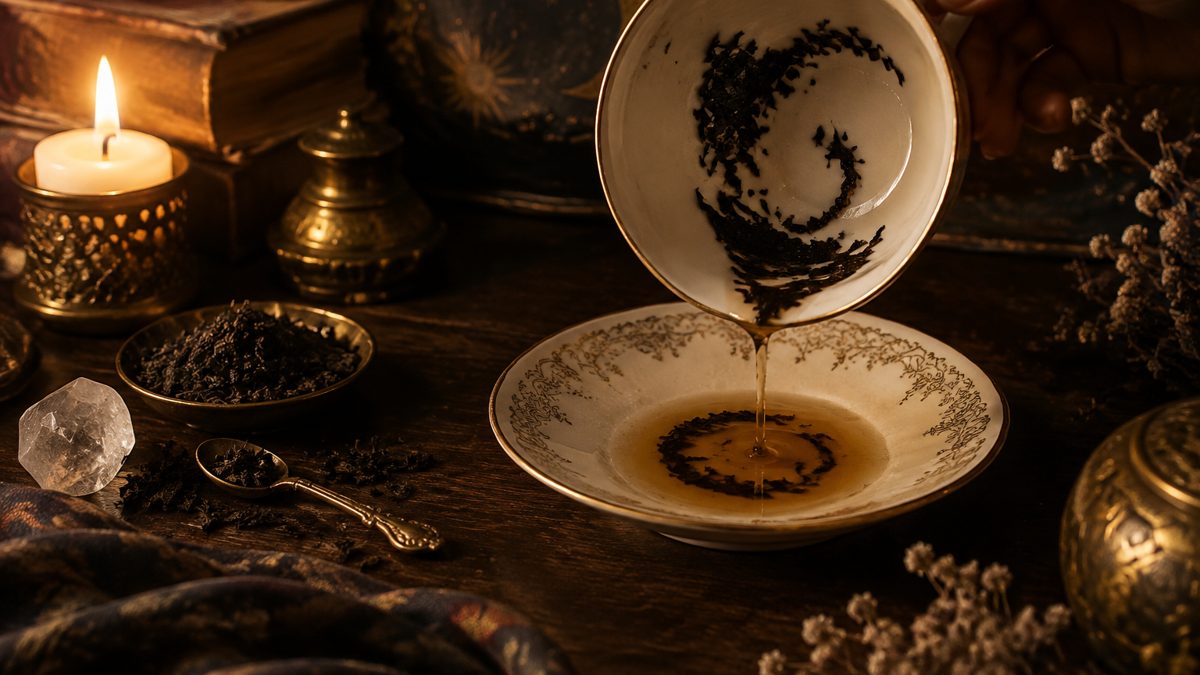
5. Faites tourner, égouttez et révélez le motif
Once only a little liquid remains, gently rotate the cup so the wet leaves travel around its interior. The aim is to distribute them, not fling them over the rim. Many modern instructions suggest three swirls, sometimes with a particular hand or direction. You may follow that convention, but consistency matters more than the number.
Place the saucer on a stable surface before turning the cup over. If the cup still holds enough liquid to spill widely, carefully pour off a little first. Invert the cup onto the saucer and allow it to drain briefly. Around half a minute is a useful experiment, although leaf size and cup shape will affect the result.
Lift the cup slowly and keep the saucer beneath it until any final drips stop. Some leaves will cling to the walls, some will gather near the base, and some may fall onto the saucer. For a first reading, focus only on the cup. Including the saucer is an optional extension, not something you must interpret.
Resist the urge to rearrange awkward leaves or repeat the process until you get an attractive image. The original arrangement is your observation material, including its blank spaces and ambiguity. If everything slides into one wet lump, you can acknowledge a preparation problem and try again later rather than inventing a meaning for a technical mishap.
- 1. Tenez fermement la tasse refroidie et faites tourner doucement le liquide restant à l'intérieur.
- 2. If following a three-swirl convention, complete three comfortable rotations without splashing.
- 3. Retournez la tasse sur la soucoupe et laissez s'égoutter l'excès de liquide.
- 4. Lift it carefully, photograph the untouched pattern, and begin with a whole-cup observation.
6. Choose a cup map before interpreting individual symbols
Un plan de la tasse donne aux positions un rôle symbolique constant. Une convention moderne courante traite l'anse comme une référence pour la personne qui reçoit la lecture, souvent appelée le consultant. Les motifs proches peuvent alors être associés aux préoccupations personnelles, au foyer ou à l'expérience immédiate. D'autres lecteurs attribuent des significations différentes ; notez donc le plan que vous choisissez plutôt que de le supposer universel.
Une autre convention courante associe le bord aux sujets proches, les parois du milieu aux situations en développement et le fond aux préoccupations à plus long terme ou plus profondes. Ce sont des catégories symboliques, non des horloges fiables. Évitez de convertir la distance exacte d'une feuille par rapport au bord en une date promise. Une distinction générale entre préoccupations immédiates et de fond suffit généralement.
Certains systèmes interprètent les côtés gauche et droit comme le passé et l'avenir, la vie intérieure et extérieure, ou ce qui part et ce qui arrive. Nul besoin de toutes ces couches à la fois. En réalité, combiner plusieurs cartes incompatibles peut permettre de justifier presque n'importe quelle conclusion. Commencez par la référence de l'anse et trois zones de hauteur, puis n'ajoutez de la complexité que si elle reste utile.
Set the handle toward you when you first record positions. You can rotate the cup to inspect a shape, but note where that shape sits in the original orientation. Otherwise, a cluster may migrate from one symbolic area to another simply because you turned the cup. A quick sketch with a marked handle prevents this common confusion.
7. Cherchez des formes sans forcer la reconnaissance
Begin with the whole arrangement rather than hunting immediately for a heart or a familiar animal. Is the cup sparse or crowded? Are most leaves near the rim, scattered across the walls, or concentrated at the base? Notice lines, clusters, gaps, and connections. These observations give individual shapes a setting instead of leaving them as isolated dictionary entries.
Next, identify two or three clear forms. A branching line might resemble a tree; an arch might suggest a bridge; a compact cluster with an extending point could look like a bird. Describe the visible features before naming the object. Writing 'curved line joining two clumps' is more precise than jumping straight to 'a successful reunion.'
Les gens reconnaissent naturellement des formes familières dans des motifs ambigus, une tendance souvent appelée paréidolie. Cela ne rend pas l'exercice sans valeur, mais cela explique pourquoi différents lecteurs peuvent voir des choses différentes dans une même tasse. Considérez la reconnaissance comme une interprétation imaginative plutôt que comme la preuve qu'un message extérieur a été déposé là spécialement pour vous.
If a shape only appears after repeated turning, squinting, and persuasion, mark it as uncertain or leave it out. You are allowed to see nothing recognizable in part of the cup. Empty space does not automatically mean loneliness, and an untidy cluster does not automatically signal trouble. Good observation includes knowing when there is too little information.
8. Interprétez les symboles par le contexte, non par des verdicts figés
Once you have identified a plausible image, explore three sources of meaning: the associations found in a chosen reference, your personal response, and the reading's question. A tree, for example, can suggest growth, roots, family, shelter, or gradual development. In a question about studying, steady learning might be a more relevant association than family history.
Consult Tea Leaf Symbols and Meanings for possibilities, but do not keep searching through references until you find the answer you want. Symbol lists often disagree because they reflect different authors and traditions. Choose an interpretation that fits the visible shape and question, while acknowledging reasonable alternatives. A reference should broaden your thinking, not overrule your judgment.
Consider how images relate spatially. A bridge beside two separate clusters could invite reflection on connection between groups. A winding line near a tree might suggest a gradual route toward stability. These are constructed symbolic narratives, not facts about future events. Keep the language exploratory: 'This could reflect' is more responsible than 'This proves.'
Terminez en traduisant la lecture en une question ou en une action que vous maîtrisez. Si un oiseau évoque la communication, peut-être devez-vous rédiger un courriel ou demander des précisions. La tasse ne peut garantir une réponse. Une interprétation utile accroît votre capacité à choisir avec discernement au lieu de vous rendre dépendant des signes.
9. Suivez un exemple concret, de la tasse à l'action pratique
Imaginez une lecture d'entraînement avec la question : « Qu'est-ce qui mérite mon attention alors que je commence un projet d'écriture partagé ? » Il s'agit d'un exemple illustratif, non du récit de l'expérience d'un véritable client. Le lecteur utilise l'anse comme point de référence personnel, le bord pour les préoccupations immédiates, le milieu pour les sujets en développement et le fond pour les thèmes de fond.
Near the rim and handle, a small cluster resembles a bird, though it could also be a leaf. Halfway down the opposite wall, an arch appears to join two groups of tea leaves. At the base, a branching shape looks more clearly like a tree. The reader records those observations and labels the bird identification as uncertain.
Using familiar symbolic associations, the reader considers communication for the bird, cooperation for the bridge, and steady growth for the tree. In the context of a shared project, those ideas suggest discussing expectations, connecting different working styles, and allowing time for development. Another plausible tree association is established habits, which raises a useful question about whose routines will shape the collaboration.
The final interpretation is modest: 'This pattern invites me to clarify communication and create a workable structure before expecting quick progress.' Nothing in the cup establishes whether the project will succeed or whether the collaborator is trustworthy. The practical outcome is to arrange a planning conversation, agree on responsibilities, and set a review date based on the actual schedule.
- 1. Record the question and chosen cup map before interpreting.
- 2. List the bird-like cluster, connecting arch, and branching base shape, including their locations and uncertainty.
- 3. Compare relevant meanings and note at least one alternative interpretation.
- 4. Choisissez une prochaine étape concrète : discutez avec le collaborateur des rôles, des échéances et des préférences de communication.
10. Recognize common mistakes and troubleshoot gently
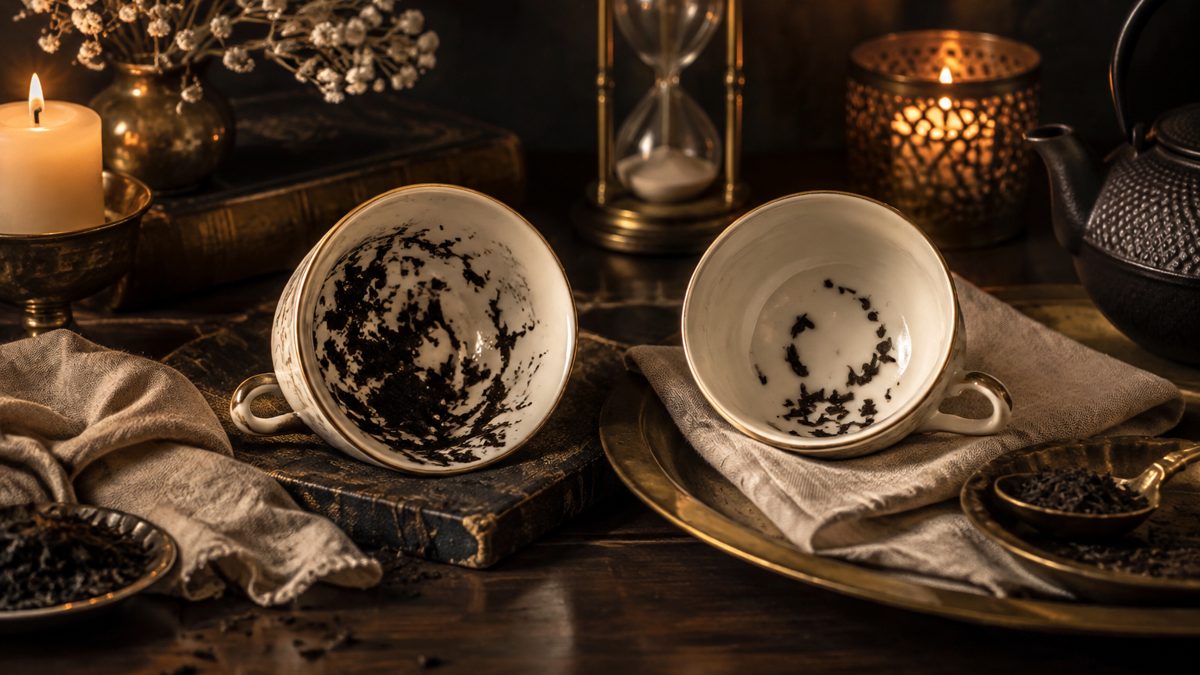
A cup covered in sludge usually calls for a practical adjustment, not a dramatic interpretation. Try less tea, larger leaf pieces, or slightly less remaining liquid. If all the leaves fall onto the saucer, experiment with retaining a little more moisture before inversion. Change one variable at a time so you can learn what works with your particular cup.
Another common mistake is trying to interpret every fragment. A single cup can contain dozens of suggestive marks, and assigning all of them significance produces a confusing story. Choose a few clear images and one or two overall features. A short, coherent reading is often more useful than an elaborate catalogue of symbols that contradict one another.
Be alert to confirmation bias: the tendency to notice details that support what you already believe. If you expect an argument, a pointed cluster may become a weapon while a connecting line goes unnoticed. Write an alternative reading before settling on your preferred one. Ask what you would see if the question concerned friendship rather than conflict.
Repeatedly reading the same question can also turn reflection into reassurance-seeking. If you feel compelled to make another cup until the answer becomes comforting, stop for the day. Return to the real-world information available to you. An unclear reading is not a failure, and you do not owe any pattern a conclusion.
11. Keep the practice physically safe and ethically grounded
Les risques les plus immédiats sont banals : brûlures, éclaboussures, vaisselle cassée et ingrédients inadaptés. Utilisez une tasse intacte destinée à un usage alimentaire ; les pièces anciennes ou décoratives ne conviennent pas forcément aux boissons chaudes. Tenez l'eau chaude hors de portée des enfants et des animaux. Attendez que la tasse soit confortable à manipuler avant de la faire tourner ou de la retourner.
Check tea blends for allergens, caffeine, and herbs that may be unsuitable during pregnancy, with particular conditions, or alongside medicines. Familiarity in folklore does not establish safety for ingestion. Ask a pharmacist or qualified clinician when uncertain, and do not drink unidentified foraged plants. Drinking tea is optional; an adapted practice with cooled leaves avoids pressure to consume it.
Candles, incense, and ritual additives are unnecessary. If you use a candle, place it in a stable holder away from loose fabric and never leave it unattended. Avoid smoke where it affects breathing or exposes pets. Never add essential oils or nonfood ritual materials to drinking tea. If your separate ritual uses salt water, do not pour it onto plants or garden soil.
Lorsque vous lisez pour quelqu'un d'autre, demandez sa permission, convenez du sujet et précisez que la lecture est interprétative et non une prédiction vérifiée. N'annoncez jamais, à partir d'une forme, un décès, une maladie, une grossesse, des malédictions ou un désastre inévitable. N'effrayez personne pour lui vendre un remède. Protégez sa vie privée, évitez les promesses et soutenez son droit de rejeter toute interprétation qui ne lui paraît pas utile.
12. Keep a journal that preserves what you actually saw
Un journal de lecture du thé aide à séparer l'observation de l'interprétation et du recul rétrospectif. Notez la date, la question, le type de thé, la quantité approximative, la tasse utilisée et la méthode de préparation. Ajoutez votre humeur et le plan de la tasse. Ces détails peuvent sembler banals, mais ils peuvent expliquer pourquoi une séance produit des formes distinctes et une autre à peine plus qu'un amas dense de feuilles.
Photograph the cup before much handling, ideally from above and from an angle that shows the walls. Note the handle position in each image or sketch. Then list the shapes in plain descriptive language, marking unclear ones. Keep this original record intact rather than rewriting it after subsequent events make one interpretation feel especially compelling.
In a separate paragraph, write the associations you considered and the interpretation you chose. Include alternatives, questions raised, and any action you plan to take. Later, record what happened without treating a broad resemblance as proof of prediction. Remember to notice mismatches, forgotten symbols, and ordinary explanations as carefully as apparent correspondences.
Review several entries for usefulness rather than supernatural accuracy. Did the practice help you identify a concern, prepare a conversation, or slow down before reacting? Did it leave you more anxious? Your journal can show whether the practice supports you. If it repeatedly encourages fear or dependency, changing your approach or taking a break is sensible.
- 1. Record preparation, mood, question, and the mapping convention used.
- 2. Add an unedited photograph or sketch and a factual description of the visible shapes.
- 3. Write possible meanings, uncertainty, and one practical takeaway in a separate interpretation entry.
- 4. Revenez plus tard pour consigner les résultats et l'utilité, sans modifier les notes d'origine.
13. Close the reading and develop your own steady practice
Terminez en résumant la lecture en deux ou trois phrases. Nommez le thème principal, reconnaissez ce qui reste incertain et repérez toute prochaine étape utile. Nul besoin d'un rituel de clôture dramatique. Un simple moment de gratitude, une respiration tranquille ou la fermeture du carnet peuvent marquer le retour à l'activité ordinaire.
Éliminez les feuilles avec soin et lavez la tasse et la soucoupe. Les feuilles de thé nature peuvent généralement aller dans un système de compostage domestique adapté, mais évitez d'entasser à répétition des feuilles humides directement autour des plantes d'intérieur, où elles peuvent favoriser les moisissures. Ne laissez pas le thé usagé stagner longtemps, et gardez les feuilles caféinées hors de portée des animaux.
For practice, use the same cup and map for several sessions while varying only what needs practical adjustment. Read occasionally rather than turning every decision into a consultation. You might examine a cup with a trusted friend and compare observations before discussing meanings. Different impressions can teach flexibility, provided neither person insists that their interpretation is the only valid one.
The heart of tea-leaf reading is attentive looking joined with thoughtful storytelling. Tradition offers a framework, reference pages offer possibilities, and experience helps you recognize your own habits of interpretation. Let the cup open a conversation rather than close a decision. The most grounded reading leaves you with room to think, ask questions, and choose your next step freely.
These practices are shared as tradition and personal reflection, not as a substitute for medical, legal or financial advice.
Continuez d'apprendre
- Symboles des feuilles de thé
- How to read tarot cards
- How to use angel oracle cards
- Comment lire les cartes à jouer
- Comment utiliser les cristaux dans les sortilèges
- Comment utiliser les herbes en sorcellerie
- How to read the Dr. Moorne Egyptian Tarot
- How to read dice
- How to read tea leaves
- Comment utiliser un pendule
- Comment lancer un sort à la bougie
- How to make a spell jar
- How to make a sigil
- How to cleanse your home
- How to set up an ancestor altar
- How to open a sacred space
- How to time spells with the moon
- How to work with water and salt
- How to make a protection charm bag
- Read the Journal ou visitez la shops