How-To Guide
Comment purifier spirituellement votre maison
Par Seraphina

A home can feel different after an argument, an illness, a move, or a long season of stress. Sometimes the change is easy to explain: stale air, unfinished chores, difficult memories, or too little rest. Spiritual cleansing offers a deliberate way to acknowledge those feelings and mark a fresh beginning. It can sit comfortably alongside ordinary cleaning, maintenance, and care.
Dans de nombreuses traditions, on purifie ou bénit les lieux de vie par la prière, l'eau, les parfums, le son, la lumière ou des gestes chargés de sens. La signification de ces pratiques dépend de la communauté et de la personne. Certains les comprennent spirituellement ; d'autres les abordent comme des rituels symboliques qui soutiennent l'attention et l'intention. Aucune preuve fiable n'indique que les rituels domestiques chassent des forces surnaturelles, et aucune sensation particulière ne prouve qu'une purification a fonctionné.
This guide approaches the subject with warmth, cultural care, and practical common sense. You do not need expensive tools, a dramatic ceremony, or certainty about what you believe. A tidy surface, a bowl of plain water, and a few honest words may be enough for a meaningful personal practice. Your comfort and the consent of everyone sharing the home matter more than elaborate instructions.
Nous explorerons le contexte de la purification du foyer, choisirons des matériaux adaptés, préparerons l'espace et construirons un rituel doux, pièce par pièce. Vous trouverez aussi un exemple concret, des conseils pour interpréter votre expérience et des façons de tenir un journal utile. Pour comparer les techniques une à une, consultez la page de référence complémentaire, Méthodes de purification de la maison, et n'adaptez que ce qui convient réellement à votre foyer.
Looking for the meaning of a single card or ingredient? Keep our Home cleansing methods guide open beside you.
1. Decide What Spiritual Cleansing Means to You
Before choosing a method, name the reason you want to cleanse. Perhaps you have moved into a new apartment, finished a difficult project, welcomed a baby, or ended a relationship. A specific reason gives the ritual direction. “I want this room to support restful evenings” is more useful than an open-ended demand to eliminate everything negative.
Distinguish an intention from a promise. An intention describes how you hope to live and what you will practice; a promise claims an outcome you cannot control. You might intend to speak more kindly, protect quiet time, or make space for grief. A cleansing cannot guarantee harmony, prevent misfortune, or change another person's behavior.
Consider what “clean” means in your spiritual vocabulary. It need not mean that sadness, anger, or uncertainty are unwelcome. A supportive home can hold difficult emotions without treating them as contamination. Think of cleansing as making room for life rather than demanding constant happiness or judging yourself for having a hard week.
Write one sentence you can return to throughout the process. For example: “I am caring for this home so it can support safety, rest, and honest conversation.” If religious language is meaningful to you, use a prayer from your own practice. If not, ordinary language is entirely appropriate; sincerity does not require ceremonial phrasing.
2. Understand the History Without Flattening Traditions
La purification et la bénédiction du foyer existent dans de nombreuses sociétés, mais elles ne forment pas une pratique universelle aux ingrédients interchangeables. Selon la tradition, un rite peut exprimer la dévotion, l'hospitalité, la protection, le souvenir ou la préparation d'une occasion sacrée. La purification spirituelle moderne associe souvent une symbolique personnelle à des idées empruntées, ce qui rend d'autant plus important de savoir d'où vient une pratique.
Some Christian communities bless homes with prayer and holy water. Incense has devotional roles in various Buddhist, Hindu, Christian, and other settings, although its purpose and use differ. Jewish household practices surrounding the mezuzah belong to a specific religious framework and should not be reduced to a generic cleansing technique. These examples illustrate diversity, not a menu of equivalent tools.
Smoke practices among Indigenous peoples are also diverse. “Smudging” should not be used as a catch-all label for burning any herb, because it can refer to particular ceremonies with community-specific meanings and responsibilities. White sage and sweetgrass carry cultural significance in some communities. Popular retail packaging is not a substitute for learning from appropriate sources.
Folk household customs in parts of Europe and elsewhere have included sweeping, washing thresholds, prayer, salt, and seasonal plants. Details vary by place, family, and period; claims about a single ancient recipe deserve caution. Start with your own background where possible, use reputable cultural histories, and seek community guidance before attempting practices intended for initiated or authorized participants.
3. Choisissez une méthode adaptée à votre foyer
La méthode la plus adaptée est celle que vous pouvez accomplir en toute sécurité, avec respect et sans déranger personne. Les approches sans fumée sont souvent le point de départ le plus simple. Vous pouvez associer le nettoyage ordinaire à des intentions énoncées, à de la musique douce, à de légers battements de mains ou à un point focal visuel. Aucune n'est intrinsèquement plus efficace spirituellement qu'une autre ; le sens perçu dépend de la croyance, de l'association et de l'expérience personnelle.
L'eau peut symboliser le renouveau sans être aspergée partout. Posez un petit bol sur un plateau stable, puis servez-vous-en comme point focal en énonçant votre intention. Si vous souhaitez essuyer une surface, suivez les consignes d'entretien de ce matériau. La symbolique spirituelle ne rend pas l'eau sans danger pour l'électronique, le bois brut, les tissus délicats ou d'autres objets sensibles à l'humidité.
Sound can mark a transition, but volume is not a measure of effectiveness. A softly rung bell, a short song, or your own speaking voice may be sufficient. Avoid sudden noises around sleeping children, sound-sensitive people, and animals. If hearing or sensory needs make sound unsuitable, silent gestures and written intentions are equally valid alternatives.
Smoke is optional, never a requirement. Skip it around respiratory conditions, smoke-sensitive occupants, birds, or other vulnerable animals, and wherever building rules prohibit it. Essential-oil diffusion is not automatically a safe substitute, especially around pets. Home Cleansing Methods can help you compare approaches, but a comfortable, low-impact choice usually serves a shared home best.
4. Gather a Small, Practical Kit
Begin with ordinary household supplies: a rubbish bag, a donation box, clean cloths, and cleaning products appropriate to your surfaces. Add drinking water for yourself and a notebook if you want to record the experience. These unglamorous items often contribute more to a welcoming room than a large collection of ceremonial accessories.
Pour le rituel lui-même, choisissez un ou deux objets plutôt que de rassembler tout ce que vous avez vu en ligne. Un bol d'eau claire, une bougie à piles, une photographie qui compte pour vous ou une clochette peuvent offrir un point de concentration net. Les objets peuvent porter une symbolique personnelle, mais il n'est pas nécessaire d'acheter quelque chose vendu comme spirituellement puissant.
Si les herbes font partie de votre pratique établie, identifiez la plante et vérifiez comment la manipuler en toute sécurité. Une plante vendue pour la décoration, le parfum ou l'usage rituel n'est pas nécessairement comestible. Évitez les mélanges inconnus et les poudres en vrac sans information sur les ingrédients. Gardez les herbes hors de portée des enfants et des animaux de compagnie, et ne partez pas du principe que naturel signifie inoffensif.
Salt is optional and often unnecessary. It can scratch surfaces, corrode metal, and harm plants when discarded in soil or watering containers. A small amount kept inside a closed container can carry symbolic meaning without being scattered. Likewise, choose an LED light instead of an open flame when you want the symbolism of illumination without fire risk.
- 1. Set out your cleaning supplies and one chosen ritual object on a stable, uncluttered surface.
- 2. Check ingredients, care labels, household sensitivities, and any building restrictions before beginning.
- 3. Put away everything you do not need, leaving clear walking routes and keeping exits unobstructed.
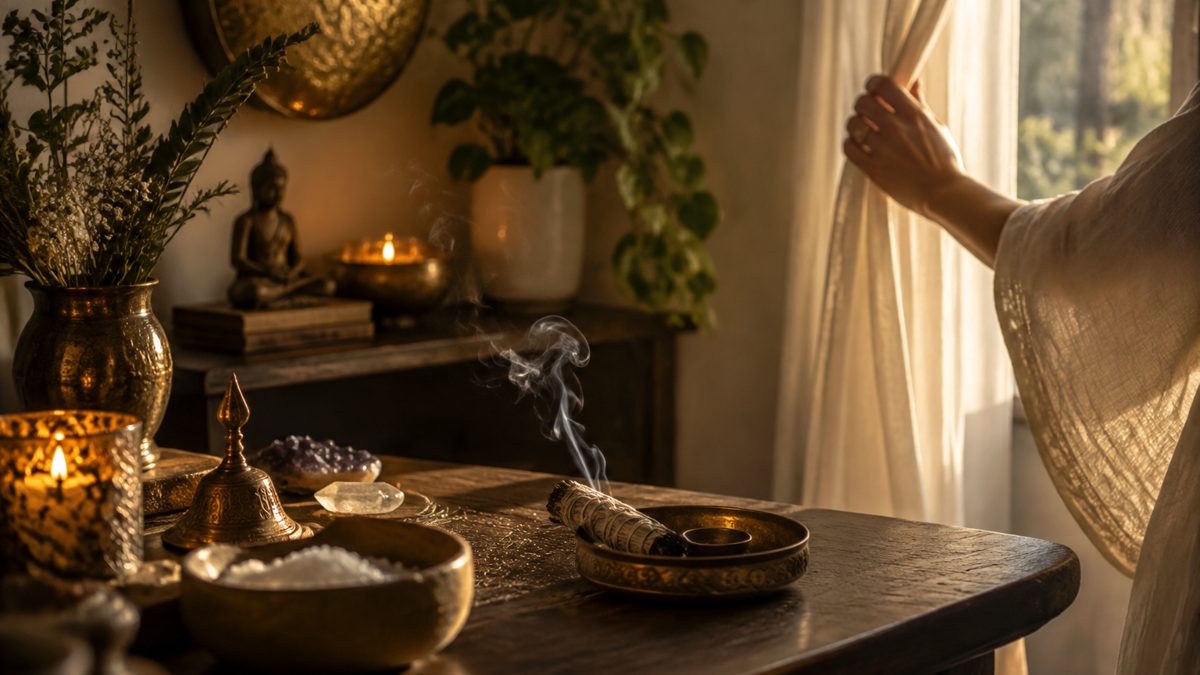
5. Prepare the Space and Ask for Consent
Talk with housemates before using fragrance, sound, prayer in shared areas, or changes to household objects. Explain what you plan to do and ask what would make them comfortable. Participation should be optional. A shared living room is not yours alone to redefine, and someone declining a ritual is not introducing negative energy.
Occupez-vous d'abord des conditions pratiques. Sortez les ordures, retirez les aliments avariés, lavez la vaisselle et traitez les sources évidentes d'odeurs. Si vous remarquez de l'humidité, des nuisibles, un câblage endommagé ou une odeur récurrente inexpliquée, cherchez la cause matérielle. Le rituel peut accompagner l'entretien de la maison, mais il ne peut remplacer les réparations, le traitement contre les nuisibles ou l'évaluation professionnelle d'un problème de sécurité.
Choose a manageable scope. Cleansing a whole house when you are tired may turn a supportive practice into another burden. One bedside table or one doorway is a legitimate starting point. Schedule enough time to finish without rushing, and leave a little time afterward to put supplies away and enjoy the room.
Ventilate if outdoor conditions, security, and health needs allow. Check pollen, air quality, weather, and the safety of children and pets before opening windows. An open window can represent a fresh start, but no supernatural exit is required. In unsuitable conditions, use your normal safe ventilation arrangements and keep the symbolic gesture entirely indoors.
- 1. Agree on the rooms, timing, and permitted materials with everyone affected.
- 2. Complete a short physical tidy, prioritizing waste, dishes, trip hazards, and frequently used surfaces.
- 3. Arrange safe ventilation if appropriate, then place your chosen ritual object where it cannot be knocked over.
6. Centrez-vous et ouvrez le rituel
Commencez par remarquer ce que vous ressentez, sans chercher à produire un état particulier. Vous pouvez être plein d'espoir, distrait, sceptique ou contrarié. Aucun de ces sentiments ne vous disqualifie. Asseyez-vous ou tenez-vous debout confortablement, sentez le soutien sous vous et prenez quelques respirations tranquilles, sans forcer une respiration profonde ni retenir votre souffle.
Regardez autour de vous et repérez quelques détails ordinaires : la couleur d'un rideau, le poids d'une tasse ou la lumière du jour sur le sol. Cela garde la pratique reliée à la pièce que vous habitez réellement. Si fermer les yeux vous met mal à l'aise, gardez-les ouverts. Si l'immobilité est difficile, un rangement lent peut servir d'activité d'ouverture.
Lisez ou prononcez l'intention que vous avez écrite plus tôt. Vous pourriez dire : « Je marque un nouveau départ et je fais de la place au repos. » Ce sont des mots suggérés, non une formule traditionnelle ni un ordre au pouvoir garanti. Modifiez-les jusqu'à ce qu'ils sonnent comme quelque chose que vous diriez naturellement, ou gardez l'intention pour vous.
Set a clear endpoint before you begin moving through the home. For example, decide that the ritual will end after one pass through three rooms. A defined boundary prevents the urge to repeat actions until everything feels perfect. You are completing a chosen act of care, not testing whether the home has become spiritually flawless.
- 1. Pause in a comfortable position and notice your surroundings for about a minute.
- 2. State your intention aloud, silently, or in writing.
- 3. Décidez des pièces que vous visiterez et de l'action qui signalera que le rituel est terminé.
7. Follow a Gentle Room-by-Room Method
Start somewhere convenient, such as the entrance or the room you use most. Some traditions specify a direction or route, but there is no universal rule requiring clockwise movement or a particular doorway. Unless you are following an established practice you understand, choose a route that is easy to remember and physically accessible.
At each room, pause and consider its everyday purpose. A kitchen supports nourishment; a bedroom supports rest; a workspace supports concentration. Remove one small obstacle to that purpose before performing your symbolic action. Clear the chair, put away the shoes, or open the curtains. Linking the ritual to a practical change gives the intention somewhere to land.
Use the same simple action throughout: speak a sentence, ring a bell softly, or briefly hold your attention on an LED candle resting safely on a surface. You do not have to touch every wall or reach every corner. Avoid climbing, stretching into unsafe places, or moving heavy furniture simply to complete a ceremonial route.
Finish each room by naming one habit that could sustain your intention. A calmer bedroom may need a phone-charging place outside the bed area. A welcoming kitchen may need a shared washing-up agreement. These decisions are not an afterthought; they translate the meaning of the cleansing into conditions that can actually change daily life.
- 1. Enter the first room and name its purpose in one short sentence.
- 2. Make one practical improvement, such as clearing a surface or removing rubbish.
- 3. Accomplissez l'action symbolique de votre choix et répétez ou adaptez votre intention.
- 4. Note one supportive household habit, then continue to the next agreed room.
- 5. Complete one pass only, leaving inaccessible or private spaces undisturbed.
8. Close the Practice and Dispose of Materials Safely
Return to your starting point or settle in the room where you want to spend time afterward. A closing gesture can be as simple as putting down the bell, switching off the LED candle, or saying, “This practice is complete for today.” You do not need an intense emotional release for the ending to count.
Restore the household to a safe, ordinary state. Close windows if necessary, secure cleaning products, and move bowls or decorative items away from edges. If you used a real candle despite the smoke-free preference, extinguish it fully before leaving the room. Check that any heat-resistant holder and surrounding materials have cooled before storing them.
Dispose of materials according to what they contain, not an assumed spiritual requirement. A small bowl of plain water can go down the sink. Do not pour salt water onto plants or soil. Oils, wax, concentrated cleaners, and unidentified mixtures need disposal appropriate to the substance and local guidance rather than being emptied into drains or outdoors.
Avoid burying ritual remnants or leaving offerings in parks, waterways, or shared gardens. Food can attract wildlife or pests, and thread, wax, glitter, and packaging can become litter. If you want an environmentally considerate closing gesture, water a plant normally with fresh water or make a separate contribution to caring for your immediate surroundings.
9. A Worked Example: Resetting a Small Apartment
Imagine a hypothetical renter, Alex, who has had a stressful month and wants the apartment to feel less associated with work. The home has a living room, kitchen, and bedroom, and Alex lives with a cat. Rather than choosing incense or essential oils, Alex selects a notebook and an LED candle for a quiet, smoke-free practice.
Alex sets aside half an hour and writes, “I want this home to support a clear end to the working day.” The initial tidy focuses on the actual sources of strain: work papers on the sofa, mugs beside the laptop, and laundry across the bedroom chair. The cat remains free to rest undisturbed, with water and supplies kept out of reach.
In the living room, Alex puts work materials into a drawer and places the LED candle on the cleared table. In the kitchen, Alex washes the mugs and prepares a clean space for breakfast. In the bedroom, Alex clears the chair and moves the laptop charger outside. Each action is followed by a brief statement about the room's purpose.
After switching off the candle, Alex writes that the apartment looks more usable, while some work anxiety remains. That is a realistic outcome, not a failed ritual. The lasting commitment is to put work equipment away at a set time. The example shows how symbolic meaning and practical change can cooperate without requiring a supernatural explanation.
- 1. Choisissez une intention liée à une difficulté précise du foyer.
- 2. Match each room with a small physical change that supports that intention.
- 3. Finish with one sustainable habit rather than a plan to repeat the entire ritual every night.

10. Interprétez l'expérience sans courir après les signes
Afterward, you may feel lighter, quieter, emotional, tired, or unchanged. These reactions can reflect expectation, focused attention, physical effort, memories, or the relief of finishing a task. You can appreciate an experience without claiming certainty about its cause. Feeling nothing unusual does not mean you did the ritual incorrectly or need stronger materials.
Ordinary events are not reliable spiritual diagnostics. A flickering flame may respond to airflow or wick condition; incense smoke moves with air currents; a creaking floor reflects building materials and movement. Salt clumping can result from moisture. Do not treat these observations as proof of a curse, a presence, or a warning about someone in your household.
Évaluez la pratique à travers des questions du quotidien dans les jours qui suivent. La pièce est-elle plus facile à utiliser ? Votre nouvelle habitude du soir vous aide-t-elle à vous apaiser ? Les accords sur les espaces partagés sont-ils devenus plus clairs ? Ces observations sont plus utiles que la recherche de coïncidences spectaculaires. Rappelez-vous que le sommeil, la météo, la charge de travail et les relations peuvent influencer l'impression qu'on a de sa maison, indépendamment de tout rituel.
Si la peur grandit, suspendez l'interprétation spirituelle plutôt que d'intensifier la purification. Le sentiment persistant d'être observé, l'incapacité à dormir ou l'envie de répéter des rituels par sécurité méritent le soutien bienveillant d'un professionnel de santé. Des maux de tête soudains, des vertiges ou une confusion à l'intérieur peuvent indiquer un danger environnemental ; sortez prendre l'air et cherchez une aide urgente plutôt que de tenter un autre rituel.
11. Avoid Common Mistakes and Unhelpful Expectations
One common mistake is treating discomfort as evidence that something supernatural is wrong. An untidy room, tension after an argument, or unease in an unfamiliar building does not establish a spiritual threat. Start with the simplest plausible explanations and practical responses. A difficult conversation or a repair request may be more helpful than another cleansing.
Another mistake is adding more ingredients whenever a ritual feels ordinary. Combining smoke, oils, salt, candles, and sound increases complexity and potential hazards without establishing greater effectiveness. Keep the practice understandable enough that you can explain why each element is present. If you cannot identify its purpose, you probably do not need it.
Évitez le perfectionnisme rigide quant aux formulations, au moment, aux phases de la lune ou aux coins oubliés, à moins qu'une tradition précise donne un sens à ces détails dans votre propre pratique. Les rituels personnels peuvent être souples. Les interruptions arrivent, les enfants ont besoin d'attention, et les limites de mobilité ou d'énergie comptent. On a le droit de s'arrêter plus tôt, et une pratique écourtée n'est pas spirituellement dangereuse.
Finally, do not use cleansing to bypass grief, conflict, or accountability. Removing reminders of a disagreement will not resolve it without communication. A ritual after bereavement should not imply that the deceased person or your sadness is unwelcome. Let the practice support practical help, emotional honesty, and appropriate care rather than replacing them.
12. Keep Safety, Consent, and Ethics at the Center
If you use flame, keep it in a stable, suitable holder on a heat-resistant surface, away from curtains, loose clothing, papers, and drafts. Never leave it unattended or carry burning materials through a cluttered home. Keep working smoke and carbon monoxide alarms where appropriate. Never cover, disconnect, or disable an alarm to accommodate a ritual.
Avoid burning unfamiliar plants or resins, and remember that ventilation does not make smoke harmless. People with asthma, migraines, or fragrance sensitivities may need completely unscented methods. Birds are particularly vulnerable to airborne contaminants. For other pets, check ingredient-specific advice with a veterinarian rather than relying on a seller's broad assurance that a product is natural.
Do not ingest ritual herbs, oils, salt mixtures, or cleansing waters. Do not apply substances to skin merely because they are labeled spiritual or traditional. Follow cleaning-product labels, and never mix bleach with ammonia, acids, or other cleaners. Keep all products in clearly labeled containers, away from food, children, and animals.
Une pratique éthique signifie aussi respecter les personnes et les budgets. Ne purifiez jamais en secret les affaires d'autrui, ne jetez pas leurs objets significatifs et ne les accusez pas d'apporter de mauvaises énergies dans la maison. Si vous cherchez une aide payante, convenez à l'avance de l'étendue et du prix. Évitez quiconque garantit des résultats surnaturels, déclare une malédiction non vérifiée ou vous pousse à des achats urgents et croissants.
13. Journal, Review, and Build a Sustainable Rhythm
A cleansing journal need not become a catalogue of omens. Record the date, your reason for practicing, the rooms involved, and the actions you took. Add practical context such as recent stress, sleep quality, visitors, or repairs. This helps you understand patterns without automatically attributing every change to the ritual.
Keep observation separate from interpretation. “I put away the work papers and felt calmer while sitting down” describes something you noticed. “The ritual removed a harmful presence” makes a claim you cannot establish from that feeling. You can still record spiritual beliefs as beliefs while leaving room for alternative explanations and changing your mind.
Relisez la note après quelques jours plutôt que de vérifier sans cesse l'atmosphère. Demandez-vous quelle amélioration pratique a duré et si la cérémonie vous a soutenu ou pesé. Si une nouvelle habitude a aidé, gardez-la. Si un parfum a provoqué un mal de tête ou si le processus a encouragé des vérifications anxieuses, simplifiez ou arrêtez. Le but est une maison plus agréable à vivre, non un nombre croissant d'obligations.
Choose a rhythm based on need and enjoyment rather than fear. A brief seasonal reset, a welcoming ritual after moving, or an occasional quiet tidy may be enough. Your home does not need constant spiritual correction. At its best, cleansing is a deliberate expression of care: noticing your surroundings, honoring what matters, and making ordinary room for the life you want to live.
- 1. Before the ritual, write your intention and a brief description of the home's practical condition.
- 2. Afterward, record what you did, how you felt, and any safety or comfort concerns.
- 3. Several days later, note which changes remained useful without searching for supernatural confirmation.
- 4. Gardez une habitude utile et décidez si un autre rituel vous serait réellement profitable.
These practices are shared as tradition and personal reflection, not as a substitute for medical, legal or financial advice.
Continuez d'apprendre
- Home cleansing methods
- How to read tarot cards
- How to use angel oracle cards
- Comment lire les cartes à jouer
- Comment utiliser les cristaux dans les sortilèges
- Comment utiliser les herbes en sorcellerie
- How to read the Dr. Moorne Egyptian Tarot
- How to read dice
- How to read tea leaves
- Comment utiliser un pendule
- Comment lancer un sort à la bougie
- How to make a spell jar
- How to make a sigil
- How to cleanse your home
- How to set up an ancestor altar
- How to open a sacred space
- How to time spells with the moon
- How to work with water and salt
- How to make a protection charm bag
- Read the Journal ou visitez la shops