How-To Guide
How to Use Angel Oracle Cards: A Step-by-Step Guide
Par Seraphina
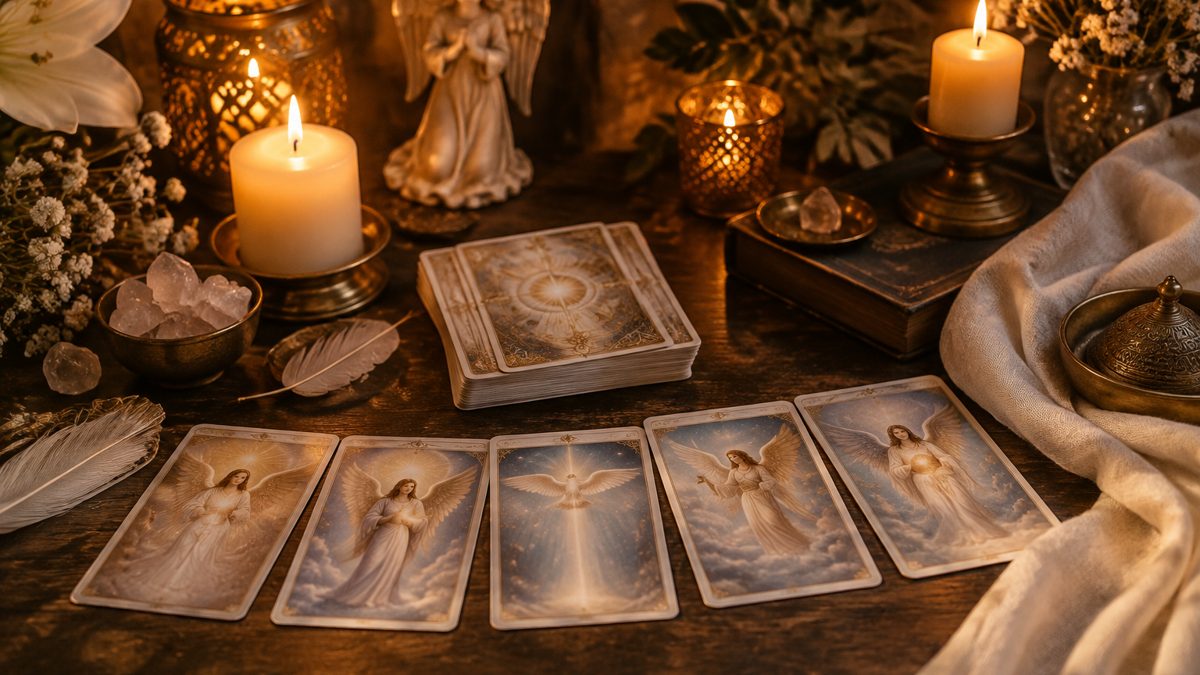
How to Use Angel Oracle Cards: A Step-by-Step Guide
There is something quietly inviting about a deck of cards waiting on a table: the painted wings, the unfamiliar symbols, the possibility of pausing long enough to hear yourself think. At Crossroads Journal, I like to approach practices like this with warmth and curiosity, but also with both feet on the ground. Angel oracle cards can belong to a spiritual tradition, a personal ritual, or a reflective journaling practice. You do not have to pretend certainty about the unseen to explore what the images bring to mind.
Je suis Seraphina, et mon approche est simple : que les cartes ouvrent une conversation plutôt que de fermer une question. Certains lecteurs croient qu'un jeu oracle des anges offre la guidance d'anges ou d'autres êtres spirituels bienveillants. D'autres comprennent l'expérience à travers le symbolisme, l'intuition et la façon dont une piste de réflexion bien choisie peut révéler quelque chose qui s'agitait déjà sous les distractions du quotidien. Ces perspectives ne sont pas identiques, mais l'une comme l'autre peut soutenir une pratique délibérée et porteuse de sens, à condition de rester honnête sur ce que vous croyez et sur ce que vous ignorez.
This guide will take you from choosing your first deck to making a small reading your own. We will cover intention and prayer, daily draws, beginner-friendly spreads, interpretation, archangel traditions, journaling, and a complete sample reading. There is no requirement to buy elaborate tools, memorize a hidden system, or receive a dramatic sign. A deck, a little time, and permission to stay curious are enough to begin.
Looking for the meaning of a single card or ingredient? Keep our Angel oracle card meanings guide open beside you.
1. Understand what angel oracle cards are
Les cartes oracle des anges sont des cartes illustrées conçues autour d'une imagerie angélique, de thèmes spirituels ou de messages associés à la guidance et à l'encouragement. Une carte peut porter un mot tel que patience, courage ou renouveau. Une autre peut nommer un archange ou représenter une porte, un jardin, une lanterne ou une paire d'ailes. La plupart des jeux comprennent un livret expliquant le symbolisme voulu par le créateur et suggérant des façons de lire les cartes. Il n'existe aucune structure unique : le nombre de cartes, la langue et les croyances sous-jacentes varient d'un jeu à l'autre.
Within angel-oriented spiritual practice, readers may regard drawing a card as an invitation to receive a message from a benevolent presence. That is a matter of belief, not an established mechanism or a guarantee of supernatural communication. I find it helpful to make that distinction early. A reading can feel moving, timely, or deeply personal without proving where the experience came from. You can honor its emotional significance while leaving the larger metaphysical question open.
You can also use these cards without treating them as divination. A picture of a bridge might prompt you to consider a transition; a card about kindness might encourage you to examine your tone in a difficult conversation. In that approach, the deck supplies a subject for reflection rather than information about hidden events. The usefulness lies in the attention you bring to the prompt and the choices you make afterward.
Before your first reading, write one sentence describing your own starting point. Perhaps you believe angels can offer spiritual guidance. Perhaps you are exploring a family tradition. Perhaps you simply enjoy symbolic art. None of those positions requires performing conviction you do not feel. I would rather begin with an honest question than build a ritual around someone else’s certainty.
2. Know how oracle cards differ from tarot
Tarot and oracle cards share a family resemblance: both use images that can be arranged and interpreted. Their structures, however, differ. A conventional tarot deck contains 78 cards, divided into 22 Major Arcana cards and 56 Minor Arcana cards. The Minor Arcana usually comprises four suits, each with numbered and court cards. Decks vary in naming and imagery, but that underlying framework gives tarot readers a shared vocabulary across many editions.
Oracle decks do not follow one universal pattern. A creator might build a small collection of brief affirmations or a larger system with several categories and layered symbolism. An angel oracle deck might focus entirely on archangels, organize its cards around virtues, or mix angels with broader contemporary spiritual themes. Its guidebook is therefore especially useful: you are learning that particular creator’s system rather than assuming the rules of another deck apply.
Angel oracle cards often emphasize reassurance and constructive reflection, although not every deck is gentle in tone. Tarot can accommodate a broader dramatic range within its established symbolism, including conflict, endings, uncertainty, and change. Neither format is inherently more spiritually powerful, more accurate, or more suitable for everyone. The better starting point is the one whose imagery and structure help you ask thoughtful questions without feeling pressured or confused.
Vous n'avez pas besoin d'apprendre le tarot avant d'utiliser un jeu oracle des anges. Vous n'avez pas non plus à y importer des techniques de tarot. Les significations renversées, les dispositions élaborées et les correspondances avec l'astrologie ou d'autres systèmes sont facultatives, sauf si le jeu les prévoit expressément. Pour un débutant, je suggère d'apprendre d'abord le jeu selon ses propres termes. Une carte claire et une question attentive vous en apprendront davantage sur vos habitudes de lecteur qu'un dispositif élaboré que vous ne savez pas interpréter avec aisance.
3. Choose a deck you can meet with curiosity
Commencez par les illustrations, mais ne vous arrêtez pas là. Vous passerez du temps à regarder ces images de près ; notez donc si elles invitent à l'attention ou vous laissent distrait. Certains jeux utilisent une imagerie religieuse traditionnelle ; d'autres présentent les anges à travers l'illustration fantastique contemporaine, la lumière abstraite ou des scènes de nature. Aucune esthétique n'est obligatoire. Je choisirais un jeu qui me donne envie de m'attarder sur une image plutôt qu'un jeu que je me sentirais tenu d'admirer.
Lisez ensuite plusieurs exemples de messages de cartes et, si possible, un extrait du livret. Le langage laisse-t-il place au discernement ? Semble-t-il compatissant sans prétendre que chaque difficulté a une explication spirituelle simple ? Je préfère les formulations qui invitent à la réflexion à celles qui annoncent un destin inévitable. Méfiez-vous des jeux ou des services associés qui recourent à la peur, revendiquent un accès exclusif à la vérité ou laissent entendre qu'il faut acheter autre chose pour écarter une menace invisible.
Pensez aussi aux détails pratiques. Pouvez-vous tenir et battre confortablement les cartes ? L'impression est-elle lisible ? Le livret explique-t-il comment le jeu a été conçu et comment l'utiliser ? Si une tradition religieuse particulière vous intéresse, examinez les sources du créateur plutôt que de supposer qu'une imagerie angélique signifie que le jeu représente fidèlement cette tradition. Les systèmes oracle contemporains mélangent souvent des idées venues de plusieurs horizons.
You do not need an expensive deck, and you do not need someone else to give you your first one. Buying your own is perfectly reasonable. A borrowed or secondhand deck can also work if its condition and provenance are acceptable to you. Set a modest limit before browsing, choose one deck, and give yourself time to learn it. Familiarity usually offers more to a reflective practice than a rapidly growing collection.
- Look at several actual cards, not only the cover artwork.
- Read the deck description and a guidebook sample to understand its tone and beliefs.
- Check card size, readability, availability, and price.
- Choose a deck that encourages reflection without demanding unquestioning obedience.
4. Préparez un espace de lecture simple et confortable
A reading space need not resemble an altar in a photograph. A clear corner of a kitchen table can be enough. The purpose is to create a little room for attention, not to impress an imagined spiritual audience. Put down your phone if possible, move anything that might spill, and gather your deck, guidebook, and notebook. If your household is busy, even a few uninterrupted minutes may be more practical than waiting for perfect silence.
Certains lecteurs purifient ou bénissent leur jeu avant de l'utiliser. Dans diverses pratiques spirituelles contemporaines, cela peut passer par une prière, un tapotement symbolique sur le jeu, un son, ou le placement des cartes près d'un objet significatif. Ces gestes se comprennent à travers la tradition et la croyance personnelle ; ils ne sont pas nécessaires pour rendre un jeu utilisable. Si vous aimez un rituel d'accueil, choisissez-en un simple et sûr. Évitez la fumée là où elle gênerait des personnes ou des animaux, et gardez les cartes loin des flammes, de l'eau et d'un soleil qui les abîmerait.
I like the idea of beginning by getting acquainted rather than trying to activate anything. Look through the cards in order. Notice repeated colors, recurring symbols, and words that feel particularly inviting or uncomfortable. Read the creator’s introduction. This first pass helps you recognize the visual language of the deck and reduces the pressure to produce an immediate, meaningful reading. It is also a chance to spot themes you may want to approach carefully.
Decide how long your session will last before you start. Ten quiet minutes can hold a complete reading: settle, ask, draw, reflect, close. A time boundary helps prevent a simple question from becoming an afternoon of repeated draws. If the setting is distracting or you are too tired to engage, you can put the deck away. Missing a session does not damage a relationship with your cards or require a corrective ritual.
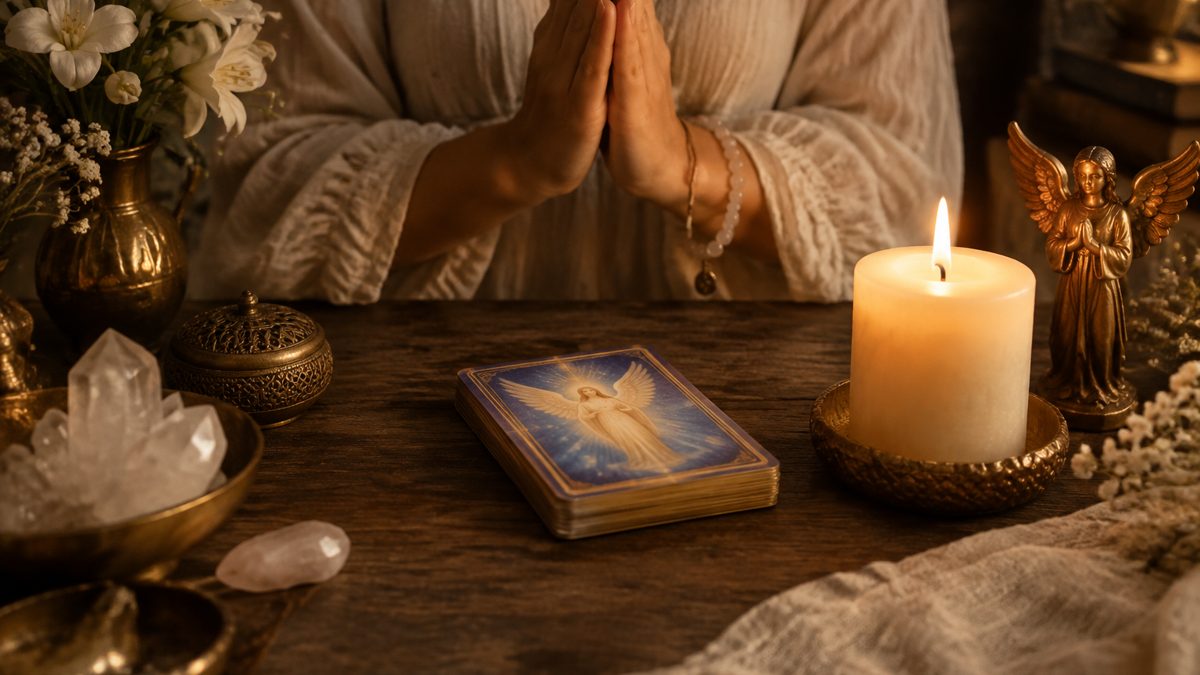
5. Set an intention or offer a prayer
Une intention donne une direction à la lecture. Elle n'a pas à être élaborée, et elle n'impose aucun résultat particulier. Avant de mélanger, demandez-vous ce que vous cherchez réellement : du réconfort, du recul, un sujet de journal ou une façon de réfléchir à votre prochaine action ordinaire. Cette petite clarification compte. Une question sur la manière d'aborder une conversation permet une réflexion plus utile que l'exigence de savoir exactement ce qu'une autre personne pense en secret.
If prayer belongs to your spiritual practice, you may begin by addressing God, angels, or a benevolent presence in language consistent with your beliefs. A simple prayer could ask for clarity, compassion, and the wisdom to keep your own judgment. You might also ask that the practice remain grounded in kindness toward yourself and others. No particular wording is required, and an awkward sentence is not a spiritual mistake.
Si vous préférez une approche non religieuse, énoncez simplement votre but : vous prenez quelques minutes pour réfléchir, observer vos réactions et envisager une prochaine étape utile. Vous pouvez poser les mains sur le jeu ou prendre une respiration confortable. Ces gestes peuvent marquer le passage de l'activité quotidienne à une attention concentrée, sans prétendre à l'action de forces invisibles. Choisissez ce qui vous semble sincère plutôt que d'emprunter un rituel qui vous met mal à l'aise.
Keep your question open-ended and within your own sphere of action. Ask what deserves your attention, what perspective you might be overlooking, or what quality you want to bring to a situation. Avoid treating the cards as a way to obtain consent, read someone’s private thoughts, or settle factual matters that require evidence. When your question concerns another person, turn it gently toward your own communication, boundaries, or assumptions.
- Name the topic in one sentence, without trying to solve every part of it.
- Choisissez une question ouverte telle que : Qu'est-ce qui m'aiderait à aborder cela avec réflexion ?
- Offer a prayer if it fits your beliefs, or state a secular intention.
- Remind yourself that the cards are prompts to consider, not commands to obey.
6. Shuffle and begin with a daily one-card draw
There is no universally correct way to shuffle an oracle deck. You can use an overhand shuffle, cut the cards into piles, or spread them face down and mix them gently on a clean surface. Choose a method that suits your hands and does not damage the cards. Once you have shuffled, draw from the top or select one from a face-down fan. The method need not be mysterious to feel intentional.
Un tirage quotidien est l'une des façons les plus simples d'apprendre. Plutôt que de demander une prédiction, demandez quel thème vous pourriez explorer aujourd'hui. Placez la carte là où vous pouvez la voir, lisez son titre et observez l'image avant d'ouvrir le livret. Accordez-vous un moment pour former une première impression. Vous ne passez pas un examen, et aucun prix ne récompense la reproduction mot pour mot de l'explication du créateur.
Si plusieurs cartes tombent pendant que vous mélangez, vous avez des options. Certains lecteurs les jugent significatives ; d'autres y voient de simples maladresses et les remettent dans le jeu. Choisissez une règle à l'avance pour ne pas changer de méthode simplement parce qu'un résultat vous plaît davantage qu'un autre. Il en va de même pour les cartes à l'envers. À moins que votre jeu ne propose des significations renversées ou que vous les ayez délibérément adoptées, remettez la carte à l'endroit.
Most importantly, let one card be enough. If the message feels puzzling or disappointing, note that response instead of immediately replacing it. Repeatedly drawing until you receive reassurance can make the practice less reflective and more urgent. You may also decide that a card does not resonate today. That is an acceptable result. A daily practice is an invitation, not an obligation, and occasional draws work just as well for learning at your own pace.
- Prévoyez environ cinq minutes et choisissez une question simple.
- Shuffle in a comfortable way, then draw one card.
- Write down its title and your first observation.
- Lisez le livret d'accompagnement et choisissez une réflexion ou une action concrète et ancrée.
- En fin de journée, relisez brièvement la note sans forcer de lien.
7. Try a few clear, beginner-friendly spreads
Un tirage est simplement une disposition dans laquelle chaque carte a un rôle défini. Les positions aident à préciser une interprétation qui serait autrement trop large. Plutôt que de demander à trois cartes de tout expliquer, vous pouvez en assigner une à la situation, une à une perspective négligée et une à une prochaine étape possible. Notez les positions avant de tirer. Cela vous évite de remanier discrètement la question pour l'adapter aux cartes qui apparaissent.
For a two-card reading, try: what I am noticing, and what else I could consider. The first position gives you a place to examine your current focus; the second invites a wider view. It is a useful arrangement when you feel caught between a familiar reaction and a more thoughtful response. Neither card needs to describe objective reality. Both can function as lenses through which to examine your understanding.
For three cards, I like: where my attention is, what could support me, and one action I can choose. The final position is deliberately modest. It asks for a possibility within your control rather than an instruction from an unquestionable authority. Another useful three-card spread is: what I appreciate, what I am learning, and what I am ready to simplify. That version works especially well for a weekly reflection.
Keep the positions visible while you interpret. A courage card in a support position might prompt you to remember a skill you already have; in an action position, it might suggest preparing for an honest conversation. Resist expanding every reading with extra clarifying cards. If a position remains unclear, return to its question, consult the guidebook, or leave a note to revisit it. Uncertainty is not a failure of the spread.
- Choose a two- or three-card layout and write down the meaning of each position.
- Shuffle while holding the overall question in mind.
- Disposez les cartes de gauche à droite dans l'ordre où elles ont été tirées.
- Interpret each card within its assigned position before looking for connections.
- Summarize the reading in one or two sentences.
8. Interpret messages without surrendering your judgment
Start with what is actually on the card. Describe the image as though you were explaining it to someone who cannot see it: a figure stands beside an open gate, the background is blue, a lantern hangs from one hand. Then notice your associations. Perhaps the gate suggests opportunity to you, while the lantern suggests preparation. Separating observation from interpretation makes it easier to see how your own experiences shape the reading.
Next, read the guidebook. Treat it as the creator’s explanation, not an infallible verdict. You may discover a symbol you overlooked or find that the written message differs from your first impression. Hold those possibilities side by side. Ask which interpretation best fits the question without stretching the facts. A card about forgiveness, for example, need not mean reconciliation, renewed access, or abandoning a boundary.
Look for practical meaning rather than dramatic certainty. A rest card does not establish why you feel tired, and a card about abundance does not predict material gain. It might instead prompt you to notice what you already have or reconsider an expectation. Cards are not substitutes for medical, legal, or financial expertise, and they cannot establish facts about those subjects. Use appropriate information and qualified help when a decision calls for them.
Be especially careful with fear-based interpretations. A dark image is not evidence of a curse, an approaching disaster, or a hostile presence. Likewise, a comforting image cannot promise safety or a particular outcome. Our minds naturally notice patterns and remember striking matches; keeping track of misses and ambiguous results helps preserve perspective. I ask three questions before accepting an interpretation: Is it compassionate? Is it plausible as reflection? Does it leave me free to choose?
9. Explore archangels as a spiritual tradition
Many angel oracle decks feature archangels, but the traditions behind those figures are not uniform. Angels appear in Jewish, Christian, and Islamic traditions, with differences in names, roles, texts, and devotional practices. Contemporary oracle creators may also draw on later esoteric teachings and modern spiritual systems. A deck that presents a neat list of archangels and corresponding colors is offering a particular framework, not necessarily a universal religious teaching.
Dans de nombreux contextes chrétiens, Michel est associé à la protection et au combat spirituel, Gabriel aux messages divins et Raphaël à la guérison, notamment à travers le Livre de Tobie, dont le statut scripturaire diffère selon les traditions. Les pratiques angéliques modernes peuvent adapter ces associations en thèmes de réflexion tels que le courage, la communication et le soin. Ces thèmes symboliques n'établissent pas qu'invoquer une figure produira un résultat extérieur. Lorsqu'un jeu affirme quelque chose de précis sur la tradition, ses sources méritent un coup d'œil.
If archangel devotion fits your beliefs, you might choose one figure to learn about through reputable sources from the relevant tradition. Read about the historical or textual context before adding correspondences from a deck. You could then offer a respectful prayer, draw a card, and reflect on a quality associated with that figure. Avoid assuming that traditions are interchangeable or that one guidebook speaks for every community that honors angels.
Vous pouvez aussi travailler avec l'imagerie de façon symbolique, en précisant bien que cela diffère d'une pratique dévotionnelle. L'imagerie de Michel peut inviter à réfléchir à une limite ; celle de Gabriel peut inciter à prêter attention à votre manière de vous exprimer. Rien n'oblige à contacter un être nommé, à sentir une présence ou à recevoir un signe. Si une pratique entre en conflit avec votre foi ou vous met mal à l'aise, laissez-la de côté. Le respect inclut celui de vos propres limites.
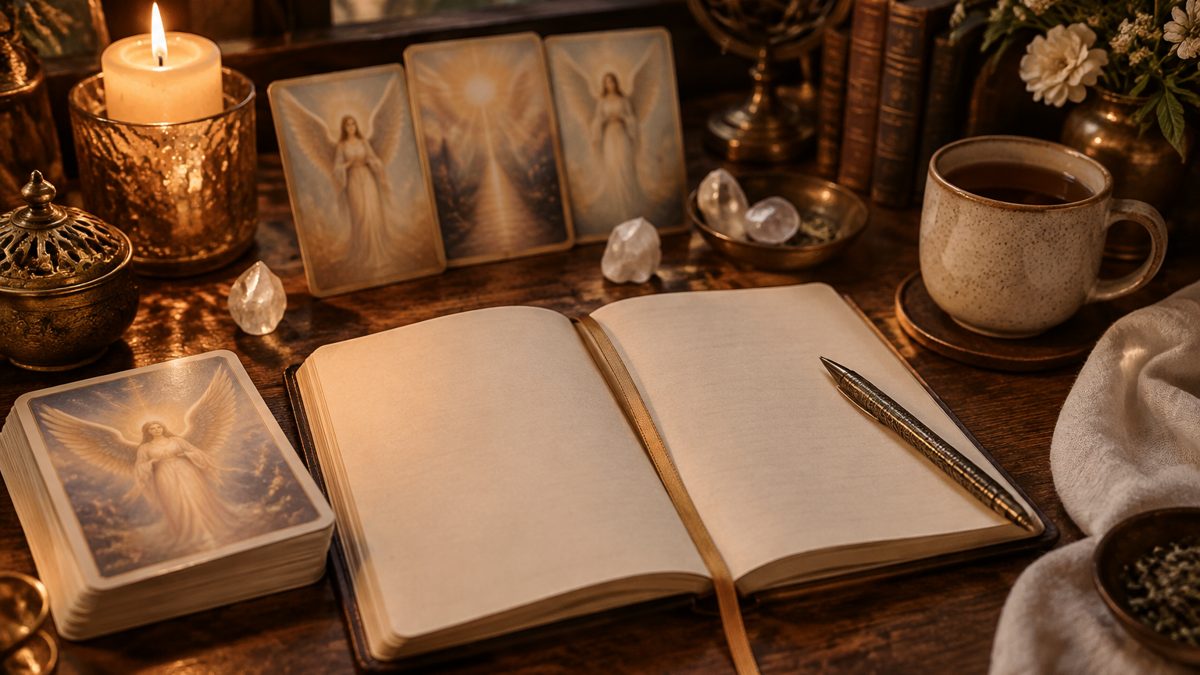
10. Keep a journal that welcomes honest observation
An oracle journal does not need to be beautiful to be useful. A plain notebook or a simple digital document will do. Record the date, your question, the deck, the card or cards drawn, and a few sentences about your response. Include the spread positions if you used them. These details give you a reliable record rather than relying on memory, which tends to highlight the most striking or emotionally satisfying moments.
Separate the card’s wording from your interpretation. You might note that the card’s title is Patience, while your response is that you feel rushed about a creative project. Then add what the guidebook contributed and what you actually intend to do. This distinction prevents a personal association from gradually becoming something you remember as an explicit message. It also helps you recognize which parts of the reading came from your existing knowledge of the situation.
Leave room for disagreement. Write down when a reading felt irrelevant, when you could not make sense of it, and when a suggested action did not suit your circumstances. Honest notes are more valuable than a record edited into a string of apparent confirmations. If the same card appears repeatedly, it may be interesting to reflect on, but repetition alone does not prove an outside message. You can explore the theme without assigning it special authority.
Relisez votre journal après quelques semaines. Cherchez des schémas dans vos questions et vos réactions plutôt que d'essayer de mesurer le pouvoir du jeu. Cherchez-vous sans cesse la permission de vous reposer ? Revenez-vous toujours sur une conversation que vous pourriez préparer directement ? La découverte la plus utile peut concerner vos propres habitudes d'attention. Protégez la confidentialité du journal, surtout si vous y écrivez sur d'autres personnes, et évitez de présenter vos impressions comme des faits les concernant.
- Notez la question, les cartes et les positions du tirage.
- Décrivez votre première réaction avant d'y ajouter l'interprétation du livret.
- Choose one small action, or note that no action is needed.
- Revenez plus tard sur l'entrée et consignez ce qui s'est passé sans réécrire la lecture d'origine.
- Notice recurring concerns while allowing for coincidence and ordinary repetition.
11. Walk through a sample three-card reading
Here is an illustrative reading using invented card titles, not a quotation from a published deck or a report of an actual supernatural message. Imagine that you have been postponing a personal writing project. You ask: What could help me return to this project in a thoughtful, manageable way? Your positions are where my attention is, what could support me, and one action I can choose. You draw Listening, Kindness, and Open Door.
In the first position, Listening might prompt you to examine how much advice you have been collecting. Perhaps you have read so many suggestions that you can no longer hear your own preferences clearly. That is one interpretation, not a fact established by the card. You test it against your experience: have you really been seeking more input instead of beginning? If not, Listening could invite another relevant reflection, such as noticing what originally attracted you to the project.
In the support position, Kindness might suggest changing the standard by which you judge a first attempt. Instead of expecting a polished piece immediately, you could allow an untidy draft. Notice how the interpretation stays connected to the question. It does not promise that kindness will make the project successful, and it does not claim that every obstacle is merely an attitude problem. It offers a possible way to make returning less intimidating.
À la position de l'action, Porte ouverte pourrait suggérer de créer une petite ouverture plutôt que de planifier une transformation complète. Vous décidez de consacrer quinze minutes demain à esquisser une scène. Votre synthèse devient : je suis peut-être submergé(e) par les conseils extérieurs ; une exigence plus douce pourrait m'aider à commencer ; j'essaierai une courte séance d'écriture. Vous consignez ce plan et clôturez la lecture. Demain, que vous écriviez ou non, vous pourrez examiner ce qui a aidé et ce qui a gêné. La valeur de la lecture réside dans la réflexion et l'expérimentation, non dans le fait de traiter trois cartes comme une prédiction.
12. Clôturez la lecture et bâtissez une pratique durable
Closing a reading can be very simple. Gather the cards, write your final thought, and return the deck to its box or another suitable place. If gratitude belongs to your practice, offer thanks in your own words. If you prefer a secular closing, acknowledge the time you gave yourself. A closing ritual marks the end of the session; it does not need to seal an invisible doorway or protect you from consequences for doing something incorrectly.
Choose a rhythm that fits your life. You might draw one card on quiet mornings, use a three-card spread each weekend, or reach for the deck only when you want a journaling prompt. There is no spiritual attendance record. If daily draws become repetitive, try reading less often or spending more time with a single image. Learning the deck includes noticing when it supports reflection and when another activity would serve you better.
Keep a few boundaries visible. Do not let a card override clear evidence, another person’s consent, or your own considered judgment. Avoid repeatedly checking the same question in search of certainty. If you notice that you feel unable to make ordinary choices without drawing, or that readings leave you increasingly frightened or preoccupied, put the cards away and reconnect with everyday sources of support. A reflective tool should remain something you can freely choose not to use.
What I hope you carry from this guide is not a perfect technique, but a gentle balance: imagination alongside discernment, tradition alongside curiosity, and meaningful ritual alongside ordinary action. Angel oracle cards can offer a language for reflection if that language speaks to you. They do not have to explain your future or solve your life. Sometimes the most worthwhile reading ends with a modest sentence in a notebook, a clearer question, and the willingness to take one thoughtful step.
These practices are shared as tradition and personal reflection, not as a substitute for medical, legal or financial advice.
Continuez d'apprendre
- Angel oracle card meanings
- How to read tarot cards
- How to use angel oracle cards
- Comment lire les cartes à jouer
- Comment utiliser les cristaux dans les sortilèges
- Comment utiliser les herbes en sorcellerie
- How to read the Dr. Moorne Egyptian Tarot
- How to read dice
- How to read tea leaves
- Comment utiliser un pendule
- Comment lancer un sort à la bougie
- How to make a spell jar
- How to make a sigil
- How to cleanse your home
- How to set up an ancestor altar
- How to open a sacred space
- How to time spells with the moon
- How to work with water and salt
- How to make a protection charm bag
- Read the Journal ou visitez la shops