How-To Guide
How to Use Crystals in Spells and Rituals
Par Seraphina
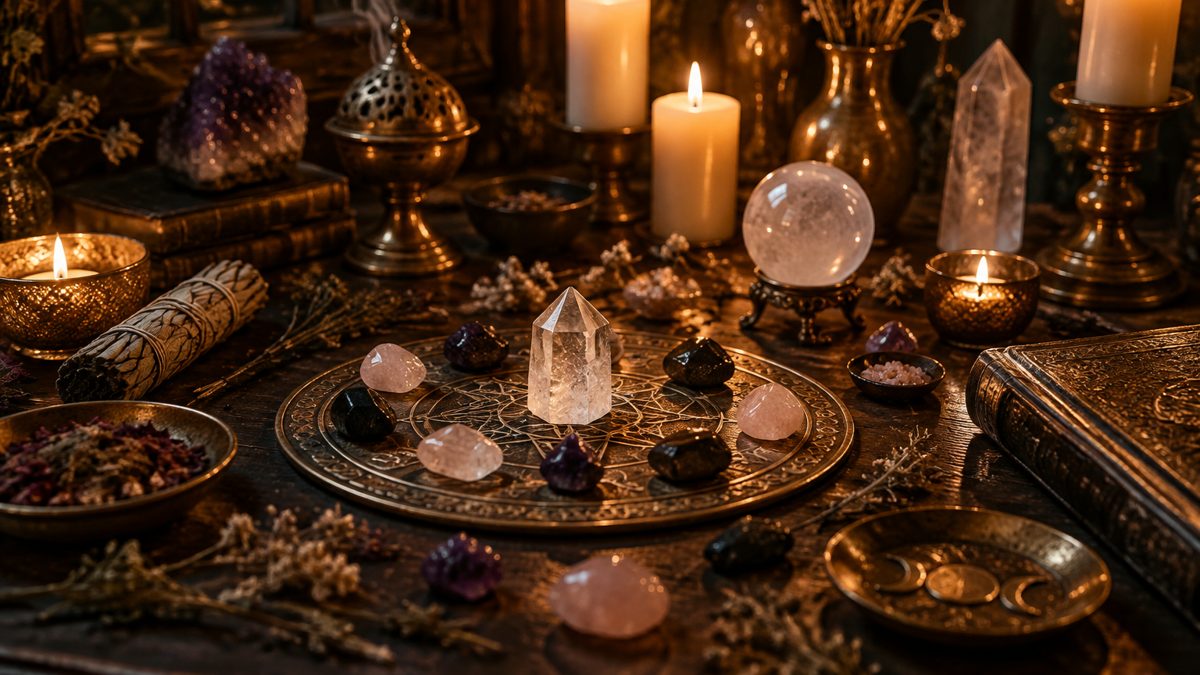
How to Use Crystals in Spells and Rituals Welcome to Crossroads Journal. I’m Seraphina, and when I bring a crystal into a ritual, I think of it as something to gather my attention around: a small, tangible reminder of what I want to honor, invite, or release. A stone’s weight, texture, color, and history can give an otherwise abstract intention somewhere to rest.
Les cristaux apparaissent dans de nombreuses pratiques magiques contemporaines, avec des significations tirées du folklore, des traditions religieuses, des systèmes de correspondances modernes et de l'expérience personnelle. Ces significations ne sont pas universelles, et affirmer que les pierres émettent des pouvoirs magiques ou changent des événements extérieurs relève de la croyance plutôt que de preuves établies. Vous pouvez aborder les pratiques présentées ici de façon spirituelle, symbolique, ou simplement comme des rituels de réflexion, sans avoir à feindre la certitude.
My approach is gentle and practical. We’ll look at choosing crystals, cleansing them without damaging them, charging them under moonlight, setting intentions, arranging grids, and incorporating stones into candle work. I’ll also share protection and love rituals designed around personal agency, consent, and ordinary follow-through rather than promises of supernatural results.
You do not need a cabinet of rare minerals, expensive equipment, or a perfectly timed full moon. One responsibly obtained stone, a clear purpose, and a little uninterrupted attention are enough to begin. Throughout this guide, physical safety comes before magical symbolism: no correspondence is worth a damaged keepsake, a distressed pet, or an unattended flame.
Looking for the meaning of a single card or ingredient? Keep our Crystals for spells guide open beside you.
1. Begin with the kind of magic you actually mean
Before choosing a crystal, I like to ask what the ritual is for. Am I marking a transition, practicing a boundary, expressing gratitude, or making space for affection? That question matters more than finding the supposedly perfect stone. An intention such as “I want to pause before agreeing to things” gives a ritual a clearer shape than “I want everything to change.” It also leaves room for an ordinary action afterward.
In many modern crystal traditions, stones are assigned correspondences: rose quartz with love, clear quartz with clarity or amplification, amethyst with contemplation, and black tourmaline with protection. These are examples of beliefs used in contemporary practice, not measurable guarantees. Different books and practitioners may offer different associations. I treat those differences as invitations to understand a particular system rather than evidence that someone must have the single correct answer.
Personal symbolism can sit beside traditional correspondence. A smooth pebble from a permitted collecting spot might remind you of steadiness more effectively than an expensive specimen. A stone inherited from a relative may carry memories that make it meaningful in an ancestor remembrance ritual. The significance comes partly from your relationship with the object, and you do not have to invent a grand explanation for that relationship.
I also keep a distinction between symbolic protection and practical safety. A protection crystal can represent boundaries, but it cannot replace a lock, a safety plan, or appropriate assistance. Likewise, a love ritual cannot secure another person’s affection. Ritual is most grounded when it supports your choices without claiming control over other people, physical hazards, or uncertain events.
2. Choose a crystal without turning it into a shopping quest
Start with the intention, then look for a stone you can identify, handle safely, and afford comfortably. For a first practice, one sturdy, polished specimen is often easier to manage than a delicate cluster. Clear quartz, rose quartz, and amethyst are familiar options in contemporary crystal work. You can also use an ordinary stone you already own, provided its surface is stable and its identity or composition does not raise handling concerns.
I prefer choosing by a combination of symbolism and practicality. Does the stone’s color suit the mood of the ritual? Does its shape sit securely on your table? Is it comfortable in your hand? You do not need to feel tingling, warmth, or a sudden mystical recognition. Such sensations can have ordinary explanations, and their absence does not make a crystal unsuitable or your practice less meaningful.
Ask sellers for the mineral name and whether a piece is dyed, coated, heat-treated, reconstructed, or otherwise altered. Treatments do not erase personal meaning, but they can affect care. Trade names sometimes obscure what a stone actually is. If the identification remains uncertain, avoid water, heat, ingestion, and unnecessary handling until you have reliable information. Do not grind, drill, or sand an unknown specimen for ritual use.
Responsible purchasing also deserves a place at the altar. Mineral extraction and trading can involve environmental and labor concerns, while detailed sourcing information may be unavailable. Ask questions without assuming a vague ethical label proves everything. Buying less, using secondhand stones, and appreciating what you already have are sensible options. If collecting outdoors, check permission and local rules, and leave protected places and culturally significant sites undisturbed.
3. Cleanse symbolically, and clean physically with care
Les praticiens des cristaux emploient souvent « purifier » pour désigner une remise à zéro symbolique : abandonner les associations antérieures et préparer un objet à un nouveau but. C'est différent d'enlever la saleté. Une pierre peut être physiquement propre alors que vous voulez tout de même marquer un nouveau départ, ou poussiéreuse alors que sa signification personnelle vous paraît parfaitement établie. Je trouve que séparer ces deux idées rend la pratique à la fois plus claire et plus sûre.
For a beginner, the simplest symbolic method is often the best. Set the stone on a clean cloth, take a few comfortable breaths, and state that you are beginning again. You might ring a bell softly, spend a minute in silence, or imagine the previous intention loosening its hold. None of these methods requires believing the stone has become contaminated, and none requires smoke, salt, or water.
Physical cleaning depends on the specific mineral and any treatments or attachments. A soft, dry cloth is a conservative choice for many stable, polished pieces, though delicate specimens may need specialist guidance. Avoid scrubbing friable surfaces or creating dust. Salt, saltwater, household cleaners, and prolonged soaking are not universal crystal-care methods. They can damage minerals, coatings, metal settings, and nearby furniture.
La fumée est facultative et n'est pas une condition d'une pratique authentique. Elle peut gêner les personnes sensibles sur le plan respiratoire et être dangereuse pour certains animaux, surtout les oiseaux. Si vous utilisez de l'encens, pensez à toutes les personnes qui partagent l'espace, assurez une ventilation adaptée et utilisez un support approprié. J'évite aussi d'emprunter des cérémonies à des traditions vivantes sans en comprendre le contexte. Une remise à zéro tranquille, dans vos propres mots, suffit amplement.
- Dégagez une petite surface et posez votre cristal sur un linge doux et sec.
- Name the reset plainly: “I release the previous purpose of this stone and begin with attention.”
- Sit quietly or use a brief, gentle sound to mark the transition.
- Examinez la pierre pour repérer d'éventuels fragments détachés ou dommages, puis rangez-la en lieu sûr.
4. Charge crystals under moonlight without chasing perfection
Dans la pratique lunaire contemporaine, « charger » signifie généralement dédier un cristal à une intention tout en l'associant à une phase lunaire. Certains praticiens privilégient la lune croissante pour la croissance, la pleine lune pour l'aboutissement et la lune décroissante pour le lâcher-prise. Ce sont des cadres symboliques, et non des mécanismes démontrés par lesquels la lumière de la lune stockerait un pouvoir particulier dans les minéraux. Utilisez-les s'ils enrichissent votre pratique ; laissez-les de côté s'ils créent une pression.
J'aime la recharge au clair de lune parce qu'elle invite à faire une pause. Un rebord de fenêtre intérieur, une étagère près d'une fenêtre ou un plateau sec peuvent devenir un lieu pour marquer la soirée. La lumière directe de la lune n'est pas essentielle à une consécration symbolique, et les nuages n'ont pas à gâcher l'occasion. Si votre fenêtre ne donne pas sur la lune, vous pouvez quand même reconnaître la phase lunaire et poser votre intention à l'intérieur.
Vérifiez l'emplacement avant de laisser quoi que ce soit pour la nuit. Les pierres placées dehors peuvent subir la rosée, la pluie, le gel, les animaux ou le vol. Une fenêtre peut devenir chaude après le lever du soleil, et certains minéraux colorés peuvent pâlir sous une exposition prolongée à la lumière. Gardez les cristaux à l'écart des rebords instables, des fenêtres ouvertes, des enfants curieux et des animaux. Les sphères de cristal transparent demandent une attention particulière, car elles peuvent concentrer la lumière directe du soleil et créer un risque d'incendie.
Il n'existe aucune durée de recharge obligatoire. Quelques minutes délibérées peuvent suffire pour le rituel que vous préparez. Lorsque vous reprenez la pierre, observez si votre intention vous semble toujours juste, plutôt que de vérifier si le cristal paraît plus puissant. Si vous manquez la pleine lune, rien n'a échoué. Vous pouvez choisir un autre soir et laisser la pratique s'adapter à votre vie.
- Choisissez une phase lunaire pour sa signification symbolique, ou simplement une soirée qui vous convient.
- Place the crystal in a dry, stable indoor location with no foreseeable morning-sun hazard.
- Speak one sentence describing what you are dedicating the stone to.
- Leave it for your chosen interval, then retrieve it and record the intention if helpful.
5. Set an intention that leaves room for choice
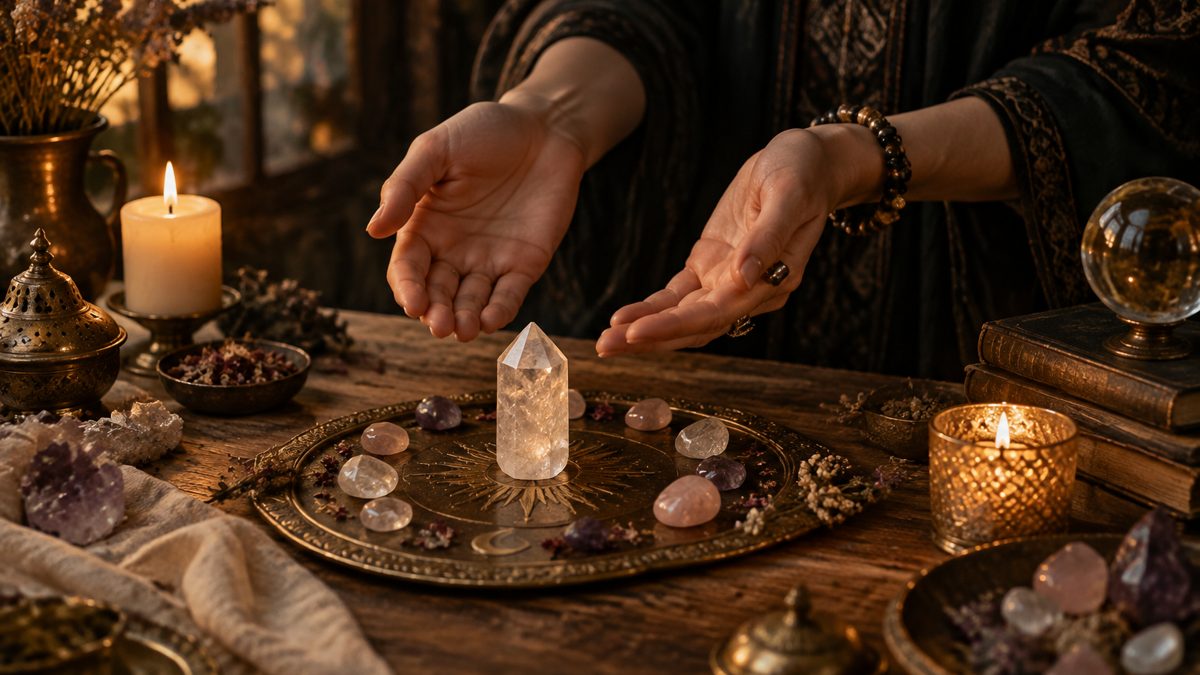
Setting an intention is the moment when a general wish becomes a usable statement. I aim for language that describes my own conduct, attention, or values. “May I recognize and communicate my limits” is more grounded than “No difficult person can ever reach me.” “I welcome mutual affection” respects consent in a way that “This particular person must love me” does not.
Tenez le cristal s'il convient de le manipuler, ou posez-le à proximité et reposez vos mains confortablement. Énoncez votre intention à voix haute, chuchotez-la ou écrivez-la. Inutile de serrer la pierre, de maintenir une posture inconfortable ou de forcer un état émotionnel. Si la visualisation ne vous vient pas naturellement, utilisez plutôt des mots, une texture ou un simple symbole écrit. Le rituel n'exige pas d'images mentales vives.
Il peut être utile d'associer l'intention à une action observable. Une pierre dédiée à la stabilité pourrait vous rappeler de lire attentivement une invitation avant d'y répondre. Un cristal associé à l'amitié pourrait se trouver à côté de la note que vous comptez envoyer. Cela vous donne quelque chose de concret à examiner plus tard, sans supposer que chaque coïncidence a été causée par le rituel.
Keep the wording kind and flexible. Intentions are not contracts that punish you for having an uncertain day. You can revise one when circumstances change, and you do not need to renew it compulsively. If the practice starts feeling like something you must perform perfectly to prevent disaster, step back and simplify. A crystal can remain an ordinary object while you take a break.
- Write a single sentence beginning with “I choose,” “I welcome,” or “May I practice.”
- Check that it concerns your own choices and does not override another person’s consent.
- Lisez-la à côté de la pierre, puis nommez une action concrète qui l'exprime.
- Store the written intention with the crystal or in your journal.
6. Build a crystal grid step by step
A crystal grid is an arrangement of stones used to express an intention through pattern, repetition, and symbolism. In some traditions, practitioners believe the arrangement directs or amplifies energy. I approach the layout as a visual ritual: its geometry helps gather attention and gives each part of an intention a place. There is no established requirement for a particular number of stones or a particular pattern.
Pour votre première grille, choisissez un simple cercle, un triangle ou un carré. Une pierre centrale peut représenter le but principal, tandis que les pierres environnantes représentent des qualités de soutien. Pour une grille de pose de limites, le centre pourrait figurer le respect de soi et les positions extérieures le discernement, la clarté du langage, le repos et la constance. Les pierres n'ont pas besoin d'être assorties, et une petite disposition est plus facile à entretenir qu'une disposition chargée.
Some practitioners call the final tracing of the pattern “activation.” You can understand this as ceremonial completion rather than switching on a proven force. A fingertip hovering above the layout is enough; there is no need to buy a wand or touch sharp crystal points. Decide when the grid will end, too. A deliberate closing helps keep it from becoming neglected clutter or an obligation.
- Choose one intention and write it on a small piece of paper.
- Find a stable surface away from pets, children, table edges, and frequently moved objects.
- Étalez un tissu ou un gabarit en papier si c'est utile, en veillant à ce qu'il soit bien à plat.
- Placez l'intention sous la pierre centrale ou à côté d'elle, puis nommez ce que cette pierre représente.
- Add the outer stones one at a time, assigning each a supporting quality.
- Trace the arrangement in the air with your finger while repeating your intention once.
- Nommez une action concrète que vous accomplirez, et choisissez une date pour réexaminer ou démonter la grille.
- À la clôture, réfléchissez brièvement, retirez les pierres et remettez-les dans un lieu de rangement sûr.
7. Combine candle spells and crystals safely
Candles and crystals make a visually appealing pairing, but I keep their roles physically separate. The candle can symbolize attention, change, or a dedicated interval; the crystal can represent the intention being considered. Neither needs to touch the other. Heat can damage or fracture some stones, and an unknown specimen is not a suitable candleholder merely because it has a convenient hollow.
Use a candle in a purpose-made holder on a stable, heat-resistant surface. Keep crystals outside the candle’s heat zone, with ample clearance from the flame and hot wax. Follow the candle manufacturer’s directions, including clearance and burn-time guidance. Remove paper, loose fabric, dried flowers, and other combustibles from the area. Do not embed crystals, herbs, or decorative fragments in a burning candle.
For simple candle work, I place a safely identified stone nearby, read my intention, and let the candle mark a short period of reflection. There is no need to dress it with oils or scatter flammable powders around it. A battery-operated candle offers a good alternative where open flames are unsuitable, including shared spaces with restrictions or homes where children and animals could interrupt the ritual.
Restez présent pendant toute la combustion et éteignez la bougie avant de partir ou de vous assoupir. Ne déplacez pas un support brûlant et ne touchez pas une pierre voisine avant que tout ait refroidi. Une extinction précoce n'est pas un mauvais présage, et une flamme vacillante n'est pas une preuve fiable d'un message. Les courants d'air, l'état de la mèche et d'autres facteurs ordinaires influent sur le comportement des bougies.
- Prepare a clear, stable surface and choose a proper candleholder or a battery-operated candle.
- Place the crystal safely away from heat, flame, and any pooled wax.
- Read your intention and spend a few minutes considering the action it asks of you.
- Extinguish the flame safely, allow the setup to cool, and put everything away.
8. Carry and place crystals as everyday reminders
A carried crystal can extend a ritual into daily life by becoming a reminder you encounter naturally. I like a small, sturdy, polished stone in a fabric pouch rather than a fragile point loose among keys. Before carrying it, check for cracks, sharp edges, shedding material, or finishes that rub off. If you are unsure whether a specimen is suitable for frequent contact, leave it on display instead.
Give the reminder a specific cue. When you notice the pouch in your bag, you might ask, “Have I left enough time to decide?” A stone beside your journal might mean, “Write one honest sentence before closing the day.” These small associations are often more useful than continually checking whether you can feel a crystal working. The practice becomes a habit of attention rather than a test.
Placement around the home can be equally simple. A stable stone near an entryway may represent the boundary between public and private life. One on a desk can mark the beginning and end of a focused activity. Avoid obstructing doors, placing stones where they may fall, or leaving heavy specimens on weak shelves. Keep small stones away from children and animals because they can be swallowed.
Bedrooms call for ordinary comfort, not rigid placement rules. A secure bedside surface is generally more practical than putting a hard or sharp object under a pillow. Avoid damp bathrooms for moisture-sensitive minerals and sunny windows for stones prone to fading. You can move a crystal whenever the location stops serving you; moving it does not cancel a vow or invite punishment.
9. Treat crystal water and mineral safety conservatively
My simplest rule is not to put crystals into drinking water, tea, bathwater, or food. Mineral safety is more complicated than whether a stone looks smooth or has a familiar name. Composition, coatings, dyes, inclusions, surface contamination, and prior handling can all matter. A claim that a stone is spiritually cleansing says nothing about whether it belongs in something you will ingest or soak in.
Selenite and satin spar are forms of gypsum often sold under similar names. They are soft and can be damaged by water, especially soaking or repeated exposure, so keep them dry. Pyrite should also stay out of water-based rituals: exposure to moisture can promote oxidation and deterioration. Do not assume a saltwater bath is gentler. Salt can introduce additional damage, including harm to settings and surfaces.
D'autres spécimens demandent de la prudence pour d'autres raisons. La malachite est un minéral contenant du cuivre, et le cinabre contient du mercure ; ni l'un ni l'autre n'a sa place dans l'eau potable, les bains ou les poudres maison. L'halite se dissout facilement. Les pierres tendres, poreuses, feuilletées, enrobées ou non identifiées conviennent mal aux méthodes humides. Même un minéral qui supporte un bref rinçage n'est pas pour autant certifié sans danger pour un élixir. La durabilité physique et l'aptitude au contact alimentaire sont des questions différentes.
If you want water symbolism, keep the crystal entirely separate. Place it beside a sealed water bottle, with enough space to prevent it falling in, and dedicate the moment rather than trying to transfer a substance or power. Never lick crystals, inhale mineral dust, or add crushed stone to oils or cosmetics. Wash your hands after handling unfamiliar specimens, and seek reliable mineral-care information for the exact material you own.
10. A simple protection ritual for boundaries
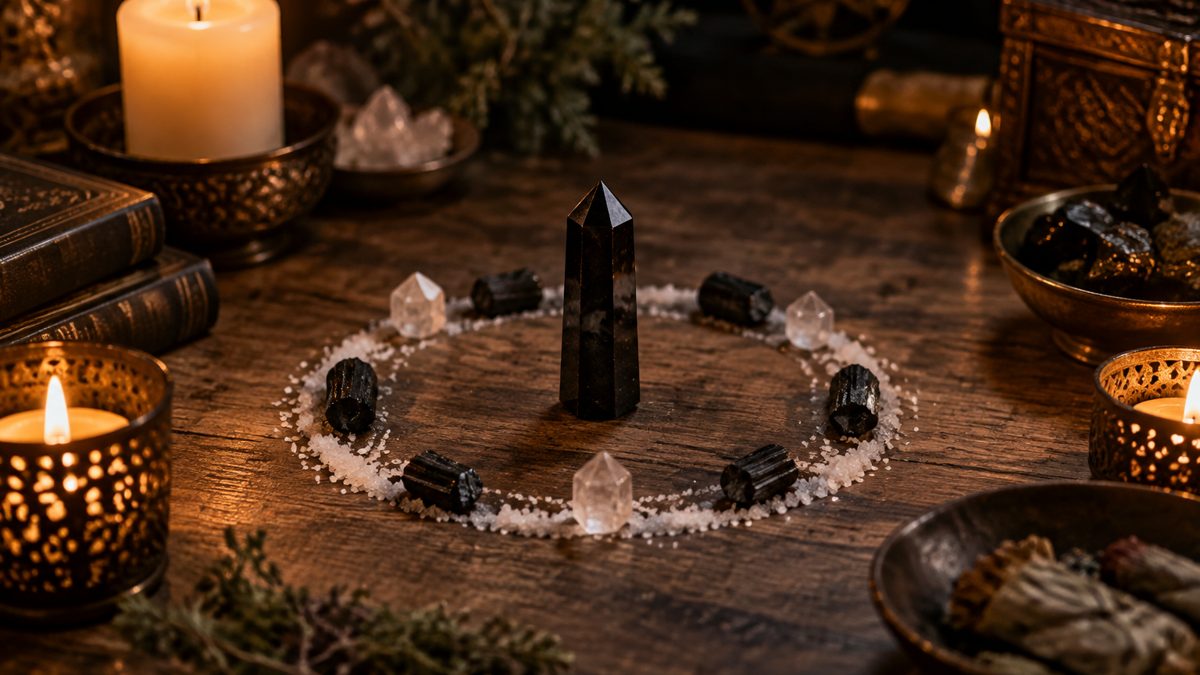
Ce rituel de protection est centré sur le discernement et les limites personnelles, et non sur la promesse d'une invulnérabilité. Choisissez une pierre stable que vous associez à la protection ; la tourmaline noire est une correspondance moderne courante, mais un galet familier peut tout aussi bien convenir. Ajoutez une feuille de papier et un stylo. Je préfère ici une version sans flamme, afin que l'attention reste sur ce que la protection signifie concrètement au quotidien.
Commencez par nommer quelque chose que vous voulez protéger : votre temps, votre espace privé, votre attention ou votre capacité à faire une pause avant de répondre. Soyez précis sans ressasser des scénarios effrayants. S'il existe une menace réelle, privilégiez les mesures de sécurité concrètes et l'aide appropriée plutôt que d'attendre un réconfort rituel. Le rôle de la pierre est de représenter votre engagement, non de détecter un danger ni de créer un bouclier physique.
Vous pouvez imaginer une limite autour de votre espace si cela vous semble porteur de sens, mais la visualisation est facultative. Au moment de clore, évitez de mettre le rituel à l'épreuve en guettant des signes d'attaque. Passez plutôt en revue l'action que vous avez choisie. Une interaction difficile par la suite ne prouve pas que la pierre a échoué, et une journée paisible n'établit pas une protection surnaturelle. Dans les deux cas, vous pouvez continuer à pratiquer la limite.
- Sit somewhere comfortable and place the stone on the paper.
- Write: “I am allowed to pause, choose, and name my limits.” Adjust the words so they sound like you.
- Nommez une limite que vous voulez pratiquer, par exemple attendre avant d'accepter un engagement supplémentaire.
- Hold your hands near the stone and say, “Let this remind me to act with discernment and respect for my limits.”
- Choose a practical next step, such as drafting a clear response or reviewing an ordinary home-safety task.
- Placez le papier et la pierre en lieu sûr, puis concluez par une simple reconnaissance : « Ce rituel est accompli. »
11. A love ritual for mutual care and openness
Pour le travail amoureux, je garde le consentement au centre. Ce rituel invite à réfléchir au type de bienveillance que vous souhaitez offrir et recevoir ; il n'est pas destiné à contraindre une personne en particulier, à interférer avec une relation ni à garantir une romance. Le quartz rose est couramment associé à l'amour dans la pratique moderne des cristaux, mais toute pierre manipulée en toute sécurité et porteuse d'une association personnelle de tendresse peut être utilisée.
Gather your crystal, paper, and a pen. An optional battery-operated candle can create a gentle atmosphere without introducing flame. You might dedicate the ritual to self-respect, friendship, family affection, or openness to a mutually wanted partnership. Love need not mean romance, and being single is not evidence that you have failed spiritually or chosen the wrong crystal.
I like this ritual to end with a modest act of care rather than a search for omens. You could send a considerate message, make time for a shared activity, or clarify what treatment you are willing to accept. If contacting someone, respect their boundaries and any lack of response. The meaningful question afterward is what you learned about your values, not whether another person behaved as the ritual requested.
- Posez la pierre devant vous et nommez la forme d'amour sur laquelle vous souhaitez réfléchir.
- Write three qualities you value in loving relationships, such as honesty, reciprocity, and kindness.
- Write one way you can offer those qualities and one boundary that helps you preserve them.
- Say, “I welcome freely chosen care. I do not ask to control another person’s heart.”
- Spend a quiet minute considering a realistic expression of affection or self-respect.
- Thank yourself for the attention, put the stone somewhere safe, and take the chosen action when appropriate.
12. Keep a journal, close rituals, and let the practice change
A small ritual journal can help you notice what is meaningful without turning every event into proof. Record the date, the stone, the intention, and any practical action you chose. If lunar timing matters to your practice, note it as context. You might also record whether the setup was comfortable, distracting, or too elaborate. Those observations are useful even when nothing dramatic happens.
At review time, separate events from interpretations. “I used the stone as a reminder before replying” describes something observable. “The crystal made someone agree with me” attributes a cause you cannot establish from that event alone. You can value a ritual’s emotional or spiritual meaning while remaining uncertain about supernatural explanations. That balance is welcome here at Crossroads Journal.
Close practices deliberately when they have served their purpose. Dismantle the grid, extinguish any candle, store the stones, and recycle or keep the intention paper as appropriate. There is no need to bury crystals, release them into waterways, or leave them in public landscapes. You can thank an object within your own beliefs without disposing of it in a way that creates environmental harm.
Surtout, laissez la pratique rester hospitalière à votre vie réelle. Si un rituel élaboré devient fatigant, revenez à une pierre et une phrase. Si vous ne ressentez aucun lien particulier avec les cristaux, vous préférerez peut-être une tout autre forme de réflexion. Je crois que la question la plus utile n'est pas « Ai-je accompli cela parfaitement ? » mais « Cela m'a-t-il aidé à porter une attention réfléchie à ce qui compte ? » C'est un point de départ tout en douceur, et un excellent point de retour.
These practices are shared as tradition and personal reflection, not as a substitute for medical, legal or financial advice.
Continuez d'apprendre
- Crystals for spells
- How to read tarot cards
- How to use angel oracle cards
- Comment lire les cartes à jouer
- Comment utiliser les cristaux dans les sortilèges
- Comment utiliser les herbes en sorcellerie
- How to read the Dr. Moorne Egyptian Tarot
- How to read dice
- How to read tea leaves
- Comment utiliser un pendule
- Comment lancer un sort à la bougie
- How to make a spell jar
- How to make a sigil
- How to cleanse your home
- How to set up an ancestor altar
- How to open a sacred space
- How to time spells with the moon
- How to work with water and salt
- How to make a protection charm bag
- Read the Journal ou visitez la shops