How-To Guide
Comment lire les cartes à jouer pour la divination (cartomancie)
Par Seraphina
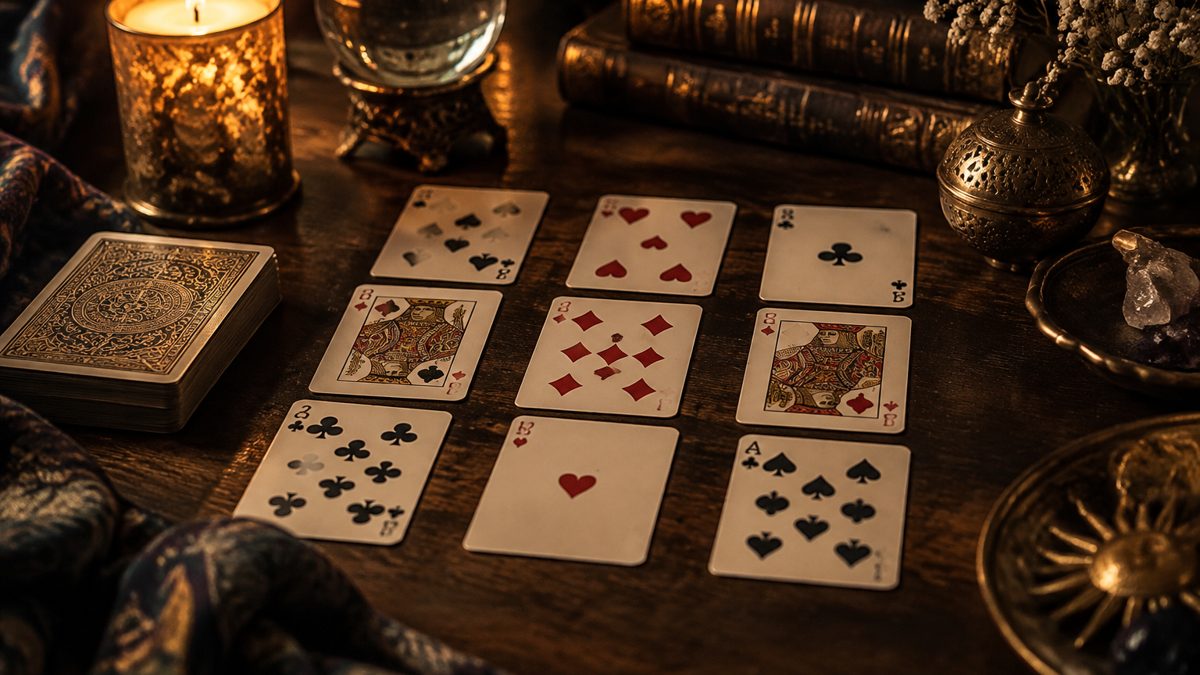
Un jeu de cartes posé sur une table de cuisine a quelque chose de merveilleusement accueillant. Il n'a besoin ni d'un emballage de velours ni d'illustrations sophistiquées pour sembler plein de possibilités. Ses cœurs et ses piques familiers appartiennent déjà à un langage de jeux, de hasard et de compagnie humaine. Ici, au Crossroads Journal, j'aime aborder la cartomancie dans ce même esprit accueillant : comme une pratique symbolique traditionnelle qui peut ménager de la place à la réflexion, à l'imagination et à un peu de cérémonie quotidienne.
I’m Seraphina, and this is the beginner’s guide I would want beside me when opening an ordinary deck for the first time. We will explore the history of playing-card divination, build a practical vocabulary for the suits and ranks, prepare a deck, and try both three-card and nine-card layouts. I will also explain the significator, show how cards modify one another, and walk through a complete example without pretending there is only one correct interpretation.
Une petite précaution avant de commencer : chacun comprend la divination à sa manière. Certains y voient une pratique spirituelle ; d'autres la traitent comme un récit, une contemplation ou un moyen de repérer leurs propres présupposés. Aucune preuve fiable n'indique que des cartes battues prédisent des événements futurs. Tout au long de ce guide, les associations magiques sont présentées comme des traditions et des croyances, non comme des faits établis, et aucune lecture ne doit être prise pour une promesse ni pour une consigne primant sur votre jugement.
You need only a standard 52-card deck, a clear surface, and something to write on. Remove the jokers for the system below. Bring curiosity rather than a demand for certainty, and choose an everyday question with room for your own agency. My favorite starting point is not “What must happen?” but “What might be useful to consider?” That small change makes the whole practice more generous.
Looking for the meaning of a single card or ingredient? Keep our Playing card meanings guide open beside you.
Comment lire les cartes à jouer pour la divination (cartomancie)
Cartomancy means divination using cards. In everyday usage, the word often refers specifically to reading ordinary playing cards, although it can describe a wider family of card-based practices. Playing cards existed before the familiar modern systems of fortune-telling attached to them. Their earlier history reaches into Asia, and cards arrived in Europe by the late fourteenth century, where different regions developed distinctive suits, designs, and games.
The hearts, diamonds, clubs, and spades used here belong to the French-suited tradition. Those symbols became widely familiar through the spread of French-style decks. European playing-card divination is documented in early modern sources, with printed methods becoming especially visible in the eighteenth and nineteenth centuries. Professional readers, household traditions, and popular manuals all helped shape the practice. That history is varied rather than a single unbroken system handed down unchanged.
Tarot and ordinary playing-card reading are related, but they are not interchangeable. Tarot developed as a card game in fifteenth-century Europe, and its widespread association with occult divination came later. A standard playing deck has no major arcana and has three court ranks per suit rather than tarot’s four. You can borrow ideas across traditions, but I find it clearer to learn the particular deck in your hands before mixing systems.
Surtout, les méthodes historiques de cartomancie ne s'accordent pas sur chaque signification. Un livre peut traiter une certaine carte comme un visiteur, un autre comme une nouvelle, un autre encore comme un type particulier de relation. Les significations de ce guide forment un cadre cohérent pour débutants, et non une prétention à l'autorité universelle. Si votre famille ou votre tradition culturelle utilise un autre système, vous n'avez pas à l'abandonner. La cohérence au sein d'une lecture compte plus que l'accumulation de toutes les définitions possibles.
1. Ask a Question That Leaves You Room to Choose
Before thinking about meanings, decide what kind of conversation you want to have with the cards. A narrow prediction can encourage you to squeeze a complex life into an unhelpful yes or no. An exploratory question gives the symbols something more useful to do. Instead of “Will my new neighbor become my best friend?” try “How can I approach getting to know my new neighbor?” The second question keeps the focus on your conduct, expectations, and available choices.
Good beginner questions are specific enough to anchor the reading but open enough to invite several perspectives. “What should I notice about starting a creative project?” is more workable than “Tell me everything about my life.” You might also ask what supports a situation, what complicates it, and what small next step deserves consideration. Avoid repeatedly rephrasing the same question until you receive the card you were hoping for.
A reading is not a reliable way to discover another person’s private thoughts, confirm accusations, or establish facts. If a question concerns a relationship, keep it on your side of the fence: what you have observed, how you communicate, and which boundaries matter to you. Cards cannot substitute for a direct conversation. They also should not guide medical, legal, or financial decisions; those belong with appropriate information and qualified support.
When reading for someone else, explain your approach and ask permission before beginning. Make clear that interpretations are symbolic and uncertain, and let the person decline any topic. I would rather offer one thoughtful possibility than deliver a dramatic pronouncement. The reader’s responsibility is not to sound all-knowing, but to keep the exchange respectful, grounded, and open to correction.
2. Learn the Four Suits as Areas of Everyday Life
Hearts concern affection, belonging, pleasure, hospitality, and emotional connection in this framework. They do not automatically mean romance. A heart might point toward friendship, family rituals, enjoying your own company, or the atmosphere you create when welcoming someone. In practice, ask: where is feeling or connection central to this question? A heart in a position called “support” might suggest encouragement or companionship, while the same suit in “complication” could invite reflection on expectations of closeness.
Clubs concern activity, learning, effort, collaboration, and the development of skills. Think of hands making something, people organizing a shared task, or a beginner practicing until a movement becomes familiar. Although some traditions connect clubs strongly with business, I use them more broadly for purposeful engagement. In a question about joining a choir, clubs might bring attention to rehearsals, regular attendance, or learning to contribute to a group.
Les carreaux concernent les choses tangibles : biens, matériaux, arrangements pratiques, échanges et ce que nous valorisons. Certaines traditions de cartomancie y mettent l'accent sur l'argent, mais ce guide utilise les carreaux comme un rappel plus large des ressources du quotidien. Un carreau peut symboliser le matériel d'un projet créatif, la place disponible dans une pièce ou un accord sur le partage d'un équipement. Il n'établit pas si un investissement réussira ni si un achat est judicieux. Gardez le symbolisme au niveau de la réflexion pratique.
Spades concern difficulty, limits, disagreement, separation, and necessary clarification. They deserve attention, but not dread. A spade might suggest that a plan needs a boundary, that an assumption needs questioning, or that something is asking for closure. In some traditional systems, spades receive severe meanings; I do not treat any card as evidence of death, illness, betrayal, or disaster. As a quick memory aid, hearts connect, clubs engage, diamonds make things tangible, and spades examine what resists or needs defining.
3. Donnez aux cartes numérotées un vocabulaire pratique
In this method, a card’s working meaning comes from combining its suit with its rank. The suit supplies the area of life; the number supplies a movement or pattern. These number associations are an interpretive scaffold, not a universal code. Learn them in small groups, and test them against ordinary situations. You are not trying to memorize fifty-two rigid predictions. You are learning to construct a sensible phrase, such as “a beginning in connection” or “effort meeting resistance.”
Aces suggest an opening, a seed, or a concentrated expression of the suit. The ace of hearts might represent an invitation to connect; the ace of clubs, the first impulse toward an activity. Twos suggest a pair, an exchange, a choice, or the task of balancing two elements. Threes suggest growth, expression, participation, or the complication that arrives when something expands beyond a pair. A three of diamonds, for instance, might prompt you to consider how several practical contributions fit together.
Fours suggest structure, stability, routine, or a boundary. Stability can be comforting or restrictive depending on the question. Fives suggest disturbance, adjustment, friction, or a change that requires a response. Sixes suggest cooperation, accommodation, or a workable rhythm after adjustment. Imagine these ranks as a small sequence: a structure forms, something disrupts it, and a new arrangement becomes possible. The six does not promise resolution; it invites you to look for ways a situation might become more workable.
Les sept suggèrent l'évaluation, l'incertitude, la patience ou la mise à l'épreuve d'une approche. Les huit suggèrent le mouvement, la répétition, l'effort concentré ou l'élan. Les neuf suggèrent l'accumulation, l'intensité ou l'approche d'un point de plénitude. Les dix suggèrent l'aboutissement, la pleine expression de la couleur ou le passage à une autre phase. Un neuf peut donc paraître satisfaisant ou encombré ; un dix peut sembler achevé ou prêt à être relâché. Les cartes voisines et la position dans le tirage aident à décider quel aspect mérite votre attention.
For a brief practice, compare the four fours: hearts might suggest familiar emotional comforts; clubs, an established practice routine; diamonds, an orderly arrangement of materials; spades, a firm limit. Notice that the rank stays recognizable while the suit changes its setting. If you cannot find a natural connection, write down two tentative possibilities rather than forcing an answer. Fluency comes from comparing interpretations with lived context, not from making every draw sound profound.
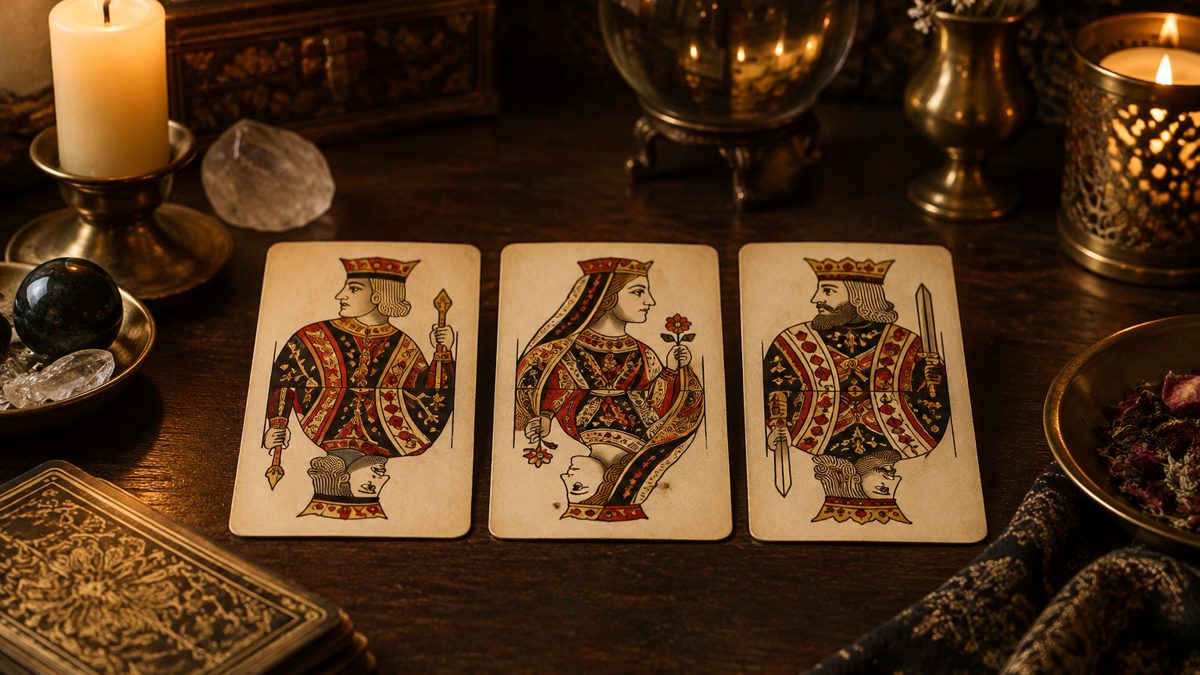
4. Read Jacks, Queens, and Kings Without Stereotypes
Les figures sont souvent l'endroit où les débutants s'embrouillent. Les manuels plus anciens peuvent décrire les gens à travers des présupposés rigides sur le genre, l'état civil, l'apparence ou la position sociale. Vous n'avez pas besoin de ces présupposés pour lire un jeu. Je préfère traiter d'abord les figures comme des rôles ou des styles d'engagement, et seulement ensuite comme des personnes possibles. Elles deviennent ainsi plus adaptables, et l'on évite de prétendre qu'une carte peut deviner le caractère d'un inconnu d'après son apparence.
Jacks suggest curiosity, messages, experimentation, or someone entering a situation with developing experience. Queens suggest cultivation, discernment, attentiveness, and the ability to sustain an atmosphere or practice. Kings suggest stewardship, direction, responsibility, and decisions that shape a wider setting. These are symbolic roles, not a hierarchy of personal worth. Anyone, of any gender or age, can embody any of them, and the same person may occupy different roles in different situations.
Combinez le rôle et la couleur comme vous combinez le nombre et la couleur. Un valet de trèfle peut suggérer un apprenant enthousiaste ou une invitation à essayer une activité. Une dame de cœur peut représenter une hospitalité attentionnée. Un roi de carreau peut indiquer la responsabilité du matériel partagé, tandis qu'une dame de pique peut suggérer un discernement clair et des limites bien tenues. Ce sont des phrases de départ, non des portraits figés. La question vous dit si la qualité de la carte est utile, excessive, absente ou simplement remarquable.
If a court seems to represent someone, ask what supports that interpretation. Does the person actually occupy the relevant role, or are you attaching their name because you wanted them to appear? When several courts turn up, consider multiple approaches or competing responsibilities before declaring a cast of characters. My favorite question is “What role is needed here?” It usually creates a more useful reading than “Who exactly is this?”
5. Prepare Your Deck and Make a Simple Reading Ritual
Any complete, readable 52-card deck will do. A well-used pack from the cupboard is just as suitable for learning as a new one. Check that all four suits are present from ace through king and set the jokers aside. Some traditions use jokers, but their meanings vary; leaving them out makes this beginner’s system easier to follow. There is no requirement to buy a dedicated divination deck.
Some practitioners believe in cleansing or consecrating cards through ritual. You might instead regard preparation as a way of settling your attention. Neither interpretation requires elaborate equipment. I suggest straightening the deck, clearing a space, and taking a quiet breath. If you enjoy symbolism, place a meaningful object nearby or wrap the deck in a favorite cloth afterward. These actions can mark the occasion without being presented as necessary for supernatural accuracy.
Mélangez de la manière qui vous est confortable et accessible. Vous pouvez mélanger à l'américaine, brasser doucement les cartes sur une table ou diviser et recombiner le jeu. Aucun décompte exact n'est requis. Avant de tirer, décidez si vous utiliserez uniquement les significations à l'endroit ; je le recommande au début, car beaucoup de cartes à jouer n'ont pas de haut clairement marqué. Décidez aussi que les cartes tombées accidentellement pendant le mélange retourneront simplement dans le jeu au lieu de devenir automatiquement des messages.
Write down the question and the spread positions before turning anything over. Shuffle, cut if you wish, and deal from the top. You do not need a special sensation to tell you when the deck is ready. A consistent procedure helps you avoid changing the rules to favor an appealing result. Stop or postpone the reading if you feel distressed or compelled to keep drawing. The cards will still be there when curiosity feels more spacious.
6. Decide Whether to Use a Significator
Un significateur est une carte délibérément choisie pour représenter la personne, la situation ou le thème central d'une lecture. Elle sert de point de repère et non de prédiction. Les systèmes traditionnels choisissent souvent une figure selon des caractéristiques personnelles, mais vous pouvez choisir selon un rôle ou une intention. Quelqu'un qui débute un loisir inconnu pourrait choisir le valet de trèfle ; quelqu'un qui explore l'hospitalité pourrait choisir la dame de cœur.
Une carte numérotée peut tout aussi bien convenir. Le deux de cœur pourrait représenter un lien en train de naître, tandis que le quatre de carreau pourrait représenter l'aménagement pratique d'un espace partagé. Choisissez une carte parce que son symbolisme correspond à la question, et non parce que vous pensez qu'elle résume votre identité permanente. Vous êtes bien plus complexe qu'un simple morceau de carton imprimé. Le significateur est une étiquette temporaire posée sur la table.
For beginners, the simplest method is to place the significator face up above the spread and then shuffle the remaining fifty-one cards. It is a chosen anchor, so do not count its presence as an independently drawn message. Alternatively, write its name in your notebook and keep the full deck intact. Some traditions leave a significator in the shuffled deck and interpret cards around it, but that requires a different procedure from the spreads taught here.
You can also skip the significator entirely. I often do when a clear written question already provides enough focus. If you use one, decide before shuffling and record the choice. Do not search through the deck afterward for a card you hoped would appear. The purpose is to orient the reading, not to manufacture confirmation.
7. Begin with a Three-Card Spread
A three-card spread is small enough to keep you honest. It gives each card a clear job and leaves less room for wandering into unrelated stories. My preferred beginner’s layout is situation, complication, and constructive response. It explores what is being considered, what makes it less straightforward, and an approach worth weighing. The third position is not an order, and it does not guarantee that a suggested action will produce a particular result.
You can also use past influence, present focus, and possible direction. If you choose that version, keep the final card conditional: it suggests a theme to consider if the current approach continues, not a future already written. I generally favor the first layout because it stays close to choice and observation. Whatever you select, write the position names first rather than deciding what they mean after seeing the cards.
Read each card through its assigned position before combining the three. A heart in the complication position does not automatically make the reading cheerful; it could bring attention to a wish for approval or an unspoken emotional expectation. A spade in the constructive-response position is not necessarily discouraging; a clear limit might be precisely the useful idea. The position changes the question you ask of the symbol.
Finish with a short summary and one grounded reflection. For example: “This looks like enthusiasm complicated by too many assumptions; I could ask a clearer question before proceeding.” Then check whether that interpretation fits what you actually know. If it does not, let it remain unhelpful. Not every arrangement needs to become a revelation, and a reading gains nothing from being forced.
- Write one question and label three positions: situation, complication, constructive response.
- Mélangez et distribuez trois cartes face cachée, de gauche à droite, puis retournez-les.
- Write one sentence per card using its position, suit, and rank.
- Connect the sentences, note an alternative interpretation, and identify one optional next step.
8. Passez à un tirage de neuf cartes
Once three cards feel manageable, try a nine-card box arranged in three rows of three. There are many traditions for reading this layout; here is one consistent beginner’s version. The top row represents background influences, the middle row represents the present situation, and the bottom row represents possible approaches. The columns, from left to right, represent your perspective, the point of interaction, and the surrounding conditions.
Read each position as the intersection of its row and column. The top-left card concerns background influences on your perspective. The top-middle card concerns the background of the interaction, and the top-right concerns earlier surrounding conditions. The center card focuses on the current interaction itself. The bottom-right card suggests an approach to the surrounding conditions, rather than predicting what the environment will inevitably do.
Begin with the center, then read each row from left to right. Afterward, read the columns downward to trace how a background theme relates to the present and to a possible response. This is a lot of information, so keep each individual interpretation short. You can note a dominant suit or repeated rank, but do not add diagonals, special corner rules, and extra layers merely because the layout has room for them.
The nine cards are best treated as a structured conversation, not nine separate forecasts. If the top row emphasizes clubs and the bottom row emphasizes hearts, one possible reading is a shift from doing and practicing toward connection and enjoyment. That is a reflective comparison, not proof of an approaching event. If the spread becomes muddy, return to the question and the center card instead of drawing more cards to explain every uncertainty.
- Notez dans votre carnet la signification des lignes et des colonnes avant de tirer les cartes.
- Deal cards one through three across the top, four through six across the middle, and seven through nine across the bottom.
- Interprétez la carte cinq comme le point d'interaction actuel, puis lisez les trois rangées.
- Lisez de haut en bas, colonne par colonne, et notez les couleurs ou les valeurs qui reviennent.
- Summarize the whole spread in three sentences and separate observations from speculation.
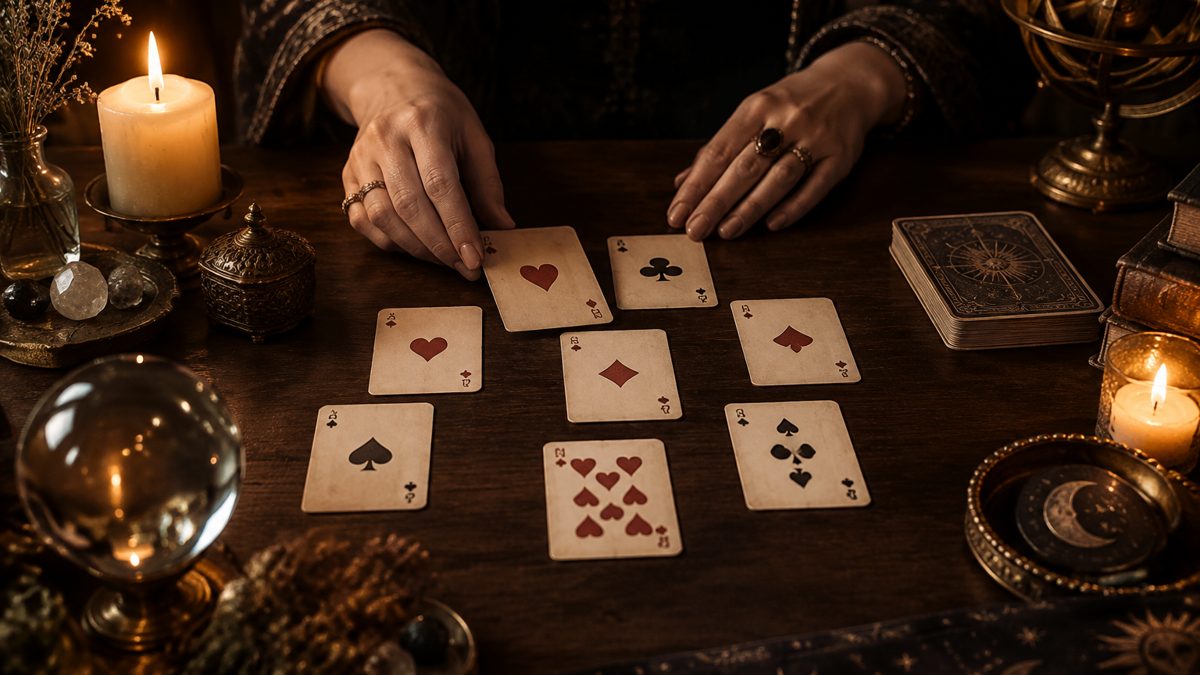
9. Combine Cards Without Losing the Question
Combining cards is less like looking up a secret password and more like making a sentence. Start with each card’s assigned position, then let nearby cards qualify the interpretation. A two of hearts beside an eight of clubs could suggest connection developed through repeated shared activity. Reverse the emphasis, and it might suggest that an activity works better with cooperation. Neither combination guarantees friendship; both offer a way to think about participation.
Contrast is especially useful. A four of hearts next to a five of clubs might place emotional comfort beside disruption in an activity. You could ask whether a familiar routine is resisting an experiment, or whether a new task is unsettling an otherwise comfortable group. The question and positions should help you choose between those possibilities. Avoid adding dramatic details, named people, or precise dates that the symbolic framework cannot establish.
Des rangs qui se répètent suggèrent un thème à examiner. Plusieurs deux peuvent mettre en lumière des échanges ou des choix ; plusieurs quatre peuvent mettre en avant la structure et les limites. De même, une concentration d'une couleur peut souligner un domaine de vie. Cependant, les cartes de toutes les couleurs ont une chance ordinaire d'apparaître, et l'absence d'une couleur ne prouve pas que quelque chose manque dans votre vie. Repérer des régularités est une technique de lecture, non la preuve d'une portée surnaturelle.
Laissez les cartes contradictoires dialoguer plutôt que d'en annuler une par une autre. Un cœur et un pique peuvent inviter à la fois à la chaleur et aux limites. Un trèfle et un carreau peuvent suggérer d'équilibrer l'enthousiasme avec des arrangements pratiques. Quand vous hésitez, écrivez « une possibilité est » et proposez une seconde lecture. J'évite aussi les règles de datation dans cette méthode pour débutants : les associations de couleurs et de nombres varient trop pour justifier de traiter une carte comme un calendrier fiable.
10. Walk Through a Complete Sample Reading
Here is a hypothetical example, not a testimonial or a prediction. Imagine I am considering a small neighborhood craft afternoon and ask, “What should I consider when inviting people to make things together?” I choose the three-card layout: situation, complication, constructive response. I use no significator. The cards are the three of hearts, the seven of diamonds, and the king of clubs. Before interpreting, I write down the facts: the gathering is only an idea, and nobody has yet been invited.
Le trois de cœur en position de situation associe croissance ou participation, lien et plaisir. Une lecture directe est que l'idée repose sur le plaisir partagé plutôt que sur des résultats impressionnants. Je pourrais me demander si je veux un après-midi vraiment détendu ou si j'attends discrètement une intimité instantanée. La carte ne montre pas que les invités s'amuseront ; elle m'aide à nommer l'espoir social qui se cache derrière le projet.
The seven of diamonds in the complication position combines assessment or uncertainty with tangible arrangements. Perhaps the useful question is whether the practical details are settled: available table space, materials, and how much preparation I can comfortably manage. I would check those things directly rather than assuming the card has discovered a hidden problem. An alternative interpretation is that I am spending so long evaluating every detail that I have not yet made a simple invitation.
The king of clubs in the constructive-response position combines stewardship with purposeful activity. I read this as an invitation to provide a clear, manageable structure: choose one accessible activity, describe what people can expect, and avoid overloading the afternoon. I do not need to identify a literal king-like person who will arrive and organize everything. The role may simply be one I can take on for this occasion.
Ensemble, les cartes suggèrent ce résumé provisoire : « Que le plaisir partagé soit le but, vérifiez les dispositions pratiques et offrez assez de structure pour faciliter la participation. » Ma prochaine étape pourrait être de demander à deux voisins si l'idée les intéresse avant de planifier davantage. Rien ici ne promet une présence, une amitié ou un après-midi réussi. La valeur de la lecture, si elle en a une, réside dans les questions qu'elle a aidé à organiser et dans les présupposés qu'elle a rendus visibles.
11. Tenez un journal et gardez une pratique douce
A reading journal is useful because memory can quietly polish a vague interpretation into something that seems uncannily exact. Record the date, question, spread positions, cards, and your initial wording before events have a chance to color it. Include what did not fit and any alternative interpretations. Later, distinguish between an actual observation and a resemblance you noticed after the fact. A journal should preserve uncertainty, not become a scrapbook of supposed proof.
For practice, draw one card and describe its symbolism in an ordinary scene rather than asking for a daily prediction. The six of clubs might become people finding a comfortable rhythm while rehearsing; the four of diamonds, a neatly arranged shelf of shared supplies. This builds vocabulary without encouraging constant monitoring for signs. You can also compare two cards and explain how changing either the suit or rank changes the story.
Si vous êtes tenté de répéter un tirage jusqu'à ce qu'il vous rassure, rangez le jeu. Davantage de cartes ne créent pas nécessairement plus de clarté. Des cartes à l'allure difficile n'exigent pas non plus d'achats protecteurs, de rituels coûteux ni d'obéir aux avertissements d'un lecteur. Quiconque affirme que vous devez payer pour lever une malédiction révélée par les cartes vous donne une raison de prendre du recul, et non de renoncer à votre jugement.
Mon rituel de clôture est volontairement simple : écrire une phrase sur ce qui a été utile, rassembler les cartes et retourner à la journée. La cartomancie peut s'aborder comme une tradition héritée, une symbolique personnelle ou une pratique imaginative tranquille. Elle n'a pas à devenir une autorité sur votre vie. Ici, au Crossroads Journal, c'est le genre de magie auquel je fais de la place : le rituel façonné par la croyance, la question réfléchie et la liberté humaine de quitter la table et de choisir par soi-même.
These practices are shared as tradition and personal reflection, not as a substitute for medical, legal or financial advice.
Continuez d'apprendre
- Playing card meanings
- How to read tarot cards
- How to use angel oracle cards
- Comment lire les cartes à jouer
- Comment utiliser les cristaux dans les sortilèges
- Comment utiliser les herbes en sorcellerie
- How to read the Dr. Moorne Egyptian Tarot
- How to read dice
- How to read tea leaves
- Comment utiliser un pendule
- Comment lancer un sort à la bougie
- How to make a spell jar
- How to make a sigil
- How to cleanse your home
- How to set up an ancestor altar
- How to open a sacred space
- How to time spells with the moon
- How to work with water and salt
- How to make a protection charm bag
- Read the Journal ou visitez la shops