How-To Guide
Comment utiliser les herbes en sorcellerie : sorts, bains et charmes
Par Seraphina
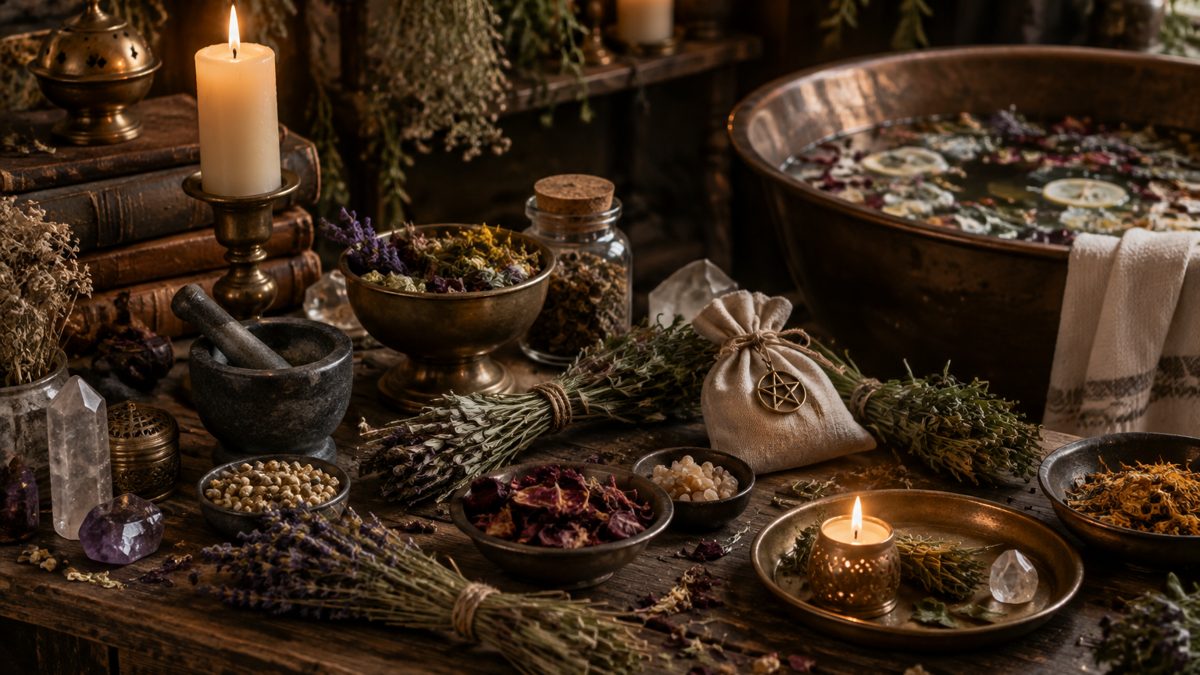
The herbs I return to most often are not rare or mysterious. They are the rosemary beside the kitchen door, the bay leaves in the cupboard, and the mint that would happily take over every pot I own. Welcome to Crossroads Journal. I’m Seraphina, and this is my guide to bringing herbs into a folk witchcraft practice with curiosity, care, and both feet on the ground.
Dans de nombreuses traditions, les gens ont utilisé des plantes pour marquer des seuils, bénir des foyers, se souvenir des morts, célébrer les changements de saison et donner une forme physique à un souhait. Ces pratiques ne forment pas un système universel unique. Leurs significations varient selon le lieu, la famille, la religion et le praticien. Ici, je propose une approche adaptable, centrée sur la maison, plutôt que de prétendre révéler un unique livre de règles ancien.
I approach herbal magic as a practice of symbolism, attention, and belief. A charm can remind us of a boundary; a kitchen ritual can make an ordinary meal feel deliberate. Neither guarantees an outcome, and divination does not establish facts or reliably predict events. Herbal witchcraft belongs alongside practical action, never in place of appropriate professional advice or ordinary precautions.
We’ll work through gathering, drying, storing, sachets, baths, floor washes, smoke, candle arrangements, protection jars, and kitchen rituals before putting everything together in a simple ceremony. You do not need every method, a garden, or an overflowing apothecary. A few correctly identified ingredients, a clear purpose, and a willingness to leave unsafe ideas alone are more than enough.
Looking for the meaning of a single card or ingredient? Keep our Herbs in witchcraft guide open beside you.
Comment utiliser les herbes en sorcellerie : sorts, bains et charmes
My starting point is always the same: decide what the practice means before deciding what to buy. Are you marking a fresh beginning, expressing gratitude, remembering someone, or creating a moment to reflect on your boundaries? Write the purpose in one ordinary sentence. “I want to make my home feel thoughtfully tended” gives you a more useful starting point than an elaborate list of ingredients with no personal connection.
Choisissez ensuite une plante dont le parfum, l'histoire, l'apparence ou l'usage quotidien soutient cette intention. Dans certaines pratiques contemporaines d'inspiration populaire, le romarin est associé au souvenir et à la protection, le laurier aux vœux ou à la reconnaissance, et la lavande à la paix. Ce sont des exemples d'associations traditionnelles, non des propriétés mesurables ni des significations universellement partagées. La menthe de la cuisine de votre grand-mère peut avoir plus de sens pour vous qu'un tableau de correspondances.
I like to distinguish an inherited tradition from a personal invention. If I learned a custom from a family member, I say so. If I adapt a published practice, I keep a note of the source. If I invent a rosemary charm because its smell reminds me of home, I call it my own symbolism. That honesty makes a practice richer, not less magical.
There is also no obligation to borrow ceremonial plants or practices from communities whose teachings you do not share. Learn the context of what interests you, respect closed or restricted traditions, and avoid treating distinct cultures as a basket of interchangeable ingredients. Familiar culinary herbs can support a meaningful personal practice without pretending to carry someone else’s authority.
1. Begin with safety, not a correspondence list
A plant’s traditional magical reputation does not establish that it is safe to swallow, breathe, burn, or put on skin. The form matters too: a culinary leaf, concentrated extract, and essential oil are not interchangeable. For the beginner practices in this guide, I leave essential oils out entirely. Never ingest products labeled for incense, crafts, fragrance, or magical use, and never assume an online seller’s spiritual description is a safety assessment.
La rue mérite une mise en garde particulièrement ferme. Elle est toxique si elle est avalée, peut provoquer de graves intoxications et peut causer de sévères réactions cutanées liées à l'exposition au soleil. Elle est particulièrement dangereuse pendant la grossesse. Je ne recommande pas la rue pour les bains domestiques, les tisanes, les huiles, la fumée ni les charmes manipulés sans précaution. Si elle pousse déjà dans votre jardin, évitez le contact avec la peau nue et demandez des conseils horticoles fiables avant de la manipuler. Un symbole écrit peut la remplacer dans un rituel.
L'armoise est une autre plante que je ne recommanderais pas à la légère. Évitez-la pendant la grossesse ou lorsque vous essayez de concevoir, et demandez un avis qualifié avant tout usage pendant l'allaitement. Elle peut aussi déclencher des réactions allergiques, y compris chez les personnes sensibles aux plantes apparentées. Pour ce guide du débutant, laissez-la simplement de côté. Les affirmations sur les rêves ou la divination ne justifient pas une exposition évitable, et la brûler ne la rend pas inoffensive.
Gardez tous les ingrédients rituels hors de portée des enfants et des animaux ; ce qu'un adulte tolère peut être dangereux pour un animal de compagnie. En cas d'allergies, d'asthme, de questions sur des médicaments, de grossesse ou de doute sur la tolérance cutanée, consultez un professionnel de santé ou un pharmacien plutôt qu'un livre de correspondances. Si vous soupçonnez une exposition ou une intoxication, contactez votre centre antipoison local ou les services d'urgence ; pour un animal, contactez un vétérinaire. N'essayez pas de remède magique et ne provoquez pas de vomissements sauf instruction contraire.
2. Cueillez les herbes avec respect et identifiez-les avec certitude
The simplest beginning is often a small packet of food-grade rosemary or bay from a reputable grocery supplier. You do not have to forage to be a “real” practitioner. If you grow herbs, retain the plant labels and learn the botanical names as well as the common ones. Common names can refer to different species, and resemblance is not enough to establish that a plant is suitable for handling or use.
When gathering outdoors, positively identify the plant using trustworthy references and, where needed, an experienced local botanist or foraging educator. Do not rely on a photograph or identification app alone. If any doubt remains, leave it standing. Avoid roadsides, sprayed areas, industrial land, and places contaminated by animal waste. Obtain permission and check local gathering restrictions; some plants and habitats are protected.
Take only a small amount from a healthy, abundant plant, leaving enough for its continued growth and for wildlife. Avoid uprooting plants or stripping every flower or seed head. For many leafy garden herbs, a dry morning after the dew has evaporated is a convenient harvesting time. Use clean scissors, remove damaged material, and keep different species separate so identification remains clear.
I sometimes pause before cutting to name what I’m gathering and why. That pause is a personal gesture of gratitude, not proof that the plant has granted permission or that harvesting has become ecologically harmless. The practical part still matters: a careful cut, a modest harvest, and an honest decision to leave a struggling plant alone. You can also honor a plant by observing it without taking anything.
3. Faites bien sécher les herbes et tenez de bons registres
Le séchage est moins spectaculaire que le travail magique, mais il demande exactement la qualité que j'apprécie dans une pratique : l'attention patiente. Triez votre récolte rapidement. Jetez ce qui est malade, moisi ou contaminé plutôt que d'essayer de le sauver pour un usage rituel. Pour les herbes culinaires du jardin, rincez si nécessaire et éliminez soigneusement l'eau en surface. Ne partez jamais du principe que le séchage éliminera les pesticides, les toxines ou d'autres contaminants.
De petits bouquets lâches d'herbes à feuilles appropriées peuvent être suspendus dans un endroit sec et ombragé, avec une circulation d'air constante. Un bouquet trop serré peut rester humide en son centre, surtout par temps humide. Sinon, étalez les feuilles en une seule couche sur une claie de séchage propre, ou utilisez un déshydrateur alimentaire selon ses instructions pour l'herbe concernée. Tenez les plantes en séchage à l'écart des graisses de cuisson, des sprays ménagers et des animaux curieux.
Leaves should be crisp rather than cool, limp, or leathery before you seal them away. Drying time varies with the plant, room humidity, and method, so a calendar alone cannot tell you when they are ready. Thick stems may retain moisture after the leaves seem dry. If a stored batch develops condensation, clumping from moisture, visible mold, or a musty smell, discard it.
Étiquetez chaque lot avec le nom courant, le nom botanique s'il est connu, la source et la date de cueillette ou d'achat. Ajoutez l'usage prévu : « de qualité alimentaire », « artisanat externe uniquement » ou « identification incertaine — ne pas utiliser ». Idéalement, un produit incertain n'entre jamais dans votre placard de travail. Mes étiquettes sont simples plutôt que pittoresques, car je veux les comprendre immédiatement, même un soir de fatigue où toutes les feuilles séchées se ressemblent un peu.
4. Build a small, well-organized herb cupboard
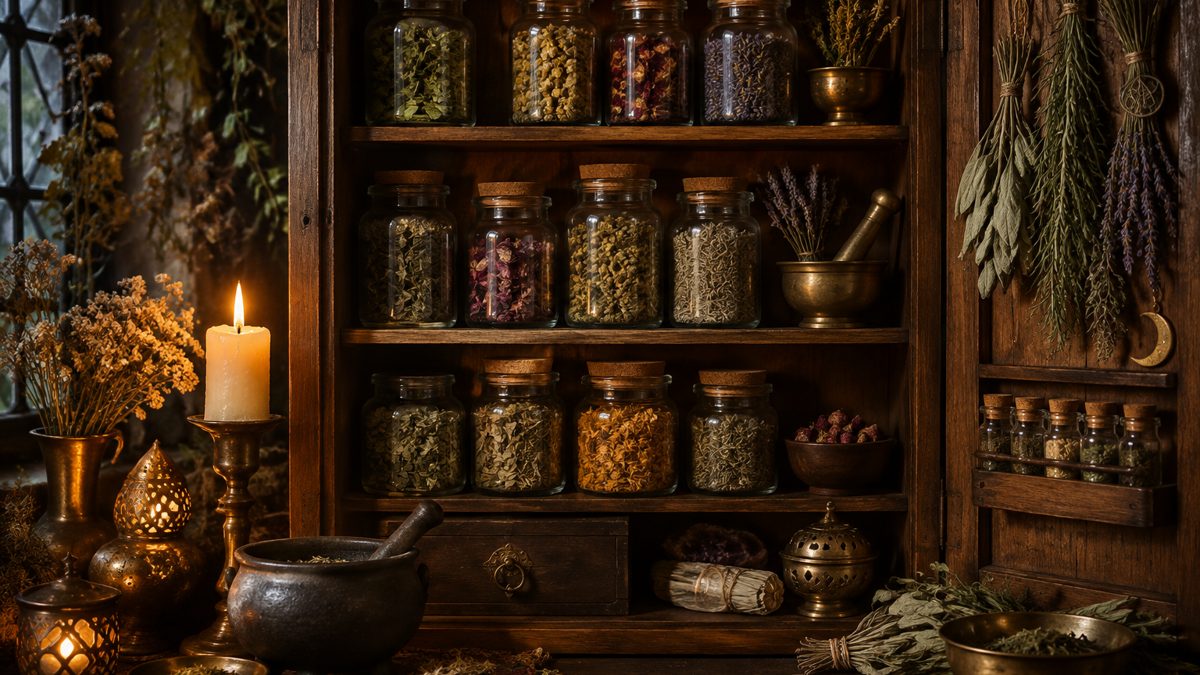
Store fully dried herbs in clean, dry, tightly closing containers away from sunlight, heat, and moisture. A cupboard is usually better than a windowsill or the shelf directly above a stove. Clear jars are convenient for inspection, but they still belong out of strong light. Check supplies periodically, and replace anything that shows deterioration. Older herbs may lose their scent, though age alone is not the only safety consideration.
Keep edible supplies separate from craft ingredients. Once herbs have touched candle wax, fragrance products, floor-cleaning tools, unknown decorations, or a non-food-safe vessel, they do not return to the kitchen. I use different spoons and containers for food and ritual crafts. This is especially important if a jar looks like an ordinary spice jar but contains something intended only for display.
Une collection de départ utile pourrait comprendre du romarin, du laurier, de la menthe et du thym de qualité alimentaire, ainsi que de la lavande ou des pétales de rose uniquement si leur identité et leur étiquetage d'usage prévu sont clairs. Les fleurs vendues par les fleuristes ne conviennent pas automatiquement à l'alimentation ou au bain. Choisissez des ingrédients pour des usages réellement prévus plutôt que de collectionner chaque plante citée dans un livre. Trois herbes familières utilisées avec réflexion valent mieux que trente bocaux que vous ne savez pas identifier avec certitude.
Keep a simple notebook beside your supplies. Record what you used, its source, the symbolic association you chose, and any practical observations. “The sachet shed dust” is useful. So is “I disliked this scent.” If you record dreams or draw a divination card, describe the interpretation as reflection, not evidence that an herb caused an event or revealed another person’s intentions.
5. Make sachets and charm bags with clear intentions
A sachet is a small fabric container for dried material; a charm bag gives that object an explicitly symbolic purpose. I like them because they can be simple, portable, and free of flame. Choose a tightly woven pouch that will not readily shed dust. Avoid powdered herbs, sharp stems, and long dangling cords. Even a securely closed pouch must stay out of reach of children and pets.
Pour un charme domestique simple, utilisez une pincée de romarin séché et un petit morceau de papier portant une phrase telle que « Que je pratique des limites claires et réfléchies. » Le laurier peut être un ajout facultatif s'il a du sens pour vous, mais une seule herbe suffit. Ces mots expriment un espoir et un engagement ; ils n'érigent aucune barrière surnaturelle et ne remplacent ni les serrures, ni les alarmes, ni d'autres protections concrètes.
Tenez un instant le sachet fermé et pensez à l'action liée au souhait. Peut-être cesserez-vous de répondre aux messages de travail pendant le dîner, ou garderez-vous votre entrée plus dégagée. Placez le charme dans un endroit approprié, inaccessible aux mains ou aux pattes curieuses, plutôt que dans la literie ou contre la peau nue. Ne glissez pas de charmes végétaux en vrac dans un berceau, un panier d'animal ou les affaires d'une autre personne sans son consentement.
Check the bag occasionally for moisture, broken seams, insects, and irritating dust. Retire it whenever it no longer serves a purpose; there is no mandatory magical expiry date. Dispose of the contents according to their materials and local waste guidance. Keeping herbs, paper, and fabric separate at the beginning makes this easier. You do not need to bury a charm or leave it outdoors to complete the practice.
- Choose one intention and write it in a single sentence.
- Ajoutez une petite pincée d'une herbe séchée familière, correctement identifiée, dans une pochette en tissu en bon état.
- Joignez votre intention écrite, fermez solidement la pochette et reliez-la à une action concrète.
- Placez-le en sécurité, puis vérifiez régulièrement son état.
6. Prepare ritual baths without treating the tub like a cauldron
Un bain rituel peut être une toilette ordinaire accompagnée d'une intention choisie. Les herbes sont facultatives. En fait, poser un bocal d'herbes fermé sur une étagère, hors de la zone d'éclaboussures, est la manière la moins exposée d'en inclure le symbolisme. Si vous avez la peau sensible, des allergies, une peau abîmée, un problème de santé pertinent ou un doute sur un ingrédient, choisissez de l'eau claire plutôt que d'expérimenter une préparation aux herbes.
Si vous choisissez un contact avec des plantes, n'utilisez qu'un ingrédient correctement identifié que vous tolérez déjà et pour lequel des sources fiables approuvent un usage externe. Le simple statut de qualité alimentaire n'établit pas l'innocuité pour la peau. Un test sur une petite zone peut révéler une irritation, mais il ne peut garantir qu'un bain complet sera sans danger ni écarter une allergie ultérieure. N'ajoutez ni rue, ni armoise, ni huiles essentielles, ni mélanges inconnus, ni extraits concentrés.
A strained, cooled infusion avoids the loose leaves that cling to skin and clog drains. Prepare a weak infusion with the chosen suitable herb in a separate clean vessel, strain it carefully through fine cloth, and add only a modest amount to comfortably warm water. Make it fresh and discard leftovers. Do not use boiling water in the bath, and stop immediately if you notice burning, itching, dizziness, or breathing discomfort.
Keep candles away from the tub, avoid glass vessels on slippery edges, and remember that plant residue or added products can make surfaces slippery. Never add oils as a default ritual ingredient. I prefer to mark the beginning with a spoken sentence and the ending by rinsing, drying, and putting on clean clothes. A shower with a symbolic herb kept outside the water works just as well for this purpose.
7. Utilisez les lavages de sol comme soin symbolique du foyer
Floor washing has a place in several distinct folk and spiritual traditions, with different materials, prayers, and directions of movement. My personal version is simply ordinary cleaning paired with deliberate reflection. Some practitioners move toward a door when symbolically releasing something, or inward when welcoming something. Those directions are conventions within a practice, not universal laws you must obey.
Clean according to the flooring manufacturer’s instructions first. An herbal infusion is not a disinfectant, and it may stain surfaces, leave residue, or damage finishes. Wood, unsealed stone, and specialty flooring can be particularly unforgiving. The safest adaptation is to use your usual compatible cleaning method while keeping the herbs in a closed jar nearby. You retain the symbolism without adding an uncertain substance to the floor.
If the surface guidance permits a particular water-based preparation and you still wish to use one, make it weak, strain it thoroughly, and test an inconspicuous spot. Avoid loose leaves and oils. Never mix homemade washes with bleach, ammonia, or other cleaning products, and do not assume vinegar is suitable for every surface. Keep people and animals away until the floor is dry and any required rinsing is complete.
As I clean, I name the ordinary task behind the ritual: making a room usable, removing tracked-in dirt, or creating a clear entrance. That language prevents “cleansing” from becoming a claim that unseen danger has been objectively removed. Dispose of wash water appropriately for its contents and local guidance, not into a stream or garden as a ceremonial offering. Responsible cleanup is part of the practice.
8. Approach incense and smoke cleansing with restraint
La purification par la fumée est une description large de pratiques qui utilisent la fumée de façon symbolique ; elle ne doit pas effacer les noms, les histoires ou les restrictions propres à des cérémonies particulières. Je décris simplement une pratique domestique personnelle plutôt que d'emprunter un titre propre à une culture. Les herbes n'ont pas besoin d'être brûlées pour avoir du sens, et la fumée ne désinfecte pas une pièce ni ne démontre l'existence d'une présence indésirable.
All smoke introduces particles and combustion products into the air. Good ventilation does not make exposure harmless. Avoid indoor burning around children, pregnant people, anyone with asthma or other respiratory sensitivities, and animals; birds are especially vulnerable. If you share a home, ask the other occupants before using fragrance or smoke. Their comfort and consent matter more than finishing your planned ritual.
For beginners, I recommend a smoke-free substitute rather than loose herbs on charcoal. Charcoal brings additional heat and carbon monoxide concerns. Do not burn unknown plants, treated decorations, poisonous herbs, essential oils, or kitchen mixtures simply because a recipe calls them “cleansing.” If you use a product intended for incense, follow its directions, use a stable heat-resistant holder and protective surface, and keep it clear of anything combustible.
Never leave burning material unattended, carry smoldering herbs through cramped rooms, disable smoke alarms, or put warm ash into the bin. Extinguish everything fully and confirm it is cold. My favorite substitute is to open a window when conditions allow, tidy a small area, and ring a bell or read an intention. You can also simply sit with a labeled, closed herb jar and let the plant’s meaning be enough.
9. Habillez un rituel à la bougie sans ajouter de risque d'incendie
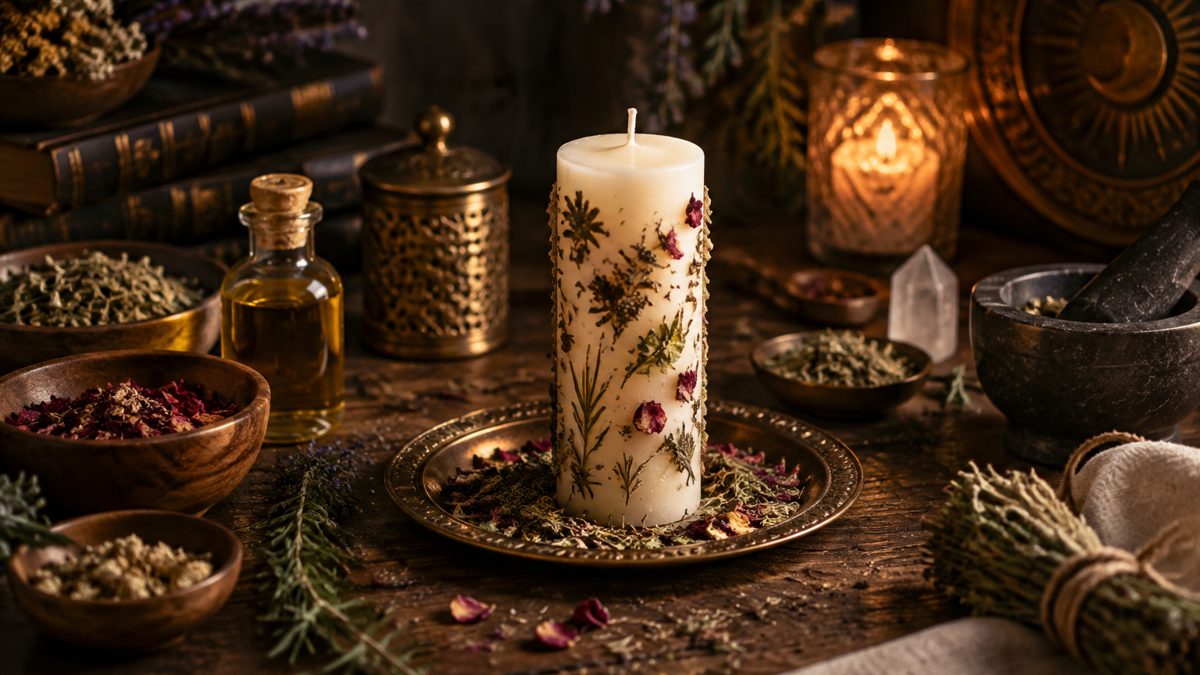
Herbal candle dressing often means coating a candle with oil and rolling it in dried plant material. I do not recommend that method. Dried herbs can ignite, act as additional wicks, and produce unpredictable flames. Plant fragments dropped into melted wax can also become fuel. A candle sold with decorative botanicals is not automatically safe just because it was commercially made.
Instead, dress the ritual setting rather than the candle itself. Use a plain candle in a suitable holder on a stable, heat-resistant surface, following the manufacturer’s instructions and clearances. Keep the herbs in a separate closed container well away from the flame and heat. Do not make a ring of dried leaves around the holder, scatter petals on the candle plate, or place a paper petition beneath a hot vessel.
Une bougie LED sans flamme rend la chose plus facile encore. Posez-la à côté d'un bocal d'herbes et d'une intention écrite, avec les piles hors de portée des enfants et des animaux. C'est mon arrangement préféré lorsque le rituel consiste à se tourner vers l'intérieur, à fermer les yeux ou à écrire un moment. L'attention vagabonde naturellement pendant un travail de réflexion, et c'est précisément pourquoi une flamme nue ne devrait pas être une exigence essentielle.
If you choose a real candle, remain present, keep it clear of drafts and anything combustible, and extinguish it before leaving or becoming sleepy. There is no need to let it burn down completely. Ending a ritual early for safety does not spoil its symbolic purpose. Nor should a flickering flame or cracked container be interpreted as proof of a message; address the physical hazard first.
10. Assemble a dry protection jar and plan its retirement
A protection jar can be a visual reminder of the boundaries and habits you want to maintain. For this guide, keep it dry and uncomplicated: a small, clean container, a pinch of rosemary, an optional bay leaf, and a folded note. You might write, “This home is a place where I practice care and clear limits.” These ingredients express a belief or intention; they do not provide a guaranteed protective effect.
Avoid adding bodily fluids, fresh plants, food scraps, liquids, sharp objects, or unidentified minerals. Wet organic mixtures can spoil, grow mold, or ferment and build pressure in a sealed container. Nails, needles, and broken glass create handling and disposal hazards without being necessary to the symbolism. There is also no reason to seal the lid with hot wax; an ordinary secure closure is sufficient.
Place the jar where it will not fall, overheat, or attract a child or pet. A nonbreakable container may be the better choice in a busy household. Pair the ritual with a concrete check: is the doorway clear, are important contacts easy to find, and have you communicated the boundary you wrote down? The jar can remind you to act, but it cannot take those actions for you.
Decide at the beginning how you will retire the object. You can empty it into appropriate household waste and clean the reusable container. Compost only suitable, uncontaminated plant material if your compost system accepts it; remove paper, string, salt, and other additions as needed. Do not bury jars, leave them in public places, or throw them into water. A quiet ending at home is entirely sufficient.
11. Bring herbal symbolism into everyday cooking
La sorcellerie de cuisine est le domaine où le rituel aux herbes me semble le plus naturel. Elle peut être aussi modeste qu'ajouter du romarin à des légumes rôtis en pensant aux personnes que vous espérez accueillir, ou incorporer de la menthe à une recette familière pour marquer une nouvelle saison. La couche symbolique ne change pas les propriétés physiques des aliments, et elle ne devrait jamais exiger une quantité dangereuse d'un ingrédient.
Use only correctly identified, food-grade herbs in ordinary culinary quantities and recipes appropriate to them. Follow normal food hygiene, storage, and temperature guidance. Do not cook with herbs taken from charm bags, incense supplies, bath mixtures, or decorative bouquets. “Natural” is not a food-safety category, and a plant’s association with abundance or love does not establish that it belongs in dinner.
Respectez toutes les personnes qui partagent le repas. Vérifiez les allergies, les préférences et les restrictions alimentaires pertinentes, et soyez transparent sur les ingrédients. Retirez les feuilles de laurier entières avant de servir, car leurs bords rigides peuvent présenter un risque d'étouffement ou de blessure. N'ajoutez pas d'herbes en secret et ne présentez pas un plat partagé comme un sortilège destiné à outrepasser le consentement de quelqu'un. L'hospitalité est un fondement bien plus sain que la tentative de contrôler les sentiments d'un invité.
Avoid improvising shelf-stable herb-infused oils, particularly with fresh herbs or garlic; improperly prepared and stored oils can present a botulism risk. Use a tested food-safety recipe and its exact storage instructions, or choose a simpler dish. My favorite kitchen ritual needs no preserved preparation at all: cook something familiar, pause before serving, and name one thing you appreciate about the work that brought the food to the table.
12. Essayez un rituel de seuil simple, puis prenez le temps d'y réfléchir
Voici un rituel sans fumée ni flamme qui rassemble les éléments de ce guide. Son but est de marquer un nouveau départ chez vous, et non de garantir une protection ou d'écarter une menace spirituelle objectivement établie. Il vous faudra un petit bocal étiqueté de romarin culinaire séché, une feuille de papier, un stylo et un chiffon adapté au nettoyage de votre seuil. Gardez l'herbe dans son bocal fermé tout au long du rituel.
Choose a time when you can work without rushing. If the doorway is shared, respect other people’s access and belongings. Begin with the ordinary task of clearing clutter and wiping the appropriate surface according to its care instructions. You are not making the entrance ritually perfect. You are giving a small, useful job your full attention and allowing it to represent something larger.
When the steps are finished, spend a few minutes writing about the experience. Did the process help you clarify what “welcome” or “boundary” means to you? Was there a practical task you had been avoiding? These observations are more useful than searching for signs that the ritual worked. If you use divination afterward, treat the result as a prompt for reflection rather than an instruction or factual prediction.
That is the kind of herbal witchcraft I hope to make room for at Crossroads Journal: curious, personal, grounded, and willing to be simple. You may eventually explore a particular regional or family tradition in greater depth, with careful sources and appropriate teachers. For now, one familiar herb and one honestly chosen action are enough. Let the ritual support the life you actually live.
- Dégagez l'entrée sans bloquer les issues, et nettoyez une surface adaptée selon la méthode recommandée.
- Set the closed rosemary jar on a stable surface away from the doorway’s traffic, children, and pets.
- Écrivez une intention, par exemple : « Je ferai place à l'accueil tout en respectant mes limites. »
- Lisez la phrase à voix haute ou en silence. Réfléchissez à la signification du romarin dans votre pratique, sans traiter cette association comme un effet promis.
- Choose one achievable action that expresses the intention: put away shoes, establish a visiting preference, or make space for a guest’s coat.
- Accomplissez l'action, rangez le pot en lieu sûr et gardez ou recyclez le papier comme vous le souhaitez. Le rituel est terminé.
These practices are shared as tradition and personal reflection, not as a substitute for medical, legal or financial advice.
Continuez d'apprendre
- Herbs in witchcraft
- How to read tarot cards
- How to use angel oracle cards
- Comment lire les cartes à jouer
- Comment utiliser les cristaux dans les sortilèges
- Comment utiliser les herbes en sorcellerie
- How to read the Dr. Moorne Egyptian Tarot
- How to read dice
- How to read tea leaves
- Comment utiliser un pendule
- Comment lancer un sort à la bougie
- How to make a spell jar
- How to make a sigil
- How to cleanse your home
- How to set up an ancestor altar
- How to open a sacred space
- How to time spells with the moon
- How to work with water and salt
- How to make a protection charm bag
- Read the Journal ou visitez la shops