How-To Guide
How to Make a Sigil
Ni Seraphina
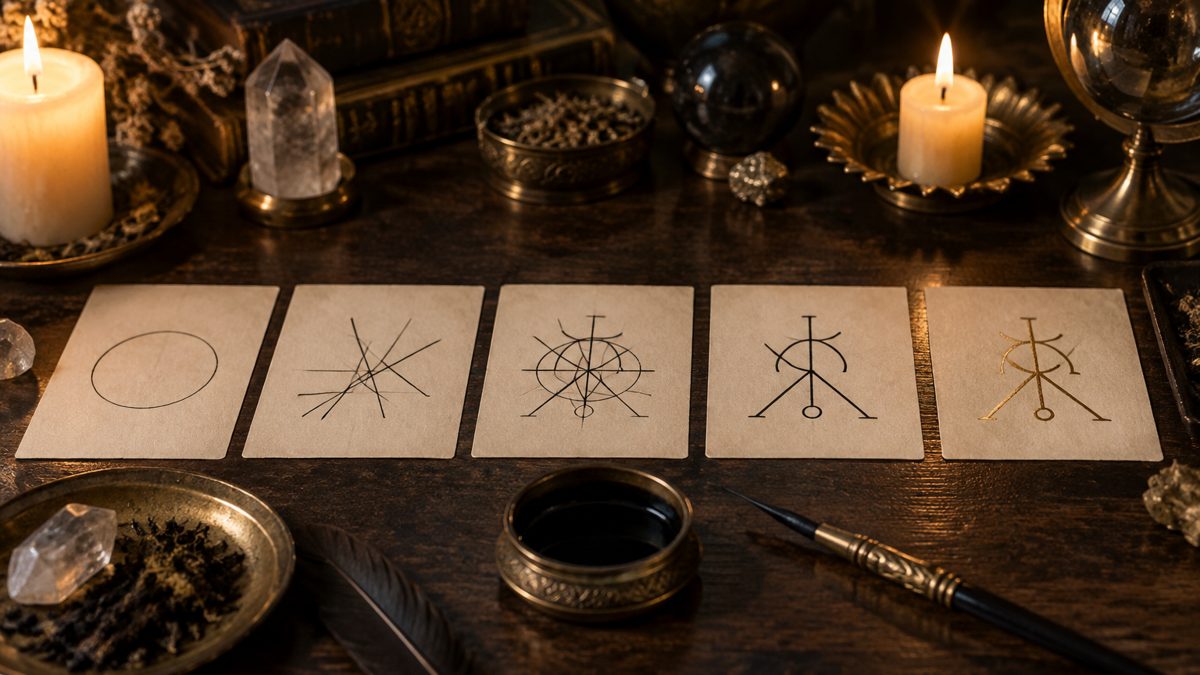
A sigil is a symbol created or chosen to represent an intention, name, power, or idea. In contemporary personal practice, making one often means turning a short statement into an abstract design, then using that design in a meaningful ritual. Some people understand this as magic; others approach it as creative reflection or a reminder of a commitment. You do not need to settle that question before picking up a pencil.
Sa Crossroads Journal, nilalapitan namin ang paggawa ng sigil bilang pagtatagpo ng tradisyon, paniniwala, at personal na gawain. Makatutulong ang isang simbolo na bigyan ng hugis ang isang bagay na mahirap ipahayag, ngunit hindi nito magagarantiyahan ang kinalabasan o mapapalitan ang praktikal na kilos. Ang sigil para sa paghahanap ng trabaho ay nararapat na kasabay ng mga aplikasyon at paghahanda sa panayam. Ang sigil para sa kalmado ay maaaring samahan ng tahimik na rutina nang hindi pinapalitan ang angkop na pangangalaga sa kalusugang pangkaisipan.
Itinuturo ng gabay na ito ang madaling lapitang pamamaraang nakabatay sa titik, habang ipinapaliwanag kung saan nakalagay ang pamamaraang iyon sa mas malawak na kasaysayan. Lilipat ka mula sa pagpili ng intensyon patungo sa pagguhit, paggamit, at pagsusuri ng iyong simbolo. May kasama ring halimbawang isinagawa na maaari mong sundan nang hindi kinokopya ang huling disenyo nito. Opsyonal ang kasanayan sa sining: ang bahagyang baluktot na marka na may kahulugan sa iyo ay ganap na angkop para sa ehersisyong ito.
Treat the instructions as a framework rather than a test of spiritual ability. You can omit candles, change the wording, keep the finished design, or stop if the process becomes uncomfortable. For alternative approaches, use the companion reference page, Sigil Methods. Here, the emphasis is on making one thoughtful, manageable sigil from beginning to end, with enough context to understand your choices.
Looking for the meaning of a single card or ingredient? Keep our Mga pamamaraan ng sigil guide open beside you.
1. Understand What a Sigil Is
The word sigil comes from the Latin sigillum, meaning a seal or small sign. Historically, the term has been applied to different kinds of symbolic marks, including signs associated with spirits, planetary powers, and ritual authority. These were not all made by reducing an intention to letters. A symbol copied from a historical magical text and a personal design made this afternoon may both be called sigils, but their purposes and contexts can differ considerably.
In medieval and early modern European ritual magic, seals and characters could form part of elaborate systems involving prayers, timing, materials, and specific religious or cosmological assumptions. Other cultures have their own talismanic, sacred, and protective designs, which should not automatically be relabeled as sigils. Similar appearance does not establish shared meaning. When studying an unfamiliar symbol, look for its name, origin, and use before assuming it is a general-purpose magical decoration.
The intention-based method popular today is strongly associated with the English artist and occultist Austin Osman Spare, whose work influenced later chaos magic practitioners. Many contemporary versions simplify or adapt those ideas, sometimes combining them with journaling, meditation, or art. This guide presents one such modern adaptation, not an unchanged ancient formula. If historical accuracy matters to your practice, distinguish what a source actually teaches from later interpretations and your own additions.
2. Choose an Intention Within Your Influence
Begin with one area of life where you want to act differently or bring more attention. Useful starting points include preparing for an exam, maintaining a creative habit, speaking clearly in meetings, or protecting time for rest. Broad wishes such as happiness or success can be meaningful, but they are difficult to translate into a workable practice. Ask what a small, recognizable expression of that wish would look like during an ordinary week.
Keep the intention centered on your choices rather than another person's obedience. Instead of trying to make a particular person love you, consider your readiness for reciprocal connection or your willingness to communicate honestly. Instead of trying to defeat a colleague, focus on preparing your work and asserting appropriate boundaries. This does not mean you control every outcome. It means your sigil points toward something you can support without overriding someone else's autonomy.
Choose a scale that leaves room for real life. An intention to study regularly is more useful than a demand never to feel distracted again. Consider resources, disability, caring responsibilities, and circumstances outside your control. For a first attempt, select a low-stakes habit rather than a frightening emergency. If your situation involves danger, serious illness, debt, or legal trouble, prioritize qualified help and practical safeguards; symbolic work can be an optional accompaniment.
- 1. Isulat ang bahagi ng buhay na nais mong tugunan sa iisang pangungusap.
- 2. Identify one behavior or choice that could support it.
- 3. Check that the intention respects consent and does not depend on controlling someone else.
- 4. Choose a modest time frame for reviewing your actions, such as one or two weeks.
3. Gather Simple, Suitable Materials
The basic materials are paper, a pencil or pen, and a surface on which to draw. Scrap paper is useful for experiments, and an eraser can help if you enjoy revising. A notebook gives you a place to record your intention and later observations. You do not need special ink, crystals, expensive tools, or purchased spellwork. Keeping the setup simple makes it easier to notice whether the practice itself suits you.
Optional materials might include a ruler, tracing paper, colored pencils, or a small envelope for storing the finished symbol. Choose additions because they help you work comfortably or carry a personal association. Blue might suggest steadiness to you, while a circle might suggest continuity. Such associations vary between people and traditions; they are not universal instructions. Ordinary paper and black ink are as appropriate as a carefully decorated ritual journal.
Magplano ayon sa iyong tunay na kapaligiran. Kung may kasama ka sa bahay, gumamit ng madadalang kuwaderno sa halip na permanenteng display na maaaring mag-anyaya ng mga ayaw na tanong. Kung mahirap ang pinong galaw ng kamay, subukan ang malalaking hugis, digital na kasangkapan sa pagguhit, o pag-aayos ng mga piraso ng papel. Iwasang maglagay ng karaniwang tinta sa balat, pagkain, o sisidlang inuman. Hindi kailangan ang kandila at insenso, lalo na kung may sensitibong paghinga, mausisang alagang hayop, mga bata, o patakaran ng inuupahan na nagbabawal ng apoy.
4. Prepare Your Space and Attention
Preparation can be ordinary and brief. Clear enough room for your materials, silence avoidable notifications, and give yourself a reasonable stopping point. Ten or twenty unhurried minutes may be sufficient for a first design. You do not need to make your home spotless or wait for a perfect mood. The purpose is to reduce distractions, not to prove that you are spiritually clean or worthy of beginning.
Mas gusto ng ilang mananaliksik na maghugas ng kamay, magsabi ng maikling panalangin, o maglagay ng makabuluhang bagay sa malapit. Ang iba naman ay basta umuupo at isinusulat ang petsa. Maaaring markahan ng mga kilos na ito ang paglipat tungo sa nakatuong gawain, ngunit wala sa mga ito ang kinakailangan upang maging mabisa. Kung gagamit ka ng panalangin o anyo ng ritwal na tiyak sa isang tradisyon, unawain ang konteksto nito sa halip na manghiram ng di-pamilyar na salita para sa atmospera. Sapat na ang payak na pahayag na naglalaan ka ng oras upang magnilay.
Settle into a comfortable posture and notice your surroundings. Breathe normally rather than forcing deep breaths or holding your breath. If closing your eyes feels unpleasant, keep them open. You should remain able to stop, move, or answer a necessary interruption. If you feel panicky, unreal, or overwhelmed, put the work aside and return to something familiar. Intensity is not a measure of skill, and distress does not mean a ritual is progressing.
- 1. Clear a small drawing area and place your supplies within reach.
- 2. Magpasya kung gaano katagal mo ito gugugulin at ano ang gagawin mo pagkatapos.
- 3. Notice your feet, your seat, and a few ordinary objects around you.
- 4. Read your chosen intention and check that it still feels appropriate.

5. Turn Your Intention Into a Clear Sentence
Write a short sentence expressing what you want to practice or encourage. Concrete language is usually easier to work with than a complicated declaration. For example, I begin my writing session with ten minutes of work identifies an action more clearly than I unlock limitless creative greatness. You can keep qualifications and practical details in your journal rather than squeezing every concern into the sentence that will become your design.
Many modern instructions recommend present-tense, affirmative wording. You may find that useful because it emphasizes a desired action rather than an unwanted condition. However, there is no established rule that negations confuse a supernatural mechanism or that a particular tense guarantees results. Choose wording that is honest enough to sit with comfortably. I practice speaking clearly may feel more believable and useful than I am perfectly confident in every conversation.
Read the sentence aloud or silently and look for hidden pressure. Words such as always, never, instantly, and perfectly can turn a supportive intention into an impossible demand. Also check for accidental bargains: you do not need to promise pain, deprivation, or sacrifice in exchange for success. Once the sentence expresses your aim, stop polishing. Endless rewriting can become a way of avoiding the ordinary action the sigil was meant to support.
- 1. Draft two or three short versions of your intention.
- 2. Choose the version that most clearly describes a helpful direction or behavior.
- 3. Remove unnecessary demands, exaggerated promises, and attempts to control others.
- 4. Copy the final sentence into your journal before transforming its letters.
6. Reduce the Sentence to a Set of Letters
One common modern method removes spaces, punctuation, vowels, and repeated letters, leaving a smaller set of forms to combine. Other versions retain vowels or use different reduction rules. There is no single universally correct sequence. For your first attempt, choose one convention and follow it consistently. Here, we will remove A, E, I, O, and U, then keep only the first occurrence of each remaining letter.
Write the sentence in capitals if that makes the shapes easier to see. Cross out vowels, then scan the remaining letters from left to right, recording each different letter once. Treat Y as a consonant for this exercise; another method may handle it differently. The result is a design toolkit, not a secret code that must be decoded later. You may rotate, overlap, simplify, or partially merge these letterforms during drawing.
If your intention uses a different language or writing system, do not force it into English spelling unless you want to. Vowel removal does not translate neatly across all scripts. You can instead simplify selected written forms, combine meaningful words visually, or use an image-based approach from Sigil Methods. The important point is to understand your chosen process, rather than assuming a method designed around the Latin alphabet must apply everywhere.
- 1. Kopyahin ang iyong pinal na intensyon sa malinaw na nababasang anyo.
- 2. Remove spaces, punctuation, and the vowels A, E, I, O, and U.
- 3. Move from left to right and keep each remaining letter only the first time it appears.
- 4. Write the reduced letter set separately so you can experiment without losing your place.
7. Build and Refine the Symbol
Begin by treating the letters as shapes rather than as readable text. An M offers diagonals, an R offers a curve and a slanting leg, and a T offers a crossbar. Place two forms on top of each other and look for shared lines. Rotate a letter, lengthen a curve, or let one stroke serve more than one purpose. Your first sketches can be awkward; exploration matters more than producing an impressive emblem.
Gumawa ng ilang maliliit na bersyon sa halip na paulit-ulit na itama ang isang malaking guhit. Subukan ang siksik na disenyo, mas bukas na disenyo, at bersyong nakabatay sa iisang patayong guhit. Panatilihin ang sapat na kaugnayan sa iyong hanay ng titik upang makabuluhan ang proseso, ngunit huwag mag-alala kung mahirap nang makilala ang bawat titik. Mas gusto ng ilang mananaliksik ang ganap na abstraksyon, habang ang iba ay nagpapanatili ng nakikitang inisyal o kilalang motibo. Walang alinman sa dalawa ang nagtatatag ng mas malaking mahiwagang kapangyarihan.
Select the design that feels coherent and is reasonably easy to redraw. Remove stray details that contribute nothing, then test it at the size you intend to use. Avoid mistaking complexity for significance. If the result resembles a familiar hate symbol, commercial logo, or sacred emblem you did not mean to invoke, revise it, especially before displaying it publicly. Accidental resemblance is a design issue, not evidence that an outside force has intervened.
- 1. Draw three to six quick combinations using your reduced letters.
- 2. Mag-eksperimento sa pag-ikot, pinagsasaluhang guhit, kurba, at espasyo.
- 3. Choose one version and simplify any unnecessary marks.
- 4. Redraw it on clean paper, leaving enough space around it to see the whole design.
8. Follow a Complete Worked Example
Suppose your aim is to establish a small creative routine. Your practical plan is to keep a notebook beside your breakfast place and write for five minutes afterward. For the sigil itself, you choose the concise sentence I WRITE DAILY. This is a direction for practice, not a prediction that illness, travel, or fatigue will never interrupt you. In your journal, you also note that missing a day will not require punishment or starting everything over.
Removing spaces produces IWRITEDAILY. Removing A, E, I, O, and U leaves WRTDLY. There are no repeated consonants in that sequence, so the final set remains W, R, T, D, L, Y. You can check the reduction once, then move on. If you notice a harmless copying difference later, you may revise it or keep the design as a personal variation; a clerical mistake is not a dangerous omen.
For one possible design, use a tall stem shared by T, D, and L. Add a short crossbar near its top, curve the D around its right side, and give the base a small rightward foot. Place a shallow W beneath it, fork the top into a Y, and add a diagonal leg suggesting R. Simplify any crowded area. Your drawing will likely differ from someone else's interpretation, which is entirely acceptable.
- 1. Record the intention I WRITE DAILY and the supporting five-minute writing plan.
- 2. Paikliin ang pangungusap sa WRTDLY gamit ang pamamaraang nasa itaas.
- 3. Sketch three arrangements, then choose the easiest one to recognize and redraw.
- 4. Bigyan ng maikling sandali ng atensyon ang natapos na simbolo, pagkatapos ay kumpletuhin ang limang-minutong sesyon ng pagsulat.
- 5. Suriin ang rutina pagkatapos ng isang linggo, na itinatala ang mga pagkakataon, hadlang, at aktuwal na sesyon ng pagsulat.
9. Give the Sigil a Deliberate Moment of Attention
Many practitioners call this stage charging or activation. Within magical belief, it may be understood as directing intention into the symbol. In a non-supernatural interpretation, it can be a deliberate transition from planning to commitment. Neither explanation requires claiming that the process has proven effects on external events. For a beginner, a quiet, bounded exercise is more appropriate than an attempt to induce an extreme or unfamiliar state.
Place the sigil where you can see it comfortably. Read your intention once, then look at the design without trying to force a sensation. Notice its outline, the movement of its strokes, and what the intention asks of you in daily life. After a short interval, mark the end by putting down your pen, closing your notebook, or saying that the exercise is complete. Feeling ordinary afterward is not a failure.
Maaari kang magsama ng maikling panalangin kung bahagi iyon ng iyong gawain, ngunit iwasang lumikha ng mga obligasyong mapipilitan kang tuparin pagkatapos. Hindi kailangan ang sakit, kakulangan sa tulog, paglalasing, hyperventilation, o matagal na pag-aayuno. Makatutulong ang timer kung madalas mong ulitin ang mga ritwal hanggang sa maramdamang eksaktong tama. Tapusin sa isang bagay na kongkreto at banayad, tulad ng pag-unat, pag-inom ng tubig, o pagsasagawa ng unang praktikal na kilos na kaugnay ng iyong intensyon.
- 1. Sit comfortably with the finished symbol in view.
- 2. Read the intention once and reflect on the action it represents.
- 3. Tingnan ang disenyo nang humigit-kumulang tatlumpung segundo hanggang dalawang minuto, at tumigil nang mas maaga kung hindi komportable.
- 4. Close the exercise with a simple gesture and return to ordinary activity.

10. Decide Whether to Keep, Display, or Release It
Different methods give different advice about what happens next. Some chaos magic approaches emphasize putting the intention out of conscious attention after the ritual. Other personal practices keep the sigil visible as a reminder. These are different working models, not instructions you must somehow satisfy simultaneously. Choose a role before you begin: the symbol can be a private ritual object, a practical cue, or an artwork associated with your intention.
For a reminder-based practice, place the design near the relevant activity: inside a study notebook, beside a musical instrument, or on your own calendar. Avoid displaying confidential intentions in shared workplaces or homes unless you are comfortable discussing them. For a release-based practice, put it in an envelope or close the journal. You do not need to force yourself to forget. Remembering your intention is normal and does not invalidate the exercise.
Destruction is optional. Tearing up ordinary paper or recycling it, where local rules allow, can provide a clear ending without fire. Do not release paper, ribbons, wax, or glitter into waterways or outdoor spaces. Burying materials can also introduce litter or unwanted substances into soil. If the intention changes, you may retire the sigil with a brief journal note. You do not need a paid cleansing, a counter-spell, or an elaborate disposal ritual.
11. Interpret Results Without Turning Everything Into a Sign
Evaluate the practice by returning to the intention and the actions you recorded. Did you write more often, prepare more consistently, or remember a boundary at a useful moment? Also note what did not change. A favorable event after a ritual does not demonstrate that the ritual caused it. Timing, chance, other people's choices, and your own behavior all matter, and a personal journal cannot isolate those influences with scientific certainty.
Dreams, coincidences, and emotional shifts may feel meaningful, and you can record them as experiences without treating them as instructions or predictions. Distinguish observation from interpretation: noticing a repeated image is one thing; concluding it guarantees a job offer is another. If an apparent sign would lead you to spend money, abandon treatment, confront someone, or take a serious risk, pause and seek ordinary evidence and appropriate advice.
If the desired outcome does not occur, do not assume you lacked faith or attracted failure. Review whether the intention was realistic and whether the supporting plan needed more time, resources, or help. Sometimes the most useful result is realizing that you do not want the original goal. Repeatedly redrawing a symbol to relieve fear can become distressing rather than supportive. If ritual feels compulsory or interferes with daily life, step back and consider professional support.
12. Avoid Common Mistakes and Keep the Practice Safe
Common beginner mistakes include crowding several goals into one sigil, searching endlessly for the perfect shape, and making new symbols instead of taking practical steps. Another is believing that every extra ingredient increases effectiveness. Start with one intention and one design, then allow time to observe your experience. If the activity becomes expensive, exhausting, or frightening, simplify it. No seller or practitioner can legitimately guarantee supernatural results, and threats of unavoidable misfortune are a warning sign.
Fire is unnecessary. If you choose a candle, use a stable, heat-resistant holder on a clear surface, well away from paper, fabric, children, and pets, and never leave it unattended. Avoid burning the sigil, especially if it contains unknown inks, coatings, glue, or synthetic materials. Incense and smoke can irritate lungs and affect animals; ventilation does not make every product safe. An unlit candle or ordinary desk lamp can mark the occasion without combustion.
Nangangailangan din ng pag-iingat ang mga halamang-gamot, langis, at asin. Ang natural ay hindi nangangahulugang ligtas lunukin, sunugin, o ipahid sa balat. Huwag lunukin ang mga halong pang-ritwal o magdagdag ng mga di-kilalang sangkap sa tubig-paliguan, pagkain, o inumin; ang mga essential oil at ilang halaman ay maaaring makasama, lalo na sa mga alagang hayop. Ilayo ang asin at tubig-alat sa mga halaman at lupa. Igalang ang pahintulot at ari-arian: huwag magtago ng sigil sa gamit ng iba, magmarka ng pinagsasaluhang espasyo nang walang pahintulot, o gumamit ng materyales mula sa katawan ng ibang tao.
13. Keep a Useful Journal and Develop Your Own Approach
A useful journal entry records the date, intention, reduction rule, sketch, and reason for choosing the final design. Add the practical action that will accompany it and the date you plan to review. You may record mood or personal associations, but you do not need to document every passing thought. Keep sensitive information secure, especially if your notes involve relationships, health, or work. Initials and general descriptions can protect other people's privacy.
At review time, compare your experience with the original aim rather than rewriting the aim to fit whatever happened. Include uneventful attempts as well as memorable ones. Ask whether the symbol helped you remember a commitment, whether the process was enjoyable, and whether any part created pressure. Your record may reveal that a visible reminder suits you better than a release ritual, or that drawing alone provides the reflection you were seeking.
Develop your approach gradually. Change one feature at a time if you want to compare experiences, and use Sigil Methods when you are ready to explore a different construction process. Read historical sources with attention to context, and keep personal adaptations clearly identified as your own. You may also decide that sigil making is not useful to you. A thoughtful practice leaves room for curiosity, revision, and stopping; it does not demand fear or certainty.
- 1. Record what you made, how you made it, and what you intended to do alongside it.
- 2. Choose a review date that discourages constant checking.
- 3. Note concrete actions and outcomes separately from feelings and symbolic interpretations.
- 4. Decide whether to continue, revise, retire, or simply enjoy the design as artwork.
These practices are shared as tradition and personal reflection, not as a substitute for medical, legal or financial advice.
Magpatuloy sa pag-aaral
- Mga pamamaraan ng sigil
- How to read tarot cards
- How to use angel oracle cards
- Paano magbasa ng playing cards
- Paano gumamit ng mga kristal sa mga spell
- Paano gumamit ng mga halamang-gamot sa witchcraft
- How to read the Dr. Moorne Egyptian Tarot
- How to read dice
- How to read tea leaves
- Paano gumamit ng pendulum
- How to cast a candle spell
- How to make a spell jar
- How to make a sigil
- How to cleanse your home
- How to set up an ancestor altar
- How to open a sacred space
- How to time spells with the moon
- How to work with water and salt
- How to make a protection charm bag
- Read the Journal or visit the shops