How-To Guide
How to Read Dice for Divination
Ni Seraphina
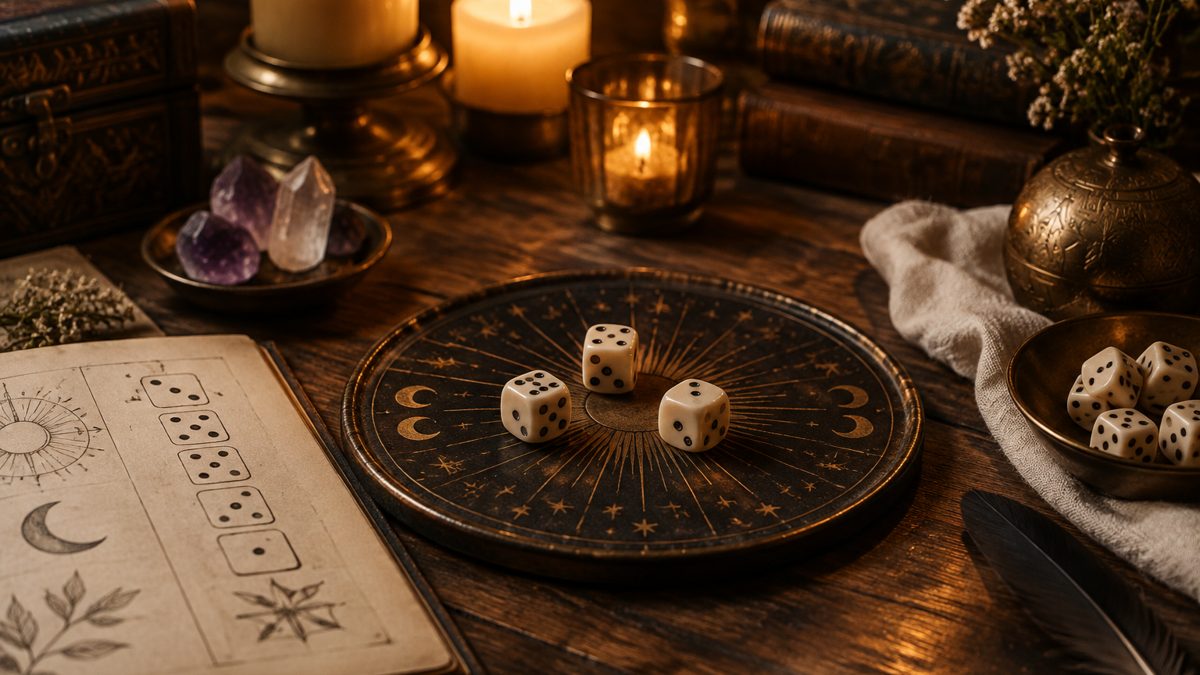
A handful of dice can turn an ordinary tabletop into a place for reflection. Their appeal is simple: you ask a question, let the dice fall, and consider what their numbers might suggest. In divination, this becomes a symbolic conversation with uncertainty rather than a reliable way to establish facts or predict what must happen.
Madalas tawaging cleromancy ang panghuhula sa pamamagitan ng dais, bagaman mas malawak ang saklaw ng katawagang iyon at sumasaklaw sa pamilya ng mga gawaing may kinalaman sa paghahagis ng palabunutan. May ilang taong lumalapit dito nang espirituwal, bilang paraan ng paghahanap ng gabay sa pamamagitan ng kanilang paniniwala. Ang iba naman ay ginagamit ito bilang malikhaing pahiwatig na sumisira sa nakagawiang pag-iisip. Hindi mo kailangang lutasin ang pilosopikal na tanong na iyon bago matutunan ang praktikal na pamamaraan.
This guide uses ordinary six-sided dice and a clearly defined reading system. It is an approachable modern framework, not a claim to recover one universal ancient tradition. You will learn how to prepare, choose a useful question, cast the dice, interpret a result, and translate your reflections into a sensible next step.
Keep the companion reference page, Dice Divination Meanings, nearby when you want to explore number symbolism in more depth. Here, the emphasis is on how to conduct a complete reading without becoming overwhelmed by competing rules. The aim is a practice that feels thoughtful, grounded, and genuinely useful, whether you read occasionally or keep a regular journal.
Looking for the meaning of a single card or ingredient? Keep our Dice divination meanings guide open beside you.
1. Understand the History Without Flattening the Traditions
People have used lots, marked objects, knucklebones, and dice-like pieces for decision-making and divination in many societies. These objects are related in function, but they are not interchangeable. A bone cast in a ritual setting, a numbered gaming die, and a sacred lot drawn by a religious specialist can belong to very different systems of meaning.
Sa sinaunang Mediteraneo, ang mga astragali, o buto ng tuhod ng hayop, ay ginamit sa mga laro at sa ilang gawaing panghuhula. Ang hindi pantay nilang hugis ay lumikha ng ibang sistema ng paghahagis kaysa sa makabagong kubikong dais. Kabilang din sa mga nananatiling ebidensya ang mga numerong orakulo na iniuugnay sa mga paghahagis. Ipinapakita ng kasaysayang ito na matanda na ang paghahagis ng mga bagay para sa gabay, ngunit hindi nito pinatutunayan ang iisang tuloy-tuloy na pamamaraang ibinabahagi ng bawat makabagong mambabasa.
The word cleromancy is useful as an umbrella term for divination by lots. Astragalomancy refers more specifically to divination associated with knucklebones, although popular modern writing sometimes uses it loosely for dice reading. Terminology varies between sources, so look for an explanation of the actual objects and rules rather than assuming a label tells the whole story.
When studying a particular tradition, ask who recorded it, where it was practiced, and whether the source distinguishes historical evidence from later interpretation. Respect community boundaries around restricted religious practices. You can create a personal dice ritual without presenting it as inherited Slavic, Greek, Roman, or any other culturally specific practice you have not actually learned.
2. Gather a Simple, Reliable Reading Kit
Begin with three ordinary six-sided dice, a notebook, and a flat surface. Different-colored dice make positional readings easier because you can assign a separate role to each color. If yours are identical, roll them individually into labeled spaces instead. The goal is to know which die answers which part of the question without rearranging the result afterward.
Pumili ng mga dais na may malinaw at nababasang mukha at walang halatang sira. Praktikal na opsyon ang balanseng dais pang-laro; hindi kailangan ang mamahaling bato o detalyadong simbolo. Maganda ang mga pandekorasyong dais, ngunit ang bilugang gilid, hindi pantay na pagkakagawa, o mahirap basahing marka ay maaaring magpalabo sa resulta. Walang partikular na materyal na napatunayang may supernatural na kalamangan sa iba.
A shallow tray or folded cloth can keep the dice from bouncing across the room. Leave enough room for them to tumble rather than simply slide out of your hand. A small cup is useful if gripping or shaking dice is difficult. You can also use a digital random-number generator, provided you decide its settings and rules before beginning.
Optional objects might include a meaningful photograph, an unlit candle, or a small token connected with your question. Treat these as personal supports for attention, not required sources of power. Your basic kit should remain easy to use, affordable, and accessible. A complicated setup often creates more opportunities for distraction than a plain table and three dice.
3. Choose Your Rules Before You Cast
A reading becomes clearer when the method is settled before you see the numbers. For this guide, use three dice with fixed roles: situation, challenge, and helpful response. Read each die separately using the same six number themes. This gives you a complete sentence-like structure rather than an unexplained total that could mean almost anything.
Sadyang malawak ang aming mga gumaganang kahulugan: ang isa ay nagmumungkahi ng inisyatiba; ang dalawa ay ugnayan o balanse; ang tatlo ay pagpapahayag o paglago; ang apat ay istruktura; ang lima ay pagbabago o alitan; at ang anim ay pag-aaruga o responsibilidad. Mga interpretatibong pagpili ito para sa pamamaraang ito, hindi pangkalahatang batas. Isulat ang mga ito upang hindi mo tahimik na baguhin ang kahulugan para umangkop sa gustong sagot.
Other systems read the sum of several dice, use a marked casting cloth, or assign special meanings to doubles and triples. Those approaches can be valid parts of a chosen symbolic practice, but they should not be mixed casually. A meaning written for a total of eleven does not automatically explain an individual die, and positional rules cannot be reconstructed after a cast.
For your first several readings, ignore where dice land beyond keeping them inside the tray. Do not add bonus meanings for proximity, direction, noise, or the time on the clock. You can experiment later, but a stable starting framework makes it easier to learn what you are actually doing and recognize where your own interpretation enters.
- 1. Assign one die or labeled space to situation, one to challenge, and one to helpful response.
- 2. Copy the six working meanings into your notebook before casting.
- 3. Decide that a die outside the tray, stacked on another die, or tilted without a clear upper face will be rerolled by itself.
- 4. Set a limit of one main cast and, only if necessary, one clearly framed clarifying cast.
4. Ask a Question That Leaves Room for Choice
The most useful questions focus on something you can examine or influence. Instead of asking whether your life will improve, ask what deserves attention as you work toward a specific goal. Instead of asking what another person secretly thinks, ask how you can communicate more clearly or decide what boundaries you need in that relationship.
Karaniwang mas angkop sa simbolikong pagbasa ang mga bukas na tanong kaysa sa pagpupumilit ng hatol na oo o hindi. Maaaring mag-anyaya ang isang numero na pag-isipan ang istruktura, negosasyon, o pagbabago, ngunit hindi nito mapapatunayan ang kondisyong medikal, maibubunyag ang pribadong usapan, o matutukoy kung mapagkakatiwalaan ang isang tao. Ituring ang mga usaping iyon bilang mga tanong na nangangailangan ng ebidensya, tuwirang pag-uusap, o angkop na propesyonal na payo.
Give the reading a reasonable scope. What will help me prepare for next week's conversation is easier to explore than what is my destiny. A timeframe describes the period you intend to reflect on; it does not make the dice capable of forecasting events within that period. Narrowing the question simply makes your interpretation less vague.
Write the question exactly as you intend to ask it. If it contains several separate problems, choose one or plan separate readings on another occasion. You may discover that the act of refining the question already provides useful clarity. That is not a failed divination session; it is one of the practical benefits of slowing down.
- 1. Pangalanan ang paksa sa isang pangungusap, tulad ng paghahanda para sa mahirap na talakayan.
- 2. Identify what is within your control: preparation, communication, timing, or boundaries.
- 3. Turn the concern into an open question beginning with what or how.
- 4. Tiyaking hindi hinihiling ng tanong sa mga dais na magbigay ng mga katotohanang kailangan mong i-verify sa ibang paraan.
5. Prepare Yourself and the Reading Space
Pumili ng lugar kung saan komportable kang makaupo at maririnig mo ang sarili mong mga iniisip. Maglinis ng sapat na espasyo para sa tray at kuwaderno, pagkatapos ay isantabi ang mga nakagagambalang notification kung praktikal. Hindi mo kailangan ng ganap na katahimikan o perpektong mood. Ang paghahanda ay simpleng paraan lamang upang ihiwalay ang panahong ito ng sinadyang pagninilay sa natitirang bahagi ng araw mo.
Notice your emotional state before starting. If you are frightened, exhausted, angry, or urgently hoping for one particular answer, name that in your notes. You may still choose to reflect, but consider postponing the cast when disappointment would feel unbearable. Dice are not a dependable way to regulate a crisis or obtain certainty under pressure.
Some practitioners like to cleanse their tools symbolically. A dry cloth, a spoken intention, or a minute of quiet can serve that purpose without smoke or liquids. If cleansing has spiritual meaning for you, frame it as your ritual belief. Dice do not need supernatural purification to function as randomizing objects or reflective prompts.
Keep physical safety straightforward. An electric candle avoids an open flame; if using a real candle, place it in a stable holder away from fabric and never leave it unattended. Smoke can aggravate respiratory conditions and affect pets. Avoid soaking dice in salt water, which may damage finishes or metal, and do not pour salt water onto plants or garden soil.
6. Cast the Dice: A Complete Step-by-Step Method
Once your question and rules are ready, take a few ordinary, comfortable breaths. Read the question aloud or silently. You may add an intention such as wanting to see the situation more clearly, but special wording is unnecessary. Avoid promising yourself that the cast will reveal an unquestionable truth; that expectation makes ordinary ambiguity harder to handle.
Shake the dice in your hand or cup and release them onto the prepared surface. If you are using identical dice, cast one at a time into the corresponding labeled spaces. Let each die settle naturally. There is no required number of shakes, no ideal casting hand, and no need to repeat the action until it feels sufficiently dramatic.
Record the raw result before interpreting anything. Write the role and number together, such as situation four, challenge two, helpful response five. This preserves the actual cast and prevents later memory from blurring into the story you developed. If a die needed rerolling under your advance rules, record that briefly without treating the mishap as an omen.
Now read one position at a time, then connect them. Start with the plain number theme, consider how that theme could appear in its assigned role, and compare the interpretation with what you already know. Finish with a modest action rather than a prediction. A good session should leave you with something to examine or try, not a command you feel obliged to obey.
- 1. Date the entry and copy your question and positional assignments.
- 2. Settle your attention and cast the three dice using the method you chose.
- 3. Apply only your prewritten rules for unclear or out-of-bounds dice.
- 4. Record every number in its correct position before consulting meanings.
- 5. Interpret the positions separately, then write a short combined reading.
- 6. Choose one proportionate next step and close the session.
7. Basahin ang Anim na Numero ayon sa Konteksto
One can prompt questions about beginnings, independence, initiative, or excessive self-reliance. Two can point toward partnership, exchange, balance, or hesitation between alternatives. Neither is automatically favorable or unfavorable. In a challenge position, one might invite you to examine whether you are carrying everything alone, while two might raise the issue of compromise that has become avoidance.
Three can suggest expression, experimentation, social connection, or scattered effort. Four can suggest routines, foundations, limits, or rigidity. If four appears as helpful response, you might benefit from a schedule or clear agreement. If it describes the challenge, the same number may invite you to question a rule that no longer serves its purpose.
Five can suggest movement, disruption, curiosity, or friction. Six can suggest care, responsibility, repair, or overextension. A five is not a warning that disaster is coming, and a six does not guarantee harmony. Their usefulness lies in the questions they generate: what needs to change, whose needs are being considered, and which responsibilities are genuinely yours?
Use the companion page, Dice Divination Meanings, to deepen your vocabulary, while checking that any interpretation matches the method you chose. Readings become richer through specificity, not through collecting every possible association. For each number, select one or two themes that fit the position and explain why. If nothing fits, it is acceptable to leave the result unresolved.
8. Follow a Worked Example From Question to Action
Isipin na naghahanda kang talakayin sa kasama sa bahay ang hindi patas na hatian ng gawaing-bahay. Ang tanong mo ay: Paano ko malalapitan nang mas konstruktibo ang usapan ngayong linggo tungkol sa pagbabahagi ng gawaing-bahay? Angkop ito dahil tungkol ito sa iyong paghahanda at asal. Hindi nito hinihiling sa mga dais na ibunyag ang pribadong motibo ng kasama sa bahay o garantiyahan ang kalalabasan ng talakayan.
Suppose the cast is situation four, challenge two, and helpful response five. Four suggests looking at existing structure: perhaps there is no agreed schedule, or tasks have accumulated around whoever notices them first. That is a hypothesis to compare with your experience. The die itself does not establish that your household arrangements are unfair or ineffective.
Two in the challenge position suggests examining negotiation and balance. You might realize you have been avoiding disagreement by saying everything is fine. Alternatively, both people may have different understandings of equal effort. Five as helpful response invites flexibility and a change in approach, perhaps trying a new task arrangement rather than arguing over who is naturally more responsible.
The combined reading could be: Make the current arrangement visible, discuss differences directly, and propose a short experiment. Your practical action is to list recurring tasks, ask for the housemate's perspective, and agree on a two-week trial with a review date. This is a reasonable plan even without divination, which is a useful test of whether the reading supports sound judgment.
- 1. Write down known facts separately from assumptions about the other person.
- 2. Translate each number into a question relevant to its position.
- 3. Combine the answers into a tentative interpretation, using language such as might or could.
- 4. Pumili ng praktikal na kilos at suriin ito kalaunan sa pamamagitan ng aktuwal na pag-uusap, hindi sa isa pang paghahagis.
9. Asikasuhin ang mga Pag-uulit, Pagkakasalungatan, at Clarifier
Repeated numbers naturally attract attention, but repetition is not evidence of an urgent message. If two or three dice show the same number, you can explore that theme across the assigned roles. Three fours, for instance, might invite reflection on structure as the present condition, excessive rigidity as the challenge, and a better-designed routine as the response.
Different numbers can appear to pull in opposite directions. Four may suggest stability while five suggests change. Rather than forcing one to cancel the other, ask whether they describe different needs: maintaining a dependable foundation while changing one unhelpful habit. The assigned positions help you distinguish these functions without inventing a secret rule to resolve the tension.
If you choose a sum-based method later, remember that totals from multiple dice are not equally likely. With two fair six-sided dice, seven has more possible combinations than two or twelve. Likewise, striking patterns eventually occur by chance. Probability does not prevent symbolic reflection, but it does undermine claims that an ordinary repeat proves a supernatural intervention.
Use a clarifier only when you can name what remains unclear. Under this guide's rules, one additional single die may answer: What quality could help me carry out the response? Use the same six meanings. If the result adds confusion, stop rather than building a chain of clarifiers. Uncertainty is a legitimate conclusion, not a fault that endless casting will necessarily fix.

10. Avoid the Most Common Reading Mistakes
Ang pinakamadaling pagkakamali ay ang muling pagpapagulong hanggang makatanggap ng nakakaaliw na resulta. Ginagawa nitong paghahanap ng pahintulot ang gawain at pinaparamdam na nakababahala ang mga di-ninanais na resulta. Panatilihin ang napagkasunduan mong hintuan. Kung nakababagabag ang orihinal na pagbasa, itabi ito at suriin ang iyong reaksyon sa halip na ituring ang isa pang paghahagis bilang tanging paraan upang maibalik ang kapayapaan.
Another mistake is changing the interpretive system after seeing the result. A reader might begin with individual numbers, switch to totals, then add doubles or spatial directions because one version sounds more appealing. Experimentation is fine when it is planned and recorded. Retrofitting rules makes it difficult to tell whether a method is helpful or merely accommodating.
Watch for confirmation bias: the tendency to notice matches and overlook misses. Broad statements can fit many situations, especially after events have occurred. Write your interpretation before the outcome is known, include plausible alternatives, and record when a reading was vague or unhelpful. Honest uncertainty is more valuable than making every entry appear remarkably accurate.
Finally, avoid dividing numbers into lucky promises and unlucky threats. A difficult theme does not predict punishment, and a gentle theme does not remove the need for caution. If every cast seems to announce betrayal, danger, or destiny, step back from the method. Good reflection should expand your choices rather than narrow them through fear.
11. Practice Safety, Consent, and Ethical Boundaries
Use dice for reflection, not diagnosis, emergency assessment, legal conclusions, or financial guarantees. Never use a reading to decide whether to stop medication, ignore symptoms, make a risky investment, or dismiss evidence of danger. For consequential decisions, seek reliable information and qualified help. A symbolic prompt can help you prepare questions, but it cannot replace the answers those situations require.
Kapag nagbabasa para sa ibang tao, kumuha ng malinaw na pahintulot at ipaliwanag ang mga limitasyon ng pamamaraan. Itanong kung ano ang nais nilang tuklasin at hayaan silang tanggihan ang isang interpretasyon. Iwasan ang mga pahayag tungkol sa kamatayan, pagbubuntis, sakit, pangangaliwa, sumpa, o lihim na hangarin ng ibang tao. Ihayag ang mga posibilidad nang hindi nag-aangking may espesyal na awtoridad sa mga relasyon, hinaharap, o kakayahang pumili ng tao.
Protect privacy as carefully as you would in any sensitive conversation. Do not share someone else's question, identifying details, or journal entry without permission. If payment is involved, explain the price and scope in advance. Claims that a frightening cast requires an urgent, expensive cleansing are a serious warning sign; no dice result establishes that such a service is necessary.
Keep dice away from young children and animals because they are choking hazards. Herbs and oils are optional and may irritate skin or harm pets; natural does not mean harmless. Do not ingest ritual preparations or add unknown substances to drinks. If reading becomes compulsive, disrupts sleep, or increases anxiety, pause and seek support rather than adding more rituals.
12. Keep a Journal That Encourages Honest Learning
A useful journal separates the cast, the interpretation, and the later outcome. These are three different things. The cast is what the dice showed; the interpretation is the meaning you proposed; the outcome is what actually happened afterward. Keeping those layers distinct makes it harder to reshape an old reading until it appears to have predicted everything.
Record your question, method, number assignments, raw results, and emotional state. Then write a brief interpretation and one intended action. You can include a photograph of the cast if that helps, but a simple written record is enough. Avoid making documentation so elaborate that keeping the journal becomes a burden or distracts you from ordinary life.
At a later review, ask whether the session helped you notice something specific, make a thoughtful choice, or communicate more clearly. Also note when it increased confusion or had no practical value. A helpful reflection does not demonstrate supernatural accuracy, and an outcome that resembles your interpretation may have several explanations, including your own actions and chance.
Review patterns across several entries rather than drawing conclusions from one memorable match. You may discover that work questions lead you toward useful planning, while romantic uncertainty encourages repetitive checking. That distinction can guide healthier boundaries. Your journal should teach you about your attention, habits, and decisions, not become a ledger of omens you feel required to obey.
- 1. Create headings for date, question, method, cast, interpretation, and next action.
- 2. Magdagdag ng tala ng kumpiyansa na naglalarawan kung gaano kalinaw o kaluwag ang pakiramdam ng interpretasyon.
- 3. Magtakda ng petsa ng pagsusuri na angkop sa tanong, nang hindi umaasa sa hinulaang pangyayari.
- 4. Itala ang aktuwal na kinalabasan, ang mga alternatibong paliwanag, at kung nakatulong ba ang pagbasa.
- 5. Adjust your practice if repeated sessions produce anxiety rather than useful reflection.
13. Build a Sustainable Personal Practice
Begin with occasional readings on manageable topics rather than consulting the dice about every choice. A weekly session or a reading before a planned conversation may be enough. Keep using the same framework for several sessions so you can learn its strengths and limitations. Familiarity often produces more thoughtful interpretation than constantly switching to a new system.
Kung nais mong paunlarin ang pamamaraan, baguhin ang isang katangian lamang sa bawat pagkakataon. Maaari kang sumubok ng pang-araw-araw na pagninilay gamit ang iisang dais, isang sistemang batay sa kabuuan ng bilang, o isang tela na may mga paunang itinakdang sona. Itala ang mga bagong tuntunin bago magpagulong, at ihiwalay ang iyong mga idinagdag sa mga gawaing may makasaysayang pinagmulan. Hindi kailangan ng gawa-gawang sinaunang lahi ang personal na pagkamalikhain upang magkaroon ng kabuluhan.
Tapusin nang sadya ang bawat sesyon. Itabi ang mga dais, isulat ang susunod mong kilos, at bumalik sa mundong kung saan maaari kang mangalap ng impormasyon, makipag-usap sa mga tao, at gumawa ng pagpili. Maaaring makatulong ang pariralang pangwakas o tahimik na sandali, ngunit hindi ito kailangan upang maiwasan ang pinsala. Ang pag-iwan ng pagbasang hindi tapos o hindi nasagot ay hindi naglalagay sa iyo sa supernatural na panganib.
Sa pinakamainam nitong anyo, ang panghuhula gamit ang dais ay maaaring magbigay ng katamtamang paghinto sa pagitan ng kawalang-katiyakan at reaksyon. Nagpapagulong ka, nagmamasid, nagtatanong, at nagpapasya kung ano ang karapat-dapat bigyang pansin. Panatilihing malambot ang simbolismo, matatag ang mga praktikal na hangganan, at nangunguna ang sarili mong pagpapasya. Ang mga dais ay maaaring magbigay ng pahiwatig; nananatiling sa iyo ang responsibilidad at kalayaang pumili.
These practices are shared as tradition and personal reflection, not as a substitute for medical, legal or financial advice.
Magpatuloy sa pag-aaral
- Dice divination meanings
- How to read tarot cards
- How to use angel oracle cards
- Paano magbasa ng playing cards
- Paano gumamit ng mga kristal sa mga spell
- Paano gumamit ng mga halamang-gamot sa witchcraft
- How to read the Dr. Moorne Egyptian Tarot
- How to read dice
- How to read tea leaves
- Paano gumamit ng pendulum
- How to cast a candle spell
- How to make a spell jar
- How to make a sigil
- How to cleanse your home
- How to set up an ancestor altar
- How to open a sacred space
- How to time spells with the moon
- How to work with water and salt
- How to make a protection charm bag
- Read the Journal or visit the shops